The land price is only the beginning
Raw acreage can look inexpensive until the work required to make it buildable is added up. Clearing, access, earthwork, drainage, wastewater, water, electricity and professional services can turn a low purchase price into a substantial site-development budget. The useful number is not cost per acre alone. It is the total cost to create the homesite and infrastructure your plan actually needs.
What does build-ready mean?
For this guide, build-ready means the property has a practical building area, dependable access, a wastewater solution, water, power, drainage planning and the approvals needed to begin the next phase of construction. It does not mean every acre is cleared or landscaped. On larger tracts, concentrating work around the house, driveway and utility corridors can control costs.
A realistic budget starts with the site plan
Before requesting bids, sketch the home, driveway, septic and replacement area, well or water line, electric route, shop, future buildings and major drainage features. Contractors can price a defined scope more accurately than a vague request to develop ten acres. A coordinated plan also reduces the risk that one contractor's work must later be moved or rebuilt.
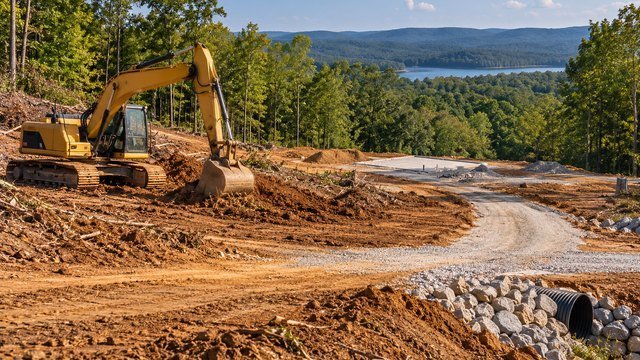
Land clearing is one of the first visible costs
Current Alabama market guides show wide clearing ranges because light brush, small trees, mature timber and stump removal require very different equipment and labor. Published 2026 estimates commonly place basic Alabama clearing in roughly the low thousands of dollars per acre, with heavy clearing and grubbing costing more. Treat statewide figures as planning ranges, then obtain parcel-specific bids.
You may not need to clear the entire property
Clearing only the building envelope, driveway, septic area, utility routes and selected yard space can preserve privacy and reduce excavation, erosion and cleanup. Pasture, future barns or recreational areas can be phased later. Selective clearing also keeps more flexibility until the final site layout is established.
Forestry mulching and full grubbing are different scopes
Forestry mulching can efficiently reduce brush and smaller vegetation while leaving processed material on the surface. A building pad generally needs a more complete scope where unsuitable organic material, roots and stumps are removed. Ask each contractor exactly what condition the site will be in when the quoted work is finished.
Grading cost depends on how much earth must move
A naturally suitable homesite may need modest shaping while a sloped site can require significant cut, fill, compaction, retaining solutions or imported material. Soil conditions, equipment access and haul distances matter. A cheap clearing quote does not mean the property is ready for a slab or foundation.
Alabama red clay can change construction conditions
Many Alabama sites include clay-rich soils that can become difficult to work when wet and hard when dry. Soil behavior varies by parcel, so foundation and road decisions should be based on actual site conditions rather than a statewide assumption. Good drainage and properly prepared structural fill are more important than simply making the surface look level.
A long rural driveway can become a major line item
Driveway cost grows with length, width, excavation, aggregate depth, geotextile, culverts, drainage crossings and the amount of soft material that must be corrected. A homesite 700 feet from the road may offer privacy but can require substantially more driveway and utility work than one near the frontage. Price the access route before committing to the house location.
Road entrances may require approval
If the property connects to an Alabama state highway, ALDOT provides an access-permit process for private-property driveways and turnouts. Its permit guidance also addresses drainage pipe requirements. County roads can have separate local requirements. Confirm the controlling road authority before installing the entrance or culvert.
Culverts and drainage belong in the driveway budget
A driveway that blocks natural drainage can wash out, flood neighboring areas or create recurring maintenance costs. Identify roadside ditches, swales and crossings before placing aggregate. The correct pipe size and elevation should be based on the site and road authority requirements rather than simply using the least expensive culvert available.
Septic feasibility comes before septic pricing
For land without central sewer, first establish that an onsite sewage system can be permitted for the proposed home. Alabama Public Health uses an application and site-evaluation process for onsite sewage systems. Soil, slope, groundwater, drainage and the required replacement area can influence the design and therefore the final installation cost.
Budget for more than the septic tank
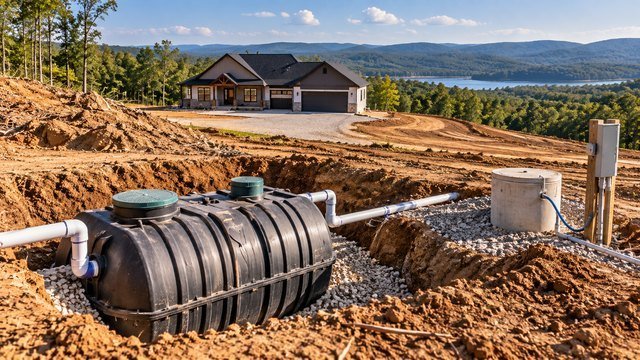
A complete wastewater budget can include site evaluation, professional services where needed, permit fees, tank, distribution or treatment components, excavation, pumps or controls, electrical work, final grading and future maintenance. Get bids against the likely or approved system rather than comparing generic tank prices.
Protect the replacement area
Alabama buyers should plan for both the initial onsite sewage area and a future replacement area. Do not let the driveway, shop, pool, heavy construction traffic or mass grading consume that reserve space. Protecting it early can prevent a costly property-layout conflict later.
Water costs depend on the source
Public water and private wells have different cost structures. Public service may involve tap, meter, line extension, trenching and a long private service line. A private well budget can include drilling, casing, pump, pressure tank, electrical service, trenching, testing and treatment. Verify the exact parcel with the provider or well professional before using a planning allowance.
Power at the road does not mean power at the house
Long setbacks can add poles, trenching, conduit, transformers, clearing, easements or customer contributions. Ask the serving electric utility for a site-specific discussion using the proposed house and shop locations. Moving the home closer to an economical service route can sometimes save more than optimizing smaller construction items.
Plan communications infrastructure at the same time
If the property needs wired internet, fixed wireless, cellular equipment or satellite service, include conduit, trenching, mounting locations and backup-power needs in the site plan. Opening the same trench twice is avoidable. Rural connectivity should be verified at the actual service address rather than assumed from a coverage map.
Stormwater can affect both cost and permitting
Major clearing and grading can create erosion and sediment problems. Alabama's environmental rules can apply to regulated construction disturbance, including projects meeting applicable acreage or common-plan thresholds. Determine whether ADEM coverage or local erosion-control requirements apply before large-scale disturbance.
Drainage work is cheaper before the house is built
Identify where water enters, crosses and leaves the property. Swales, driveway crossings, roof discharge, building-pad elevation and concentrated runoff should work together. Correcting a drainage problem after the driveway, septic field and foundation are installed can be far more expensive than planning the water path first.
Surveying is part of development, not paperwork
A current survey helps locate boundaries, easements, rights of way and the usable dimensions of the parcel. Additional layout or topographic work may be valuable on complicated sites. Building from an approximate parcel map can lead to misplaced improvements, utility conflicts or an access route that does not match the legal property.
Engineering may be money well spent on difficult sites
Steep slopes, large fills, retaining structures, drainage crossings, unusual foundations or significant stormwater issues may justify professional engineering. The goal is not to add paperwork. It is to reduce the risk of paying for earthwork that later fails, moves water to the wrong place or must be reconstructed.
Permits and fees vary by location and project
Alabama development requirements can involve state, county, municipal, health-department, road, utility and environmental authorities depending on the parcel and scope. Do not use one statewide permit allowance as if every rural property is identical. Build a permit checklist for the exact address and proposed structures.
A barndominium still needs a complete site budget
A metal-building package may simplify one part of construction, but it does not remove the need for access, earthwork, drainage, septic, water and electricity. Large slabs and attached shops can also influence pad preparation and site geometry. Compare barndominium options using total project cost rather than shell price alone.
Future shops and guest homes should be planned now
Even if a shop, barn or second dwelling will be built years later, reserve practical locations and utility routes now. The least expensive initial layout can become costly if the septic replacement area, driveway or main house blocks the only workable expansion zone.
The cheapest homesite is often the one the land already favors
A flatter, well-drained location with shorter access and utility runs may cost less to develop than the spot with the best distant view. Compare several candidate building areas before clearing. A small change in location can affect driveway length, grading, septic layout and power distance at the same time.
Use allowances only for early screening
Planning ranges are useful when comparing properties, but they should be replaced with real estimates during due diligence. Clearing prices vary with vegetation. Driveways vary with soil and length. Septic varies with site conditions. Wells vary with geology and required depth. Utilities vary with provider rules and distance. The closer you get to closing, the fewer generic allowances should remain.
Build a contingency for unknown conditions
Raw-land work regularly uncovers conditions that were not obvious from listing photos, including unsuitable fill, buried debris, wet areas, rock, additional drainage needs or longer utility routes. A contingency should be treated as part of the development budget, not as money that is automatically available for upgrades.
Sequence the work to avoid paying twice
A practical sequence often begins with survey and due diligence, then final site planning, required approvals, selective clearing, access and drainage, utility and septic coordination, building-pad preparation and construction. The exact order varies, but the principle is consistent: do not complete work that the next contractor must tear out.
Example budget categories for Alabama acreage
Create separate lines for survey and layout, clearing, stump removal, grading, driveway and culverts, drainage, septic evaluation and installation, water, electric service, communications, permits, engineering if needed, erosion control, cleanup and contingency. Keeping categories separate makes contractor bids easier to compare and reveals which parcel has the largest hidden infrastructure burden.
How to compare two raw-land parcels
Compare purchase price plus estimated development cost, not listing price alone. A more expensive parcel with a proven septic site, short driveway, public water and nearby power can be economically stronger than cheaper acreage requiring extensive clearing, a difficult well, long utility extensions and major earthwork.
Get the expensive unknowns answered during due diligence
Before closing, prioritize the questions that could change the purchase decision: legal access, septic feasibility, water source, power availability, driveway practicality, flood and drainage conditions, major clearing needs and restrictions on the intended use. Small finish choices can wait. Site constraints cannot.
The best development budget is parcel-specific
There is no single honest statewide number for developing raw Alabama land because two neighboring tracts can require very different work. Use current market ranges to screen properties, then replace them with local bids, utility information and regulatory answers. The goal is a build-ready cost estimate that is specific enough to support the purchase and construction plan.
Sources & methodology
Where this information comes from
Cost figures are planning references rather than contractor quotes. Permitting, system-selection, and location-specific guidance should be verified with the appropriate local authority or qualified professional. AcreageReady uses source-backed, AI-assisted editorial workflows and remains responsible for the material it publishes. Read how we research, edit, and correct guides.
- Alabama Department of Public Health: Selecting a Homesite and Onsite Sewage Disposal
- Alabama Department of Public Health: Onsite Sewage Forms
- Alabama Department of Public Health: Onsite Sewage Rules
- Alabama Department of Transportation: Permits
- Alabama Department of Transportation: Permit Manual
- OWNR OPS: Alabama Land Clearing Costs 2026
Common questions
Frequently asked questions
How much does it cost to clear land in Alabama in 2026?
Published 2026 Alabama market guides show wide ranges, commonly from roughly the low thousands of dollars per acre for lighter clearing to materially more for dense timber, stump removal and full site preparation. Actual bids depend on vegetation, terrain, access, disposal and the finished condition required.
Should I clear all of my Alabama acreage before building?
Usually not automatically. Many owners can reduce cost and preserve flexibility by first clearing the homesite, driveway, septic and replacement areas, utility routes and selected yard space. The right scope depends on the long-term property plan.
Does Alabama require a permit for a driveway?
It depends on the road. ALDOT has an access-permit process for connections to state highways, while county or municipal roads can have their own requirements. Identify the road authority before installing an entrance or culvert.
What should I budget for before buying raw Alabama land?
At minimum, estimate survey and layout, clearing, grading, driveway and drainage, septic, water, electricity, communications, permits or professional services where applicable, cleanup and contingency. The biggest unknowns should be investigated during due diligence.
Is power at the road enough to assume electricity will be inexpensive?
No. The cost to serve the homesite can depend on distance, poles, trenching, transformers, easements and utility policies. Ask the serving utility about the exact parcel and proposed building location.
Can I price septic before a soil and site evaluation?
Only as a rough allowance. Alabama's onsite sewage process considers site and soil conditions, and the required system can affect installation cost. A more useful bid comes after the likely or approved system is understood.
What is the biggest mistake when budgeting raw land development?
Treating every cost as an independent line item without a coordinated site plan. House location affects driveway length, grading, septic placement, utility distance and drainage, so those decisions should be evaluated together.
Ready to talk with a local professional?
Share your location and project details so AcreageReady can identify relevant providers as the network grows.
Get a free quote