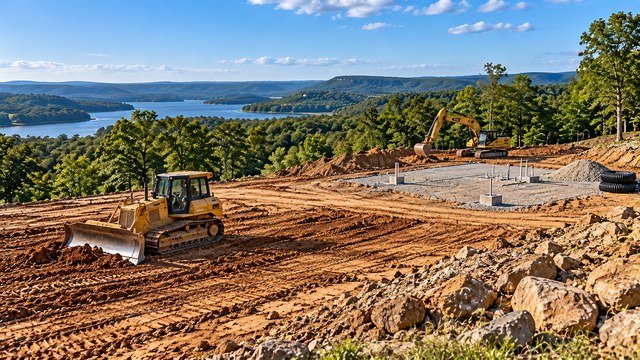
Raw land cost is really a site-development budget
Turning Arkansas acreage into a build-ready homesite is a bundle of projects rather than one line item. Clearing, access, grading, drainage, wastewater, water, electric service, communications, surveys and permits can each become major costs. The useful number is the all-in cost to reach a usable homesite, not a generic statewide cost per acre.
There is no honest single statewide development price
Arkansas terrain and infrastructure vary too much for one statewide number to be reliable. A level pasture with road frontage and nearby utilities is a different project from wooded Ozark acreage with steep access, rock, a long power extension and an individual well. Build the budget from parcel-specific scopes and bids.
Start with a site plan before ordering equipment
Sketch the proposed house, driveway, septic primary and secondary areas, well, power route, drainage features and future buildings. This exposes conflicts before money is spent. Moving a homesite can shorten a driveway but lengthen electric service, reduce a view but improve septic feasibility, or make a well easier to separate from wastewater.
Survey and boundary work can prevent expensive mistakes
Before clearing near boundaries or placing permanent infrastructure, confirm the legal parcel and relevant easements. A survey can help locate corners, encroachments and the relationship between the proposed improvements and property lines. GIS parcel maps are useful screening tools but should not be treated as surveyed boundaries.
Legal access comes before driveway construction
A physical road or trail does not necessarily provide permanent legal access. Confirm public-road frontage or a recorded easement and understand maintenance obligations before pricing a driveway. If access depends on neighboring land, title review can be as important as earthwork.
State-highway access requires coordination with ARDOT
For a driveway connecting to an Arkansas state highway, ARDOT's access rules require a permit process. The published instructions state that no work may begin on state highway right-of-way until the permit has been issued. Resolve the access point before finalizing the house and driveway layout.
Driveway cost depends on length, slope and drainage
A rural driveway can require clearing, excavation, geotextile, base material, gravel, compaction, culverts and ditch work. Long mountain driveways can also require switchbacks, turnouts or substantial grading. Compare contractors using the same width, depth, aggregate and drainage scope rather than a vague price per foot.
Culverts and crossings can become major line items
Low areas, roadside ditches and intermittent drainage channels may need properly sized crossings. A cheap driveway that repeatedly washes out is not cheap over the life of the property. Evaluate where runoff concentrates and whether the access route remains usable during heavy Arkansas rain.
Clearing cost depends on what must actually be removed
Pasture cleanup, brush removal and mature timber clearing are different jobs. Stumps, large hardwoods, steep slopes, rock, disposal requirements and the amount of finish grading affect the scope. Define whether a quote includes felling, stump removal, hauling, burning where lawful, chipping, mulching and final cleanup.
Forestry mulching and full clearing serve different goals
Forestry mulching can be useful for opening trails, reducing brush and selectively clearing without excavating every root system. A building pad, septic field or road may require more conventional clearing and grubbing. Match the method to the final use rather than clearing the entire tract unnecessarily.
Ozark and Ouachita terrain can change grading costs quickly
Slope affects excavation, equipment access, retaining needs, erosion control and driveway geometry. Rock can further change production rates and foundation preparation. Evaluate the specific homesite and access route instead of assuming that total acreage describes usable building area.
Build the pad around drainage, not just the view
A scenic low point or hillside bench may create water-management problems. Plan finish grades so water moves away from structures without concentrating runoff onto the septic area, driveway or neighboring property. Include swales, ditches, culverts and stabilization in the earthwork scope where needed.
Septic feasibility can determine whether the site plan works
Arkansas onsite-wastewater rules make septic planning a core development issue. Standard systems require suitable primary and secondary absorption areas. Soil conditions, seasonal water tables, restrictive layers, bedrock, slope and required setbacks can change the type and footprint of a system.
Protect both the primary and secondary wastewater areas
The replacement area is not spare open ground to use later for a shop, driveway or pool. Arkansas rules require primary and secondary absorption areas in relevant onsite-wastewater planning. Identify and protect those areas early so later improvements do not consume the reserve location.
Do not begin building before required wastewater approval
Arkansas Department of Health onsite-wastewater rules require applicable approvals before construction proceeds. For subdivisions, the rules specifically state that construction cannot begin on a lot until final approval for onsite wastewater use has been made by the Department. Confirm the process that applies to the exact parcel before site construction.
Well placement has to work with the septic layout
Arkansas sanitation rules for an individual water well with onsite wastewater specify location criteria, including at least 50 feet from a lot line and 100 feet from onsite wastewater systems proposed on the same or adjacent lots. Both primary and secondary wastewater systems must meet applicable setbacks.
Private well construction is regulated infrastructure
Arkansas water-well rules establish minimum standards for well construction and repair. Wells subject to those rules must be constructed by a validly licensed person unless an exemption applies. The rules also require yield testing for drilled wells, which is another reason to budget from a qualified contractor's complete scope.
Budget the finished water system, not just drilling
A complete private-water budget can include mobilization, drilling, casing, grout, well development, pump equipment, pressure storage, controls, electrical work, trenching, plumbing, testing and treatment. A quoted drilling rate is not necessarily the cost of water at the house.
Electric service can be a hidden raw-land cost
Identify the serving electric utility and request a site-specific service discussion. The nearest visible line may not be the point from which the utility will serve the home. Line extensions, poles, transformers, easements, clearing, underground construction and customer-owned equipment can all affect the project.
Homesite location can save or spend thousands on utilities
Measure the distance from the likely utility service point to the proposed meter and house. Also measure the water line, driveway and other trench routes. A homesite pushed deep into a large tract can improve privacy while materially increasing infrastructure quantities.
Temporary power belongs in the construction plan
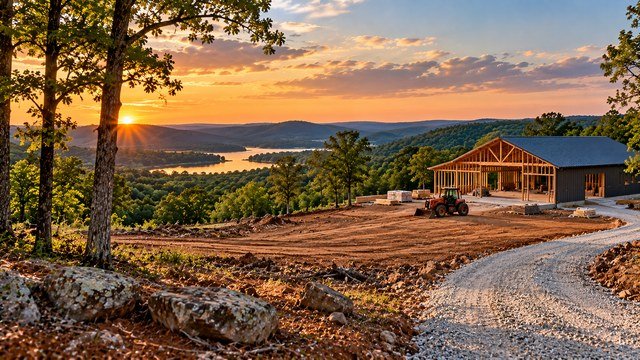
Ask the utility and builder how power will be supplied during construction. A temporary service, generator or early permanent meter can affect sequencing and cost. Coordinate it before crews arrive rather than treating temporary power as an afterthought.
Internet should be treated as infrastructure when it matters
If the property must support remote work or connected equipment, verify address-level wired, fixed-wireless, cellular and satellite options. Test cellular performance at the actual homesite. A regional coverage map does not prove that a wooded hollow or mountain parcel has usable service.
Flood mapping is a starting point, not the whole drainage study
Use current FEMA and Arkansas GIS flood-hazard information to screen the tract and proposed improvements. Then evaluate actual topography, drainage paths and local floodplain requirements. A parcel can have serious runoff or access problems even when the house site is outside a mapped Special Flood Hazard Area.
Erosion control matters on disturbed Arkansas soil
Clearing and grading expose soil to rainfall and runoff. Stabilize disturbed areas and plan construction entrances, drainage and seeding appropriate to the project. Larger or more complex disturbances can involve additional environmental requirements, so confirm the rules before major earthwork.
Local permits and requirements vary
Arkansas development requirements can differ by county, municipality and project type. Ask the authorities with jurisdiction about building, floodplain, driveway, subdivision and other approvals. Private covenants can add separate restrictions that do not appear in public zoning rules.
Price site work with written scopes
A useful bid identifies quantities and exclusions: acres or square feet cleared, driveway dimensions and aggregate depth, culvert sizes, grading limits, material import or export, stabilization and cleanup. Written scopes make competing bids easier to compare and reduce disputes about what the price included.
Sequence work so one contractor does not undo another
A common sequence is due diligence and layout, access, selective clearing, major grading and drainage, wastewater and water infrastructure, electric and communications, then finish grading and stabilization. The exact order varies, but coordination prevents a utility trench from destroying a finished driveway or heavy equipment from crossing a new septic field.
Keep a contingency for subsurface surprises
Rock, unsuitable soils, unexpected groundwater conditions, additional drainage and utility requirements can appear after work begins. Raw-land projects benefit from a contingency rather than a budget that assumes every unknown will break in the owner's favor.
Compare acreage using all-in build-ready cost
For two candidate parcels, add the purchase price to the estimated cost of access, clearing, grading, drainage, septic, water, power and other required infrastructure. A higher-priced parcel with an existing driveway and utilities can be financially stronger than cheaper raw land with difficult development conditions.
Arkansas development due diligence in one sequence
Confirm title, boundaries and legal access first. Establish a workable house, driveway, septic and well layout next. Verify flood and drainage conditions, then obtain utility and site-work information using the same layout. Only after those pieces are understood should the project rely on a final development budget.
Use the Arkansas buying guide as the pre-development checklist
Before estimating construction, work through the broader acreage due diligence in AcreageReady's Buying Rural Land in Arkansas guide. Development costs become more accurate after access, restrictions, wastewater feasibility, water, utilities, terrain and flood risk have been screened.
Related: Buying Rural Land in Arkansas: The Complete 2026 Acreage Guide
Sources & methodology
Where this information comes from
Cost figures are planning references rather than contractor quotes. Permitting, system-selection, and location-specific guidance should be verified with the appropriate local authority or qualified professional. AcreageReady uses source-backed, AI-assisted editorial workflows and remains responsible for the material it publishes. Read how we research, edit, and correct guides.
- Arkansas Department of Health - Rules Pertaining to Onsite Wastewater Systems
- Arkansas Department of Transportation - Access Driveways Rules
- Arkansas Code of Rules - Arkansas Water Well Construction Rules
- Arkansas Code of Rules - Authorized Water Well Constructor
- Arkansas Code of Rules - Individual Water Well
- Arkansas GIS Office - Flood Hazard Zone Polygon
Common questions
Frequently asked questions
How much does it cost to develop raw land in Arkansas?
There is no reliable single statewide total. Cost depends on access, clearing, terrain, drainage, septic feasibility, water source, electric distance and the amount of infrastructure required to reach the chosen homesite.
What are the biggest raw-land development costs in Arkansas?
Common major categories are driveway and access work, clearing and grading, drainage, onsite wastewater, a private well or water connection, and electric-service extension.
Should I test septic feasibility before buying Arkansas land?
Yes when onsite wastewater is expected. The septic layout can control where the house, well, driveway and future improvements can go, and Arkansas rules require suitable primary and secondary absorption areas for applicable systems.
Does Arkansas require a second septic area?
Arkansas onsite-wastewater rules include primary and secondary absorption areas for standard system planning. Protect the required secondary area from conflicting development.
Can I build before septic approval in Arkansas?
Do not assume construction can begin first. Arkansas Department of Health rules govern onsite wastewater approval, and subdivision rules expressly prohibit construction on a lot until final wastewater approval is made. Confirm the process for the exact parcel.
Do I need a permit for a driveway on an Arkansas state highway?
ARDOT's published access-driveway rules require a permit process and state that work cannot begin on state highway right-of-way until the permit has been issued.
Who can construct a private water well in Arkansas?
Arkansas water-well rules state that wells subject to the rules are to be constructed by persons with a valid license unless an applicable exemption exists.
How far should a private well be from septic in Arkansas?
The cited Arkansas individual-well sanitation rule specifies at least 100 feet from onsite wastewater systems proposed on the same or adjacent lots, plus other location criteria. Confirm the requirements for the specific project.
Why can mountain acreage cost more to develop?
Steep access, rock, drainage, retaining needs, longer driveways and difficult equipment access can increase site-work quantities even when the purchase price per acre is attractive.
How should I compare two Arkansas raw-land parcels?
Compare all-in build-ready cost. Add purchase price to parcel-specific estimates for access, clearing, grading, drainage, wastewater, water, electric service and other required infrastructure.
Ready to talk with a local professional?
Share your location and project details so AcreageReady can identify relevant providers as the network grows.
Get a free quote