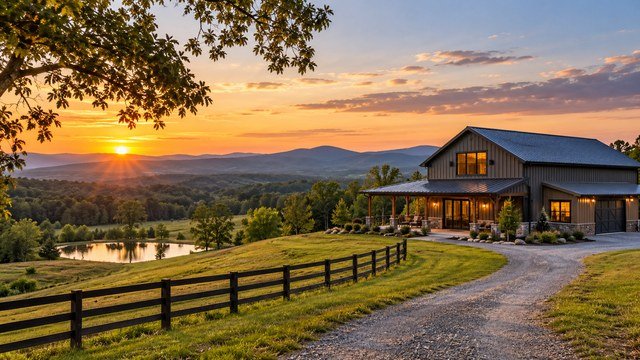
There is no single best part of Alabama for acreage
The right Alabama acreage market depends on what you want the property to do. A buyer commuting into Huntsville has different priorities from someone building a self-sufficient homestead, managing timber, keeping livestock, or looking for a weekend property. Instead of ranking counties by a single score, this guide groups practical search areas by the tradeoffs that matter to rural buyers.
Start with the property plan, not the county name
Write down the minimum acreage, home type, shop or barn size, livestock plans, garden or pasture needs, commute limit, water preference, internet requirement, and total site-development budget before searching. A beautiful tract in the wrong location can become a poor fit when the driveway, septic, power, clearing, or daily travel is considered.
Alabama offers several very different acreage environments
North Alabama includes Tennessee Valley farmland, foothills, lakes, and growing employment centers. Central Alabama mixes metro-edge acreage, rolling timberland, and lake country. East Alabama includes Auburn-Opelika growth and rural land toward the Georgia line. South Alabama has extensive forest and agricultural land, while the Gulf Coast adds coastal growth, wetlands, storm exposure, and different insurance considerations.
North Alabama: Huntsville and the Tennessee Valley
Madison, Limestone, Morgan, Marshall, and surrounding counties put acreage buyers within reach of the Huntsville employment market while offering rural and semi-rural settings outside the urban core. This region can work well for buyers who want a barndominium or small homestead without giving up access to major employers, healthcare, shopping, and services.
Madison County works best when proximity matters more than maximum acreage
Madison County can appeal to buyers who need frequent access to Huntsville and want a rural homesite on the metro edge. The tradeoff is development pressure. Buyers should pay close attention to nearby subdivisions, road projects, annexation, utility extensions, deed restrictions, and whether the surrounding rural character is likely to change.
Limestone County combines Huntsville access with a broader rural search area
Limestone County is a logical search area for buyers working in the Huntsville-Decatur corridor. Flat to gently rolling land can be attractive for homesites, shops, gardens, and pasture, but parcel-level drainage, soil, road access, utility service, and future development still need to be checked. Do not assume that agricultural appearance means the tract is ready to build.
Morgan County can fit buyers balancing Decatur, Huntsville, and rural living
Morgan County provides access to Decatur and regional employment while extending into rural areas with farms, timber, and rolling terrain. It can make sense for buyers who want practical access to services but do not need to live immediately adjacent to Huntsville. Compare the exact commute and utility situation rather than treating the entire county as one market.
Marshall County adds lake-country and foothill options
Marshall County can appeal to buyers who value Guntersville-area recreation, wooded acreage, and more varied terrain. Sloped sites can create attractive views, but they can also increase driveway, grading, drainage, foundation, and septic complexity. A lower land price does not automatically offset a difficult building site.
Northwest Alabama: Shoals-area acreage
Lauderdale, Colbert, Franklin, and Lawrence counties give buyers access to the Florence-Muscle Shoals area while offering farmland, timberland, and rural communities. This can suit buyers who want a smaller regional employment center rather than a large metro. Check travel time to healthcare, building suppliers, schools, and daily services from the actual parcel.
Northeast Alabama: foothills, timber, and scenic acreage
DeKalb, Cherokee, Etowah, Jackson, and nearby counties can offer wooded and scenic acreage in the Appalachian foothills. These areas may fit recreation-oriented homesteads, cabins, timber properties, or barndominiums where terrain is part of the appeal. Steep slopes, rock, drainage, road grades, and utility extension can materially affect the build budget.
Birmingham outer counties: acreage with metro access
Shelby, St. Clair, Blount, Bibb, Walker, and other counties around Birmingham give buyers several directions to search for acreage while maintaining access to the state's largest central employment and service area. The practical question is how far from the metro you need to go before the parcel size, restrictions, traffic, and development pattern match your goals.
Shelby County is a metro-access choice, not a low-cost-acreage assumption
Shelby County can work for buyers prioritizing Birmingham access, schools, services, and resale depth while still wanting land. Because growth and suburban development reach well beyond city boundaries, investigate zoning or land-use rules, subdivision covenants, road traffic, nearby development approvals, and utility availability before assuming a rural-looking tract will stay rural.
St. Clair County offers an east-of-Birmingham search corridor
St. Clair County can fit buyers who need access to Birmingham while preferring acreage east of the metro. Interstate access can be valuable, but commute convenience varies sharply by road network and parcel location. Compare rural road access, slopes, drainage, septic feasibility, and the cost of reaching utilities from the proposed homesite.
Blount County can appeal to buyers looking north of Birmingham
Blount County offers rolling and wooded acreage between Birmingham and North Alabama. It can be attractive for buyers who value a rural setting while keeping regional access in multiple directions. Terrain should be evaluated carefully because a tract with substantial acreage may have a much smaller practical area for the house, driveway, septic field, shop, and pasture.
Bibb and Walker counties can fit buyers willing to trade commute time for space
West and southwest of Birmingham, buyers may find larger rural landscapes and extensive timberland. These areas can suit homesteads, hunting properties, forestry objectives, or buyers who work remotely. The tradeoff can be longer travel to jobs, hospitals, specialized contractors, and shopping, so daily-life logistics deserve as much attention as the parcel itself.
Auburn-Opelika and east Alabama
Lee County and surrounding east Alabama counties can appeal to buyers who want rural property with access to Auburn-Opelika, Interstate 85, and the Georgia side of the region. Buyers should separate land intended primarily as a residence from land expected to support livestock, timber, rentals, or future subdivision because those goals can lead to very different location choices.
Lee County favors buyers who value Auburn-Opelika access
Acreage outside the developed parts of Lee County can provide room for a barndominium, shop, or small homestead while keeping university-area services nearby. Growth can also change roads and neighboring land uses. Verify restrictions, public utility plans, surrounding development, and whether the intended rural use is compatible with the location.
Chambers, Tallapoosa, and Randolph counties widen the east Alabama search
Buyers willing to live farther from Auburn-Opelika can expand into more rural east Alabama. These counties can fit wooded homesteads, lake-area searches, small farms, and buyers prioritizing acreage over a short commute. Broadband, well or public-water availability, septic suitability, and contractor travel distance should be verified parcel by parcel.
Montgomery-area acreage and central Alabama
Autauga, Elmore, Montgomery, and nearby counties offer rural options around the state capital. This region can work for buyers who need Montgomery access but want more land than a conventional suburban lot. Search by drive time and utility territory rather than county alone because the practical experience can change quickly from one side of the metro to another.
Autauga County can work for northwest-of-Montgomery acreage
Autauga County offers a mix of growing communities and rural land. Buyers should compare access toward Prattville and Montgomery with the cost and restrictions of individual parcels. A homesite farther from town may offer more privacy while increasing driveway length, utility extension, emergency-response time, and routine travel.
Elmore County combines Montgomery access with lake and rural markets
Elmore County includes very different property types, from growth corridors to rural and lake-influenced acreage. Clarify whether water recreation, commuting, pasture, timber, or privacy is the priority. Parcels near major water features require especially careful flood, drainage, access, septic, and shoreline-related due diligence.
West-central Alabama can favor space, timber, and recreation
Tuscaloosa, Hale, Greene, Pickens, Fayette, and surrounding counties include large rural landscapes and extensive forest resources. Buyers who do not need a short metro commute may find this part of the state worth searching for timber, hunting, recreation, homesteading, or a private homesite. Road quality and distance to services can become major selection factors.
Tuscaloosa County offers both university-area access and genuinely rural land
Tuscaloosa County stretches well beyond the city and includes rural communities, timberland, and acreage. Buyers can use drive time to Tuscaloosa as a filter while comparing land farther from the growth area. Pay attention to terrain, flood history, rural road conditions, broadband, and how far construction crews must travel.
South Alabama: timber, agriculture, and larger rural landscapes
Much of south Alabama is heavily forested and agricultural. Counties away from the coast and larger cities can appeal to buyers prioritizing privacy, hunting, timber management, small farming, or larger tracts. Alabama Forestry Commission data shows forest resources span vast rural portions of the state, so timber condition and management can be economically relevant rather than merely aesthetic.
Wiregrass: Dothan-area acreage
Houston, Dale, Coffee, Geneva, Henry, and surrounding counties give buyers access to the Dothan and Wiregrass region. The area can fit small farms, homesteads, barndominiums, and buyers who want a regional service center without living in a major metro. Agricultural operations, soil conditions, water sources, road frontage, and storm resilience should all be part of the parcel review.
Coffee and Dale counties can suit buyers connected to Enterprise and Fort Novosel
Acreage buyers with employment or family ties to Enterprise and the Fort Novosel area can search rural parts of Coffee and Dale counties while maintaining access to regional services. Commute routes, aircraft or training-related noise in some areas, restrictions, and utility service should be evaluated for the exact location.
Baldwin County is a coastal-growth market with rural pockets
Baldwin County can appeal to buyers who want Gulf Coast access while living on acreage, but it should be approached differently from interior rural Alabama. Rapid development, traffic, wetlands, drainage, flood exposure, wind risk, insurance, and changing surrounding land uses can materially affect both ownership and construction decisions.
Mobile-area rural land requires coastal due diligence too
Mobile County and nearby southwest Alabama can offer wooded and rural tracts with access to Mobile, but buyers should investigate flood history, drainage, wetlands, storm exposure, insurance, evacuation considerations, and road access. A parcel well inland can still have water-management issues that are not obvious from a listing photo.
Black Belt acreage deserves a property-specific approach
Counties across Alabama's Black Belt can offer agricultural, timber, hunting, and recreational properties with significant acreage. Buyers should avoid treating the region as a single bargain category. Soil, road infrastructure, local services, floodplains, property management needs, and distance to healthcare or employment can vary substantially.
Timberland can be an asset if you understand what you are buying
Alabama has nearly 23 million acres of forestland, and most timberland is privately owned. On a wooded tract, identify species, age classes, access, stream crossings, previous harvests, and management needs. If timber value affects the purchase decision, use a qualified forester rather than relying on a listing description or an informal estimate.
Pasture buyers should focus on usable acres, not total acres
A twenty-acre parcel is not automatically twenty acres of pasture. Woods, steep slopes, wet ground, utility easements, ponds, roads, homesites, septic areas, and buffers reduce usable grazing or hay acreage. Walk the land and estimate the acres that can actually support the intended livestock or agricultural use.
Barndominium buyers need a buildable rectangle, not just acreage
Large metal buildings can require a substantial level pad, truck access, drainage, septic space, utility routes, and room for construction equipment. A narrow, steep, or irregular tract can have plenty of total acreage but still be difficult for a wide building and shop layout. Test-fit the building, driveway, septic, and future improvements before closing.
Septic suitability can eliminate an otherwise attractive parcel
The Alabama Department of Public Health advises buyers to investigate sewage disposal before purchasing land that lacks central sewer. Soil suitability, seasonal groundwater, slope, flooding, water features, lot size, and replacement area can affect onsite sewage. Neighboring property with septic does not prove the parcel you are buying will work.
Water availability changes from parcel to parcel
Some rural properties have access to a public or community water system while others require a private well. Verify whether a water line actually serves the road, whether a meter is available, the tap cost, pressure, easements, and distance to the homesite. For wells, investigate local drilling conditions, expected depth, water quality, power, and treatment needs.
Power at the road is not the same as power at the homesite
Ask the serving electric utility for parcel-specific information. Long setbacks can require poles, trenching, transformers, clearing, easements, or customer contributions. A homesite selected only for the view may cost much more to serve than one positioned closer to existing infrastructure.
Use Alabama's broadband map before assuming remote work will be easy
ADECA's Be Linked Alabama program provides statewide broadband mapping and county profiles. Use the map as a screening tool, then verify the exact service address with providers and test cellular performance on the property. Rural broadband expansion is ongoing, so current parcel-level verification matters more than an old listing statement.
Current-use valuation can matter for qualifying farm and timber property
The Alabama Department of Revenue provides current-use valuation for qualifying Class III agricultural and forest property. A new owner must apply with the county assessing official during the applicable window if the property is to continue receiving current-use treatment. Buyers planning development should also understand potential rollback provisions when qualifying land is converted to another use.
Road frontage and legal access deserve separate verification
A visible driveway or dirt road does not prove permanent legal access. Review the deed, title work, survey, recorded easements, public road status, and maintenance responsibilities. Also verify that the entrance can physically support construction deliveries, emergency vehicles, trailers, and the turning movements required by the planned barndominium or farm.
Use maps to screen terrain before spending money on a property visit
Alabama Cooperative Extension recommends using property descriptions, aerial imagery, and topographic maps as part of land planning. Before driving hours to see a tract, review elevation, water features, roads, apparent clearings, neighboring uses, and historic imagery when available. Mapping cannot replace field inspection, but it can eliminate obvious mismatches.
Walk the land after rain when possible
Dry-weather showings can hide drainage problems. After rainfall, look for ponding, flowing swales, saturated road sections, culvert problems, erosion, and runoff entering from neighboring property. Drainage affects the house pad, driveway, septic, pasture, garden, pond, and long-term maintenance budget.
Compare properties by all-in development cost
A useful comparison includes purchase price plus survey, closing, driveway, clearing, grading, drainage, septic, water, power, communications, foundation preparation, permits, professional services, fencing, and contingency. A more expensive tract with a short driveway and nearby utilities can sometimes produce a lower finished homesite cost than cheaper raw land.
Create a commute-and-services radius before searching listings
Map the maximum acceptable drive to work, hospital care, groceries, schools if relevant, feed or farm supply, building suppliers, and an interstate or major highway. This turns a vague statewide search into several realistic zones and helps prevent buying a property that feels peaceful on Saturday but becomes inconvenient every weekday.
Visit the surrounding roads, not just the parcel
Drive several miles in each direction. Note truck traffic, road width, bridges, flood-prone crossings, industrial uses, poultry or livestock operations, subdivisions, shooting ranges, quarries, and other neighboring activities. Rural land is affected by the larger landscape, and those conditions may not appear in the listing.
Acreage near growth corridors needs a future-neighbor check
In Huntsville, Birmingham, Auburn-Opelika, Montgomery, Tuscaloosa, Baldwin County, and other growing areas, investigate nearby plats, subdivisions, utility expansions, road projects, and annexation patterns. Buying on the rural edge can provide convenience, but the view across the road may not remain pasture forever.
A practical Alabama shortlist for different buyer types
For Huntsville-oriented commuters, start with Madison, Limestone, Morgan, and Marshall counties. For Birmingham access, compare Shelby, St. Clair, Blount, Bibb, and Walker based on commute and budget. For Auburn-Opelika access, start with Lee and expand into Chambers, Tallapoosa, and Randolph. For Montgomery, compare Autauga and Elmore with rural portions of Montgomery County. For Dothan and Wiregrass living, examine Houston, Coffee, Dale, Geneva, and Henry. For buyers prioritizing timber, recreation, or privacy over commuting, widen the search into west-central, northeast, and south Alabama. These are search starting points, not parcel-level endorsements.
The best Alabama acreage is the tract that supports the whole plan
County reputation matters less than legal access, usable land, septic feasibility, water, power, drainage, restrictions, broadband, insurance, taxes, commute, and development cost on the exact parcel. Build a regional shortlist, then make every candidate prove that it can support the home, shop, homestead, or land-management plan you intend to create.
Sources & methodology
Where this information comes from
Cost figures are planning references rather than contractor quotes. Permitting, system-selection, and location-specific guidance should be verified with the appropriate local authority or qualified professional. AcreageReady uses source-backed, AI-assisted editorial workflows and remains responsible for the material it publishes. Read how we research, edit, and correct guides.
- U.S. Census Bureau: County Population Totals and Components of Change, 2020-2025
- Alabama Department of Public Health: Can I Live On This Lot?
- Alabama Department of Public Health: Selecting a Homesite
- ADECA: Be Linked Alabama Broadband
- ADECA: Broadband Community Profiles
- Alabama Department of Revenue: Current Use
- Alabama Forestry Commission: Forest Resources
- Alabama Cooperative Extension System: Land Planning Essentials
Common questions
Frequently asked questions
What part of Alabama is good for acreage near Huntsville?
Madison, Limestone, Morgan, and Marshall counties are practical starting points for buyers who want rural or semi-rural acreage while maintaining access to the Huntsville region. Compare commute time, development pressure, utilities, terrain, septic feasibility, and the total cost to build on each parcel.
Where should I look for acreage near Birmingham?
Shelby, St. Clair, Blount, Bibb, Walker, and rural parts of the broader Birmingham region provide different combinations of commute, terrain, development pressure, and available land. Search by actual drive time and parcel characteristics rather than county name alone.
Is north or south Alabama better for a homestead?
Neither is universally better. North Alabama can offer strong access to Huntsville and varied terrain, while south Alabama includes extensive agricultural and forest land and several regional service centers. Climate, soil, water, utilities, commute, land use, and the type of homestead should drive the choice.
What should I check before buying wooded land in Alabama?
Review legal access, boundaries, timber condition, terrain, streams and wetlands, previous harvesting, road and bridge needs, wildfire considerations, septic suitability, utilities, and the intended management plan. If timber value matters financially, consider a qualified forester.
Can I put a barndominium on rural Alabama acreage?
Potentially, but the exact parcel must support the project. Verify applicable building requirements and restrictions, septic or sewer, water, electric service, driveway access, drainage, flood conditions, insurance, financing, and enough usable area for the building pad and future improvements.
How can I check internet service on rural Alabama land?
Use ADECA's Be Linked Alabama broadband map and county profiles for initial screening, then verify the exact service address directly with providers and test cellular service on the property. Availability can change at a very local level.
Does Alabama offer current-use property valuation for acreage?
Qualifying Class III agricultural and forest property may receive current-use valuation. Alabama Revenue says applications are handled by the county assessing official and new owners must apply after a sale if they want qualifying treatment to continue. Verify eligibility and rollback implications for the specific tract.
What is the biggest mistake when choosing an Alabama acreage location?
Choosing by land price or scenery before verifying the complete property system. Legal access, usable terrain, septic, water, electricity, drainage, restrictions, broadband, insurance, commute, and site-development cost can matter more than the advertised price per acre.
Ready to talk with a local professional?
Share your location and project details so AcreageReady can identify relevant providers as the network grows.
Get a free quote