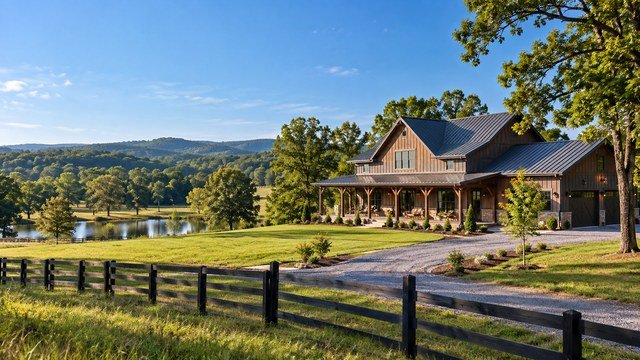
Why Alabama is worth considering for rural acreage
Alabama offers everything from wooded foothill acreage in the north to pasture, timberland, Black Belt soils, and Gulf Coast properties in the south. That variety creates opportunities for homesteads, barndominiums, shops, livestock, recreation, and timber, but it also means buyers should evaluate each parcel on its actual soils, drainage, access, utilities, and local rules rather than assuming all rural Alabama land develops the same way.
Start with the intended use of the property
Write down what the land must support before shopping: a primary home, barndominium, shop, livestock, garden, hunting, timber, pond, guest house, RV storage, or some combination. A parcel that works well for recreation may be expensive to convert into a homesite if it lacks suitable septic area, reliable access, power, or buildable terrain.
Do not let the price per acre make the decision
A lower purchase price can disappear quickly when a property needs a long driveway, extensive clearing, utility extensions, engineered drainage, an unusual septic system, or major grading. Compare parcels using an estimated all-in cost to reach a usable homesite, not only the asking price.
North, central, and south Alabama can require different planning
Northern Alabama commonly brings more rolling or steep terrain and rock considerations. Central Alabama varies widely between suburban-fringe acreage, timber, pasture, and clay-heavy sites. Southern and coastal areas can add high groundwater, flood, wetland, hurricane, and drainage considerations. These are broad regional patterns, not substitutes for parcel-specific investigation.
Verify legal access before falling in love with a parcel
A visible dirt road or worn path does not automatically prove permanent legal access. Confirm that the parcel fronts a public road or has a recorded easement that provides the access needed for residential use, utilities, construction equipment, emergency vehicles, and future owners.
Read the deed, legal description, and title exceptions
Title work can reveal easements, reservations, restrictions, rights-of-way, mineral interests, and other matters that affect how acreage can be used. Review exceptions carefully and ask the closing professional or an Alabama real-estate attorney about anything that could interfere with the planned project.
Order or review a current boundary survey
A survey helps establish corners, acreage, encroachments, road frontage, easements, and the relationship between improvements and property lines. Rural fences and old roads should not be treated as reliable boundary evidence without verification.
Walk the property instead of relying on listing photos
Visit the tract and walk as much of it as practical. Look for low areas, erosion, standing water, steep slopes, washed-out crossings, dump sites, old foundations, utility corridors, neighboring uses, timber condition, fence lines, and evidence of how water moves after rain.
Septic suitability should be investigated before closing
The Alabama Department of Public Health advises buyers of land without central sewer to determine whether a suitable site exists for an onsite sewage system. Soil suitability, seasonal groundwater, proximity to lakes or streams, flooding, slope, water supply, lot size, and room for a replacement area can all matter. Do not assume that because a neighboring property has septic, the parcel you are considering will qualify.
Understand Alabama's onsite sewage permitting process
ADPH administers soil and onsite sewage requirements through its environmental health program and county health departments. Current forms include applications for permits to install small-flow onsite sewage systems and site evaluation documentation. Verify the current county process and requirements before committing to a homesite or house layout.
Protect the primary and replacement septic areas
A buyer may identify a beautiful building pad and later discover that grading, a driveway, shop, pond, or other improvement conflicts with the best septic area. Map the proposed home, septic field, replacement area, driveway, well, outbuildings, and drainage features together before site work begins.
Check whether public water is actually available
A water line visible near a road does not guarantee that a meter can be installed at a reasonable cost. Contact the serving utility directly and ask about service territory, meter availability, tap fees, line size, required extensions, easements, pressure, and the distance from the meter to the planned home.
Evaluate a private well as a separate project
Where public water is unavailable, investigate nearby well depths, groundwater conditions, drilling access, water quality testing, pump equipment, storage needs, and setbacks from septic components. Budgeting should include the complete water system rather than only the drilling price.
Power at the road is not the same as power at the homesite
Ask the electric provider for a site-specific service discussion. Long setbacks can require additional poles, trenching, transformers, easements, clearing, or customer contributions. The location of the home and shop can materially change the cost of getting electricity onto the property.
Internet and cellular service deserve their own due diligence
Coverage maps are useful screening tools but rural service can vary at the parcel level. Check available wired providers, fixed wireless, cellular performance, and satellite options. If remote work matters, test phones on the property and verify service addresses with providers before closing.
Estimate driveway and entrance costs early
Rural driveways may require clearing, excavation, geotextile, aggregate, drainage, culverts, gates, and ongoing maintenance. A long driveway through wet ground or across a drainage can cost far more than a short entrance on firm terrain. Confirm any road or county requirements for the entrance before construction.
Study topography before choosing a building site
Slope affects foundation design, driveway grades, erosion, drainage, septic layout, accessibility, and construction cost. Topographic maps can help with initial screening, but a builder, surveyor, engineer, or other qualified professional may be needed when the proposed site has significant elevation change.

Flood maps are a starting point, not the entire drainage review
Review FEMA flood information and local records, but also look at creeks, swales, culverts, pond overflow, road crossings, neighboring runoff, and evidence of previous high water. Land can experience serious drainage problems even when the proposed house is outside a mapped special flood hazard area.
Wetlands and streams can change the usable acreage
Low ground, stream corridors, and wetland areas can affect road placement, crossings, ponds, clearing, and development. If a project may affect jurisdictional waters or wetlands, determine what federal, state, or local review may apply before disturbing the area.
Construction stormwater rules can apply to rural projects
Alabama's 2026 Construction General Permit covers regulated construction activity that disturbs one acre or more, and certain smaller sites that are part of a common plan of development or sale totaling one acre or more. ADEM also states that coverage can be required for a site of any size whose discharges have a reasonable potential to cause or contribute to a water-quality concern. Verify applicability before major clearing, grading, excavation, or filling.
Large clearing projects need an erosion plan, not just a bulldozer
Removing vegetation can expose Alabama soils to heavy rainfall and runoff. Phase disturbance where practical, preserve vegetation outside the work area, stabilize entrances, manage concentrated flow, and plan sediment controls before clearing begins. ADEM's construction program requires regulated sites to use appropriate erosion and sediment controls.
Timber can be an asset and a development constraint
Wooded acreage may have merchantable timber, but its value depends on species, quality, volume, access, markets, and logging conditions. If timber value materially affects the purchase decision, consider an independent forester rather than relying on a listing estimate. Also account for stump removal and site restoration where future buildings or pasture are planned.
Look closely at old agricultural and rural improvements
Old barns, wells, ponds, fences, septic systems, fuel tanks, and utility lines can add value or create liabilities. Determine what is functional, what can legally be reused, and what may require repair, abandonment, or removal.
Check restrictions even when there is no HOA
Rural property can still be subject to recorded covenants, deed restrictions, easements, subdivision requirements, or local land-use rules. Verify whether the planned barndominium, manufactured home, livestock, short-term rental, commercial activity, additional dwelling, or shop is allowed before purchase.
Building codes and permits can vary by location
Do not assume that being outside city limits means there are no requirements. Ask the county, municipality if applicable, fire authority, health department, and relevant utilities which permits, inspections, setbacks, driveway approvals, floodplain rules, and building requirements apply to the exact parcel.
Barndominium buyers should verify the structure before buying the land
If the plan is a barndominium, confirm that the intended structure can satisfy applicable building requirements, lender and insurer expectations, septic sizing, driveway access, and utility needs. A large shop area, attached living space, porches, and future additions should be incorporated into the site plan from the beginning.
Agricultural use can affect Alabama property valuation
The Alabama Department of Revenue provides current-use valuation for qualifying Class III property, including eligible agricultural and forest property. Current use values qualifying land according to its actual qualifying use rather than its potential market use. Eligibility should be confirmed with the county assessing official rather than assumed from acreage alone.
Know the current-use application window
Alabama Revenue states that taxpayers seeking current-use valuation generally apply with the county assessing official between October 1 and January 1. A new owner must apply after a sale or other disposition if the property is to continue receiving current-use treatment. Ask the county assessor how the rules apply to the specific transaction.
Understand the possibility of current-use rollback taxes
Conversion of property receiving current-use valuation to a nonqualifying use can trigger rollback provisions. Alabama Revenue describes a calculation involving additional taxes for prior years when the statutory conditions are met. Buyers planning to subdivide or develop agricultural or forest property should investigate this before closing.
Alabama property classification matters to the tax calculation
The Alabama Department of Revenue lists agricultural, forest, and single-family owner-occupied residential property as Class III with a 10 percent assessment ratio. Actual property taxes also depend on valuation, local millage, exemptions, and whether current-use treatment applies, so county-level estimates are more useful than a statewide rule of thumb.
Ask about mineral, timber, hunting, and other rights
Rural land can involve interests beyond the surface estate. Determine what rights convey with the sale and whether leases, reservations, hunting arrangements, timber contracts, or other agreements remain in effect. Title documents and seller disclosures should be reviewed carefully.
Look at neighboring land uses before you buy
Visit at different times and inspect surrounding parcels. Poultry operations, shooting ranges, quarries, industrial sites, high-traffic roads, planned subdivisions, logging, agricultural operations, and other lawful rural uses may affect noise, dust, traffic, odors, privacy, or future resale.
Consider wildfire, severe weather, and emergency access
Rural resilience includes more than the house itself. Evaluate vegetation near structures, dead-end access, bridge or culvert capacity, address visibility, turnaround space for emergency vehicles, backup power, storm shelter options, and how quickly you can reach medical and fire services.
Insurance should be checked before the inspection period expires
Ask an insurer about the proposed home type, distance from fire protection, roof and construction materials, outbuildings, livestock, acreage, flood exposure, and any business use. For an unusual structure such as a barndominium, confirm insurability before assuming conventional homeowner coverage will be straightforward.
Financing raw acreage can differ from financing a house
Land loans may require different down payments, terms, appraisals, and underwriting than conventional home mortgages. If construction will follow soon after purchase, compare a separate land loan with construction or construction-to-permanent options and understand how equity in the land may be treated.
Get realistic site-development estimates during due diligence
Before closing, build a preliminary budget for survey, septic, water, power, driveway, clearing, grading, drainage, foundation preparation, permits, internet, fencing, and contingencies. Obtain local input for the largest unknowns rather than relying on generic national cost averages.
Use contingencies to investigate expensive unknowns
Purchase contracts can be structured around appropriate due-diligence needs, subject to negotiation and legal advice. Buyers often need enough time to investigate title, survey, financing, septic feasibility, utilities, access, flood conditions, restrictions, and other property-specific issues before becoming fully committed.
Red flags that deserve more investigation
Be cautious when a seller or listing relies on statements such as 'utilities available,' 'should perc,' 'unrestricted,' or 'build anywhere' without documentation. Other warning signs include unclear access, unexplained low areas, unrecorded roads, recent heavy clearing, boundary disputes, dumping, unusual easements, or a price that only makes sense if expensive development assumptions prove true.
A practical pre-offer screening checklist
Before making an offer, identify the parcel, road frontage, approximate build area, public or private access, visible utilities, terrain, flood information, likely septic and water approach, recorded restrictions, surrounding uses, and estimated distance to work, schools, healthcare, groceries, and emergency services. This quick screen helps avoid spending due-diligence money on parcels that obviously do not fit the plan.
A practical due-diligence checklist before closing
During the contract period, verify title and access, review or obtain a survey, investigate septic feasibility, confirm water and electric options, research flood and drainage conditions, check applicable permits and restrictions, inspect the property, obtain financing and insurance confirmation, and update the development budget with parcel-specific information.
Plan the property as a system
The best homesite is not simply the flattest or prettiest spot. House orientation, driveway, septic, replacement field, well or water line, power, drainage, shop, barn, pasture, pond, fencing, future guest space, and emergency access compete for space. Sketching them together early can prevent expensive conflicts later.
What to do immediately after closing
Secure the property, preserve survey markers, document existing conditions, transfer or establish utilities as appropriate, confirm tax and mailing records, and sequence development work. Survey and layout should generally precede indiscriminate clearing, and septic, drainage, access, and utility planning should inform the final building pad.
The Alabama acreage buying strategy
A strong rural-land purchase is one where the property's legal access, usable soils, water, utilities, terrain, drainage, restrictions, taxes, and development costs support the buyer's actual plan. Alabama can offer excellent rural opportunities, but the cheapest acre is not necessarily the least expensive place to build. Due diligence converts a promising listing into a property you can confidently develop.
Sources & methodology
Where this information comes from
Cost figures are planning references rather than contractor quotes. Permitting, system-selection, and location-specific guidance should be verified with the appropriate local authority or qualified professional. AcreageReady uses source-backed, AI-assisted editorial workflows and remains responsible for the material it publishes. Read how we research, edit, and correct guides.
- Alabama Department of Public Health: Selecting a Homesite and Onsite Sewage Disposal
- Alabama Department of Public Health: Onsite Sewage Forms
- Alabama Department of Public Health: Environmental Services
- Alabama Department of Environmental Management: Construction General Permit
- Alabama Department of Environmental Management: Do I Need Permit Coverage?
- Alabama Department of Revenue: Current Use
- Alabama Department of Revenue: Property Tax Assessment
Common questions
Frequently asked questions
What should I check first when buying rural land in Alabama?
Start with legal access, intended use, septic or sewer feasibility, water, electricity, terrain, flood and drainage conditions, restrictions, and an initial site-development budget. These items can determine whether an otherwise attractive parcel is practical to build on.
Does rural land in Alabama need a perc test for septic?
Land without central sewer needs an approved approach to onsite sewage disposal. Alabama Public Health advises buyers to determine whether the property has a suitable septic site and identifies soil, seasonal groundwater, slope, flooding, water supply, lot size, and replacement area as relevant considerations. Confirm the current evaluation and permitting process with the county health department.
Can I build anywhere on unrestricted Alabama land?
Not necessarily. 'Unrestricted' in a listing does not eliminate septic requirements, easements, floodplain rules, building requirements, stormwater rules, utility constraints, access issues, or other state and local requirements. Verify the exact parcel before buying.
How do I know whether an Alabama parcel has legal access?
Review the deed, title work, survey, road frontage, and recorded easements. A physical road or driveway is not by itself proof of permanent legal access. Make sure the access is adequate for the intended residential, construction, utility, and emergency uses.
Does Alabama have a property-tax benefit for farmland or timberland?
Qualifying Class III agricultural and forest property may be eligible for Alabama current-use valuation. The Department of Revenue says applications are made through the county assessing official, generally between October 1 and January 1. Eligibility and potential rollback consequences should be verified for the specific property.
Do I need an Alabama stormwater permit to clear rural land?
It depends on the activity and site. ADEM says its Construction General Permit applies to regulated construction disturbing one acre or more, certain smaller sites that are part of a common plan totaling at least one acre, and some sites with potential water-quality impacts. Normal agricultural and silvicultural activities are among listed exclusions. Verify the current rules before disturbing land.
Should I buy Alabama acreage before getting construction estimates?
Try to price the major site-development unknowns during due diligence. Septic, water, power, driveway, clearing, grading, drainage, and foundation preparation can materially change the economics of a parcel.
What professionals may help with Alabama rural-land due diligence?
Depending on the property, useful professionals can include a real-estate attorney or title professional, surveyor, soil professional, septic designer or installer, builder, lender, insurer, forester, engineer, utility representatives, and county or municipal officials. The right team depends on the parcel and intended use.
Ready to talk with a local professional?
Share your location and project details so AcreageReady can identify relevant providers as the network grows.
Get a free quote