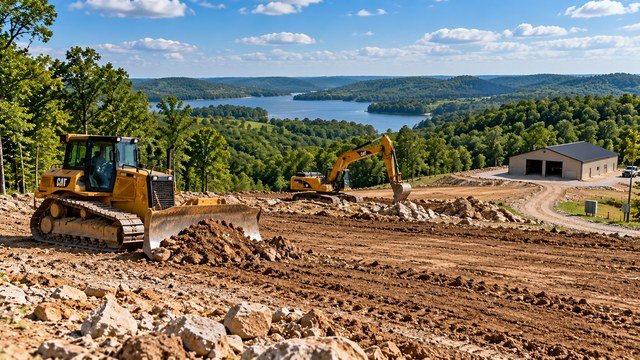
The purchase price is only the first part of a Missouri land budget
Raw acreage can look inexpensive until the cost of making it usable is added. A buildable rural homesite may need survey work, clearing, driveway construction, grading, drainage, onsite wastewater, a private well or water connection, electrical service and professional or permitting work. The most useful comparison is purchase price plus the cost to reach a build-ready condition, not price per acre by itself.
What build-ready means for this guide
Build-ready does not mean every acre is cleared. It means the planned homesite has practical access, a workable building area, a verified wastewater strategy, water, electricity, drainage planning and the approvals needed for the next construction phase. On larger Missouri tracts, concentrating infrastructure around the house, driveway and future buildings can control costs while preserving woods and pasture.
Start with a coordinated site plan
Sketch the house, driveway, shop or barn, septic system and replacement area, well, electrical route and future improvements before requesting major bids. These systems compete for usable ground and access. A homesite that shortens the driveway might complicate wastewater or place the well farther from an economical drilling location, so evaluate the site as one project rather than a collection of unrelated contractor jobs.
There is no honest single statewide development price
Missouri terrain and infrastructure vary too much for one statewide per-acre development number to be reliable. A relatively open tract with a short driveway and nearby electric service can have a very different budget from wooded Ozarks acreage with steep grades, rock, a long utility extension and challenging wastewater conditions. Use allowances for early screening, then replace them with parcel-specific information and bids.
Clearing cost depends on what is actually on the homesite
Brush, cedar, small trees, mature timber, stumps and logging debris require different equipment and cleanup. Define whether a bid includes only vegetation removal or also stump removal, grubbing, hauling, rough grading and final site preparation. A low clearing price can be misleading if the building contractor later has to remove roots and unsuitable organic material from the structural area.
Selective clearing can protect the budget
You may only need to clear the driveway, building envelope, wastewater area, utility corridors and selected yard space during the first phase. Leaving other acreage wooded can preserve privacy and recreational value while postponing unnecessary work. Mark the areas that must remain protected before heavy equipment arrives.
Missouri terrain can make grading a major expense
Rolling ground can be attractive but increase excavation, fill, retaining, foundation and drainage work. Steeper Ozarks-style sites can also make equipment access more difficult. Compare several possible homesites before committing to the location with the best view. A modest move can shorten the driveway, reduce earthwork and improve utility routing at the same time.
Rock can affect more than the foundation
Subsurface rock can influence foundation excavation, septic installation, utility trenching, driveway work and well construction. Conditions vary by parcel, so ask local excavators, well contractors and wastewater professionals what they encounter nearby. If the project depends on substantial excavation, site-specific investigation can be more useful than a generic allowance.
Driveway length can quietly dominate the site budget
A house set far back from the road may require hundreds or thousands of feet of clearing, excavation, aggregate, drainage and ongoing maintenance. The route must also support concrete trucks, well rigs, septic equipment and emergency access. Price the driveway to the proposed homesite instead of assuming a gravel entrance near the road represents the finished access cost.
State-highway access has its own requirements
When a property connects to a Missouri state highway, coordinate the entrance with the Missouri Department of Transportation. MoDOT publishes entrance types that include residential driveways and associated construction details. County and local roads can follow different processes, so identify the controlling road authority before building the entrance or installing a culvert.
Drainage belongs in the driveway design
Missouri storms can expose weak driveway construction quickly. Identify roadside ditches, natural swales, creek crossings and low areas before placing aggregate. Culverts, cross drainage, ditching, crown and finished elevation should move water without washing out the road or redirecting runoff onto neighboring land.
Septic feasibility comes before a septic installation budget
Missouri DHSS establishes minimum standards for onsite wastewater treatment systems, while local governments may adopt stricter requirements. DHSS says site and soil conditions affect system selection and performance. Determine the administrative authority for the parcel and investigate the proposed wastewater area before assuming a conventional septic system will work.
Missouri permitting can vary by parcel and local authority
DHSS explains that onsite wastewater permitting can be handled by DHSS, a contracted local authority or an authority operating under a local ordinance. Local ordinances may add requirements beyond state minimum standards. The state also notes that certain residential properties may qualify for a state permitting exemption, but that exemption does not apply uniformly in every county. Confirm jurisdiction and any exemption before work begins.
A larger parcel does not automatically solve wastewater constraints
DHSS states that where state onsite laws apply there is not a general minimum lot-size rule for an onsite wastewater treatment system, although counties and subdivisions can impose restrictions. More acreage can create layout flexibility, but the usable wastewater area still depends on site conditions, setbacks, soil and the system design.
Budget the complete wastewater system
A wastewater budget can include site or soil evaluation, permit costs where applicable, tank, treatment or distribution components, excavation, pumps or controls, electrical work, final grading and maintenance needs. More difficult sites may need alternatives to a basic gravity system. Price the likely system for the property rather than comparing generic septic-tank prices.
Private-well cost is highly site-specific in Missouri
Missouri DNR regulates well construction and says requirements are influenced by geologic, hydrologic and environmental factors. Groundwater quality and availability vary across the state, and some drilling areas have specific construction requirements. Well depth alone is therefore not enough to estimate the complete water-system cost.
Use Missouri well records before calling the driller
Missouri DNR provides tools for researching well records and permitted well and pump installation contractors. Nearby records can help establish local drilling patterns and give contractors useful context, but DNR cautions that groundwater conditions vary. Use nearby wells as evidence for planning, not as a guarantee of depth, yield or water quality on your parcel.
A complete well budget extends beyond drilling
Include casing and construction requirements, pump, pressure tank, electrical supply, trenching to the house, testing and any treatment that proves necessary. A long distance between the well and house can add trenching and electrical or plumbing cost even when drilling itself is straightforward.
Power lines at the road do not equal cheap service
Identify the electric utility serving the exact parcel and discuss the proposed meter, home and shop locations. Long extensions can involve poles, transformers, clearing, easements, trenching, conduit or customer-owned work. Moving the homesite can sometimes reduce both driveway and electrical costs, which is another reason to plan infrastructure together.
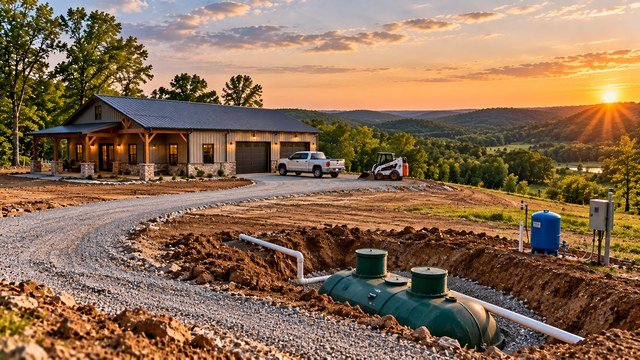
Coordinate underground utilities before final grading
Water lines, electric conduit, communications and other underground services should be planned before the driveway and yard receive their final finish. Shared corridors may be possible where allowed, but required separations and utility specifications still apply. The objective is to avoid reopening finished areas because one service was forgotten.
Internet and cellular coverage are part of rural infrastructure
Check wired, fixed-wireless, cellular and satellite options at the proposed homesite. Tree cover and terrain can make service deeper on the parcel different from service at the road. If remote work or connected equipment matters, include any trenching, conduit, towers, antennas or backup-power needs in the development plan.
Survey work should happen before expensive improvements
Boundary uncertainty can become expensive once the driveway, well, septic system or shop is installed. Review recorded easements and obtain the level of survey work appropriate to the transaction and project. Additional topographic or construction layout work can also be valuable when the site has significant slope or complicated drainage.
Easements can change the cheapest infrastructure route
Utility, access, pipeline and drainage easements can limit building locations or provide rights that affect routing. Compare the title and survey information with the proposed house, driveway, wastewater area, well and utility corridors before contractors mobilize.
Flood and drainage review can change the development plan
Evaluate mapped flood risk, creeks, ponds, low areas, evidence of erosion and whether high water can cut off the driveway. A house pad can remain dry while the access route or wastewater area has a water problem. Walk the parcel after rain when possible and investigate local drainage history.
Creek crossings can become a project of their own
If the preferred homesite requires crossing a creek or significant drainage, investigate the design, approvals and construction needed before assuming a simple pipe will work. Heavy construction traffic and emergency access can demand a more substantial crossing than ordinary passenger-vehicle use.
Future buildings should be included now
Reserve practical locations for a shop, barn, guest house or second dwelling even if those structures are years away. An inexpensive initial layout can become costly if the first driveway, septic area, well or house consumes the only workable expansion area. Future electrical and water demand can also influence today's infrastructure choices.
Barndominiums still require the same land-development fundamentals
A barndominium can change the building system, but it does not eliminate clearing, access, grading, drainage, wastewater, water or electricity. Large shops and slabs can increase the importance of pad preparation and utility capacity. Compare total finished-project cost rather than focusing only on the shell or building package.
Build a parcel-specific development worksheet
Create separate budget lines for survey and layout, clearing, stump removal, driveway and culverts, grading, drainage, wastewater evaluation and installation, water, electricity, communications, professional services, permits, cleanup and contingency. Keep uncertain items visible rather than burying them inside a single site-work allowance.
Replace allowances with real information during due diligence
Early planning numbers help compare listings, but the largest unknowns should become actual utility information, regulatory answers and contractor estimates before closing. Prioritize access, wastewater, water, electricity, major earthwork and drainage because these items can change whether the parcel still makes financial sense.
Keep a contingency for what the surface does not reveal
Raw-land projects can uncover rock, wet soils, unsuitable fill, buried debris, additional drainage work or longer utility routes than expected. A contingency is not automatically an upgrade fund. It is protection against site conditions that cannot be completely known before excavation.
Sequence work so contractors do not undo each other
A practical project often moves from survey and feasibility to final site planning and approvals, then selective clearing, access and drainage, coordinated infrastructure, pad preparation and construction. The exact order depends on the parcel, but avoid finishing a road, yard or building area that later must be excavated for utilities or wastewater work.
Compare Missouri parcels by total build-ready cost
A higher-priced tract with an established entrance, favorable wastewater area, manageable well conditions and nearby electricity can be financially stronger than cheaper acreage requiring extensive rock excavation, a long driveway and major utility extensions. Add land and development together before deciding which property is actually the better fit for the project.
The next step is to price the exact Missouri parcel
Statewide guidance is useful for identifying cost categories, but the final budget belongs to the property. Walk the proposed infrastructure routes, identify the responsible agencies and utilities, research nearby well information, investigate wastewater feasibility and request bids against a coordinated site plan. That process turns an attractive piece of raw acreage into a development decision supported by evidence.
Sources & methodology
Where this information comes from
Cost figures are planning references rather than contractor quotes. Permitting, system-selection, and location-specific guidance should be verified with the appropriate local authority or qualified professional. AcreageReady uses source-backed, AI-assisted editorial workflows and remains responsible for the material it publishes. Read how we research, edit, and correct guides.
- Missouri Department of Health and Senior Services - Onsite Wastewater Treatment
- Missouri DHSS - Onsite Wastewater Resources
- Missouri DHSS - Frequently Asked Questions
- Missouri DHSS - OWTS Construction Permit Process
- Missouri Department of Natural Resources - Well Types
- Missouri DNR - Water Wells PUB2945
- Missouri DNR - Well and Pump Installation Contractor Permitting
- Missouri Department of Transportation - Types of Entrances Requiring Permits
Common questions
Frequently asked questions
How much does it cost to develop raw land in Missouri?
There is no reliable single statewide number. The total depends on clearing, terrain, driveway length, drainage, wastewater requirements, well conditions, electrical-service distance and the scope of the project. Build a parcel-specific budget and replace early allowances with local bids during due diligence.
Does Missouri require a septic permit on rural acreage?
Missouri DHSS says onsite wastewater permits are generally required, but certain residential properties can qualify for exemptions under state rules and local ordinances can be more restrictive. Confirm the administrative authority and requirements for the exact parcel before beginning work.
Does Missouri have a minimum lot size for a septic system?
DHSS says the state onsite law does not establish a general minimum lot size where those state rules apply, but counties and subdivisions may impose restrictions. Site and soil conditions still determine whether an appropriate system can be installed.
Who regulates private wells in Missouri?
The Missouri Department of Natural Resources regulates well construction and the well and pump installation industry. DNR provides well records and contractor information that can help with parcel-level research.
Can nearby Missouri well records tell me what my well will cost?
They can help with planning, but they cannot guarantee your well depth, yield, water quality or construction requirements. Missouri DNR notes that groundwater conditions vary across the state and site-specific conditions matter.
Do I need approval for a driveway on a Missouri state highway?
Connections to Missouri state highways should be coordinated with MoDOT, which publishes entrance types and construction details. County and local roads can have separate requirements.
What are the biggest hidden costs when developing Missouri acreage?
Long driveways, rock excavation, difficult grading, advanced wastewater systems, deep or complicated wells, long electric extensions, drainage crossings and remote construction access can all materially change the budget.
Should I clear the entire property before building?
Not automatically. Clearing the homesite, driveway, wastewater area and utility corridors first can reduce initial cost and preserve flexibility for future buildings, pasture or recreational areas.
Ready to talk with a local professional?
Share your location and project details so AcreageReady can identify relevant providers as the network grows.
Get a free quote