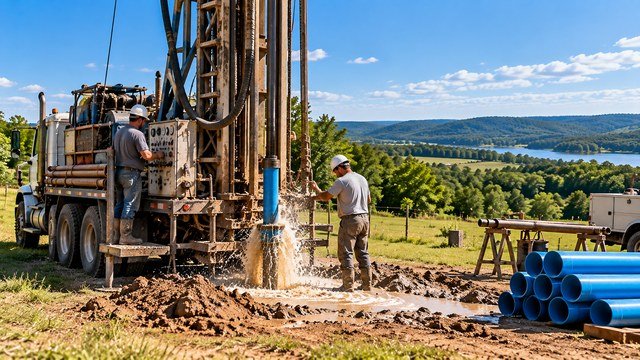
A Missouri well budget is more than a price per foot
Well drilling is often quoted by depth, but a complete rural water system can include mobilization, drilling, casing, grout, development, pump equipment, electrical work, pressure storage, trenching to the house, testing and treatment. Two wells with the same depth can therefore have different installed costs. Compare complete scopes rather than multiplying an advertised drilling rate by an assumed depth.
There is no honest single statewide well cost
Missouri groundwater and geology vary substantially. The Department of Natural Resources says some areas have abundant high-quality groundwater while others can have limited, mineralized, muddy or contaminated water. Construction requirements can also vary by drilling area. For acreage due diligence, local well records and qualified contractor input are more useful than a statewide average.
Missouri DNR regulates private well construction
The Missouri Department of Natural Resources is the regulatory authority for constructing, maintaining and plugging water wells in the state. Its Missouri Geological Survey Well Installation Section administers the well construction program and certification requirements. A private domestic well should be planned under the rules that apply to its location and intended use.
Missouri has 13 designated drilling areas
DNR's Well Installation Section Drilling Information Map identifies 13 drilling areas. Requirements differ because geology, groundwater hydrology, water quality and drilling conditions differ across Missouri. This matters financially because casing, grout and other construction requirements can change the amount of material and labor needed for a compliant well.
Use WISDIM before assuming the construction method
WISDIM is an interactive DNR map showing domestic bedrock well construction requirements and well information. Check the parcel location early in due diligence and discuss the mapped drilling area with a permitted contractor. Topography and field conditions can still create site-specific differences, so the map is a planning tool rather than a contractor quote.
Use WIMS 2.0 to research nearby wells and contractors
Missouri's Well Information Management System allows the public to search well records and well and pump installation contractors. DNR says records are available for wells drilled, reconstructed or plugged after the state's modern reporting program began in the late 1980s. Nearby records can help establish local patterns before you request bids.
Nearby well records are evidence, not a guarantee
A neighboring well can provide useful information about depth, construction and local geology, but it cannot promise that a new well will match it. Groundwater conditions can change over short distances. Review several nearby records when possible and let the driller interpret them in the context of the exact homesite.
Well depth is only one cost driver
Depth affects drilling time and material, but it is not the whole budget. Required casing depth, bore diameter, difficult formations, lost circulation, access for the rig, mobilization distance, pump setting, trench length and water treatment can all change the total. Ask which items are billed by the foot and which are fixed or separate charges.
Casing and grout protect the well and can affect cost
DNR identifies proper casing and a good grout seal as critical parts of well construction because they help keep surface contamination from entering the well. Required casing varies with local geology and drilling area. A bid that appears cheaper because it assumes less casing should not be compared directly with a scope designed for more demanding construction requirements.
Some Missouri areas can require additional casing planning
DNR provides a casing point request process and specifically notes its usefulness in certain drilling areas. Where geology or water-quality protection requires more casing and grout, the project can cost more than a simple depth estimate suggests. Ask the driller whether a casing point request or other DNR coordination is appropriate for the parcel.
Rig access should be solved before drilling day
A well rig needs safe access and enough working room. Steep grades, soft ground, narrow gates, overhead branches, creek crossings and unfinished driveways can increase mobilization difficulty or make a preferred location impractical. Walk the proposed route with the driller before finalizing the well location or completing landscaping.
Choose the well location with the entire site plan
The well, septic system, replacement wastewater area, house, driveway, shop and utility corridors should be laid out together. A well location that is easy for the rig may create a long water trench or conflict with future improvements. Coordinate required separation from contamination sources before expensive site work begins.
The pump is a separate part of the water-system budget
Drilling creates the well, but the property still needs equipment to move water to the house. Pump selection depends on factors such as well depth, pumping level, desired flow and pressure, elevation and household demand. Request a complete pump proposal rather than assuming the drilling quote includes everything below and above ground.
Pressure tanks and controls belong in the complete system price
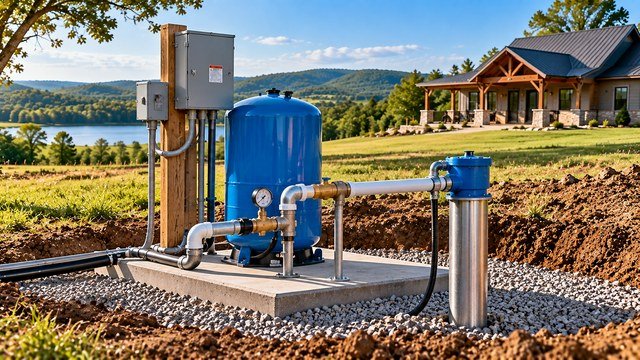
A typical private system also needs pressure storage and controls so the pump does not start every time a small amount of water is used. Include the pressure tank, pressure switch or controller, valves, fittings and any protective equipment specified by the installer. Equipment choices can affect both upfront price and pump cycling over time.
Electrical work can be easy to overlook
The pump needs an electrical supply sized for the equipment and installation. Depending on the project, electrical work may include trenching, wire, conduit, disconnects, controls and coordination with temporary or permanent house power. DNR notes that regulated pump installation work extends to plumbing and electrical lines from the well to the point of entry in the structure.
The trench from the well to the house can materially change cost
A scenic well location far from the home can require a long water line and electrical route. Rock, road crossings, finished driveways and elevation changes can make that trench more expensive. Include the full distance to the house or mechanical room when comparing potential well locations.
Water quantity should match the intended use
A domestic residence, livestock operation, irrigation system and multiple-building property can have very different water demands. Tell the driller what the property is expected to support, including future uses. DNR notes that well type is influenced by service connections, people served, geology and the amount of water needed.
Water quality cannot be guaranteed by compliant construction
DNR cautions that Missouri's groundwater quality varies and that a properly constructed well cannot guarantee usable water quality. Some areas can produce mineralized, muddy or otherwise problematic water. Budget for testing after drilling and avoid assuming that clear water automatically means the chemistry is suitable for the household.
Water testing should be part of commissioning the system
Testing provides a baseline for a new well and helps determine whether treatment is actually needed. Discuss appropriate testing with the well professional and relevant health or environmental authorities. Keep the laboratory results with the well record so future changes in water quality can be compared with the original condition.
Treatment equipment should solve measured problems
Filters, softeners, iron treatment, disinfection and other equipment add cost and maintenance. Select treatment based on test results and household needs rather than buying a generic package before the well is drilled. Some water-quality conditions can also influence well construction itself, so involve the driller early when local records show known issues.
Missouri requires permitted well and pump professionals for regulated work
DNR says individuals doing business to construct water wells or perform regulated pump installation work must hold the appropriate permit. The public can use WIMS 2.0 to search contractor records. Verify the contractor's current status and ask who will be responsible for the drilling record and other required reporting.
Contractors must prenotify DNR before regulated well work
Missouri's prenotification process requires contractors to notify DNR at least 24 hours before beginning regulated work such as water-well installation, pump installation, reconstruction or plugging, subject to emergency provisions. This is primarily the contractor's compliance task, but landowners should understand that legitimate well work involves more than simply scheduling a rig.
Landowners have a narrow self-installation exception, but it is not a shortcut for most projects
DNR's well guidance notes that landowners may install their own well or pump without a contractor permit under Missouri law and rules. That does not remove construction standards or make a complex drilling project simple. Most acreage buyers will be better served by qualified permitted professionals with the equipment and local geologic experience to complete and document the work correctly.
Private domestic wells differ from public water-supply wells
A well serving a private residence is not automatically regulated the same way as a public water system. DNR's 2025 regulatory fact sheet explains that wells meeting the definition of a public water supply fall under additional Public Drinking Water Branch requirements and can require construction authorization before drilling. Clarify the intended use if the property will serve multiple connections, a business or the public.
Do not assume an old well is an asset
An existing well can reduce development cost only if its location, condition, construction, yield and water quality are acceptable for the project. Search available records and have the system evaluated before assigning it significant value. An undocumented or failing well can become a repair or plugging obligation instead of a savings.
Abandoned wells need proper attention
DNR asks owners to report abandoned wells and regulates well plugging because unused openings can create groundwater and safety concerns. If acreage contains an old well, identify it during due diligence rather than burying, filling or building over it. Include professional plugging in the development budget when appropriate.
Get drilling bids that describe assumptions clearly
Ask each bidder to identify mobilization, drilling method, included footage, overage rates, casing and grout assumptions, development, pump scope, pressure equipment, trenching, electrical work, testing, reporting and exclusions. A detailed proposal makes it easier to understand why two bids differ and what happens financially if the well must go deeper than expected.
Carry a contingency for depth and subsurface uncertainty
No amount of mapping can reveal every condition before drilling. The final depth, formation behavior, water quantity and construction needs may differ from nearby wells. Build a contingency around the parts of the proposal that can change with actual drilling conditions rather than treating the initial estimate as a guaranteed final price.
Compare acreage by total water-development cost
A cheaper tract can become more expensive if the likely well is deep, the rig access is difficult, the water needs substantial treatment and the well sits far from the house. Compare land price plus well, septic, driveway, electricity and other infrastructure. The best parcel is the one that works for the complete project, not necessarily the one with the lowest asking price.
A practical Missouri well due-diligence sequence
Locate the parcel in WISDIM, search WIMS and other DNR well information for nearby records, identify permitted local drillers, map the homesite and wastewater area, discuss likely construction and access, obtain detailed drilling and pump proposals, and carry a contingency. After drilling, retain the well record and water-quality results with the property files.
Use parcel-specific evidence to build the final budget
The strongest Missouri well estimate combines state drilling-area information, several nearby records, a coordinated site plan and local contractor proposals. That approach will not eliminate uncertainty, but it produces a far more defensible development budget than assuming a statewide depth or copying a generic per-foot price from another region.
Sources & methodology
Where this information comes from
Cost figures are planning references rather than contractor quotes. Permitting, system-selection, and location-specific guidance should be verified with the appropriate local authority or qualified professional. AcreageReady uses source-backed, AI-assisted editorial workflows and remains responsible for the material it publishes. Read how we research, edit, and correct guides.
- Missouri DNR - Water Wells PUB2945
- Missouri DNR - Who Regulates Water Wells in Missouri? PUB4001
- Missouri DNR - Well and Pump Installation Contractor Permitting
- Missouri DNR - Well Information Management System WIMS 2.0
- Missouri DNR - WISDIM
- Missouri DNR - Well Installation FAQ PUB2193
- Missouri DNR - Well Installation Prenotification
- Missouri DNR - Well Types
Common questions
Frequently asked questions
How much does it cost to drill a water well in Missouri in 2026?
There is no reliable single statewide installed price. Depth, geology, drilling area, casing, access, pump equipment, trenching, electrical work, testing and treatment can all change the project. Use nearby DNR well records and detailed local bids to build a parcel-specific budget.
Who regulates private water wells in Missouri?
The Missouri Department of Natural Resources regulates the construction, maintenance and plugging of water wells through its Missouri Geological Survey Well Installation Section.
Does Missouri have different well drilling requirements by location?
Yes. DNR identifies 13 drilling areas with construction requirements that vary because of geology, hydrology, water quality and drilling conditions. WISDIM can be used to identify the area and applicable domestic bedrock well information.
How can I find nearby well depths in Missouri?
Missouri DNR provides public well searches through WIMS 2.0 and mapping tools including WISDIM and GeoSTRAT. Nearby records can show local drilling history, but they do not guarantee the depth or yield of a new well.
Does a Missouri well driller need a permit?
DNR requires individuals doing business in regulated well construction and pump installation to hold the appropriate contractor permit. WIMS 2.0 can be used to search permitted contractors.
Can a Missouri landowner drill their own well?
DNR guidance notes a landowner self-installation exception under state law and rules, but construction standards still apply. Professional drilling equipment, groundwater protection requirements and site-specific geology make qualified permitted contractors the practical choice for most acreage projects.
Does a compliant Missouri well guarantee good drinking water?
No. DNR says groundwater quality and availability vary across Missouri and that compliant construction cannot guarantee usable water quality. Testing after drilling helps determine whether treatment is needed.
What should be included in a complete well quote?
Ask about mobilization, drilling footage and overage rates, casing, grout, well development, pump, pressure tank, controls, trenching, plumbing, electrical work, testing, reporting and exclusions.
Should I research a well before buying Missouri acreage?
Yes. DNR drilling-area maps, nearby well records, contractor input, rig access and the proposed house and septic layout can reveal major water-development risks before closing.
What should I do with an abandoned well on Missouri land?
Do not simply bury or ignore it. Missouri DNR regulates well plugging and asks owners to report abandoned wells. Have the well identified and include proper plugging or other required work in the property-development plan.
Ready to talk with a local professional?
Share your location and project details so AcreageReady can identify relevant providers as the network grows.
Get a free quote