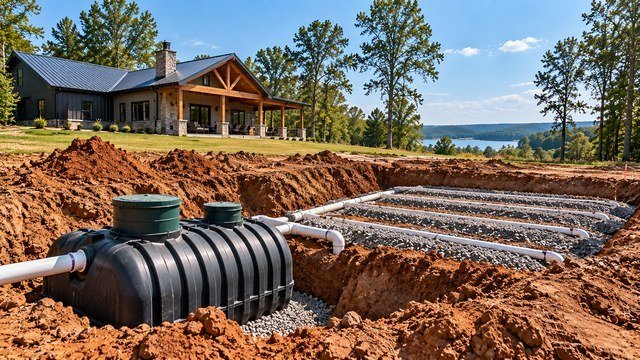
The septic question should come before the house plan
If an Alabama parcel does not have access to a public or central sewer, onsite sewage suitability can determine whether the land works for the home you want to build. ADPH advises buyers to investigate sewage disposal before purchasing land because neighboring lots can have very different soils and site conditions. A good-looking homesite is not automatically a suitable septic site.
What Alabama buyers often mean by a perc test
Buyers commonly use the phrase perc test as shorthand for checking whether land can support a septic system. Alabama's current onsite sewage process is broader than simply timing how quickly water moves through a hole. ADPH rules and forms focus on site and soil evaluation, system design, setbacks, hydraulic loading, landscape position, groundwater and other conditions that affect onsite sewage disposal.
Start by asking whether sewer is actually available
Before paying for septic work, verify whether a city, utility, private system or other central sewer serves the parcel and whether connection is required or realistically available. A sewer line somewhere on the road does not necessarily mean the property has a connection point at an affordable elevation or distance. Get the serving utility's answer for the exact parcel.
ADPH oversees Alabama's onsite sewage program
The Alabama Department of Public Health Division of Community Environmental Protection administers soil and onsite sewage requirements, with county health departments providing local environmental services such as onsite sewage applications and permits. The county health department is therefore one of the first calls for a rural parcel that will rely on septic.
The Permit to Install is a critical milestone
ADPH's buyer guidance states that a property owner must submit an application for a Permit to Install an onsite sewage disposal system to the local health department. When a complete application meets the applicable requirements, an approved Permit to Install allows the contractor or installer to proceed with the permitted system. Do not confuse a preliminary opinion about the land with an approved installation permit.
Current forms distinguish small-flow and large-flow projects
ADPH's current forms include the CEP-2 application for a small-flow onsite sewage disposal system with total flow below 1,800 gallons per day or twelve bedrooms or fewer, along with a site evaluation form. Larger developments use different application pathways. A typical single rural home will usually fall on the small-flow side, but verify the current form and project classification with ADPH.
Bedroom count can affect septic planning
Onsite sewage design is tied to projected wastewater flow, and residential bedroom count is an important planning input. Decide whether bonus rooms, future bedrooms, guest quarters or an apartment above a shop are part of the long-term plan before the system is designed. Building more sleeping capacity later can create problems if the approved system and replacement area were planned around a smaller home.
Soil suitability is more important than surface appearance
Green grass, mature timber or a dry-looking field does not tell you enough about the soil profile. ADPH specifically identifies soil suitability as a consideration when choosing a homesite. Soil texture, structure, restrictive layers and other characteristics influence how effluent can be treated and dispersed. The evaluation needs to address the actual proposed disposal area.
Seasonal groundwater can change the answer
A property may look dry during a summer showing and still have seasonal groundwater conditions that matter for onsite sewage. ADPH identifies high seasonal groundwater as a homesite consideration. Ask how wet-season indicators are evaluated and whether the proposed disposal area has limitations that are not obvious during dry weather.
Slope matters to system location
Slope affects water movement, construction access and the way effluent moves through soil. Alabama's onsite sewage rules note that slope gradient and landscape position influence water retention, erosion, machinery use and soil-water states. A gently usable disposal area may be more valuable than a dramatic steep homesite that leaves little workable ground.
Drainage ways are a major warning sign
The Alabama onsite sewage rules state that drainage ways are unsuitable for effluent disposal fields and should be avoided. Buyers should identify swales, intermittent drainage paths and areas where runoff concentrates, not just mapped streams. Walking the property after rain can reveal water movement that is difficult to see in listing photos.
Flooding should be evaluated separately from a flood-zone map
ADPH lists flooding frequency among the factors buyers should consider. FEMA mapping is useful, but local drainage, ponding and seasonal saturation can affect a site even outside a mapped high-risk flood zone. Look for debris lines, sediment, washed areas and standing water, and ask local professionals about site history.
Lakes, streams and water features affect site planning
ADPH identifies proximity to lakes and streams as an onsite sewage consideration. The house, septic tank, disposal field, replacement field, well, driveway and water features all need to coexist on the parcel while meeting applicable separation requirements. Waterfront acreage can have plenty of total area but surprisingly little usable area.
A replacement area is part of responsible land planning
ADPH advises buyers to make sure the lot can accommodate the septic system as well as a replacement area for future use. Treat that replacement area as protected infrastructure, not leftover yard. A future pool, shop, guest house, driveway or grading project should not consume the only practical location for a replacement system.
Do not judge septic feasibility by acreage alone
A ten-acre tract can have less usable septic area than a two-acre tract if most of the larger property is steep, wet, rocky, constrained by drainage or occupied by easements and planned improvements. Focus on usable soil and geometry near the intended homesite rather than assuming that a high acreage number guarantees approval.
The proposed home location and septic area should be planned together
Do not design the house in isolation and then search for somewhere to put septic. Put the proposed residence, porches, garage or shop, driveway, well, utilities, tank, primary disposal field and replacement field on one working site plan. Moving the house early is inexpensive compared with redesigning the property after construction begins.
Barndominiums need the same septic due diligence
A barndominium may have a large footprint, attached shop, long driveway, guest space or future outbuildings that compete for usable land. The metal shell does not change the need for an approved wastewater solution. Coordinate the septic layout before ordering a building package or committing to a slab location.
Guest houses and multiple dwellings can change the project
If the acreage will eventually include a second home, accessory dwelling, family cabin or rental, disclose that plan during due diligence. Alabama's rules define development flow across planned dwellings and establishments, so multiple structures can change the regulatory and design picture. Planning one small house today while silently assuming several more tomorrow can create avoidable constraints.
Large shops can still affect the septic site even without plumbing
A shop may occupy the best soil, cross the replacement field with heavy equipment or force the driveway through a protected area. If the shop includes a bathroom, apartment, commercial use or other wastewater source, it becomes even more important to coordinate with the health department and system designer.
Heavy clearing should wait until the disposal area is understood
Before mass clearing, grading or stump removal, identify the likely septic and replacement areas and ask the evaluating professional what site disturbance should be avoided. Heavy equipment can change grades, compact soil and obscure natural features. Preserve options until the onsite sewage plan is sufficiently developed.
Do not stockpile materials on the future field
Construction traffic, soil piles, building materials and equipment storage should be kept away from protected disposal and replacement areas. The septic field is not simply an empty patch of yard. Mark it on the construction plan so every contractor understands where heavy activity should be restricted.
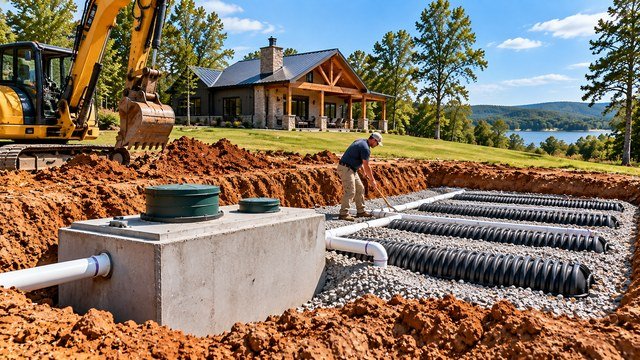
A survey helps connect septic planning to the real parcel
Use a current boundary survey to understand property lines, easements, rights of way and the dimensions of the tract. Septic planning based on an approximate online parcel map can fail if the assumed homesite is closer to a boundary or easement than expected. A survey also helps coordinate the driveway, well and utilities.
Legal access and septic feasibility are separate due-diligence items
A parcel can have suitable soils but poor legal access, or excellent road frontage but no practical onsite sewage location. Do not let a favorable answer on one issue substitute for the others. Rural land should be evaluated as a system that includes access, wastewater, water, power, drainage, restrictions and buildability.
Private wells need to be coordinated with septic
If the property will use a private well, show the proposed well location on the same site plan as the onsite sewage system. ADPH lists availability of a safe and adequate water supply among homesite considerations. Well access, power, treatment equipment and required separation from potential contamination sources should be resolved before finalizing the home location.
Public water does not eliminate septic constraints
Many rural Alabama parcels have public water but no public sewer. That can simplify drinking-water planning while leaving onsite sewage as a primary land-use constraint. Verify the water tap and meter costs separately, then complete the septic due diligence as if wastewater were its own major infrastructure project.
Ask for existing septic records on improved property
When buying land with an existing home, mobile home or abandoned homesite, ask the county health department what onsite sewage records are available. Identify the permitted system location, installation information and repair history when possible. Do not assume an old tank or visible field line means the system is approved, functional or adequate for the proposed new residence.
An old system may not fit a new house plan
A replacement home can have a different bedroom count, footprint or wastewater demand than the structure that previously occupied the property. A new driveway, shop or addition may also conflict with the old field. Have the current proposal reviewed rather than assuming the historic system automatically transfers to a substantially different project.
Subdivision lots deserve their own verification
ADPH advises buyers of subdivision lots to ask the county health department whether the developer obtained final approval showing adequate provisions for sewage disposal, water supply and solid waste disposal. Even with subdivision approval, confirm the specific lot, approved concept and any restrictions that affect the house you intend to build.
Adjacent septic systems do not prove your lot will work
ADPH explicitly warns that suitability on adjacent land does not guarantee suitability on the parcel being purchased because soils can change over short distances. A neighbor's conventional system is useful context, not approval. Base the purchase decision on evaluation of the actual tract.
Conventional systems are not the only possible systems
Site conditions and design flow can affect which onsite sewage approach is appropriate. Avoid assuming every property will receive the same tank-and-field configuration as a nearby home. Ask the evaluating professional and health department what system type the site supports and what operating or maintenance responsibilities come with it.
Alternative or more complex systems can change ownership costs
If a site requires pumps, controls, treatment components or other specialized features, include electricity, inspections, service, maintenance and replacement components in the long-term budget. A land purchase can still make sense, but the buyer should understand the infrastructure being accepted rather than comparing only the initial installation price.
Get system estimates only after the site concept is credible
A contractor cannot provide a meaningful apples-to-apples price without knowing the approved or likely design, tank size, field configuration, pump requirements, excavation conditions and access. First establish the regulatory and site concept, then obtain written estimates that identify exactly what is included.
Septic cost should be part of the all-in land budget
The purchase price is only one component of rural land cost. Budget separately for evaluation, design or professional services when needed, permit fees, installation, clearing, access, electrical needs for pumps, final grading and future maintenance. A cheap parcel can become expensive if its infrastructure is difficult.
Use a septic contingency in the purchase contract when appropriate
Discuss with your real-estate professional and attorney whether the purchase agreement should provide enough time and access for onsite sewage due diligence and a satisfactory outcome before the buyer becomes fully committed. The exact contract language is a legal matter, but the practical goal is simple: learn whether the land works before the right to walk away expires.
Do not rely only on a seller's statement that the land percs
Ask what evaluation was completed, who performed it, when it was done, what home size or bedroom count it assumed, where the approved or evaluated area is located, and whether documentation is available from the health department. The phrase land percs can hide major differences between an old informal test and a current permit-ready site evaluation.
Ask whether an approval has an expiration or project-specific limits
Rules, forms, ownership and building plans can change. When reviewing older documentation, ask the county health department whether it remains usable for the current owner and proposed project or whether a new application, evaluation or permit is needed. Never assume an old document automatically authorizes today's construction.
Map the primary and replacement areas before closing
Knowing that some part of the parcel may support septic is not enough if the location conflicts with the intended house, views, driveway or future shop. Ask for the evaluated area to be identifiable on a site plan or in the field so the buyer understands how the septic solution affects the overall property layout.
Walk the proposed disposal area yourself
After professionals identify the likely area, physically walk it. Look at slope, vegetation, drainage, access and its relationship to the home. This helps prevent a technically workable design from surprising the buyer later because it occupies the only flat yard, blocks a planned barn or requires an unexpected pump configuration.
Protect the system during construction
Once construction begins, keep vehicles, excavation, foundations, utility trenches and material storage away from the permitted field and replacement area unless specifically coordinated. Give the site plan to the builder, grading contractor and utility crews. Damage prevention is easier than solving a conflict after the house is nearly complete.
Know what records to keep after installation
Retain the permit, site evaluation, design, as-built or installer documentation, inspection records, tank and component information, maintenance instructions and any later pumping or repair records. Future owners, contractors and health officials may need these documents, and they are far easier to preserve now than reconstruct years later.
A failing system should be addressed rather than hidden
Surfacing sewage, persistent wet areas, sewage odors, plumbing backups or known system failures deserve prompt professional attention. Alabama county health departments provide onsite sewage repair and tank-replacement application services. Buyers of improved rural property should investigate warning signs rather than assuming a pump-out will solve every problem.
Questions to ask the county health department before buying
Ask whether records exist for the parcel, which current application and site-evaluation process applies, whether the proposed bedroom count matters, what minimum lot or site requirements affect the tract, how replacement area is handled, what professional evaluations are needed, what fees and timing apply, and whether any previous denial, repair or subdivision information is on file.
Questions to ask the soil or septic professional
Ask what area was evaluated, what soil and landscape limitations were found, what system concept appears feasible, whether pumps or special components may be needed, where the replacement area should be protected, how the house and driveway affect the layout, and what additional work is required before a permit can be issued.
Red flags for Alabama acreage buyers
Slow down if the seller refuses access for evaluation, says no testing is needed because the neighbor has septic, cannot identify the old system, plans place the house over the only likely field area, the site is dominated by drainage ways or wet ground, heavy grading has already altered the best area, or the purchase deadline arrives before the county process can be meaningfully completed.
A practical septic due-diligence sequence
First verify sewer availability. Next contact the county health department and review any existing records. Establish the intended bedroom count and long-term property plan, obtain a current survey, complete the appropriate soil and site evaluation, locate the primary and replacement areas, coordinate the house, well and driveway, understand the likely system type and cost, and satisfy the purchase contingency before closing.
Your pre-purchase Alabama septic checklist
Confirm sewer status, county health department contact, existing records, intended bedrooms, survey, legal access, soil and site evaluation, seasonal groundwater considerations, slope and drainage, flood history, streams and water features, primary disposal area, replacement area, well location, home footprint, driveway, future shop or guest house, likely system type, permit pathway, installation estimate and contract contingency.
The goal is not merely to pass a test
The real goal is to know whether the parcel can support the home and long-term property plan without creating an infrastructure problem. A satisfactory Alabama septic evaluation should fit into a broader site plan that protects access, water, drainage, future improvements and replacement capacity. That is a much stronger buying decision than simply hearing that the land percs.
Sources & methodology
Where this information comes from
Cost figures are planning references rather than contractor quotes. Permitting, system-selection, and location-specific guidance should be verified with the appropriate local authority or qualified professional. AcreageReady uses source-backed, AI-assisted editorial workflows and remains responsible for the material it publishes. Read how we research, edit, and correct guides.
- Alabama Department of Public Health: Selecting a Homesite and Onsite Sewage Disposal
- Alabama Department of Public Health: Onsite Sewage Forms
- Alabama Department of Public Health: Onsite Sewage Disposal Rules
- Alabama Department of Public Health: Environmental Services
- Alabama Department of Public Health: Certificates, Licenses and Permits
- Alabama Department of Public Health: County Health Department Locations
Common questions
Frequently asked questions
Does Alabama require a perc test before installing a septic system?
Alabama's current process focuses on onsite sewage permitting and site and soil evaluation rather than relying on the casual phrase perc test alone. The exact evaluation and application requirements should be confirmed with the county health department for the parcel.
Who approves septic systems in Alabama?
The Alabama Department of Public Health administers the onsite sewage program, with county health departments handling local environmental services such as applications and permits. Start with the county health department serving the property.
Should I test septic suitability before buying rural land in Alabama?
Yes, when the property will not have central sewer. ADPH specifically advises buyers to determine whether a suitable onsite sewage site exists before buying and warns that neighboring property suitability does not guarantee the parcel being considered will work.
Does an Alabama septic system need a replacement area?
ADPH advises buyers to make sure the lot has room for the septic system and a replacement area for future use. The replacement area should be protected from buildings, driveways, grading and other improvements.
Can a neighboring septic system prove my Alabama property will pass?
No. ADPH warns that soils can change over short distances and that adjacent land being suitable does not necessarily mean the property being purchased is suitable.
Does bedroom count matter for an Alabama septic system?
Yes. Alabama's onsite sewage framework uses projected wastewater flow and distinguishes small-flow systems in part by bedroom count. Tell the health department and system professional the realistic current and future bedroom plan.
Can I clear my Alabama land before the septic evaluation?
It is safer to identify and protect the likely disposal and replacement areas before major clearing or grading. Heavy equipment, compaction and grade changes can affect the site and can consume areas needed for the system.
What should I get in writing before closing on Alabama land that needs septic?
Obtain the available county records, current evaluation or permit documentation applicable to the proposed project, a clear understanding of the primary and replacement areas, the likely system requirements and realistic installation costs. Coordinate the purchase contingency with your real-estate and legal professionals.
Ready to talk with a local professional?
Share your location and project details so AcreageReady can identify relevant providers as the network grows.
Get a free quote