There is no single Alabama septic-system price
The installed cost of an onsite sewage system depends on the property, the home, the soil and the system the site can support. A straightforward conventional installation on suitable land can have a very different budget from a site that needs additional treatment, pumping, engineered design, difficult excavation or extensive site preparation. For acreage buyers, the useful number is the total approved and installed system cost, not a generic tank price.
Start with septic feasibility before estimating construction cost
Before focusing on equipment prices, determine whether the proposed homesite can support an onsite sewage system and what type of system is appropriate. Alabama Department of Public Health guidance emphasizes evaluating sewage disposal before construction and before purchasing land where central sewer is unavailable. Soil, landscape position, groundwater, slope, available area and other site conditions can affect the design.
What Alabama buyers call a perc test is really broader site due diligence
The phrase perc test is commonly used by buyers, but Alabama's onsite sewage process relies on soil and site evaluation rather than a single informal test. The evaluation helps establish the site's limitations and appropriate system design. Treat this work as an early development expense because its findings can change the house location, septic layout and total project budget.
Permitting is part of the project cost
A new onsite sewage system requires the applicable local health department permitting process before installation. Budget for current application, evaluation and permit-related fees, and verify the amount with the county health department because fees and procedures can change. Do not treat an old fee schedule or another county's project as a guaranteed price for the current parcel.
The house design affects septic sizing
Residential onsite sewage design is tied to expected wastewater loading, so the planned dwelling matters. Bedrooms, occupancy assumptions and other design factors can influence required capacity. Finalize enough of the building program to give the soil professional, designer and health department accurate information rather than designing a system around a house that later grows substantially.
Conventional systems are generally the simplest cost scenario
Where soils, drainage, available area and other site conditions are suitable, a conventional tank and soil-absorption system may be the most straightforward installation. Even then, total cost can vary with tank size, field size, pipe runs, excavation, access, clearing, grading and contractor pricing. Compare complete scopes rather than tank-only advertisements.
Difficult sites can require a more expensive system
Sites with limiting soil or landscape conditions may need a design different from a basic conventional layout. Additional treatment, dosing, pumping, specialized components or engineered design can materially increase initial cost and may create ongoing electrical, inspection or maintenance requirements. The correct system should follow the approved site evaluation and design, not a buyer's preferred price point.
Engineered design and professional services deserve their own budget line
When a site requires professional design or additional technical work, separate those fees from installation. Depending on the project, professional services can include soil and site evaluation, design, engineering, surveying or layout work. Ask which services are included in a contractor's proposal and which must be hired separately.
The septic tank is only one part of the price
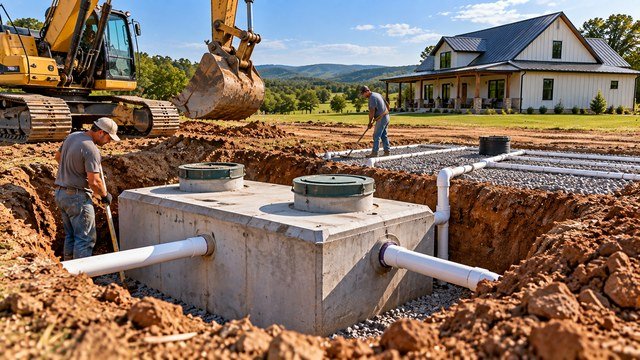
A complete onsite sewage system can involve the tank, inlet and outlet components, distribution piping, absorption field, excavation, aggregate or other specified materials, risers, pumps or controls where required, final grading and restoration. A low advertised tank price therefore tells you very little about the total cost of making a rural home operational.
Drain-field size and layout can change excavation costs
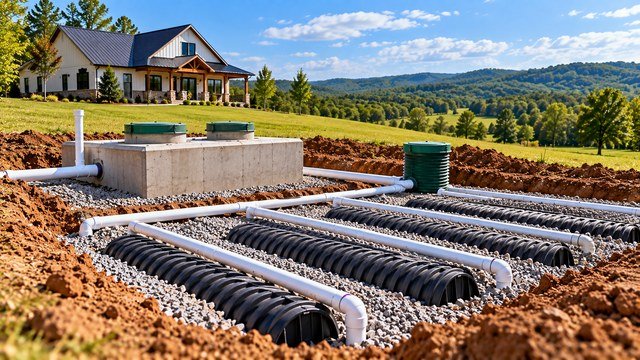
The absorption area must fit the approved design and site. Longer runs, multiple trenches, difficult slopes, trees, rock, wet areas or restricted equipment access can increase labor and site work. Preserve enough suitable land for the primary field and any required replacement area before deciding where the driveway, shop, pool or barn will go.
Protect the replacement area as part of the property's value
A replacement area is not wasted acreage. It protects the long-term usability of a property that depends on onsite sewage. Avoid placing permanent structures, heavy traffic, extensive grading or other incompatible improvements where future wastewater disposal may be needed. Map the area before major site work begins.
Long sewer runs from the house can increase cost
The relationship between the house and septic area affects trenching, pipe length and elevation. A scenic house pad far from suitable soil may create a more complicated wastewater layout. Coordinate the building pad and septic design early instead of assuming the system can simply be placed behind the house.
Pumps and controls add both construction and operating cost
Some designs require pumping or other powered components. That can add equipment, electrical work, controls and future maintenance compared with a gravity-based system. If a proposed design uses powered equipment, ask what happens during an outage, what routine service is required and what components may eventually need replacement.
Related: Power, water, septic and internet for rural Alabama land
Site access matters to the installer
Excavators, delivery trucks and other equipment need access to the tank and field areas. Steep terrain, soft ground, narrow gates, creek crossings, dense timber or an unfinished driveway can add mobilization and preparation costs. Ask the installer what access must be established before work begins.
Clearing and grading can be separate expenses
A septic proposal may assume the site is already accessible and appropriately prepared. Tree removal, stump work, rough grading, erosion control or restoration may be outside the quoted scope. Clarify responsibility before comparing bids so one proposal does not appear cheaper simply because it excludes site work.
Rock, groundwater and unsuitable soils can change the budget
Subsurface conditions are one reason septic estimates should include contingency. Rock can complicate excavation, while seasonal groundwater and restrictive soil conditions can affect the approved design. A rural parcel that looks dry during a summer showing can still have site limitations identified during professional evaluation.
Coordinate the septic system with the private well
If the property also needs a private well, plan both systems together. Well placement, wastewater components, the house, driveway and future structures all compete for usable space and must satisfy applicable requirements. Resolving the water and wastewater strategy early reduces the chance that one system blocks the preferred location of the other.
Get written proposals with the same scope
Ask each installer to identify the approved system type, tank and field scope, excavation, materials, pumps or controls, electrical responsibilities, inspections, restoration, exclusions and change-order pricing. A line-by-line comparison is much more useful than choosing the lowest total from proposals that describe different work.
Ask who handles permits and inspections
Clarify whether the installer coordinates permit paperwork and required inspections or whether the owner must handle portions of the process. Confirm what documentation you should receive when the installation is approved. Keep those records with the property because they can be useful for future maintenance, additions and resale.
Do not install first and try to legalize the system later
The approved process should guide construction. Installing a system without the required evaluation, permit or inspection can create expensive corrections and uncertainty for future buyers. Before excavation starts, confirm that the installer is working from the current approved plan and applicable local health department requirements.
Maintenance belongs in the ownership budget
A septic system is infrastructure that requires ongoing care. Tank pumping frequency depends on use and system conditions, while systems with pumps, treatment components or other mechanical equipment can have additional service needs. Keep access points serviceable and maintain records rather than burying the system and forgetting it.
Avoid sending unnecessary water into the system
Excessive household water use can overload an onsite system and reduce treatment performance. Repair plumbing leaks, understand where water-treatment backwash or other discharges go, and follow guidance appropriate to the installed system. Good operating habits can protect both the drain field and the owner's investment.
Keep vehicles and heavy equipment off the field
Driving or parking over septic components can compact soil or damage piping and tanks. This is especially important during construction when subcontractors may not know where the system is located. Mark the approved field and replacement area on the site plan and physically protect them during building work.
Landscaping decisions can affect long-term performance
Do not treat the absorption area like ordinary yard space. Deep-rooted vegetation, major grading, patios, sheds, pools and other improvements can interfere with the system or future access. Maintain the area according to the approved design and guidance from the appropriate professionals.
A repair can become a major property expense
When an older system fails, the cost depends on what failed, the remaining suitable area and what current requirements apply to the repair. A property with a protected replacement area can be easier to address than one where later improvements consumed all suitable land. This is one reason septic records and site planning matter when buying an existing rural home.
Inspect existing septic information during a rural-home purchase
For property with an existing system, ask for permits, installation records, pumping history, repair records and the known location of the tank and field. A buyer's due diligence may also include an appropriate septic evaluation or inspection. Do not assume that a functioning toilet proves the system is properly located, sized or in good condition.
Build the septic budget into total land-development cost
For raw acreage, septic should sit beside driveway, clearing, grading, water, electricity, communications and foundation preparation in the development budget. The cheapest parcel can become expensive when several infrastructure systems are difficult at the same time.
Related: Alabama raw land development costs
Use allowances instead of pretending the unknowns are fixed
During early land shopping, create separate allowances for evaluation and design, permitting, system installation, electrical work if required, clearing and access, restoration and contingency. Replace allowances with written site-specific proposals as due diligence progresses. This keeps uncertainty visible instead of hiding it inside one optimistic number.
A pre-purchase septic cost checklist
Before closing on Alabama acreage without sewer, determine whether appropriate onsite sewage due diligence has been completed, identify the likely homesite, protect adequate disposal and replacement areas, understand the likely system type, confirm applicable health department requirements, obtain realistic local cost information and preserve a contingency for site-specific conditions.
Related: Buying rural land in Alabama · Best places to buy acreage in Alabama
Questions to ask an Alabama septic installer
Ask what system the approved design requires, what is included in the proposal, what site preparation is assumed, who coordinates permits and inspections, whether electrical work is needed, what restoration is included, how changes are priced, what maintenance is expected and what documentation and warranty information you receive.
The right number is the cost of the approved working system
The best septic estimate is built from the actual Alabama parcel, proposed home and approved site conditions. Generic national averages can help with early screening, but they should not override local evaluation and contractor pricing. Before buying or building, understand the complete path from soil and site evaluation through final approval and long-term maintenance.
Sources & methodology
Where this information comes from
Cost figures are planning references rather than contractor quotes. Permitting, system-selection, and location-specific guidance should be verified with the appropriate local authority or qualified professional. AcreageReady uses source-backed, AI-assisted editorial workflows and remains responsible for the material it publishes. Read how we research, edit, and correct guides.
- Alabama Department of Public Health: Onsite Sewage
- Alabama Department of Public Health: Before Construction
- Alabama Department of Public Health: Onsite Sewage Forms
- Alabama Department of Public Health: Selecting a Homesite and Onsite Sewage Disposal
- Alabama Department of Public Health: Environmental Services
Common questions
Frequently asked questions
How much does a septic system cost in Alabama?
There is no dependable statewide flat price. Total installed cost depends on soil and site conditions, system type, tank and field requirements, excavation, access, professional services, permitting, pumps or controls and local contractor pricing. Obtain site-specific evaluation and written installation proposals.
Do I need a permit for a septic system in Alabama?
Yes. New onsite sewage systems are subject to Alabama Department of Public Health and local health department requirements, including the applicable evaluation, permitting and inspection process before the system is placed into use.
Is a perc test required in Alabama?
Buyers often use the term perc test, but Alabama's current process is based on broader soil and site evaluation for onsite sewage disposal. The evaluation considers conditions that affect system selection and design rather than relying only on an informal percolation test.
Why can an engineered septic system cost more?
A difficult site can require professional design, additional treatment, pumping, controls, specialized materials or more complex installation. Those components can add both upfront construction expense and ongoing operating or maintenance costs.
What should be included in a septic-system quote?
A useful proposal should identify the approved system type, tank, absorption field, materials, excavation, pumps or controls if applicable, electrical responsibilities, inspections, site preparation, restoration, exclusions and how unexpected conditions or changes are priced.
Should I evaluate septic before buying rural Alabama land?
Yes. ADPH advises buyers to investigate sewage disposal before purchasing land where central sewer is unavailable. Septic feasibility can determine the usable homesite, development cost and whether the property works for the intended project.
Can I put a shop or driveway over the septic field?
Permanent structures, vehicle traffic, heavy equipment and major grading can damage or interfere with septic components and suitable soil. Protect the approved absorption and replacement areas and coordinate other improvements around them.
How does a private well affect septic planning?
The well and septic system should be planned together so the approved locations, applicable separation requirements, house, driveway and future improvements fit on the property without conflicts.
Ready to talk with a local professional?
Share your location and project details so AcreageReady can identify relevant providers as the network grows.
Get a free quote