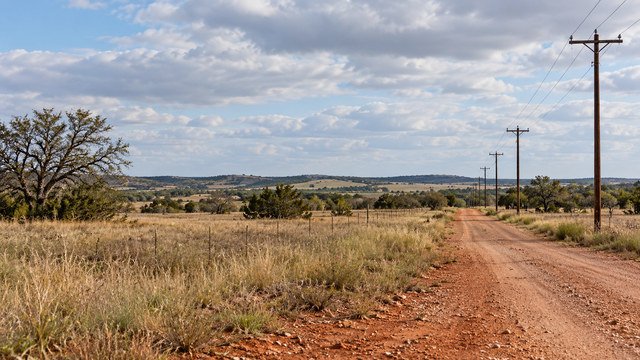
Power at the road does not mean power is ready at the homesite
A rural Oklahoma parcel can have electric lines along the road and still require a substantial project before a new house, barndominium, shop, well, or RV service can be energized.
The serving utility must confirm whether its facilities can serve the property, where the point of delivery will be, whether a transformer or line extension is needed, and what portion of the work or cost belongs to the customer.
For buyers, electrical feasibility belongs in the land due-diligence process before the driveway, house pad, shop, well, or septic layout is finalized.
First identify the utility that actually serves the parcel
Oklahoma does not have one statewide electric provider. Depending on the location, service may come from an investor-owned utility, an electric cooperative, or a municipal or governmental electric system.
The Oklahoma Corporation Commission regulates the prices and service reliability of the state's investor-owned electric utilities, including OG&E, Public Service Company of Oklahoma, and Liberty Utilities. Municipal systems and most electric cooperatives are outside OCC retail rate regulation.
Do not assume that the company serving a nearby house also serves your tract. Ask for an address or parcel-specific territory confirmation.
Electric cooperatives cover much of rural Oklahoma
Electric cooperatives are especially important for acreage buyers because cooperative systems serve large rural territories throughout Oklahoma.
The Oklahoma Association of Electric Cooperatives reports that co-ops serve customers across all 77 counties and cover most of the state's landmass.
Each cooperative can have its own construction standards, membership requirements, extension policies, deposits, easement forms, and cost-sharing rules, so the correct answer comes from the serving co-op rather than a statewide average.
The 300-foot rule is a useful starting point for regulated utilities
Oklahoma Corporation Commission electric utility rules state that a regulated utility shall extend overhead distribution lines 300 feet to provide service to each bona fide application for residential service without cost to the consumer, subject to the rule and the utility's approved tariff.
That does not mean every rural electric project receives 300 feet of every possible construction item for free. The rule addresses distribution-line extension, and utility tariffs define how service, underground construction, excess extension length, customer work, and other conditions are handled.
If your parcel is served by a cooperative or municipal utility, ask for that provider's own extension policy because OCC rate rules do not necessarily govern it in the same way.
Extensions beyond the free allowance can require an advance
Under the OCC framework for regulated utilities, when a required distribution extension exceeds the applicable free limit, the utility can require payment for the extension beyond that allowance.
The rule also allows an extension above the free limit to be made for a lesser payment or no payment when anticipated revenue economically justifies additional utility investment under an approved formula.
This is why two rural homes with the same distance from the road can receive different project estimates if the utility, load, existing facilities, route, or tariff conditions differ.
There is no reliable statewide dollar-per-foot number
Rural electric line-extension pricing is highly project-specific. A short overhead run across clear, accessible ground is fundamentally different from underground service through rock, a road crossing, a creek, dense timber, or a long private drive.
The utility's design can involve poles, conductors, trenching, conduit, transformers, switches, easements, clearing, road bores, engineering, inspections, and customer-installed equipment.
Use online per-foot estimates only as rough context. For a purchase decision, request a written or documented utility estimate tied to the actual parcel and proposed meter location.
Ask where the nearest usable distribution line is, not just the nearest wire
A visible line may be transmission, three-phase distribution, a private service drop, or a circuit that cannot simply be tapped at the location you want.
The utility should determine the nearest practical point of connection and whether existing facilities have the voltage, phase, capacity, and configuration needed for the proposed load.
A real feasibility review is more valuable than measuring from the property line to the nearest pole.
The meter location can change the entire project
Some rural projects place the meter near the road and run customer-owned conductors to the home. Others extend utility facilities deeper onto the property and place the meter closer to the structure.
The utility's rules, easements, transformer location, service length, voltage drop, road access, and future development plan all affect that decision.
Before choosing a house site hundreds or thousands of feet from the road, compare the cost and responsibilities of each meter-location option.
Overhead service is often simpler, but site constraints matter
Overhead extensions can be economical when the utility has a clear route, adequate pole access, acceptable clearances, and workable easements.
Trees, steep terrain, ponds, creek crossings, road crossings, existing structures, future barns, and large equipment routes can complicate pole placement.
Plan for mature tree growth and future construction rather than routing a new overhead line through the only logical location for a shop, driveway, or barn.
Underground service usually has more customer-specific construction
Underground power can improve appearance and reduce exposure to some overhead hazards, but it requires a carefully designed route and can shift trenching, conduit, backfill, or added construction costs to the customer depending on the utility's tariff or policy.
OCC rules require regulated utilities to include underground-service terms in their filed tariffs, including how additional underground costs and trenching or backfilling responsibilities are handled.
Rock, groundwater, utilities, driveway crossings, future excavation, and long distances can make underground service materially more expensive or complex.
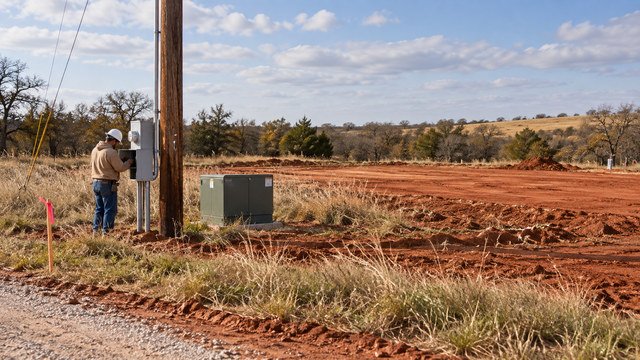
Rock and red dirt can both affect underground construction
Oklahoma geology varies widely. Some sites trench easily, while others encounter sandstone, limestone, shallow rock, dense clay, or difficult drainage conditions.
A route that looks simple on an aerial map may require rock excavation, imported bedding, conduit changes, or a different alignment in the field.
If underground service is important to you, ask whether the utility estimate assumes normal trenching conditions and who pays when field conditions change.
Utility easements are not paperwork to leave until the end
If the utility must place poles, conductors, transformers, or underground facilities across private land, it may require a recorded easement or other access rights.
The easement route can affect fences, gates, future structures, ponds, tree planting, roads, and resale plans.
Review the proposed route before signing and coordinate it with the survey, house site, septic area, driveway, well, shop, and future land divisions.
A transformer may be required even when a line is nearby
The existing distribution system may not have a transformer in the right location or with sufficient capacity for a new residence and its planned loads.
Large shops, electric heat, multiple HVAC systems, welders, well pumps, EV charging, pools, hot tubs, or future second dwellings can affect service sizing.
Give the utility a realistic load description early so the original design does not have to be reworked later.
Tell the utility about the shop, well, and future buildings
A rural property often grows after the first house is built.
If you expect a large shop, detached apartment, barn, irrigation equipment, second home, gate operator, RV pedestal, pool, or additional well pump, include those plans in the conversation.
The utility may design the transformer, service, meter arrangement, or line route differently when future load is known.
Well pumps can create a separate power-planning problem
A water well may be far from the house or may be drilled before permanent residential service is ready.
The pump's horsepower, voltage, starting characteristics, distance from the source, and control equipment affect conductor sizing and voltage drop.
Coordinate the driller, pump installer, electrician, and utility so the electrical plan supports the well without unnecessary duplicate service equipment.
Temporary construction power can save headaches
Builders often need electricity before the permanent house service is ready.
Temporary service can support tools, trailers, pumps, lighting, and construction operations while the permanent electrical system is being completed.
Ask the utility whether it offers temporary construction service, what equipment the customer must provide, what inspections are required, and whether the temporary location can later transition efficiently to permanent service.
PSO and OG&E both have dedicated new-construction processes
Public Service Company of Oklahoma provides a new-home service process for newly constructed residences, while OG&E provides construction-service applications and project support for new electric needs.
Starting the formal request early gives the utility time to identify the service location, develop a design, arrange easements, calculate required customer contributions, schedule materials, and coordinate inspections.
Do not wait until framing is complete to discover that the transformer, meter point, or route needs to change.
Your electrician's work is separate from the utility's work
The utility generally owns and constructs facilities up to its defined point of delivery. The customer is responsible for approved service equipment and wiring on the customer side.
That can include a meter base, service disconnect, panel, grounding system, pedestal, conduit, trench, feeder, or other equipment depending on the service design.
Have a licensed electrician review the utility's specifications before equipment is purchased or installed.
Inspections can control when the meter is energized
Even after the utility's facilities are ready, permanent service may depend on required electrical inspections and release from the authority having jurisdiction.
Inspection responsibility varies by location and local authority.
Confirm the permit and inspection path early, especially on unincorporated land where buyers sometimes assume there is no inspection requirement at all.
Road and driveway planning should happen with the power plan
Utility crews need safe access to install and maintain facilities.
A long driveway, locked gate, narrow entrance, soft ground, steep grade, low tree canopy, or undersized culvert can slow construction or complicate long-term maintenance.
Coordinate driveway clearing and grading with the utility route so you do not pay to clear the same corridor twice or place poles where road improvements will later conflict.
Tree clearing can be part of the hidden cost
A new overhead or underground route may require clearing a corridor beyond the homesite itself.
The utility may specify required clearances, while the owner may be responsible for some clearing or restoration depending on the provider and project.
Ask exactly who cuts trees, removes stumps, disposes of debris, repairs disturbed ground, and restores fences.
Call 811 before customer-side digging begins
Utility construction often overlaps with driveway, water, septic, propane, drainage, and communications work.
Before customer contractors excavate for conduit, trenching, foundations, fencing, or other improvements, use Oklahoma's 811 locate process and follow the applicable excavation rules.
A locate request is not a substitute for a coordinated site plan, especially where privately owned lines may not be marked by the public locate system.
Do not overlook broadband and generator planning
If electric facilities are being trenched a long distance, it can be a good time to plan separate communications conduit where allowed and properly separated.
Rural owners should also decide whether the home will have a standby generator, portable-generator inlet, battery storage, solar, or future EV charging.
These systems have electrical and utility-interconnection implications, so include them in the design rather than adding them as an afterthought.
Power feasibility should be checked before closing on difficult acreage
For a parcel with a long setback, no obvious utility line, a private road, difficult terrain, or uncertain easements, power can become one of the largest unknown site-development items.
Ask the utility for the most concrete information it can provide before the due-diligence period expires.
If a formal design requires an application, deposit, site address, or ownership documentation, learn that process early and build enough contingency into the purchase decision.
Questions to ask the serving electric utility
A good utility conversation should produce more than a yes-or-no answer about availability.
- Do you serve this exact parcel?
- Where is the nearest usable distribution point?
- Is the proposed home location practical to serve?
- How much line extension is required?
- What free-extension allowance or construction credit applies?
- How is the customer contribution calculated beyond that allowance?
- Would the service be overhead or underground?
- Who pays for trenching, conduit, backfill, clearing, and road bores?
- Is a new transformer required?
- What meter location do you recommend?
- What easements are required?
- What customer equipment must be installed?
- What inspections or releases are required before energization?
- Can temporary construction power be provided?
- What lead time should the owner expect after all requirements are satisfied?
- Can future shop, well, EV, generator, or second-home loads be included in the design?
Build a complete rural-power budget, not just a utility allowance
The utility's contribution or extension estimate is only one part of the electrical budget.
- Utility line-extension contribution
- Transformer or special-facility charges if applicable
- Easement or survey work
- Tree clearing and access preparation
- Customer trenching or conduit where required
- Road or driveway crossings
- Meter base, pedestal, disconnect, and service equipment
- Electrician labor and materials
- Long customer-owned feeders
- Temporary construction service
- Electrical permits and inspections
- Well-pump electrical work
- Shop or barn service
- Generator, transfer switch, solar, battery, or EV provisions
- Contingency for rock, route changes, or added utility requirements
Coordinate power with the rest of the acreage plan
Electric service should be designed alongside the driveway, house pad, septic system, water well, drainage, propane, broadband, shop, gate, pond, and future structures.
The cheapest electrical route in isolation can become expensive if it blocks the septic field, crosses the future shop pad, conflicts with drainage, or requires relocation when the driveway changes.
A simple scaled site plan shared with the utility and major contractors can prevent costly conflicts.
The bottom line
Rural electric service in Oklahoma is not priced with one statewide formula that buyers can safely apply to every tract.
For regulated utilities, Oklahoma rules provide an important 300-foot overhead residential extension framework and require approved tariff terms for additional and underground construction. Cooperatives and municipal systems can follow different policies.
Before buying or building, identify the serving utility, confirm the actual connection point, request an address-specific design or estimate, understand the customer-side work, and coordinate the power route with the entire property plan.
Sources & methodology
Where this information comes from
Cost figures are planning references rather than contractor quotes. Permitting, system-selection, and location-specific guidance should be verified with the appropriate local authority or qualified professional. AcreageReady uses source-backed, AI-assisted editorial workflows and remains responsible for the material it publishes. Read how we research, edit, and correct guides.
- Oklahoma Corporation Commission: Electric Utility Rules, OAC 165:35-25-2 Distribution Extensions
- Oklahoma Corporation Commission: Electric Utility Regulation
- Oklahoma Corporation Commission: Current Rules
- OG&E: Construction Services
- OG&E: Oklahoma Terms and Conditions of Service, Extension Policy
- Public Service Company of Oklahoma: New Home Service
- Public Service Company of Oklahoma: Rates and Tariffs
- Oklahoma Association of Electric Cooperatives: Member Cooperatives
- Oklahoma Association of Electric Cooperatives: Cooperative Service Footprint
- AcreageReady: Buying Rural Land in Oklahoma
- AcreageReady: Oklahoma Zoning & Building Permits
- AcreageReady: Oklahoma Water Wells
Common questions
Frequently asked questions
How much does it cost to bring electricity to rural land in Oklahoma?
There is no dependable statewide price. Cost depends on the serving utility, distance from usable distribution facilities, overhead versus underground construction, transformer needs, terrain, easements, trenching, clearing, road crossings, and the utility's approved extension policy. Get a parcel-specific estimate before relying on a budget.
Does Oklahoma require utilities to provide 300 feet of electric line for free?
Oklahoma Corporation Commission rules state that a regulated utility shall extend overhead distribution lines 300 feet for a bona fide residential service application without cost to the consumer, subject to the rule and the utility's approved tariff. Cooperative and municipal utility policies can differ.
Is underground electric service more expensive in Oklahoma?
It often can be because underground construction may involve trenching, conduit, backfill, rock excavation, road bores, and added utility costs. The exact responsibility and pricing depend on the serving utility's tariff or policy and the site conditions.
Who pays for a transformer on rural property?
That depends on the utility, the service design, the customer's load, and the applicable extension policy. Do not assume a transformer is included or separately charged. Ask for the utility's written design and customer contribution.
Can I put the meter at the road and run power to the house myself?
Sometimes, but only if the serving utility allows that service arrangement and the customer-side feeder is designed and installed to applicable electrical requirements. Long runs can create voltage-drop and conductor-sizing issues, so involve both the utility and electrician.
How early should I contact the electric utility for a new rural home?
As early as possible, ideally during land due diligence or initial site planning. Long extensions, easements, transformer changes, engineering, inspections, and material scheduling can affect both the budget and construction timeline.
Does seeing a power pole at the road guarantee service?
No. The visible facility may not be the correct voltage, phase, ownership, or connection point for the proposed service. The serving utility must confirm whether and how the parcel can be served.
Should I plan the power route before the septic system and well?
Plan them together. Power, septic, well, driveway, drainage, structures, and easements can compete for the same corridors and setbacks. Coordinating them on one site plan reduces relocation and rework.
Ready to talk with a local professional?
Share your location and project details so AcreageReady can identify relevant providers as the network grows.
Get a free quote