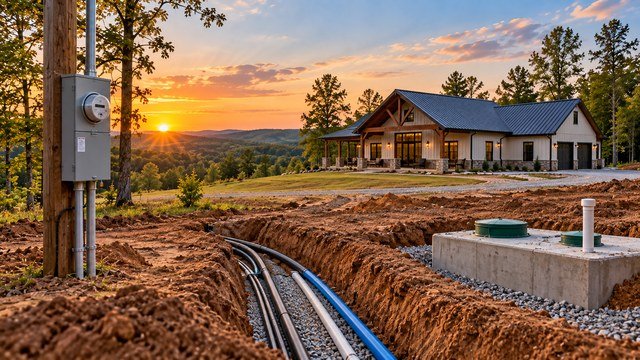
Utilities can determine whether cheap acreage is actually affordable
Raw Alabama land may look inexpensive until you price the infrastructure required to live on it. Electricity, drinking water, wastewater disposal, internet, driveway access, clearing and trenching work as one system. The goal is not simply to ask whether utilities are nearby. You need to know who serves the parcel, what they will provide, where they will provide it, and what work or cost remains your responsibility.
Verify utilities before choosing the final homesite
A house location that looks perfect on an aerial photo can create unnecessary expense if it is hundreds of feet from the practical power route, uphill from the water connection, in the best septic replacement area, or difficult to reach with construction equipment. Sketch the driveway, house, shop, septic field, replacement area, well or water line, electrical route and communications route together before committing to the final layout.
Step 1: identify the actual electric provider
Alabama does not have one statewide residential electric provider. Alabama Power is the state's investor-owned electric utility regulated by the Alabama Public Service Commission, while electric cooperatives, municipal systems and TVA-related systems also serve parts of Alabama. The PSC notes that cooperatives, municipal systems and TVA are outside its electric regulatory jurisdiction. Start with the parcel address or tax parcel and identify the utility with the right to serve that location.
Power lines near the property do not guarantee a cheap connection
A line visible along the road is only the starting point. Ask the serving utility whether residential service is available, where the service point would be, whether a transformer upgrade is required, and what extension policy applies. Long setbacks can require additional poles, underground conduit, trenching, clearing, easements or customer contributions.
Ask the electric utility for a site-specific layout early
Give the utility a proposed house location, driveway route, shop location and expected electrical load. A barndominium with a large shop, welder, HVAC equipment, well pump, pool, RV connection, EV charging or future outbuildings can have different service needs from a small house. Planning the load and route before grading can prevent rework.
Overhead and underground service create different site-work needs
Overhead service may require clearances, pole locations and vegetation management. Underground service can require trench depth, conduit, pull boxes or other utility-specific construction. Never assume a trench detail from another project applies to your parcel. Obtain the serving utility's current specifications before excavation.
Preserve utility corridors when clearing the land
Do not clear only the house pad and then discover that the least expensive power route crosses an area you intended to preserve. Mark likely utility corridors before final clearing and grading. At the same time, protect septic areas, drainage paths, mature trees you want to keep and future shop or barn sites.
Step 2: determine whether public water is actually available
A water main on a nearby road does not automatically mean the parcel can receive a meter. Identify the public, municipal, community or private water system serving the area and ask whether service is available to the exact parcel. Confirm meter availability, tap or connection charges, line-extension requirements, pressure, easements and who owns the service line after the meter.
Measure the distance from the meter to the house
A rural water connection can still require a long private service line from the road to the homesite. Distance, elevation change, pipe sizing, trenching, road or creek crossings, pressure and freeze protection can affect the design. Include the private side of the connection in the site-development budget rather than budgeting only for the utility's meter fee.
If public water is unavailable, investigate a private well
ADEM states that it does not regulate individual private wells and does not maintain a statewide database of them. It recommends contacting the local health department or a certified drinking-water laboratory about water-quality testing and a certified well driller about construction concerns. The Geological Survey of Alabama may also have limited well records useful for local research.
A neighboring well is useful evidence, not a guarantee
Nearby well depths and yields can help frame expectations, but geology can vary across a property. Ask local certified drillers about typical depth, casing, yield, pump requirements and known water-quality issues. Keep a contingency because the final cost is not known until the well is drilled and completed.
Budget the entire well system
The drilling invoice is only one part of a private-water system. Depending on the project, the budget may also need casing, pump, pressure tank, electrical service, trenching to the house, controls, storage, filtration or treatment, testing and a well house or protective equipment. Coordinate the well location with septic setbacks and the broader site plan.
Test private well water instead of assuming it is safe
ADEM maintains a drinking-water laboratory certification program and notes that consumers may consider certified laboratories for private-well testing. Local health departments in Alabama also list private well water testing among environmental services in some counties. Ask what tests are appropriate for the location and intended use rather than relying only on appearance or taste.
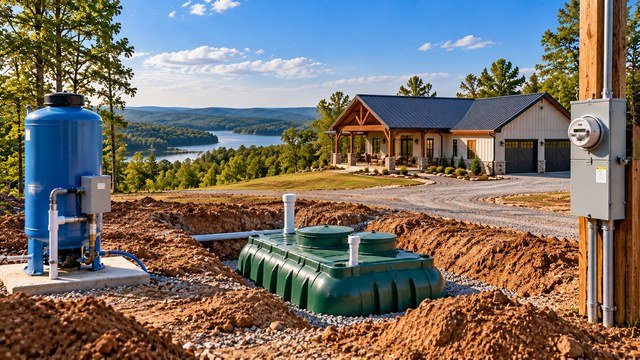
Step 3: resolve septic feasibility before construction
If the property is not connected to a public sanitary sewer, Alabama requires a permit from the local health department before a new onsite sewage disposal system is installed. ADPH specifically advises buyers to investigate sewage disposal before purchasing land because some sites are not suitable for conventional septic systems.
Soil and site conditions drive the septic design
ADPH identifies shallow soil, slow drainage, wet conditions and inadequate lot size as potential problems for conventional septic. A registered professional performs the required soil and site evaluation. Difficult conditions can require an engineered system rather than a conventional layout, which can materially change the development budget.
Protect both the primary field and replacement area
The septic layout should influence where the driveway, house, shop, pool, barn, parking and future additions go. Heavy equipment and grading can damage or consume suitable soil. Treat the proposed disposal area and required reserve or replacement area as protected parts of the property plan before construction traffic begins.
Follow the Alabama septic sequence
ADPH county guidance describes the basic sequence: obtain the professional soil/site work, submit the permit application and required plans to the local health department, receive the Permit to Install, use an appropriately licensed installer, coordinate inspection, and obtain approval before use. Do not install the system first and attempt to permit it afterward.
Current septic forms and fees should be checked locally
ADPH maintains statewide onsite sewage forms, including the small-flow Permit to Install application and site-evaluation documentation. Fees and local procedures can change, so use the current county health department information when budgeting. For example, county environmental fee schedules can be updated independently of older project estimates.
Step 4: verify internet at the exact service location
ADECA's Be Linked Alabama initiative maintains the state's broadband mapping program and county profiles. The map is useful for screening areas and understanding reported service, but a rural buyer should still verify the exact address or location with the provider before relying on broadband for remote work, school, security cameras or business operations.
Do not confuse coverage with an installable connection
A map may show service in the area while the provider still needs an extension, construction contribution or additional equipment to reach a specific rural homesite. Ask the provider whether the address is serviceable today, what technology is available, the expected speed tier, installation requirements and whether the line can reach a long private driveway.
Plan a backup connection if internet is mission-critical
For remote work or a home business, evaluate more than one connection method. Depending on the property, options may include wired broadband, fixed wireless, cellular service or satellite. Test cellular performance at the actual homesite and consider how power outages affect each system.
Install communications conduit while trenches are open
Even if fiber or another wired provider is not available today, inexpensive conduit installed during site work can make a future connection easier. Coordinate power and communications routes while following required separation and utility specifications. The objective is to avoid excavating a finished driveway or landscaped yard later.
Call 811 before excavation
Before digging for utility trenches, driveway drainage, water lines or other improvements, use the applicable Alabama 811 process so existing underground facilities can be located. New rural construction often involves repeated excavation, so utility-locate planning should become part of the construction schedule rather than an afterthought.
Coordinate the driveway with every utility
The driveway is often the backbone of a rural site. Utility routes may parallel or cross it, construction trucks need reliable access, and culverts or drainage structures can constrain trench locations. Design access, drainage and utilities together before installing the final gravel or pavement section.
Sequence clearing and grading carefully
A practical sequence is to confirm the survey and legal access, establish a preliminary site plan, complete septic evaluation, contact utility providers, identify the water strategy, establish driveway and drainage concepts, then clear and rough-grade only what is needed. Exact sequencing varies by parcel, but early utility decisions reduce the risk of moving dirt twice.
Avoid trenching before final elevations are known
Installing water, electrical or communications lines too early can place them at the wrong depth after the site is graded. Establish the planned driveway and building elevations first. On sloped Alabama land, even modest changes in the house pad can change drainage and utility routes substantially.
Future buildings should be included now
If the long-term plan includes a detached shop, barn, guest house, RV pad, gate, well house, pool or livestock facilities, reserve routes and capacity for them. Upsizing conduit or planning a subpanel location during initial construction can be easier than rebuilding infrastructure later.
Utility easements can control where you build
Review the survey, deed and title work for recorded utility easements and rights of way. New service may also require an easement. Make sure the proposed home, shop, septic area and fence plan do not conflict with existing or required utility corridors.
Floodplains, wetlands and drainage can complicate utility routes
A utility route that appears shortest on a map may cross a drainage channel, flood-prone area, wetland, steep slope or unstable soil. Those conditions can increase engineering, permitting, construction and maintenance complexity. Evaluate the route on the ground before treating a straight-line distance as the project cost.
Create separate allowances for each utility system
Do not use one vague 'utilities' line in the land-development budget. Track electric service and extension, water meter or well, private water line, septic evaluation and system, internet installation, communications conduit, trenching, clearing, restoration and professional fees separately. This makes it easier to compare two parcels honestly.
Get written information when possible
Phone conversations are useful early, but major purchase decisions deserve documentation. Save utility emails, service maps, estimates, septic reports, provider availability results, well-driller notes and survey information. Record the date because service availability, fees and construction policies can change.
Build a contingency for unknown conditions
Raw-land infrastructure contains uncertainty. Rock, groundwater, unsuitable soil, long utility extensions, transformer requirements, low well yield, driveway crossings and provider construction can all change the final number. A contingency is part of a responsible site-development budget, not an optional luxury.
A practical pre-purchase utility checklist
Before closing, identify the electric provider and likely service point; verify public-water availability or speak with local well drillers; complete or obtain appropriate septic due diligence; screen broadband through Be Linked Alabama and confirm providers; review legal access and easements; map the driveway and likely utility corridors; and estimate the distance from existing infrastructure to the proposed homesite.
A practical post-purchase order of operations
After closing, finalize the survey and site plan, complete required septic evaluation and permitting, obtain provider designs or requirements, establish the driveway and drainage plan, clear only necessary corridors, rough-grade the homesite, install coordinated underground infrastructure at the appropriate stage, complete septic and utility inspections, and document final locations for future maintenance.
The cheapest parcel can become the most expensive homesite
A tract with a higher purchase price but short utility runs, suitable septic soil, public water and an existing driveway may cost less to develop than inexpensive acreage requiring a long road, engineered septic, deep well and major electric extension. Compare properties using total build-ready cost rather than price per acre alone.
Treat utilities as part of land selection, not something to solve later
The strongest rural-land purchase is one where the house, access, power, water, wastewater and communications plan works before construction begins. Alabama has many viable rural building locations, but every parcel has its own service territories, soils, terrain and infrastructure. Verify each system at the exact property and make the site plan prove that the pieces fit together.
Sources & methodology
Where this information comes from
Cost figures are planning references rather than contractor quotes. Permitting, system-selection, and location-specific guidance should be verified with the appropriate local authority or qualified professional. AcreageReady uses source-backed, AI-assisted editorial workflows and remains responsible for the material it publishes. Read how we research, edit, and correct guides.
- Alabama Public Service Commission: Electricity
- Alabama Public Service Commission: Utility Services Division
- Alabama Department of Public Health: Can I Live On This Lot?
- Alabama Department of Public Health: Soil and Onsite Sewage
- Alabama Department of Public Health: Onsite Sewage Forms
- Alabama Department of Environmental Management: Information for Consumers and Private Wells
- Alabama Department of Environmental Management: Drinking Water Laboratory Certification
- ADECA: Be Linked Alabama Broadband
- ADECA: Broadband Community Profiles
Common questions
Frequently asked questions
How do I find out who provides electricity to rural land in Alabama?
Start with the parcel address or tax parcel and contact utilities serving the area. Alabama Power is the state's investor-owned electric utility, but cooperatives, municipal systems and TVA-related systems also serve Alabama. Confirm the actual service territory before budgeting a connection.
Does power at the road mean electricity will be cheap to connect?
No. The serving utility still needs to determine the service point, transformer needs, extension requirements and whether poles, underground conduit, clearing, easements or customer contributions are required to reach the homesite.
Can I use a private well on rural Alabama property?
Private wells are common where public water is unavailable. ADEM says it does not regulate individual private wells and recommends contacting local health departments or certified laboratories about water-quality testing and certified well drillers about construction concerns.
Do I need a septic permit in Alabama?
If the property is not connected to a public sanitary sewer, Alabama requires a permit from the local health department before installing a new onsite sewage disposal system. Soil and site evaluation should happen early because some parcels are unsuitable for conventional systems.
How do I check broadband on rural Alabama land?
Use ADECA's Be Linked Alabama broadband map and county profiles as screening tools, then confirm the exact address with the provider. Ask whether service is installable today, what technology and speeds are available, and whether construction is required to reach the homesite.
Should utilities be installed before the driveway?
They should be planned together. The exact construction sequence depends on the site, but driveway alignment, drainage, final grades and utility crossings should be coordinated before permanent surfacing so trenches do not require unnecessary rework.
Should I install internet conduit even if fiber is not available yet?
It can be useful when trenches are already open, provided the installation follows applicable separation and provider requirements. Empty conduit can make a future wired connection easier and reduce excavation through finished areas.
What is the biggest utility mistake when buying rural Alabama land?
Assuming nearby infrastructure equals affordable service. Verify the exact electric provider, service point, water source, septic feasibility, broadband availability, easements and distances to the proposed homesite before comparing the parcel's true development cost.
Ready to talk with a local professional?
Share your location and project details so AcreageReady can identify relevant providers as the network grows.
Get a free quote