Arkansas septic cost starts with the site, not the tank
A septic budget is really a wastewater-site budget. The tank is only one component. Soil conditions, slope, bedroom count, absorption-area size, excavation difficulty, access, pumping requirements and the type of treatment system can all move the final price.
For rural-land buyers, the most important question is not simply what a septic tank costs. It is whether the parcel has a suitable primary and secondary absorption area in a location that works with the house, driveway, well and future improvements.
A useful 2026 planning range
For early budgeting, treat any statewide dollar figure as a planning allowance rather than a quote. A straightforward conventional installation on an accessible site can be materially less expensive than an engineered or alternative system on difficult soil or steep terrain.
Get parcel-specific proposals after the site evaluation and approved design. Contractor pricing, excavation conditions and system requirements vary too much across Arkansas for a single statewide number to be dependable.
Arkansas requires approval before construction
Arkansas Department of Health rules require an onsite wastewater permit application and detailed plans to be submitted and approved before construction of a building or residence where the rules apply. Construction, alteration, repair or extension of an onsite wastewater system also requires a valid Permit for Construction.
The system cannot be placed into operation until it has been inspected and approved and a Permit for Operation has been obtained. That makes septic feasibility an early land-development item, not a task to leave until the house is nearly ready.
The Designated Representative is an important part of the process
Under the state rules, Part I of the permit application is completed by a Designated Representative and approved by the Department or its Authorized Agent before system construction begins. The application includes items such as percolation-test results, soil determinations, lot dimensions, system design and layout.
For a buyer evaluating acreage, involving the appropriate qualified professional early can expose limitations before money is committed to a house location or closing.
Arkansas permit review fees are based on structure size
The Arkansas Department of Health fee schedule lists individual sewage-disposal permit review fees by structure size. The published schedule ranges from $30 for structures of 1,500 square feet or less to $150 for structures over 4,000 square feet, with intermediate tiers for larger structures.
Those state review fees are only one small part of a septic budget. Site evaluation, design, excavation, materials, installation and any specialized treatment components can cost far more. Always confirm the current fee and any local charges before applying.
Soil suitability can matter more than acreage
Owning five, ten or twenty acres does not automatically guarantee an easy septic installation. The rules require suitable primary and secondary absorption areas for lots, tracts or parcels using standard onsite wastewater systems, with suitability based on natural soil data.
A smaller parcel with favorable soil and a simple homesite can be easier to develop than a much larger tract where rock, shallow soil, seasonal wetness or steep slopes constrain the usable wastewater area.
Protect both the primary and secondary absorption areas
The secondary absorption area is not leftover space. It preserves a future replacement area if the original absorption system eventually needs to be replaced or expanded.
When laying out a rural property, avoid casually placing a shop, pool, driveway, barn, parking area or other permanent improvement over land needed for wastewater treatment. A site plan should reserve those areas from the beginning.
Conventional systems are usually the simplest scenario
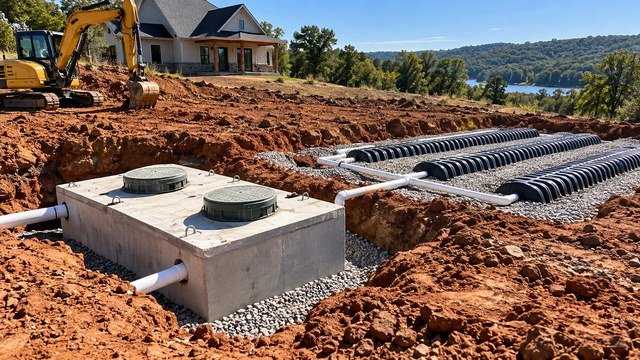
Where soil, slope and site conditions support a standard system, the installation may consist of a septic tank, distribution components and a subsurface absorption area. Simpler excavation and shorter runs generally make budgeting easier.
Even a conventional design is site-specific. Tank sizing, trench layout and absorption requirements should come from the approved design rather than a generic online diagram.
Alternative systems can increase the budget
Sites that cannot support a straightforward conventional layout may require a different treatment or dispersal approach allowed by the state rules. Additional tanks, pumps, controls, treatment components, specialized media or more complicated installation can increase both initial and long-term costs.
Do not assume an alternative system is automatically a deal breaker. Instead, identify the required design, installation price, electrical needs and maintenance obligations before deciding whether the property still fits the project budget.
Rocky Ozark sites can change excavation costs
Northern and western Arkansas can include steep terrain, shallow soils and rock. Those conditions can affect trench excavation, equipment access and the practical location of the absorption area.
A scenic ridge-top homesite can therefore create a different wastewater budget than a gently sloping parcel with deeper suitable soil. Evaluate the actual homesite rather than generalizing from the county or acreage size.
Wet ground and drainage deserve attention
Low areas, concentrated runoff and seasonally wet ground can complicate a site even when the property looks dry during a summer showing. Observe drainage patterns and ask how soil and seasonal conditions were evaluated.
Keep roof drainage, driveway runoff and grading plans from directing excess water toward the absorption area. Wastewater design and overall site drainage should support each other.
Bedroom count can affect system sizing
Residential wastewater design commonly considers expected occupancy and bedroom count, not simply the number of people currently living in the house. A future bedroom addition can therefore matter to the original wastewater plan.
Decide early whether the house may expand. Designing around the long-term plan can be more practical than discovering later that the wastewater layout limits an addition.
Access for installation equipment affects price
A system located far from the road, behind a creek crossing or on a steep bench may require more equipment time and site preparation. Tree removal, temporary access and difficult material delivery can add cost even when the wastewater design itself is ordinary.
Ask installers what site access is included in the proposal and what conditions would trigger additional excavation or mobilization charges.
Tank location should support future pumping
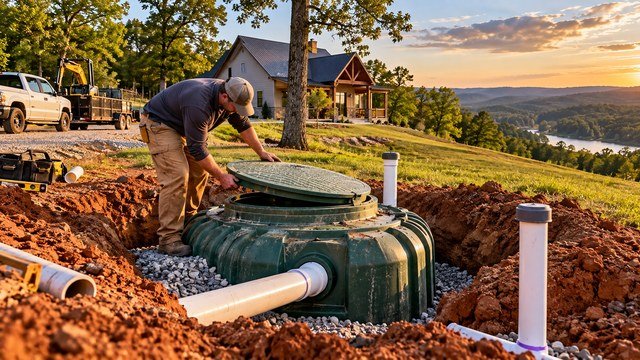
A septic tank eventually needs service. Locating it where a pumping truck can reasonably reach it, while still following the approved design and required separations, can make future maintenance easier.
Do not bury access points beneath landscaping or permanent structures. Record the final tank and field locations for the property file.
A private well and septic system must be planned together
Many Arkansas acreage projects rely on both an onsite wastewater system and a private well. Their locations cannot be chosen independently because sanitation and separation requirements influence the site plan.
Map the proposed house, well, primary and secondary absorption areas, driveway and major outbuildings before finalizing any one component.
Do not let the driveway consume the best septic ground
A driveway is often the first improvement installed on raw acreage, but an early route chosen without a wastewater layout can cross or isolate usable absorption-area soil.
Before heavy road work begins, identify the likely house and wastewater areas. A modest change in driveway alignment can preserve valuable buildable ground.
Get written installation scopes
When comparing septic bids, make sure the proposals cover the same scope. Tank size, trench footage, pumps, controls, electrical work, excavation, rock charges, backfill, finish grading, inspections and permit responsibilities should be clear.
The lowest headline number is not necessarily the lowest completed cost if major items are excluded.
Budget for electrical work when the design needs it
Systems with pumps, alarms or treatment equipment may need dedicated electrical work. Confirm whether the septic contractor includes that work or whether a separate electrician is required.
For raw-land projects, coordinate this with temporary and permanent electric-service planning so the wastewater system is not waiting on an overlooked power connection.
Repairs and replacements need permits too
Arkansas rules address alterations, repairs and extensions as well as new systems. The Department's published fee schedule lists a $30 review fee for alteration, repair or extension of an individual sewage-disposal system.
For an existing rural home, do not assume an old septic system can simply be expanded without review. Verify the system record, condition and approval path before planning additional bedrooms or major remodeling.
Existing septic systems deserve due diligence
When buying improved acreage, ask for permits, installation records, pumping history and any repair documentation. Locate the tank and absorption field and understand whether a secondary area remains available.
A functioning system on inspection day does not automatically prove that it is appropriately sized or documented for a planned renovation. Match records to the intended use of the property.
New construction sequencing matters
A practical sequence is to evaluate the site, establish the wastewater concept, coordinate the house and well locations, obtain required approvals, protect the absorption areas during site work and install the system at the appropriate construction stage.
Heavy equipment should not repeatedly cross or compact protected absorption areas simply because the septic installation is scheduled late.
Ask about maintenance before choosing a system
Initial installation cost is only part of ownership. Pumps, alarms, treatment components and other mechanical equipment can create inspection, service and replacement expenses over time.
Ask what maintenance the proposed system requires, who services that equipment locally and what a typical service visit involves.
Keep a septic contingency in the land-development budget
Raw-land projects routinely uncover conditions that were not obvious from the listing. Rock, difficult access, design changes or additional site work can affect the final wastewater cost.
Keep septic contingency separate from the house-construction contingency so an expensive site surprise does not immediately consume money intended for the building itself.
Compare parcels by build-ready cost
A parcel with a higher purchase price but straightforward septic feasibility may be less expensive overall than cheaper acreage requiring a complicated wastewater solution, long driveway and extensive utility work.
Compare properties using the combined cost to reach a permitted, build-ready homesite rather than price per acre alone.
Make septic feasibility part of the purchase decision
Before closing on undeveloped Arkansas acreage, understand whether the intended homesite can support the wastewater plan you expect. When appropriate, structure due diligence so there is time to evaluate the site before the purchase becomes unconditional.
The septic question belongs alongside legal access, survey, flood risk, water and electric service in the initial land-buying checklist.
Related: Buying Rural Land in Arkansas: The Complete 2026 Acreage Guide
Arkansas septic planning checklist
Before treating a septic budget as complete, confirm the site, design, approval path, installer scope and future maintenance expectations.
- Identify the intended house location and bedroom plan.
- Have the site and soil evaluated through the proper Arkansas process.
- Reserve both primary and secondary absorption areas.
- Coordinate septic, well, driveway and outbuilding locations.
- Confirm the required system type before relying on a budget.
- Verify current state and local permit or review fees.
- Compare written contractor scopes rather than headline prices.
- Plan electrical service for pumps or controls when required.
- Protect absorption areas from construction traffic and drainage changes.
- Keep approved plans, permits and final system-location records.
Sources & methodology
Where this information comes from
Cost figures are planning references rather than contractor quotes. Permitting, system-selection, and location-specific guidance should be verified with the appropriate local authority or qualified professional. AcreageReady uses source-backed, AI-assisted editorial workflows and remains responsible for the material it publishes. Read how we research, edit, and correct guides.
Common questions
Frequently asked questions
How much does a septic system cost in Arkansas in 2026?
There is no dependable single statewide installed price. Cost depends on the approved system type, soil and slope, tank and absorption-area requirements, excavation conditions, access, pumps or controls and contractor pricing. Use a parcel-specific site evaluation and written installation quotes for a real budget.
Do I need a septic permit in Arkansas?
Arkansas Department of Health rules require permits for construction and operation of onsite wastewater systems where the rules apply. The construction permit must be approved before installation, and the system must be inspected and approved before operation.
How much is the Arkansas septic permit review fee?
The Arkansas Department of Health's published fee schedule lists individual sewage-disposal permit review fees from $30 to $150 depending on structure size, with a $30 review fee for repairs, alterations or extensions. Confirm the current fee when applying.
What is a Designated Representative in the Arkansas septic process?
Arkansas rules provide for a Designated Representative to complete Part I of the permit application, including site and design information such as soil or percolation results, lot dimensions and system layout, for approval by the Department or its Authorized Agent.
Does a large Arkansas parcel automatically qualify for septic?
No. Acreage alone does not establish suitability. Soil, slope, drainage and the availability of suitable primary and secondary absorption areas are important to the approval and layout.
Why does Arkansas require a secondary absorption area?
The secondary area preserves suitable land for future wastewater absorption needs if the primary area must be replaced or expanded. It should be protected from incompatible development.
Can I build the house before septic approval?
Arkansas onsite wastewater rules require the applicable permit application and plans to receive approval before construction of a building or residence. Confirm the requirements for the specific parcel with the Department or its Authorized Agent before starting work.
Can rocky Arkansas land make septic more expensive?
Yes. Rock, shallow soil, steep slopes and difficult equipment access can affect system design and excavation. The effect is parcel-specific, which is why site evaluation should happen early.
Should I inspect the septic system before buying an Arkansas rural home?
Yes. Review available permits and records, locate the tank and absorption area, evaluate system condition and determine whether the existing system fits the intended use or planned expansion.
What should I do before buying Arkansas land that needs septic?
Identify the likely homesite, evaluate wastewater feasibility, preserve primary and secondary absorption areas, coordinate the well and driveway layout, verify the approval process and include realistic wastewater costs in the all-in build-ready budget.
Ready to talk with a local professional?
Share your location and project details so AcreageReady can identify relevant providers as the network grows.
Get a free quote