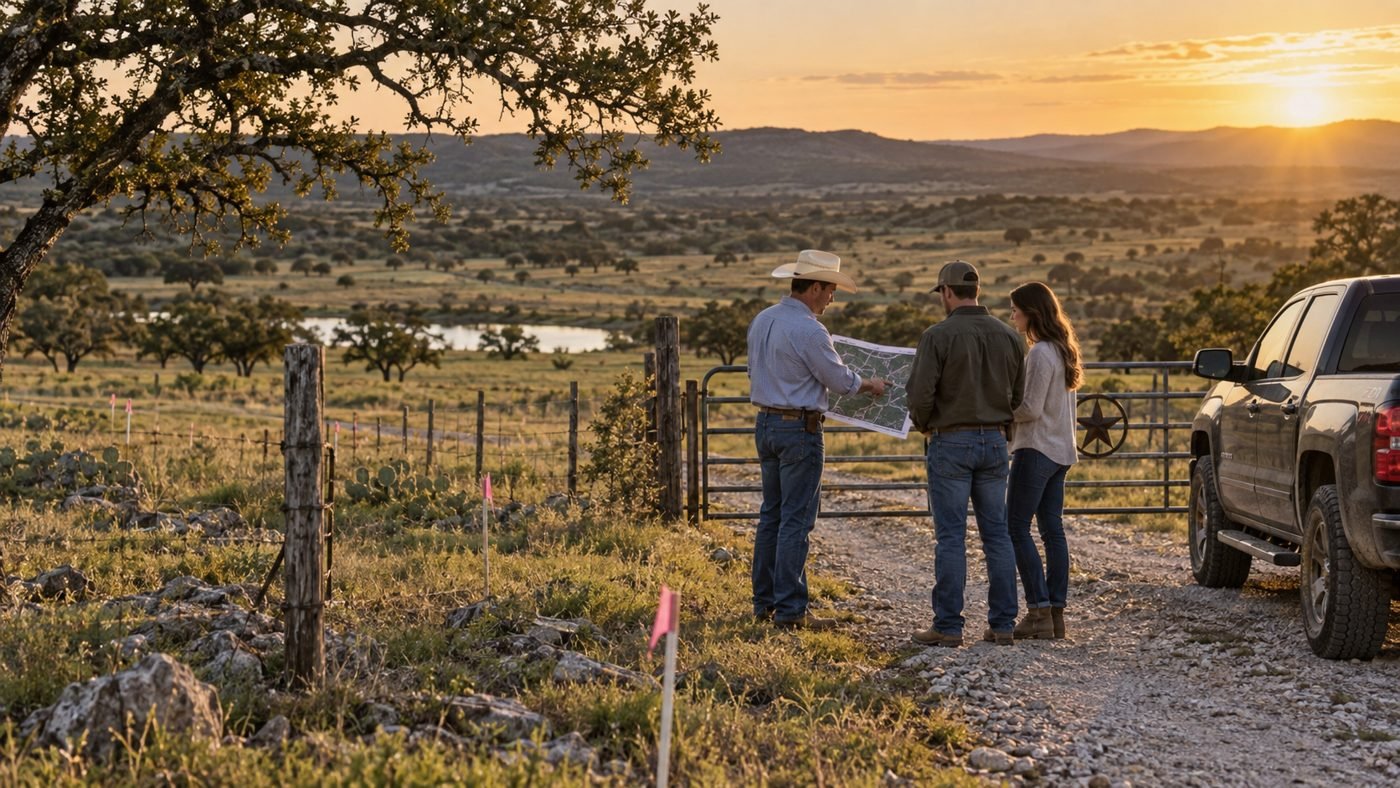
Before you buy Texas land, verify the things that can change the whole deal
A rural tract can look perfect from the road and still carry expensive problems that are easy to miss during a showing. The biggest risks are usually not cosmetic. They are access, title, easements, flood conditions, wastewater, water supply, utility distance, site-development cost, and restrictions on how the land can be used.
The goal of due diligence is not to eliminate every uncertainty. It is to identify the issues large enough to change what the property is worth to you before your contractual deadlines expire.
Use this checklist as a planning framework and coordinate legal, title, survey, engineering, environmental, tax, and construction questions with qualified professionals when the issue is material to the purchase.
1–5: Start with access, boundaries, and title
The first five checks answer a basic question: do you actually have the land, access, and rights you think you are buying? Texas rural transactions often depend heavily on surveys, metes-and-bounds descriptions, easements, and title exceptions.
- 1. Verify legal access. Confirm the property has a recorded right of access to a public road, not simply a path that has been used informally.
- 2. Determine who maintains the road. A private road, shared drive, or easement road may come with maintenance obligations that are not obvious during a showing.
- 3. Review a current survey. Locate boundaries, acreage, improvements, fences, encroachments, easements, roads, and other items that may affect the usable site.
- 4. Compare the survey with the legal description and advertised acreage. Do not assume fence lines are property lines.
- 5. Review the title commitment and every meaningful exception. Pay attention to access easements, utility easements, pipeline easements, deed restrictions, leases, and other recorded interests.
6–8: Restrictions, mineral rights, and energy infrastructure
Owning the surface does not automatically mean you control every right associated with the property. Texas rural land can also be affected by deed restrictions, mineral reservations, surface leases, pipelines, and oil or gas activity.
The Texas Real Estate Commission's current Farm and Ranch Contract is designed for rural properties and includes provisions relevant to farm and ranch transactions. For mineral ownership or complex reservations, title review and legal advice are especially important.
- 6. Read deed restrictions, subdivision restrictions, and property-owner association documents. Check rules for home size, manufactured homes, RV use, livestock, businesses, short-term rentals, fencing, shops, and additional dwellings.
- 7. Determine what mineral rights, executive rights, royalties, and surface rights are actually conveying. Do not assume the mineral estate follows the surface estate.
- 8. Check Railroad Commission maps for mapped oil wells, gas wells, pipelines, permitted locations, and related infrastructure on or near the tract.
9–11: Flooding, drainage, and environmental constraints
A parcel does not need to sit inside a mapped flood zone to have drainage problems. Creek crossings, low areas, upstream runoff, steep slopes, poorly placed culverts, and concentrated flow can all affect where a home, driveway, septic system, or shop can realistically go.
FEMA's Map Service Center is the official public source for federal flood hazard maps, but a flood map is only one layer of site review.
- 9. Check FEMA flood maps and local floodplain information. Understand whether the proposed building site, driveway, or access route crosses mapped flood hazard areas.
- 10. Walk the property for drainage clues. Look for washouts, debris lines, eroded channels, ponding, wet-weather crossings, steep slopes, and areas where runoff concentrates.
- 11. Investigate environmental constraints when relevant. Wetlands, protected habitat, dumping, old tanks, contaminated areas, or prior commercial and agricultural uses can require deeper review.
12–13: Septic feasibility can determine whether the property is buildable
If the property is not served by public sewer, wastewater deserves early attention. TCEQ requires a site evaluation before an on-site sewage facility can be selected, and local permitting programs can be more restrictive than state minimums.
A tract with difficult soils, limited disposal area, high groundwater, rock, or tight setbacks may need a more expensive aerobic or engineered system.
- 12. Confirm septic feasibility for the home and future improvements you want. Evaluate the proposed disposal area before locking in the house, pool, shop, driveway, well, or guest-house location.
- 13. If an existing septic system is present, verify permits, age, type, maintenance history, condition, and whether it can support your intended use. TCEQ advises new owners to notify the local permitting authority after purchase.
14–15: Verify the water plan before assuming a private well will work
If there is no reliable water system serving the property, research groundwater before you close. Texas Water Development Board databases contain well location, depth, construction, aquifer, water-level, and water-quality information for many wells across the state.
Nearby well reports can help establish expectations, but they cannot guarantee your future well depth, yield, or water quality.
- 14. Identify the actual water source. Determine whether the property has a meter, community water availability, an existing well, or will require a new private well.
- 15. Research nearby well records through TWDB. Compare reported depths, aquifers, drill dates, water levels, and other available information, then discuss the pattern with a licensed local driller.
16–17: Utilities and connectivity need real answers, not listing language
The phrase 'utilities available' can mean a service line crosses the front of the property, or it can mean a provider exists miles away. Those are very different budgets.
Utility providers, not the listing description, should be the source of truth for connection feasibility and extension requirements.
- 16. Verify electric service directly with the serving utility. Ask for the nearest connection point, extension policy, transformer requirements, easement needs, and likely customer contribution.
- 17. Test internet and cell service at the property. Check actual fixed-broadband providers, wireless signal, satellite options, and whether the service level supports work, school, security cameras, and smart-home systems.
18–20: Access construction, clearing, soil, and rock can reshape the budget
A parcel may be legally accessible yet still need tens of thousands of dollars of physical access and site work before construction can begin.
Walk the likely driveway and building areas with the finished project in mind, not just the current landscape.
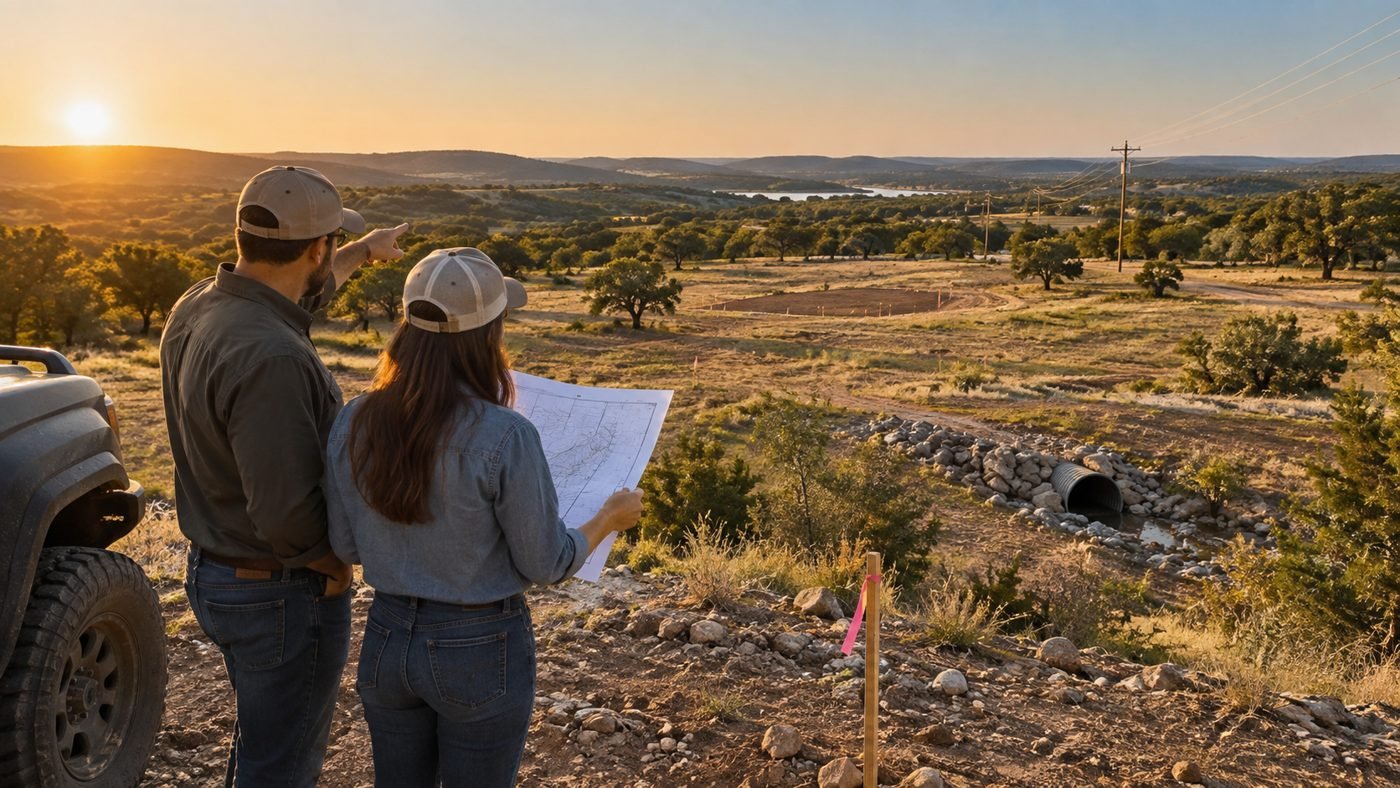
- 18. Estimate driveway and culvert work. Measure the likely driveway length and identify creek crossings, drainage ditches, steep grades, gates, and turning requirements for construction equipment.
- 19. Estimate clearing and site preparation. Separate brush removal from stump removal, excavation, grading, drainage, fill, and pad construction.
- 20. Understand soil and rock conditions. Expansive clay, shallow rock, unstable fill, steep slopes, and poor drainage can affect foundation design, excavation, septic, road work, and landscaping.
21–22: Understand the tax picture before changing how the land is used
Texas agricultural, timber, and wildlife-management appraisal can reduce taxable value substantially, but buyers need to understand whether the property actually qualifies and what happens if its use changes.
The Texas Comptroller states that a change from qualifying agricultural use can trigger rollback tax based on the difference between agricultural and market-value taxation for the preceding three years.
- 21. Verify any agricultural, timber, or wildlife-management appraisal with the county appraisal district. Ask what use, acreage, documentation, and intensity standards must continue after purchase.
- 22. Understand current taxes, special districts, assessments, and possible rollback exposure. Do not assume the seller's current tax bill will be your long-term tax bill after development.
23: Make sure the whole property layout works together
A homesite should be planned as a system. The house, shop, driveway, septic, well, drainage, utilities, pool, guest house, barns, pasture, garden, and future additions all compete for usable space.
A property can have plenty of acreage and still have a poor usable layout because of easements, floodplain, topography, setbacks, access, septic area, or utility corridors.
- 23. Sketch the long-term site plan before closing. Place the major improvements conceptually and make sure their access, setbacks, utilities, drainage, and service areas do not conflict.
24: Build the development budget before deciding whether the land is a bargain
Raw acreage should be compared on total usable-site cost, not purchase price per acre. A cheaper tract can become the expensive option if it needs a long driveway, deep well, aerobic septic, large power extension, major clearing, or difficult drainage work.
AcreageReady's current Texas raw-land development guide uses roughly $30,000 to $100,000 or more as an early planning range for many parcels that need multiple major systems before the house itself.
- 24. Build a line-item development budget for access, clearing, grading, septic, water, power, drainage, permits, surveys, and contingency. Replace allowances with real quotes as quickly as possible.
25: Use the due-diligence period to replace assumptions with evidence
The final check is really the process that supports the other 24. Your contract deadlines determine how much time you have to investigate the property and decide whether the findings still support the purchase.
TREC maintains separate current contract forms for unimproved property and farm and ranch transactions, reflecting the fact that rural property has issues that differ from a conventional residential resale.
- 25. Create a due-diligence calendar on day one. Track survey, title, restrictions, access, septic, water, utilities, flood review, taxes, site-work estimates, financing, insurance, and every contractual deadline in one place.
A practical Texas land-buying sequence
Start with the issues that can make the property unusable for your plan: legal access, title, restrictions, flood conditions, septic, water, and utility feasibility. Then move into site-development pricing and long-term layout.
If one item fails, do not automatically abandon the property. Determine whether the problem can be solved, what the solution costs, and whether that new total still makes sense compared with other land.
- Verify access, title, survey, and restrictions
- Check flood, drainage, environmental, oil-and-gas, and pipeline conditions
- Confirm septic and water feasibility
- Verify power and connectivity
- Price driveway, clearing, grading, and drainage
- Review tax treatment and rollback exposure
- Test the long-term site layout
- Update the total development budget before your deadlines expire
Keep researching
Acreage Planning resources
Due diligence, development sequencing, utilities, access, and the decisions that shape a rural property project.
Sources & methodology
Where this information comes from
Cost figures are planning references rather than contractor quotes. Permitting, system-selection, and location-specific guidance should be verified with the appropriate local authority or qualified professional. AcreageReady uses source-backed, AI-assisted editorial workflows and remains responsible for the material it publishes. Read how we research, edit, and correct guides.
- Texas Real Estate Commission: Farm and Ranch Contract
- Texas Real Estate Commission: Current Contract Forms
- Texas Commission on Environmental Quality: Getting a Permit for an OSSF
- Texas Commission on Environmental Quality: Advice for OSSF Owners and Buyers
- Texas Water Development Board: Groundwater Data
- Texas Water Development Board: Locating a Water Well Report
- FEMA: Flood Map Service Center Guidance
- Railroad Commission of Texas: Public GIS Viewer
- Texas Comptroller: Agricultural, Timberland and Wildlife Management Appraisal
Common questions
Frequently asked questions
What should I check before buying land in Texas?
At minimum, verify legal access, survey and boundaries, title exceptions, easements, restrictions, mineral and surface rights, flood risk, drainage, septic feasibility, water source, power availability, taxes, road and driveway needs, site-development costs, and your contractual due-diligence deadlines.
How do I know if Texas land can support a septic system?
A licensed site evaluator or professional engineer evaluates the proposed disposal area and property conditions. TCEQ requires a site evaluation before the appropriate OSSF system is selected, and local permitting requirements can be stricter than state minimums.
How can I research water wells near Texas land I am buying?
The Texas Water Development Board provides groundwater databases and submitted driller reports with information such as well location, depth, aquifer, construction, water levels, and available water-quality data.
Should I worry about mineral rights when buying Texas acreage?
Yes. The mineral estate can be separate from the surface estate. Determine what is actually conveying and have qualified title or legal professionals review mineral reservations, leases, surface-use issues, and related rights when they are material to the purchase.
Can agricultural valuation change after I buy Texas land?
Yes. Qualification depends on the property's use and local appraisal standards. A change away from qualifying agricultural use can trigger rollback tax for prior years, so confirm the property's status and requirements with the county appraisal district.
How much should I budget to develop raw Texas land after purchase?
There is no universal amount, but a useful early planning range for parcels needing several major systems is roughly $30,000 to $100,000 or more before the home itself. Well depth, septic type, driveway length, power extension, clearing, grading, and drainage can move the total substantially.
Ready to talk with a local professional?
Share your location and project details so AcreageReady can identify relevant providers as the network grows.
Get a free quote