Financing rural land is different from financing a finished house
A lender evaluating raw Oklahoma acreage is underwriting both the borrower and the property. With no completed home serving as straightforward residential collateral, access, utilities, intended use, improvements, acreage, marketability, and development risk can matter more than buyers expect.
Define what you are buying and what you intend to do with it before choosing a loan product.
There is no single standard Oklahoma land loan
Land financing may come from banks, credit unions, agricultural lenders, Farm Credit institutions, private lenders, sellers, and government agricultural programs. Conventional terms are set by each lender.
The product for a future homesite may differ from financing for recreational acreage or a working farm.
Separate raw land, improved land, and construction financing
Raw land may have no utilities, driveway, septic approval, well, or structures. Improved land may already have some of those features. A parcel intended for an immediate home build may fit a construction or construction-to-permanent strategy.
Ask prospective lenders how they classify the exact parcel before relying on advertised terms.
Expect lender terms to vary more than ordinary home mortgages
Down payment, amortization, maturity, interest rate, balloon provisions, fees, and acreage limits can vary significantly by lender and property type.
Request a written term sheet and compare cash required at closing, payment structure, maturity date, prepayment terms, and fees.
A larger down payment may be part of the deal
Raw-land lenders often require more borrower equity than a typical owner-occupied home mortgage because undeveloped land can be harder to value and resell.
There is no universal Oklahoma down-payment percentage for conventional land loans. Ask lenders for the maximum loan-to-value ratio for your exact property type.
Your credit profile still matters
Lenders generally review credit history, outstanding debt, income, liquidity, and repayment capacity. Strong credit does not make a difficult property financeable, but it can strengthen the overall application.
Review credit reports, avoid unnecessary new debt, and gather documentation for income, assets, liabilities, and cash reserves.
Debt-to-income is only one part of rural underwriting
Rural land lenders can also evaluate global cash flow, liquidity, collateral value, farm income, business obligations, and post-closing reserves.
Preserve room in the budget for surveys, closing costs, driveway work, utility extensions, septic, wells, fencing, clearing, drainage, and construction.
Cash reserves matter after the purchase
Buying acreage is often only the first large expense. Rural development can create substantial costs soon after closing.
Do not use every available dollar to reach closing if doing so leaves no realistic way to make the property usable.
The appraisal may be more complicated than a house appraisal
Rural parcels differ in acreage, road frontage, improvements, water, terrain, soil, flood exposure, mineral rights, location, and development potential, which can make comparable sales difficult.
If the appraisal is lower than the contract price, the lender may reduce the amount it is willing to finance.
Legal access can make or break financing
A parcel that appears accessible may rely on an easement, private road, shared drive, or informal route across neighboring property. Lenders and title professionals may require durable legal access.
Review recorded easements and road agreements before the financing contingency expires.
A survey can answer questions the appraisal cannot
An appraisal estimates value. A boundary survey addresses where the property actually is and can identify monuments, boundary relationships, encroachments, easements, and other matters within the surveyor's scope.
Do not assume the lender's appraisal replaces a survey.
Title work deserves the same attention as the loan
Review the title commitment and exceptions early enough to ask questions before closing. A lender's title requirements protect the lender's collateral interest, while the buyer still needs to evaluate whether recorded matters interfere with the intended use.
Coordinate questions among the title company, surveyor, lender, and qualified legal counsel when an issue is unclear.
Mineral rights may not transfer with the surface
Oklahoma buyers should not assume ownership of the surface automatically includes every mineral interest beneath it. Mineral estates may have been severed through earlier conveyances.
Review the deed, title materials, seller disclosures, and appropriate professional advice before assigning value to mineral ownership.
Utilities affect both your budget and the property's usability
A low purchase price can be misleading if electric service requires a long extension, the property needs an expensive well, or no acceptable septic site is available.
Use written estimates where possible rather than relying on a listing description that says utilities are nearby.
Verify electric service before assuming a future home is easy
Identify the serving electric utility and ask what is required for new service, line extensions, easements, transformers, meter locations, and construction power.
Distance from an existing line does not tell you the final cost or whether the route is straightforward.
Well feasibility is not the same as guaranteed water
If the parcel will depend on groundwater, investigate nearby well information, drilling conditions, water quality considerations, and applicable Oklahoma requirements.
A neighboring well does not guarantee the same depth, yield, quality, or drilling cost on your parcel.
Septic feasibility should be checked before closing
A parcel without sewer service needs a viable wastewater plan. Soil conditions, lot layout, setbacks, system type, and Oklahoma Department of Environmental Quality requirements can affect feasibility and cost.
Do not assume acreage alone guarantees a conventional septic system.
Flood risk can affect value and future construction
Use FEMA mapping and local information to screen the parcel for flood hazards, but remember that drainage problems can exist outside mapped flood zones.
Walk the property after rain when possible and evaluate culverts, creek crossings, low areas, and the proposed homesite.
Road frontage is not the same as an approved driveway
A parcel can front a public road while still requiring approval for a new entrance, culvert, or driveway location.
Confirm who controls the road and what standards apply before finalizing a homesite plan.
Zoning and permits can change the financing plan
Rural does not mean unregulated. County, municipal, subdivision, floodplain, building, driveway, septic, and other requirements can apply depending on location and project.
A lender approval is not a land-use approval.
Restrictions and covenants can limit what you finance
Private deed restrictions or subdivision covenants may control home size, building materials, livestock, manufactured homes, accessory structures, or commercial activity even when government zoning is permissive.
Read recorded restrictions before the due-diligence deadline.
USDA Rural Development and USDA FSA are different programs
USDA is associated with several loan programs. USDA Rural Development housing programs and Farm Service Agency farm loans serve different purposes and have different eligibility rules.
Do not assume that a parcel qualifies for a USDA program simply because it is rural.
FSA Farm Ownership loans are for eligible farm and ranch operations
USDA Farm Service Agency says Farm Ownership Loans support eligible farmers and ranchers purchasing, developing, or expanding agricultural operations.
These are not generic low-down-payment loans for anyone who wants recreational acreage or a country homesite. Oklahoma applicants can work with their local USDA Service Center to determine whether a proposed operation fits.
The Direct Farm Ownership maximum is currently $600,000
USDA currently lists a maximum of $600,000 for Direct Farm Ownership loans. The program can be used for qualifying farm purchases and certain farm development or improvements.
The maximum is a program ceiling, not an automatic approval amount. Actual financing depends on eligibility, repayment ability, collateral, appraisal, available funds, and the proposed farm operation.
FSA guaranteed loans work through commercial lenders
With a guaranteed farm loan, the commercial lender makes and services the loan while FSA guarantees a portion of the lender's principal exposure when program requirements are met.
A guarantee reduces lender risk. It does not eliminate borrower eligibility, repayment, collateral, or documentation requirements.
Joint financing can combine FSA and another lender
FSA's joint-financing Farm Ownership structure allows FSA to participate alongside another lender. USDA states that FSA can finance up to 50 percent of the purchase cost or value under this structure.
Ask both FSA and the participating lender how liens, amortization, collateral, and closing requirements will be coordinated.
The FSA Down Payment Program is specialized
The Direct Farm Ownership Down Payment Program is designed for eligible beginning farmers and ranchers and other qualifying applicants under FSA rules.
USDA says the applicant must contribute at least 5 percent of the farm purchase price. FSA can finance 45 percent up to the program maximum, with the remaining financing coming from another eligible source. This is not a general 5 percent down land loan.
The current FSA Down Payment loan maximum is $300,150
USDA's current program materials state that the FSA portion cannot exceed 45 percent of the lesser of the purchase price, appraised value, or $667,000, resulting in a maximum FSA Down Payment loan of $300,150.
Verify current figures before applying because program limits can change.
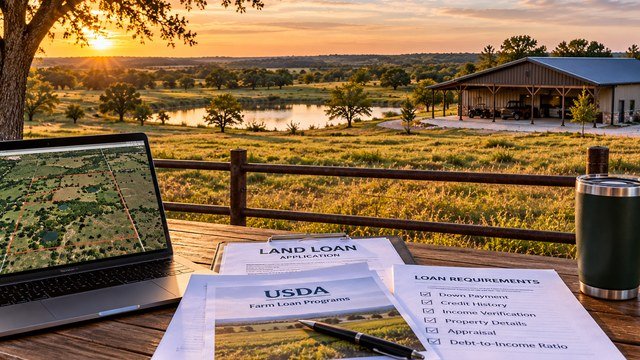
September 2026 FSA rates provide a useful current snapshot
For September 2026, USDA lists Direct Farm Ownership at 6.000 percent, Direct Joint Financing at 4.000 percent, and the Farm Ownership Down Payment rate at 2.000 percent.
Those are FSA program rates effective September 1, 2026. They are not representative rates for ordinary Oklahoma bank land loans, and guaranteed-loan rates are set by participating lenders subject to FSA rules.
FSA eligibility involves more than buying agricultural-looking land
FSA direct farm loans are intended for family-size farmers and ranchers who meet program criteria and generally cannot obtain sufficient commercial credit on reasonable rates and terms.
Applicants must demonstrate repayment ability and provide required collateral and documentation. Discuss eligibility with FSA early rather than structuring a purchase around a program you may not qualify for.
Beginning farmer has a specific FSA meaning
FSA's beginning-farmer rules are more specific than simply being new to rural property ownership. Program eligibility can include how long the applicant has operated a farm and, for some programs, limits tied to ownership of agricultural acreage.
Use the current FSA definition and local office guidance rather than an informal use of the term beginning farmer.
Seller financing can be another path
Some rural land transactions use seller financing, where the seller accepts payments over time rather than receiving the entire purchase price from a third-party lender at closing.
Terms can include substantial down payments, shorter maturities, balloon payments, interest, and default remedies. Use qualified legal and title professionals.
A land contract is not automatically the same as receiving a deed at closing
Alternative seller-financing structures can allocate title and possession differently. Buyers need to understand exactly when legal title transfers, what happens after default, and who is responsible for taxes, insurance, and maintenance.
Do not choose a structure only because the monthly payment looks affordable.
Construction-to-permanent financing may fit an immediate build
If the goal is to purchase land and begin construction soon, ask lenders whether the acquisition can be incorporated into a construction or construction-to-permanent loan.
These loans commonly involve plans, specifications, builder approval, budgets, draw schedules, inspections, and an appraisal based on the completed project.
Existing land equity may help a later construction loan
If you buy land first and later build, a future lender may consider qualifying equity in the property when structuring construction financing.
How much credit you receive depends on that lender's appraisal and underwriting rules, not simply what you paid for the parcel.
Do not finance land before estimating development costs
The monthly land payment is only one component of affordability. Build a separate development budget for access, clearing, grading, drainage, power, water, septic, fencing, surveys, engineering, permits, and contingency.
A cheaper parcel with difficult infrastructure can cost more overall than a higher-priced parcel that is genuinely build-ready.
Get lender prequalification before making aggressive offers
A lender familiar with rural Oklahoma property can tell you what documentation it expects, how it treats raw versus improved acreage, and what loan-to-value framework applies.
Prequalification is not final approval, but it can expose financing mismatches before you sign a contract.
Keep a financing contingency when appropriate
A purchase contract should reflect the buyer's actual financing plan and due-diligence needs. Contract terms are legal matters, so use a qualified Oklahoma real-estate professional or attorney for advice on the specific transaction.
Understand financing, appraisal, access, survey, and notice deadlines before they expire.
Gather documents before the lender asks
Depending on the loan, lenders may request identification, tax returns, pay information, bank statements, asset and liability details, purchase contract, legal description, survey, appraisal, insurance information, and business or farm records.
Agricultural borrowers may also need production history, leases, balance sheets, cash-flow projections, and a farm business plan.
Explain the intended use clearly
Tell the lender whether the acreage will be a future residence, working farm, cattle property, recreational tract, investment, business site, or combination.
Intended use can affect the loan program, underwriting, appraisal, insurance, and documentation.
Compare balloon risk, not just the payment
A loan with a long amortization can show an attractive monthly payment even if the note matures much sooner.
If a balloon balance is due after several years, the borrower may need to refinance, sell, or pay a large lump sum. Know the amortization period and actual maturity date before signing.
Understand fixed versus variable rates
Ask whether the rate is fixed or variable. For a variable loan, ask what index and margin apply, how often the rate can change, and whether there are periodic or lifetime caps.
Compare more than the initial payment.
Closing costs need their own cash budget
Land transactions can include appraisal, survey, title, recording, lender, legal, inspection, and other expenses depending on the deal.
Ask for estimates early and confirm which expenses can be financed, if any.
Insurance may be different before a house exists
Vacant acreage, farm property, existing outbuildings, livestock, and construction each create different insurance questions.
Ask an insurance professional what coverage is appropriate from the day you take title and what the lender requires.
Agricultural tax treatment does not make a loan agricultural
Property-tax classification and loan classification are separate issues. A parcel receiving agricultural use-value treatment does not automatically qualify the buyer for an agricultural loan or FSA program.
Evaluate financing, land use, and property taxes as separate due-diligence tracks.
Interview several lenders using the same questions
Give each lender the same parcel details and intended use so comparisons are meaningful. Ask about down payment, loan-to-value, rate type, term, amortization, balloon date, acreage limits, appraisal, survey, title requirements, closing costs, prepayment terms, and construction plans.
A lender experienced with rural property may recognize access, utility, agricultural, and appraisal issues earlier.
Build a one-page parcel financing summary
Create a package with purchase price, acreage, county, legal access, road frontage, utilities, improvements, intended use, planned construction date, estimated development budget, and requested loan amount.
Include maps, listing information, survey documents, and estimates when available.
Red flags deserve answers before earnest money becomes nonrefundable
Be cautious when access is undocumented, the legal description is unclear, utilities are described only as nearby, septic feasibility is unknown, or the purchase price depends on unverified mineral or development claims.
Financing approval does not cure property defects.
A strong rural-land purchase has two approvals
Think of the transaction as needing both a financial approval and a property approval. The financial approval asks whether the loan is affordable and acceptable to the lender. The property approval asks whether the acreage supports your intended use at a realistic total development cost.
Do not let a lender's willingness to finance substitute for your own land due diligence.
Use this Oklahoma financing checklist before closing
Confirm the loan type, down payment, rate structure, maturity, amortization, balloon provisions, appraisal, cash-to-close, reserves, and conditions.
Separately verify legal access, title, survey, restrictions, flood exposure, driveway feasibility, power, water, septic, zoning or permitting, and realistic improvement costs. For FSA financing, verify current eligibility, program limits, rates, and local office requirements directly with USDA.
Keep researching
Acreage Planning resources
Due diligence, development sequencing, utilities, access, and the decisions that shape a rural property project.
Sources & methodology
Where this information comes from
Cost figures are planning references rather than contractor quotes. Permitting, system-selection, and location-specific guidance should be verified with the appropriate local authority or qualified professional. AcreageReady uses source-backed, AI-assisted editorial workflows and remains responsible for the material it publishes. Read how we research, edit, and correct guides.
- USDA FSA: Farm Ownership Loans
- USDA FSA: Current FSA Loan Interest Rates
- USDA FSA: Beginning Farmers and Ranchers Loans
- USDA FSA: Farm Loan Programs
- USDA FSA: Oklahoma State Office
- USDA FSA: Oklahoma State Programs
- USDA FSA: September 2026 Lending Rates
- FEMA Flood Map Service Center
- AcreageReady: Buying Rural Land in Oklahoma
- AcreageReady: Oklahoma Easements and Legal Access
- AcreageReady: Oklahoma Land Surveys and Property Lines
- AcreageReady: Oklahoma Rural Power
- AcreageReady: Oklahoma Septic Systems
- AcreageReady: Oklahoma Water Well Drilling
Common questions
Frequently asked questions
How much down payment do I need for rural land in Oklahoma?
There is no universal down-payment requirement for conventional Oklahoma land loans. It varies by lender, property type, loan-to-value limit, borrower strength, and intended use. USDA FSA's specialized Farm Ownership Down Payment Program requires at least 5 percent from eligible applicants, but that is not a general 5 percent land-loan program.
Can I get a 30-year loan on raw land in Oklahoma?
Possibly, but land-loan terms vary widely. Some lenders use shorter maturities, different amortization periods, or balloon payments. Ask for both the amortization period and actual maturity date before comparing payments.
Can USDA finance land in Oklahoma?
USDA Farm Service Agency offers Farm Ownership programs for eligible farm and ranch operations. They are not generic loans for any rural homesite or recreational acreage. USDA Rural Development housing programs are separate and have different property and borrower requirements.
What is the maximum FSA Direct Farm Ownership loan in 2026?
USDA currently lists the Direct Farm Ownership maximum at $600,000. The maximum is a program ceiling, not an automatic approval amount, and applicants must satisfy eligibility, repayment, collateral, appraisal, and other program requirements.
Does the FSA beginning-farmer program really require only 5 percent down?
The FSA Direct Farm Ownership Down Payment Program requires eligible applicants to contribute at least 5 percent of the purchase price. FSA finances a portion, currently up to 45 percent subject to its maximum, while the remaining financing comes from another eligible source. It is a specialized farm program, not a conventional land-loan standard.
Will a lender finance land without a well or septic system?
Some lenders finance unimproved land, but terms and underwriting vary. Buyers should still verify water and septic feasibility before closing if the intended use depends on them.
Do I need a survey to finance Oklahoma acreage?
Requirements vary by lender and title circumstances. Even when a lender does not require a new boundary survey, a survey can help confirm boundaries, access, easements, encroachments, and planned improvement locations.
What should I do before applying for an Oklahoma land loan?
Define the intended use, estimate total development costs, check credit and liquidity, gather financial documents, and assemble parcel information. Compare several lenders while verifying title, legal access, survey needs, utilities, water, septic, flood risk, restrictions, and permitting.
Ready to talk with a local professional?
Share your location and project details so AcreageReady can identify relevant providers as the network grows.
Get a free quote