How much does it cost to develop raw land in Texas in 2026?
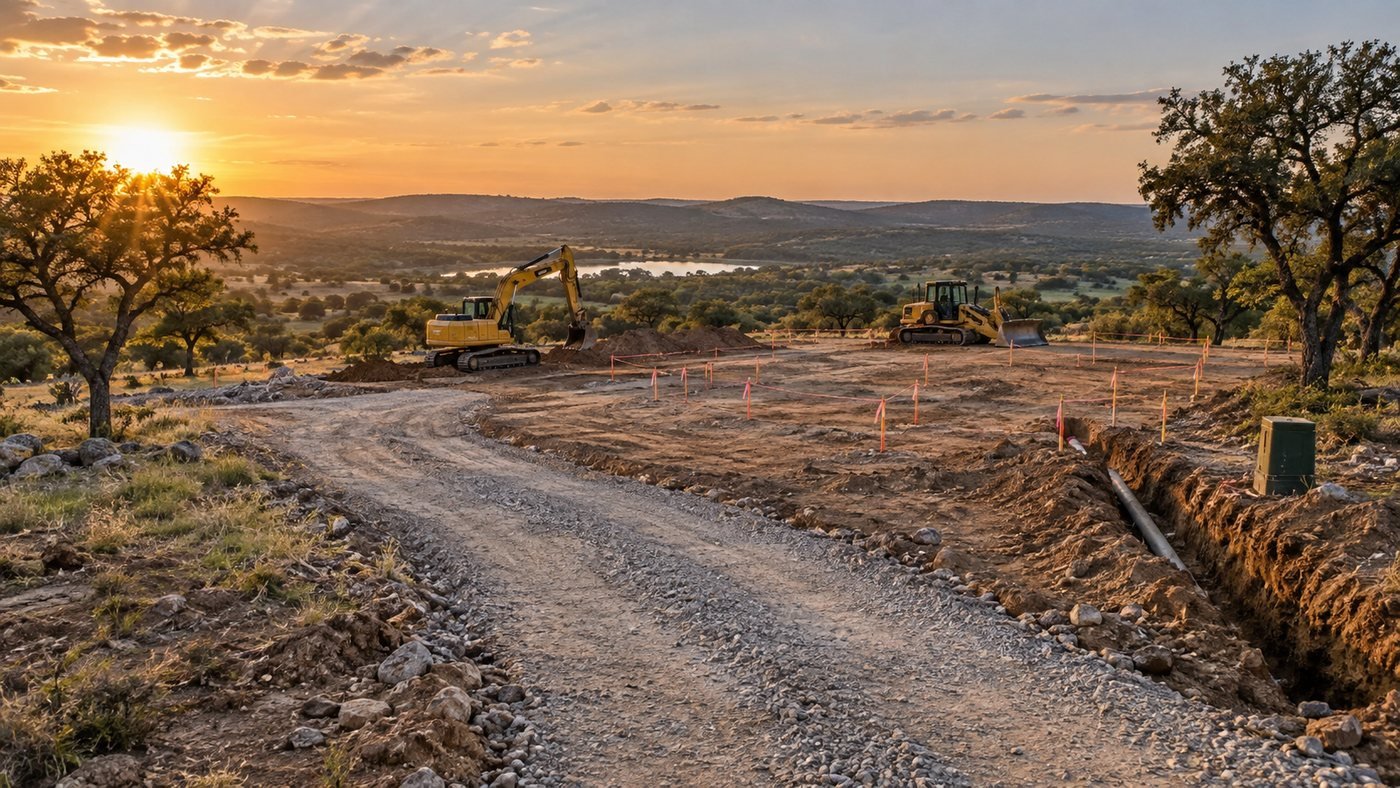
For early planning, a raw Texas parcel that needs the major basics can easily require another $30,000 to $100,000 or more before the house itself is built. That total can include clearing, driveway access, septic, a private water well, electrical service, grading, drainage, permits, and other site work.
Current 2026 consumer data for the Dallas area puts the average cost to bring utilities to land at about $21,032, while a broader rural-land planning tool that combines septic, well, power, driveway, and clearing commonly shows total site costs of $30,000 to $100,000 or more before vertical construction. Those are planning references, not bids.
The range is so wide because a five-acre tract with an existing driveway, nearby power, good soil, and community water is a very different project from a wooded ten-acre tract that needs a deep well, aerobic septic, a long electrical extension, major drainage work, and a 500-foot driveway.
- Simple sites with nearby utilities may stay near the lower end
- Remote or difficult parcels can exceed $100,000 in site development before the house
- Distance to power, well depth, septic type, driveway length, and drainage are major variables
- Do not treat the land purchase price as the full cost of making the property buildable
A realistic raw-land budget is built from separate systems
There is no single line item called raw-land development. The total is the sum of several systems that need to work together. A useful budget separates each category so you can replace planning allowances with real quotes as due diligence progresses.
The main categories are access, clearing, grading, water, wastewater, power, drainage, permits, and contingency. Some properties also need propane, fencing, culverts, retaining work, erosion control, or temporary construction access.
- Survey, due diligence, and site planning
- Land clearing and brush removal
- Driveway, culvert, and construction access
- House pad, excavation, and grading
- Private water well or water-service extension
- Septic system
- Electric service and trenching
- Drainage and erosion control
- Permits, inspections, and local fees
- Contingency for rock, poor soil, long utility runs, and scope changes
Land clearing and site preparation
Current 2026 planning ranges for Texas land clearing often run roughly $1,200 to $6,500 per acre, depending on vegetation density, tree size, terrain, access, debris disposal, and whether the work is simple brush reduction or true grubbing and construction preparation.
Clearing should be separated from grading. Cutting brush or mulching cedar does not create a compacted house pad. If the site needs excavation, imported fill, compaction, drainage shaping, or rock removal, those should be priced as separate scopes.
For a future home or shop, mark the likely building area, driveway, well, septic, and drainage features before clearing begins. Removing too much vegetation too early can create erosion, destroy useful screening, or force expensive rework.
Driveway and rural access costs
Long rural driveways are one of the most underestimated site costs. Current rural planning guides commonly use roughly $15 to $60 per linear foot as a broad allowance for driveway construction, though material, width, culverts, base depth, drainage, and local soil conditions can move the number significantly.
A 300-foot driveway at $15 to $60 per foot represents roughly $4,500 to $18,000 as a planning example. A 600-foot drive doubles that arithmetic before gates, culverts, turnarounds, concrete aprons, or heavy-duty construction access are added.
For acreage, ask whether the driveway is being priced as temporary construction access, a finished gravel drive, or a permanent engineered drive. Those are different products.
Septic system costs
Septic is one of the first feasibility items to investigate because the property determines the system. Current 2026 Texas planning ranges commonly put conventional systems in the mid-thousands, while aerobic or engineered systems can move into the low five figures or higher.
AcreageReady's current Texas septic cost guide uses roughly $3,000 to $8,500 as a broad conventional planning range and about $10,000 to $20,000 for many aerobic systems, with actual pricing driven by site evaluation, soil, setbacks, disposal area, electrical requirements, and local permitting.
Do not finalize the house, pool, shop, guest house, or driveway layout until you understand where the septic and reserve areas can go.
Private water well costs
If public or community water is not available, the well can become one of the largest unknowns in the budget. Current 2026 Texas consumer pricing puts drilling around roughly $28 to $62 per foot, but the complete water system also needs casing, pump equipment, controls, pressure storage, trenching, electrical work, testing, and sometimes treatment.
Using that drilling range, a 300-foot bore represents roughly $8,400 to $18,600 for drilling before the rest of the water system is added. A deeper well, difficult geology, larger pump, storage tank, or treatment system can increase the total substantially.
Review nearby Texas Water Development Board well records before buying, but use them as context rather than a guarantee. Two nearby properties can still have different depths and yields.
Electric service and utility extensions
Power cost depends heavily on where existing service ends and where the meter and building site will be located. A short connection near an existing line may be manageable, while a long extension can become a five-figure project.
Current rural Texas planning guides commonly show longer 500-foot-plus electrical extensions reaching roughly $10,000 to $30,000 or more, depending on the serving utility, overhead versus underground construction, transformers, trenching, easements, and required upgrades.
Do not rely on a real-estate listing that simply says 'electric available.' Ask the serving utility for the actual point of connection, extension policy, customer contribution, transformer requirements, and a written planning estimate when possible.
Grading, drainage, and house-pad preparation
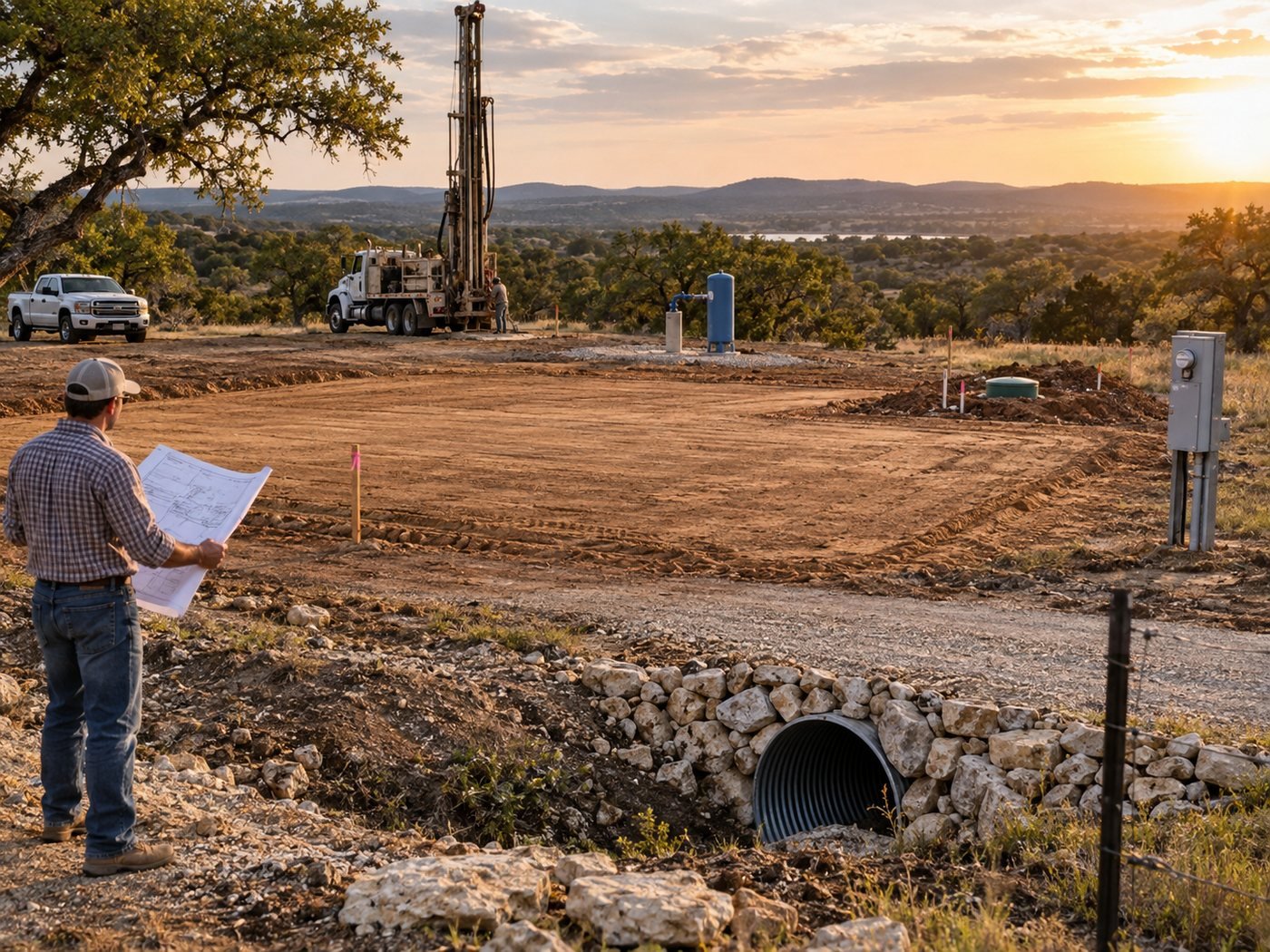
A buildable site needs more than a flat-looking patch of ground. Finished-floor elevation, drainage, soil suitability, imported fill, compaction, rock excavation, swales, culverts, and erosion control can all affect site-prep cost.
North Texas contractors currently advertise basic compacted pads starting in the mid-thousands and more complete clearing, pad, driveway, and drainage packages in the tens of thousands. Those figures illustrate why site work should be budgeted separately from the building contract unless the builder explicitly includes it.
The cheapest pad is not useful if water drains toward the foundation, fill is not compacted correctly, or the driveway becomes impassable during wet weather.
Permits, surveys, and professional services
Texas does not have one universal raw-land development fee. County, city, utility district, groundwater district, floodplain, septic, driveway-access, and building requirements vary by location.
Budget for surveys, site evaluations, engineering where required, permit fees, inspections, utility applications, and any floodplain or access work that applies to the property.
These items may be small compared with the well or driveway, but they control whether the rest of the plan can move forward. Resolve them early rather than after permanent work has started.
Example raw-land development budgets
The examples below are screening budgets only. They show how quickly site costs can stack up even before the house is included.
A relatively straightforward parcel might need $5,000 of clearing and access work, $8,000 for septic, $12,000 for a well system, $7,500 for driveway and drainage, and $5,000 for electrical service. That is already about $37,500 before permits, surveys, grading surprises, or the home.
A more difficult property might need $20,000 of clearing and pad work, $15,000 for aerobic septic, $25,000 for a deeper well, $20,000 for a long driveway, and $20,000 for power extension. That reaches $100,000 before the building itself.
The order of operations can save money
The sequence matters because each system affects the next one. Start with legal access, survey information, easements, flood conditions, and conceptual site planning. Then confirm septic and water feasibility before committing to major clearing or a permanent building pad.
After the basic layout works, plan construction access, clearing, rough grading, utilities, foundation work, and final drainage. The exact order varies by parcel, but permanent improvements should not be placed before the constraints that control them are understood.
- Confirm access, boundaries, easements, and restrictions
- Sketch the home, driveway, well, septic, shop, and future improvements together
- Verify septic and water feasibility
- Get utility-extension information directly from the provider
- Establish construction access and clearing limits
- Complete rough site work and utilities
- Build the structure
- Finish grading, drainage, driveway, landscaping, and erosion control
What to verify before buying raw Texas land
The best time to discover an expensive site condition is before closing. A cheaper parcel can become the more expensive property if it needs a deep well, long power extension, engineered septic, major drainage work, or extensive rock excavation.
Use your due-diligence period to replace assumptions with documents and quotes. The goal is not to know every final cost before buying, but to identify the line items large enough to change the purchase decision.
- Where exactly is the legal and physical access?
- Where is the nearest usable power connection?
- Is water service available, or will you need a private well?
- What do nearby well records suggest about depth?
- Has the property been evaluated for septic?
- What parts of the tract are in flood-prone areas?
- How long will the finished driveway be?
- How much clearing and grading is actually required?
- Where will drainage go after the site is developed?
- What local permits or district rules apply?
Keep researching
Acreage Planning resources
Due diligence, development sequencing, utilities, access, and the decisions that shape a rural property project.
Sources & methodology
Where this information comes from
Cost figures are planning references rather than contractor quotes. Permitting, system-selection, and location-specific guidance should be verified with the appropriate local authority or qualified professional. AcreageReady uses source-backed, AI-assisted editorial workflows and remains responsible for the material it publishes. Read how we research, edit, and correct guides.
- Angi: Cost to Get Utilities on Land in Dallas, TX, 2026
- Before You Buy Land: 2026 Land Development Cost Estimator
- Texas Commission on Environmental Quality: OSSF Permitting
- Texas Water Development Board: Groundwater and Well Data
- Texas Department of Licensing and Regulation: Water Well Drillers and Pump Installers
- Angi: Texas Land Clearing Cost Data
Common questions
Frequently asked questions
How much should I budget to develop raw land in Texas?
A useful early planning allowance is often $30,000 to $100,000 or more before the house, depending on whether the property needs clearing, driveway access, septic, a well, power extension, grading, drainage, and permits. Simple sites can cost less, while remote or difficult parcels can cost substantially more.
What is usually the most expensive part of developing rural land?
It depends on the parcel. Deep wells, long power extensions, long driveways, difficult septic systems, major clearing, rock excavation, and drainage work can each become a major cost driver.
Does 'utilities available' mean utilities are already on the property?
Not necessarily. It can mean service exists somewhere nearby. Confirm the actual connection point, extension cost, capacity, easements, and provider requirements before relying on the listing description.
Should I install septic before clearing the land?
Usually you should establish the septic area and overall site plan before broad clearing begins. Some clearing may be needed for evaluation or access, but permanent clearing limits should account for the home, well, septic, driveway, drainage, and future improvements.
How much contingency should I carry for raw-land development?
A contingency of roughly 10% to 20% is a common planning approach for uncertain site work, but difficult properties may justify more. Rock, poor soils, long utility runs, drainage problems, and scope changes can create significant overruns.
Is raw land cheaper than buying an improved lot?
The purchase price may be lower, but the total project can be higher once access, utilities, septic, water, clearing, grading, drainage, and professional fees are added. Compare total usable-site cost rather than price per acre alone.
Ready to talk with a local professional?
Share your location and project details so AcreageReady can identify relevant providers as the network grows.
Get a free quote