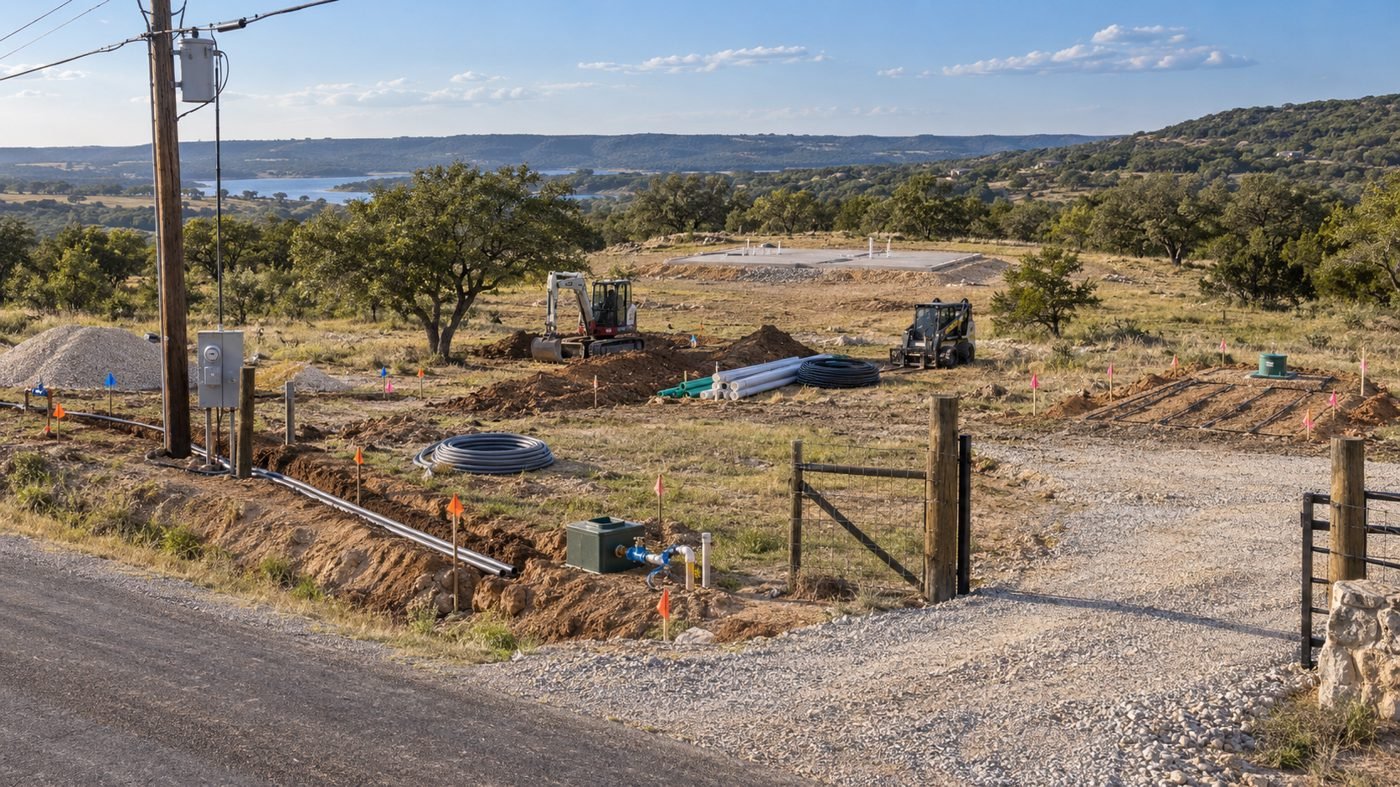
Most rural utility projects land somewhere in the five-figure range
As a broad 2026 planning range, installing the basic utilities on vacant land often falls somewhere between roughly $9,000 and $35,000, with remote or difficult parcels pushing far beyond that. Angi's current national guidance places many projects between about $6,500 and $30,000, while HomeGuide lists an average range of about $9,000 to $34,500 for electricity, water, gas, and septic.
Texas city-level data lands in a similar zone. Angi's 2026 Dallas data shows an average around $21,000, with final cost driven heavily by the distance to existing infrastructure, trenching conditions, whether the property needs a well and septic, and how much of the work the utility versus the landowner is responsible for.
These numbers are useful for screening land, not replacing quotes. Rural utility cost is unusually site-specific.
Electricity can be cheap near an existing line or very expensive on a long extension
Electric service is one of the biggest swing items. If usable power is already at the property and the meter location is close to the home, the cost may be relatively modest. If the serving utility must extend primary or secondary lines, install poles or a transformer, or cross difficult terrain, the cost can jump quickly.
Current 2026 consumer data commonly uses roughly $5 to $25 per linear foot for many electrical extensions. For longer rural runs, screening ranges around $10 to $50 per foot are often used when the utility's free or standard allowance has been exceeded.
Utility policy matters as much as distance. Oncor's current tariff provides up to 300 feet of qualifying overhead single-phase extension at no charge for certain small permanent loads, with customer contributions applying beyond the standard allowance. CoServ likewise has a formal line-extension process for homes, wells, barns, and other rural loads located too far from existing lines.
- Short connection near existing power: potentially low four figures
- General planning range: roughly $5 to $25 per linear foot
- Long rural extension screening range: roughly $10 to $50 per foot beyond allowances
- Possible added costs: transformer work, poles, easements, clearing, trenching, and utility studies
Underground electric usually costs more than overhead
Underground electrical service adds excavation, conduit, underground-rated conductors or cable, bedding, warning tape, backfill, and sometimes rock excavation. It can provide a cleaner site and reduce exposure to trees, but the upfront cost is usually higher.
Texas utility and contractor pricing varies widely because the owner may be responsible for some or all of the trench, conduit, and restoration while the utility provides other portions. Clarify the scope before comparing overhead and underground options.
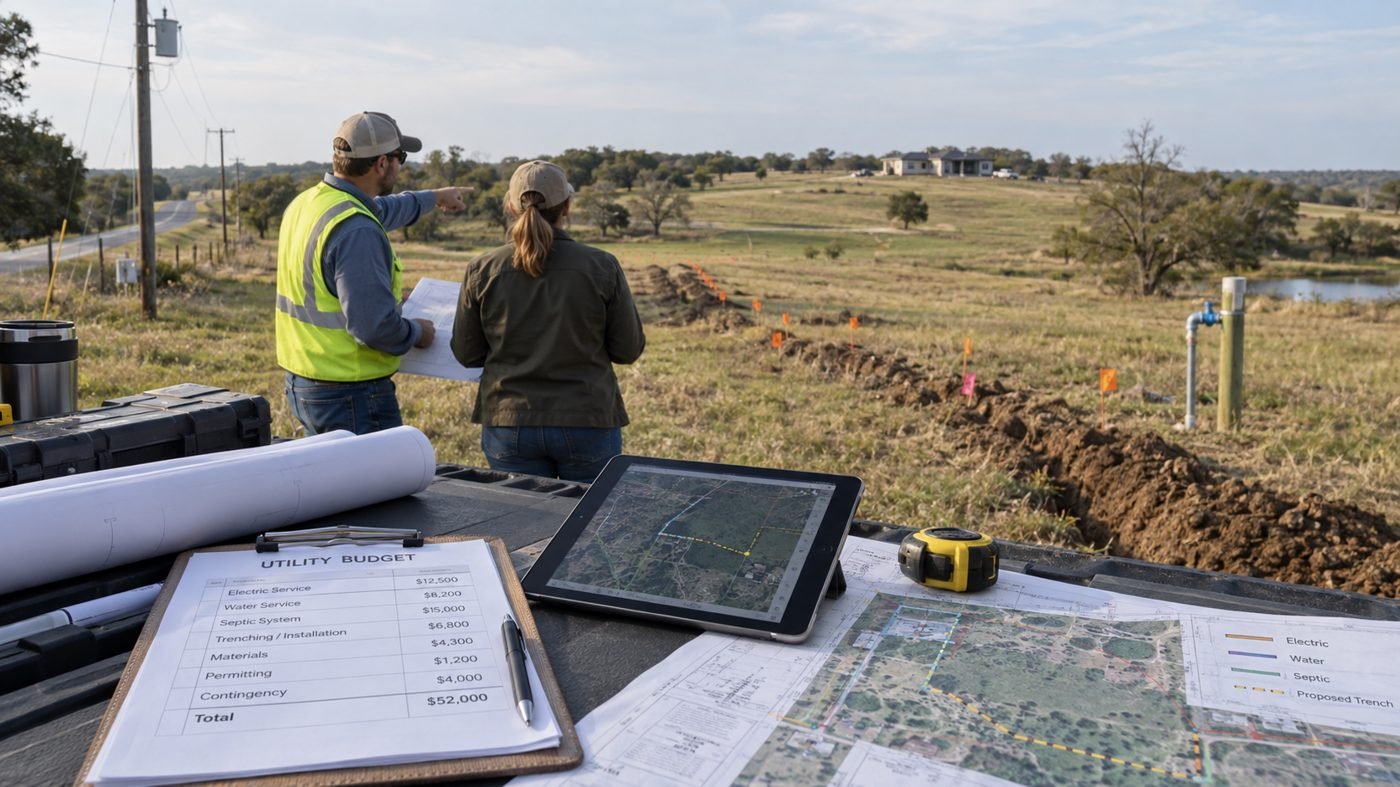
A private well can be one of the largest utility line items
If public water is unavailable, the property may need a private well. Current 2026 Dallas-area consumer data places many well projects around $5,160 to $10,310, while broader rural planning guidance often reaches $15,000 or more for deeper or more complex systems.
The complete water system can include drilling, casing, grouting, pump, wire, controls, pressure tank, trenching, electrical service, water testing, storage, treatment, and a well house or enclosure.
Depth is the major unknown. Nearby well records can help with planning, but they do not guarantee your parcel will hit the same formations, yield, or water quality.
Public water can be less expensive, but the main still has to reach your parcel
Where a rural property can connect to a public or cooperative water system, the project may involve a tap or meter fee plus the private service line from the meter to the home.
Current Dallas-area 2026 data puts many city-water connections around $1,030 to $6,190. However, long line extensions, road crossings, larger meters, pressure issues, or utility impact fees can push the cost higher.
Do not assume a public-water line on the road means a meter is immediately available. Verify capacity and connection requirements with the serving provider.
Septic is usually a major rural utility cost
If there is no public sewer, the property will usually need an on-site sewage facility. Current Dallas-area 2026 data places many new septic installations around $3,510 to $11,860, while difficult sites and advanced treatment systems can exceed those ranges.
The system cost depends on the site evaluation, soil, slope, drainage, design flow, number of bedrooms, system type, pumps and controls, disposal area, permitting, and electrical work.
A conventional gravity system on a suitable site can cost much less than an aerobic or engineered system on difficult soils.
Public sewer connections can be simpler but are not always cheap
If sewer service is available, current 2026 Dallas-area consumer data places many sewer connections around $1,550 to $5,880. Distance to the main, tap fees, impact fees, depth, road boring, lift requirements, and private lateral length can change that significantly.
In fringe-growth areas, a parcel can technically lie near sewer infrastructure but still face a substantial extension or connection cost. Get the utility's requirements in writing before assuming sewer is the cheaper option.
Natural gas is optional on many rural properties
Where natural gas service exists, the cost may include a meter, service line, trenching, and private gas piping. Current Dallas-area 2026 consumer data shows many connections around $515 to $2,060, with underground gas work often priced around $15 to $25 per linear foot.
Many acreage properties simply do not have a gas main nearby. In that case, propane is usually the practical alternative.
Propane installation adds tank and piping cost but avoids a gas-main extension
A propane system can be installed on rural land even when natural gas is unavailable. Current 2026 Dallas-area consumer guidance places many propane tank installations around $620 to $2,580, while broader national ranges can extend to roughly $5,700 depending on tank size and installation type.
A complete propane budget may include the tank, concrete pad or burial, regulators, gas piping, trenching, permits, protective bollards, and initial fuel fill.
If propane will also serve a generator, water heater, furnace, range, or shop, size the tank and piping for the combined load rather than treating each appliance separately.
Internet may be inexpensive to activate or costly to extend
If fiber, cable, or fixed wireless already serves the property, broadband setup may be a relatively small line item. If the provider must extend facilities, bore under a road, add poles, or run a long private conduit, construction charges can become significant.
Because rural broadband varies address by address, verify the exact homesite with the provider rather than budgeting from a nearby neighbor's service.
Trenching can be a major hidden cost
Utility budgets often focus on the equipment and forget the excavation. Current 2026 Texas consumer data puts basic electrical or utility trenching around $395 to $1,240 per 100 linear feet in many situations.
Rock, caliche, tree roots, wet ground, retaining walls, road crossings, existing pavement, creek crossings, and difficult equipment access can increase trenching cost sharply.
Where practical, coordinate utility corridors early so excavation, driveway construction, drainage, and building work do not repeatedly disturb the same ground.
Distance from the road to the homesite matters more than buyers expect
A 50-foot setback and a 1,000-foot setback produce very different infrastructure budgets. Even when utilities reach the road frontage, the landowner may still pay for the private run from the meter or service point to the house.
Long private runs can require larger wire, larger water pipe, booster equipment, pressure calculations, additional pull boxes, conduit, and more excavation. Moving the homesite several hundred feet deeper into the property can add thousands or tens of thousands of dollars.
Rocky or heavily wooded property can increase every utility cost
Utility installation is easier on accessible, open ground with workable soil. Dense trees, steep slopes, limestone, wet areas, drainage channels, and narrow access can increase clearing, excavation, restoration, and equipment costs across multiple trades.
That is one reason two parcels with the same acreage and the same utility distance can have very different development budgets.
Permits, studies, and fees belong in the utility budget
In addition to construction, budget for permits, inspections, site evaluations, utility studies, connection fees, meter fees, septic permits, engineering, easement documents, and possible road-bore permits.
Angi's 2026 national guidance places total utility-related permit fees broadly around $150 to $2,300, with septic permitting often among the larger items. Local fees can be higher or lower.
A practical rural utility budget by scenario
The most useful way to budget raw land is by scenario rather than by one statewide average. A property with power and public water at the road can be dramatically cheaper to develop than a remote tract that needs a long electric extension, well, septic, propane, and extensive trenching.
- Easy parcel with nearby power and public water: often low five figures or less
- Typical rural parcel needing well, septic, and electric work: often $20,000 to $50,000+
- Remote parcel with long power extension, deep well, difficult septic, and heavy excavation: $50,000 to $100,000+ is possible
- Very remote or difficult land can exceed those ranges substantially
Example: a moderately rural Texas homesite
Consider a property that needs a 400-foot electric run, a private well, a septic system, a propane tank, and roughly 300 feet of shared trenching. A rough planning budget could easily land in the $25,000 to $50,000 range before driveway work, house-pad construction, major rock excavation, or unusual permits.
That example is intentionally broad. The electric utility might include part of the extension, the well could be shallower or deeper than expected, and the septic site evaluation could support a simple gravity system or require a more expensive alternative design.
Get utility estimates before finalizing the purchase
The best way to reduce uncertainty is to replace allowances with parcel-specific information during the option or due-diligence period. Ask the electric utility for extension information, verify public-water and sewer availability, review nearby well records, identify the septic authority, and estimate the private distance from each service point to the homesite.
If one utility cost could make the property unaffordable, do not wait until after closing to investigate it.
Utility cost checklist for rural land
Build a simple spreadsheet with one line for every utility and separate the provider's work from the owner's work. That makes missing scope easier to spot.
- Electric utility extension
- Transformer, poles, or underground utility facilities
- Meter base and customer electrical service
- Private trenching and conduit
- Public water tap or private well
- Pressure tank, storage, and water treatment
- Public sewer tap or septic system
- Natural gas connection or propane tank
- Internet or communications extension
- Permits, inspections, engineering, and utility studies
- Easements, surveying, and legal documentation
- Restoration, clearing, road boring, and rock excavation
- Contingency for unknown site conditions
Keep researching
Acreage Planning resources
Due diligence, development sequencing, utilities, access, and the decisions that shape a rural property project.
Sources & methodology
Where this information comes from
Cost figures are planning references rather than contractor quotes. Permitting, system-selection, and location-specific guidance should be verified with the appropriate local authority or qualified professional. AcreageReady uses source-backed, AI-assisted editorial workflows and remains responsible for the material it publishes. Read how we research, edit, and correct guides.
Common questions
Frequently asked questions
How much does it cost to put utilities on rural land?
A broad 2026 planning range is roughly $9,000 to $35,000 for many vacant-land utility projects, but rural parcels can exceed $50,000 or even $100,000 when they need long electric extensions, deep wells, expensive septic systems, rock excavation, or other major infrastructure.
How much does it cost to run electricity to rural land?
Current 2026 planning data commonly uses about $5 to $25 per linear foot for many electric extensions, with long rural runs sometimes screened around $10 to $50 per foot beyond utility allowances. The serving utility's tariff and extension policy control the actual customer contribution.
How much do a well and septic system cost together?
Current rural planning sources often place combined well and septic costs around $6,000 to $20,000, but Texas projects can go higher depending on well depth, pump equipment, soil, septic type, permits, and site conditions.
Is it cheaper to connect to city water and sewer or install a well and septic?
It depends on how close the public mains are and the provider's fees. Short public connections can be cheaper, but long water or sewer extensions can cost more than a private well and septic system. Compare both options using parcel-specific estimates.
What is the biggest hidden utility cost on rural land?
Distance and excavation are two of the biggest surprises. A service may exist at the road, but the landowner can still be responsible for hundreds of feet of trenching, pipe, conduit, wire, restoration, and private distribution to reach the homesite.
Should I get utility estimates before buying rural land?
Yes. If utility cost could affect whether the property works financially, verify service availability and obtain planning estimates during the purchase due-diligence period rather than after closing.
Ready to talk with a local professional?
Share your location and project details so AcreageReady can identify relevant providers as the network grows.
Get a free quote