Land clearing should start with the end use, not the machine
A rural Idaho property can need very different clearing depending on whether the goal is a house pad, driveway, pasture, defensible space, utility corridor, shop site, septic area, or simply better access through overgrown acreage.
The wrong method can create extra grading, drainage, disposal, or restoration work later. Forestry mulching may be ideal for selectively opening wooded acreage, while excavation is often better when roots, stumps, structural fill, and precise grades matter.
Before hiring a contractor, define what must remain, what must be removed, how the cleared area will be used, and what conditions must be left behind for the next phase of construction.
Forestry mulching and excavation solve different problems
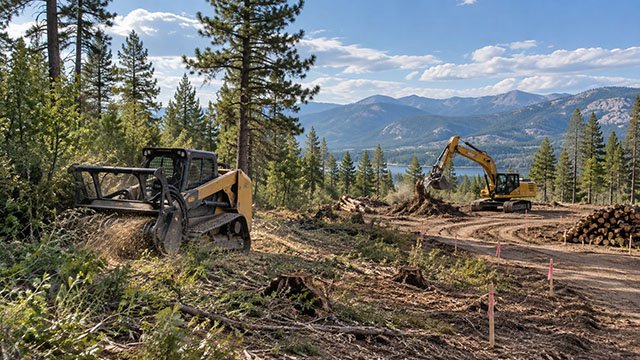
Forestry mulching uses a tracked or wheeled carrier with a mulching head to grind brush, saplings, small trees, and surface vegetation into woody material that remains on site.
Traditional clearing with an excavator, dozer, skid steer, or loader physically removes or pushes vegetation, stumps, roots, and soil.
Neither approach is automatically better. The right choice depends on tree size, slope, soil, future construction, debris plan, fire risk, access, and how aggressively the ground needs to be disturbed.
When forestry mulching works well
Mulching is often a strong fit for selective thinning, brush removal, trail creation, fence-line access, view corridors, overgrown pasture edges, and opening wooded acreage without stripping the site down to bare mineral soil.
Because the machine can process vegetation in place, there may be less hauling and less immediate soil disturbance than with conventional grubbing.
That can make mulching useful when the owner wants to improve access or reduce dense vegetation while preserving many mature trees and keeping the forested character of the property.
What forestry mulching does not do
Mulching does not automatically create a build-ready house pad or finished road base.
Large stumps, buried roots, unsuitable soil, boulders, drainage problems, and grade changes can remain after vegetation is mulched.
If the area will support foundations, slabs, septic components, retaining walls, or engineered fill, additional excavation and compaction work may still be required.
When excavation and grubbing make more sense
Excavation is usually the stronger option where stumps and root systems must be removed, grades must be changed, structural fill will be placed, or the site must be opened for foundations, utilities, septic, or road construction.
An excavator can pull stumps, move boulders, dig drainage features, load debris, and coordinate with grading work in ways a dedicated mulcher cannot.
The tradeoff is greater soil disturbance, larger debris piles, more restoration work, and potentially more erosion exposure if the cleared area is not stabilized quickly.
Many Idaho projects use both methods
A practical acreage-clearing plan often combines equipment rather than relying on one machine.
A mulcher can open access, thin brush, and reduce small vegetation first. An excavator can then remove larger stumps, prepare the building envelope, shape drainage, and handle areas that need structural excavation.
Using each machine for the work it does best can reduce unnecessary disturbance and make debris management easier.
Do not clear the entire parcel just because you can
Overclearing increases cost and can remove wind protection, privacy, shade, wildlife cover, snow-management benefits, and erosion resistance.
It can also create a much larger area that must be graded, seeded, maintained, or defended against invasive weeds.
Clear the house, driveway, utility, septic, fire-safety, and usable-yard areas intentionally while preserving vegetation that does not conflict with the long-term site plan.
Mark the house, driveway, septic, well, and utility corridors first
A clearing contractor works faster and more accurately when the important site features are visible before the machines arrive.
Use survey stakes, paint, flagging, or GPS layout to identify property lines, the proposed building pad, driveway centerline, septic reserve area, well area, utility route, drainage features, and trees that must remain.
This reduces the risk of clearing the wrong area or damaging a feature that another contractor needs later.
Property boundaries matter more than they look
Tree removal near a boundary can create expensive disputes if the line is assumed instead of surveyed.
Old fences, informal roads, tree lines, and GIS parcel maps are not always precise enough for work that permanently removes timber or changes access.
If clearing will occur close to a property line, confirm the boundary with a survey or reliable recorded information before equipment starts.
Streams and forested drainage areas need special care
Idaho's Forest Practices Act is designed to protect forest soil, water, vegetation, wildlife, and aquatic habitat during forest practices.
Idaho Department of Lands guidance includes specific standards for logging, forest roads, stream protection, slash management, and potentially unstable slopes.
If the parcel contains forest land, streams, draws, wetlands, or steep terrain, determine whether the work is a regulated forest practice and what protective measures apply before clearing.
Timber harvesting can trigger Idaho forest-practice notification requirements
Idaho Department of Lands administers a Notification of Forest Practice and Fire Hazard Management process for qualifying timber-harvest activities.
IDL refers to the associated paperwork as the Compliance/Notification or 'slash' or 'brush' form.
A homeowner selectively clearing a few trees around a house site is not always the same as a commercial timber harvest, so discuss the actual scope with IDL when the property is forest land or the work resembles a harvest operation.
Road building through forest land can also fall under forest-practice rules
The Idaho Forest Practices Act covers more than cutting trees. IDL states that its standards address forest road building, reforestation, stream protection, and other forest practices.
That matters when a land-clearing project includes opening a road through wooded acreage rather than simply clearing a residential yard.
Coordinate the road alignment, stream crossings, drainage, and erosion controls before pushing a road into steep or forested terrain.
Clearing one acre or more can trigger construction stormwater requirements
Idaho DEQ requires permit coverage for construction activity that disturbs one acre or more and discharges stormwater, including smaller sites that are part of a common plan of development or sale disturbing one acre or more.
DEQ defines construction activity broadly enough to include clearing, grading, and excavation.
If the clearing is part of a larger home, shop, driveway, utility, or site-development project, calculate the total disturbed area rather than looking only at the footprint being cleared on a single day.
A SWPPP may be required before land disturbance starts
For projects requiring Idaho's Construction General Permit, DEQ requires a Stormwater Pollution Prevention Plan before the Notice of Intent is submitted.
The SWPPP documents erosion and sediment controls, pollution-prevention measures, site drainage, discharge points, inspection procedures, and stabilization practices.
This is one reason large acreage projects should coordinate clearing, grading, and erosion control as one site-development plan instead of separate unrelated jobs.
Bare soil is the biggest difference between clearing methods
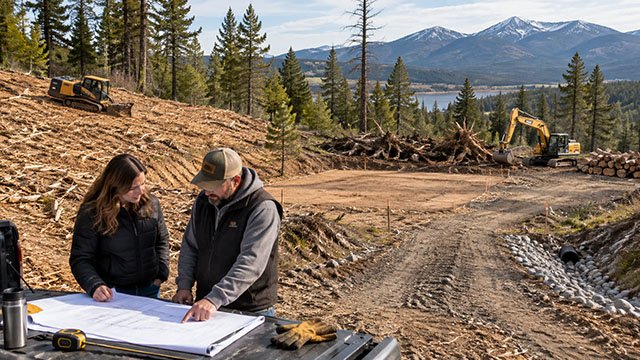
Mulching often leaves a layer of woody material over much of the soil surface, while grubbing and dozer work can expose large areas of bare soil.
Bare soil is much more vulnerable to runoff, erosion, rutting, dust, and weed establishment.
If excavation or grubbing is required, plan temporary stabilization and final seeding before the contractor leaves rather than waiting until erosion becomes visible.
Do not push debris into draws or drainage paths
A windrow of stumps, logs, slash, and soil can act like a small dam when placed across a natural drainage.
Water can pond behind the debris, cut around it, erode the slope, or redirect runoff toward a driveway, building pad, neighboring property, or stream.
Keep debris piles, berms, and windrows out of drainage paths unless they are part of an intentionally designed erosion-control plan.
Stump holes need to be handled differently in structural areas
Pulling stumps leaves disturbed holes filled with roots, organic material, and loose soil.
If the area will become a building pad, driveway, slab, retaining-wall base, or other structural surface, those holes should be excavated and backfilled with suitable material using appropriate compaction.
Simply pushing loose native soil back into large stump holes can create future settlement.
Do not bury large amounts of wood under future improvements
Buried logs, roots, and stumps decompose over time and can leave voids or soft zones.
That makes buried woody debris a poor choice beneath foundations, slabs, roads, parking areas, or engineered fills.
If onsite burial is being considered in a nonstructural area, confirm local rules, drainage implications, future land use, and the long-term settlement risk first.
Debris disposal should be priced before clearing starts
The clearing price can change substantially depending on what happens to logs, brush, stumps, and slash after they are cut.
Common options include mulching, chipping, firewood processing, sawlog removal, hauling to a disposal or recycling facility, creating approved slash piles, or burning natural vegetation where legally allowed.
Ask the contractor to identify the disposal method and any hauling, trucking, tipping, grinding, or burn-pile preparation charges in the bid.
Burning slash is regulated in Idaho
Idaho's statewide fire-safety burn permit is required for burning outside city limits from May 10 through October 20, excluding campfires.
The Idaho Department of Lands burn-permit system also warns that other permits, approvals, local restrictions, tribal requirements, or DEQ air-quality rules may apply.
A burn permit is not permission to burn prohibited material, and the person conducting the burn remains responsible for following current restrictions.
DEQ rules limit what can be burned
Idaho DEQ allows certain outdoor burning of natural vegetation under specific conditions but prohibits burning many wastes such as plastics, tires, treated wood, petroleum materials, insulated wire, and construction waste.
DEQ also notes that local ordinances or burn bans can further restrict outdoor burning.
Keep construction debris separate from clean natural slash so a vegetation pile does not become an illegal mixed-waste burn pile.
Burning is not always the cheapest debris option
Burn piles require safe placement, drying time, fire-weather conditions, permits, monitoring, equipment, and final cleanup.
Large stumps and green logs can burn poorly and smolder for long periods.
On some projects, grinding, chipping, hauling, or processing merchantable wood can be more predictable than maintaining slash piles for a future burn window.
Forestry mulch is not automatically finished landscaping
Fresh mulch can look clean immediately after the machine passes, but it contains uneven chips, shredded wood, small stems, and disturbed vegetation.
The material will settle and decompose over time, and deeper mats may need to be redistributed in areas intended for pasture, lawn, septic, or construction.
Ask the contractor what the finished surface will look like and whether a follow-up pass, raking, grading, or seeding is included.
Mulching too close to the final building pad can create extra cleanup
A thick layer of woody material is useful for erosion control in some nonstructural areas but must usually be stripped from locations that will receive structural fill, concrete, pavement, or compacted aggregate.
If the exact building pad is known, it may be more efficient to grub that area clean while using mulching around the surrounding acreage.
That hybrid approach preserves mulch where it is useful and avoids paying twice to process the same vegetation.
Rocky Idaho ground can change clearing productivity
Shallow bedrock, large boulders, basalt, steep slopes, and dense mature timber can slow equipment and increase wear.
A mulcher that moves quickly through brush may make far less progress in large timber or rocky ground.
Ask contractors to visit the site rather than relying only on acreage totals when the terrain or vegetation is highly variable.
Slope affects both safety and the choice of equipment
Tracked equipment can work on slopes that are difficult for wheeled machines, but every machine has practical and manufacturer limits.
Steep slopes also increase erosion risk and can make stump removal, piling, hauling, and restoration more difficult.
A contractor experienced in mountain property should be able to explain where equipment can safely work and where hand work, selective treatment, or a different approach is needed.
Wet soil can turn a clearing job into a grading problem
Heavy equipment operating on saturated ground can rut the site, compact topsoil, damage roots of trees meant to remain, and push mud into drainage paths.
In some Idaho locations, waiting for drier or frozen conditions can reduce surface damage and restoration cost.
Ask how weather affects the contractor's schedule and what happens if the ground becomes too soft to work responsibly.
Protect the trees you plan to keep
A tree can survive the clearing operation and still decline later if roots are cut, soil is compacted around the trunk, bark is damaged, or grade is changed over the root zone.
Create visible equipment-exclusion zones around high-value trees rather than relying on operators to judge root protection from the cab.
This matters especially around mature pines, firs, shade trees, and trees that will remain close to the future house.
Clearing can expose a property to invasive weeds
Disturbed soil gives opportunistic weeds a place to establish.
Equipment can also move seed or plant fragments between jobs if tracks, tires, buckets, mulching heads, and undercarriages are not cleaned.
Include post-clearing seeding, monitoring, and weed control in the site plan instead of treating vegetation removal as the end of the project.
Plan defensible space without stripping the property bare
In wooded parts of Idaho, clearing may also be part of wildfire-risk reduction.
Effective fuel management can include removing dead material, thinning dense vegetation, pruning lower limbs, separating fuels, and maintaining access rather than simply removing every tree.
Coordinate wildfire goals with local fire-district guidance, Idaho Department of Lands resources, and the long-term landscape plan.
Access for fire apparatus and construction equipment can overlap
A driveway that works for a pickup may not work for a concrete truck, lowboy, drilling rig, fire engine, or utility vehicle.
When opening access, consider width, grade, turn radii, overhead branches, soft shoulders, culverts, gates, and turnaround space.
Clearing the correct access envelope early can prevent repeated tree removal as larger equipment arrives later.
A land-clearing bid should define what 'cleared' means
Contractors use the word 'clearing' differently.
One bid may mean vegetation cut to ground level. Another may include stump removal, grubbing, hauling, rough grading, slash disposal, and final cleanup.
Write the expected finished condition into the scope so every bidder is pricing the same result.
Ask for separate pricing by work type
Breaking the bid into components makes it easier to control the budget and compare methods.
Useful line items can include mobilization, forestry mulching, large-tree removal, stump removal, excavation, hauling, burn-pile construction, chipping, road opening, final grading, seeding, and erosion control.
This also makes it easier to change the scope if the project budget needs to be reduced.
Hourly equipment rates need production assumptions
Hourly pricing can work well when conditions are uncertain, but the owner still needs a realistic idea of expected production.
Ask how many acres, trees, stumps, or linear feet the contractor expects to complete per day under conditions similar to your property.
A lower hourly rate can cost more if the machine is undersized, frequently down, or poorly matched to the vegetation.
Fixed-price clearing needs clear quantity limits
A fixed price is easier to budget but should define the area, tree sizes, stump count or treatment, debris method, and excluded conditions.
If a contractor assumes mostly brush and then discovers mature timber, rock, buried debris, or difficult access, the change-order discussion can become contentious.
Use maps, marked boundaries, photos, and a site walk to make the fixed-price scope as objective as possible.
Questions to ask an Idaho land-clearing contractor
The contractor should be able to explain both the equipment plan and the finished condition.
- Would you use forestry mulching, excavation, dozing, or a combination here?
- What tree and brush sizes can your equipment process efficiently?
- Will stumps be left, ground, pulled, or excavated?
- What will the finished ground surface look like?
- How will logs, brush, stumps, and slash be handled?
- Are hauling and disposal fees included?
- Will you build burn piles, and who handles permits and burning?
- How will you protect trees that remain?
- How will drainage paths and streams be protected?
- What happens if you encounter rock or buried debris?
- Is final grading included?
- Is erosion control or seeding included?
- How do wet ground or wildfire restrictions affect the schedule?
- What work is specifically excluded from the bid?
A practical Idaho land-clearing checklist
Use this sequence before heavy equipment begins work.
- Confirm property boundaries
- Mark trees and areas that must remain
- Lay out the house, driveway, septic, well, utilities, and future buildings
- Identify streams, wetlands, draws, steep slopes, and drainage paths
- Determine whether Idaho forest-practice notification applies
- Determine whether construction stormwater permit coverage applies
- Choose mulching, excavation, or a hybrid method by area
- Decide what happens to logs, brush, stumps, and slash
- Check burn-permit and local fire restrictions before planning to burn
- Keep construction waste out of slash piles
- Protect structural areas from buried organic material
- Plan erosion control and stabilization
- Plan weed control and reseeding
- Define the finished condition in the contractor scope
- Get written exclusions and unit prices for unknown conditions
Coordinate clearing with the rest of the Idaho site-development plan
Land clearing is usually the first visible construction activity, but it should not be planned in isolation.
AcreageReady's Idaho grading, excavation, gravel-driveway, well, septic, rural-power, retaining-wall, and build-ready-land guides can help determine what needs to happen immediately after clearing.
The best clearing plan makes the next contractor's job easier rather than creating extra hauling, grading, drainage, or restoration work.
The best clearing job leaves only what the next phase needs
A successful project is not measured by how many trees or acres were cleared.
It is measured by whether access is usable, important vegetation is protected, drainage still works, debris is managed, structural areas are clean, disturbed soil is stabilized, and the next phase can start without undoing the previous work.
Choose the clearing method around the final property plan, not around whichever machine happens to be available first.
Sources & methodology
Where this information comes from
Cost figures are planning references rather than contractor quotes. Permitting, system-selection, and location-specific guidance should be verified with the appropriate local authority or qualified professional. AcreageReady uses source-backed, AI-assisted editorial workflows and remains responsible for the material it publishes. Read how we research, edit, and correct guides.
- Idaho Department of Environmental Quality: Stormwater
- Idaho Department of Environmental Quality: IPDES Permits
- Idaho Department of Environmental Quality: Can I Burn?
- Idaho Department of Lands: Burn Permit Application
- Idaho Department of Lands: Forest Practices Act
- Idaho Department of Lands: Compliance/Notification
- Idaho Department of Lands: Forest Practices Guidance Documents
- AcreageReady: How Much Does Land Grading Cost in Idaho?
- AcreageReady: Excavation Cost in Idaho
- AcreageReady: How Much Does It Cost to Make Rural Land Build-Ready in Idaho?
Common questions
Frequently asked questions
Is forestry mulching better than excavation for Idaho land clearing?
It depends on the goal. Forestry mulching is often useful for selective brush and small-tree removal with less soil disturbance, while excavation is better when stumps, roots, grade changes, structural areas, or utility work must be addressed.
Do I need a permit to clear land in Idaho?
There is no single statewide land-clearing permit for every project. Depending on the work, forest-practice notification, construction stormwater coverage, local grading rules, burn permits, stream or wetland approvals, and other requirements may apply.
When does Idaho construction stormwater permitting apply to clearing?
Idaho DEQ requires permit coverage for construction activities that disturb one acre or more and discharge stormwater, including qualifying smaller sites that are part of a common plan of development or sale disturbing one acre or more.
Can I burn land-clearing debris in Idaho?
Certain natural vegetation may be burned when allowed, but statewide fire-safety burn permits are required outside city limits from May 10 through October 20, excluding campfires. DEQ air-quality rules, local restrictions, burn bans, and other approvals can also apply.
Can construction debris go into a slash burn pile?
No. Idaho DEQ prohibits burning many construction and trade wastes, including treated wood, plastics, petroleum materials, insulated wire, and similar prohibited materials. Keep those materials separate from clean natural vegetation.
Should stumps be removed before building?
Stumps and large roots should generally be removed from structural areas such as house pads, slabs, roads, and engineered fills. The resulting holes should be backfilled with suitable material and compacted appropriately.
Does forestry mulching remove stumps?
Mulching can reduce above-ground vegetation and may grind some stump material, but it does not necessarily remove the full root system. If the area will be structurally developed, additional grubbing or excavation may be required.
What should be included in a land-clearing bid?
The bid should define the clearing limits, equipment and method, stump treatment, debris handling, hauling, burn-pile work, grading, erosion control, cleanup, exclusions, and unit prices for uncertain conditions such as rock or extra hauling.
Ready to talk with a local professional?
Share your location and project details so AcreageReady can identify relevant providers as the network grows.
Get a free quote