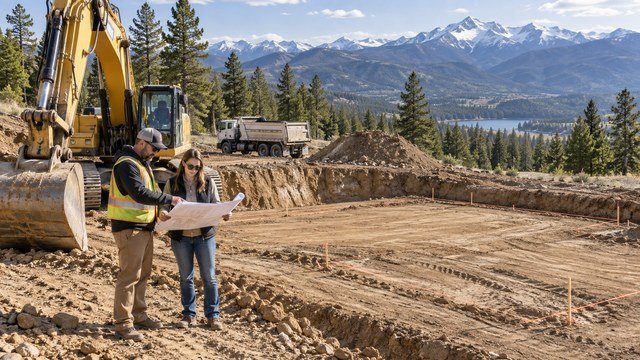
Excavation is one of the hardest rural site-work costs to estimate from a listing
Excavation cost in Idaho depends on how much material must be moved, how deep the work goes, whether the site contains basalt or boulders, how easily equipment can reach the work area, and what happens to the excavated material afterward.
A shallow foundation on workable soil may be straightforward. A mountain homesite with deep cuts, rock breaking, retaining conditions, long utility trenches, and off-site haul can become one of the most expensive parts of preparing raw land.
For acreage buyers, excavation should be treated as a site-specific cost rather than a simple statewide price per cubic yard.
A practical 2026 excavation budget
Current 2026 national data from Angi puts many residential excavation projects between about $1,658 and $6,712, with a national average near $3,973.
That range is useful for small and average residential digs, but raw Idaho acreage can exceed it quickly when the project includes a large house pad, long utility trenches, steep cuts, deep frost-related excavation, difficult access, or rock.
For early land planning, separate ordinary excavation from high-risk items such as basalt, imported fill, haul-off, dewatering, retaining work, and long equipment mobilization.
House-pad excavation is different from foundation excavation
House-pad excavation prepares the overall building area by removing unsuitable material, cutting high ground, filling low areas, and creating the planned elevation.
Foundation excavation is the more precise digging for footings, stem walls, crawlspaces, basements, or slab edges.
A contractor may perform both, but the equipment, tolerances, material handling, and sequencing can be different enough that they should be clearly separated in the quote.
Basements can move a large volume of soil
A full basement can require thousands of cubic feet of material to be excavated and handled.
The cost is not only the dig itself. Soil must be stockpiled, reused, compacted elsewhere, or hauled away, and the excavation must leave enough working room for forms, waterproofing, drainage, and foundation construction.
If the property has rock or limited room for stockpiles, basement excavation can become substantially more expensive.
Basalt and rock are major Idaho excavation risks
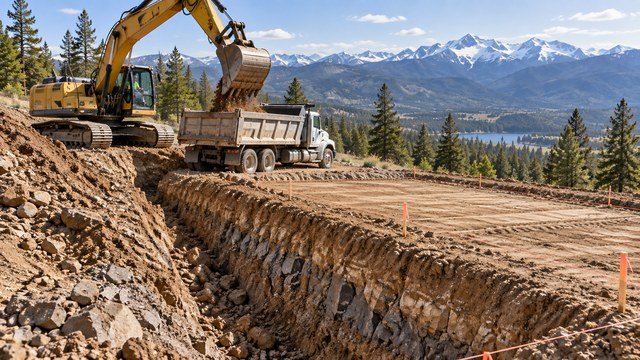
Many parts of Idaho contain shallow basalt, lava rock, boulders, or bedrock that can dramatically reduce production.
Rock may require larger excavators, hydraulic breakers, ripping, drilling, or specialized attachments.
When rock is likely, ask for a separate hourly or unit rate so the change-order exposure is known before excavation starts.
Soil type can change both speed and safety
Loose sandy soils, wet silts, expansive clays, gravelly material, and cohesive native soils behave differently during excavation.
Soil conditions affect how easily the material digs, how stable trench and foundation walls remain, and whether excavated soil can be reused as structural fill.
Angi's 2026 cost data notes that rocky or clay-heavy soil can add roughly $200 to $1,200 to ordinary residential excavation, but large rural projects can see much larger impacts.
Access controls which machines can reach the work
A large excavator may be efficient once it is on site but expensive or impossible to mobilize across a narrow road, weak bridge, steep approach, or tight gate.
Mountain roads, switchbacks, low overhead branches, spring mud, and winter conditions can all limit equipment access.
A site that requires smaller machines or additional staging can take longer even when the actual excavation volume is modest.
Cut and fill should be planned together
Good site design tries to reuse suitable excavated material where practical instead of paying to haul soil away and import replacement fill.
The contractor should understand which material can be reused, which must be stockpiled, and which is unsuitable for structural areas.
Balancing cut and fill can reduce truck traffic, disposal cost, and imported material, but only if the native soil meets the project requirements.
Haul-off can become a major line item
Excess soil, rock, roots, broken concrete, or unsuitable material may need to leave the property.
Haul-off adds loading, truck time, fuel, disposal coordination, and sometimes tipping fees.
Ask how many truckloads are included in the bid and what additional haul-off costs per load or per hour.
Imported fill can cost as much as the excavation
If the excavation removes unsuitable soil or creates low areas, the project may need imported structural fill, gravel, or select material.
The delivered material must then be spread, moisture-conditioned, and compacted in controlled lifts.
On acreage far from a quarry or gravel source, trucking can become a large part of the delivered cost.
Utility trenching is excavation too
Power, water, communications, propane, irrigation, and other utilities often require hundreds of feet of trenching on rural property.
Trench depth, width, soil, rock, separation requirements, bedding, warning tape, conduit, and backfill all affect cost.
If several utilities will follow the same general corridor, coordinate them before digging so the site is not repeatedly opened and repaired.
Well and septic projects create additional excavation
Septic tanks, drainfields, pump chambers, water lines, and well-service trenches all add earthwork.
Some of that work is included in specialty contractor pricing, while other parts may be performed by the excavation contractor.
Clarify responsibility so you do not budget the same excavation twice or discover that trenching was excluded from both quotes.
Drainage excavation should happen before finish grading
Ditches, swales, culverts, drainage crossings, and runoff-control features often require excavation before the final driveway or landscape grades are complete.
If drainage work is delayed, finished areas may need to be torn up and rebuilt.
Sequence major excavation, utilities, drainage, building construction, and final grading so each phase protects the work that came before it.
Call 811 before excavation in Idaho
Idaho's Damage Prevention Board says excavators should contact a one-number notification service at least two business days and no more than ten business days before excavation.
The proposed excavation area must be marked in white, and utilities need time to respond before work begins.
The locate service is free and should be part of routine planning for foundation, trenching, drainage, and driveway excavation.
One acre of disturbance can trigger Idaho stormwater requirements
Idaho DEQ requires construction stormwater permit coverage when a project disturbs one acre or more and discharges stormwater.
Clearing, grading, and excavation all count toward land disturbance, and smaller sites can also qualify when they are part of a larger common plan of development.
Covered projects need a stormwater pollution prevention plan, best management practices, and regular inspections.
Idaho's 2026 construction stormwater fees should be budgeted when applicable
DEQ's current fee schedule lists a $200 application fee for Construction General Permit coverage on projects disturbing 1 to 10 acres.
The application fee rises with larger disturbed acreage, and low-erosivity waivers have their own fee.
The permit fee may be small compared with excavation cost, but erosion-control installation, inspections, and stabilization can add meaningful project expense.
Deep excavation can require engineering and safety planning
Foundation holes and utility trenches can become hazardous when walls are deep, unstable, wet, or loaded by nearby equipment.
Excavation contractors must plan safe slopes, benching, shoring, or protective systems where required.
Do not assume a deep vertical cut can simply remain open because the soil looks firm at the surface.
Groundwater can slow excavation
Shallow groundwater, springs, irrigation leakage, or snowmelt can fill excavations and soften working surfaces.
Dewatering may require pumps, sumps, drainage paths, or a revised construction schedule.
Wet conditions also complicate compaction and can turn haul routes into mud, increasing both time and restoration cost.
Winter excavation can be possible but more expensive
Frozen ground, snow cover, short daylight, and difficult access can reduce productivity.
Frost may require ripping or breaking before normal excavation can proceed, while backfill and compaction can be harder to control.
Ask local contractors whether the project should wait for better conditions or carry a winter-production premium.
Survey control prevents expensive over-excavation
Excavating too deep creates more cost because the missing elevation has to be rebuilt with approved material.
Accurate benchmarks, stakes, laser levels, or machine-control systems help the operator stop at the planned grade.
Confirm who establishes excavation elevations and who is responsible for protecting survey control throughout the job.
Compaction belongs in the excavation scope when backfill supports structures
Backfill around foundations, under slabs, beneath driveways, and in utility trenches may need controlled compaction.
Loose backfill can settle later and damage concrete, pavement, landscaping, or buried utilities.
Ask whether compaction, moisture conditioning, and density testing are included or priced separately.
Stockpile location affects both cost and site usability
Excavated soil needs somewhere to go while foundations and utilities are being built.
Poorly placed stockpiles can block construction access, bury usable topsoil, interfere with septic areas, or force the same dirt to be moved multiple times.
Designate separate stockpile zones for topsoil, reusable structural material, rock, and waste before excavation starts.
Protect septic areas from excavation traffic
Approved drainfields and replacement areas should not become convenient staging or haul routes.
Heavy equipment can compact suitable soil and create drainage problems.
Show the septic areas on the excavation plan and physically mark them before major site work begins.
Excavation pricing can be hourly, unit-rate, or lump sum
Hourly pricing is common when the amount of rock, buried debris, groundwater, or unsuitable soil is uncertain.
Unit pricing may be used for cubic yards of excavation, truckloads of haul-off, breaker hours, or imported fill.
Lump-sum pricing is easier to budget when plans, quantities, access, and finish conditions are well defined.
What should be included in an Idaho excavation quote?
Compare quotes by the complete finished scope rather than the excavator's hourly rate.
- Mobilization
- Site clearing related to excavation
- Topsoil stripping and stockpiling
- House-pad excavation
- Foundation excavation
- Basement excavation if applicable
- Utility trenching
- Drainage excavation
- Rock excavation allowance
- Breaker or ripping rate
- Groundwater or dewatering allowance
- Excavated material stockpiling
- Haul-off quantity
- Disposal fees if applicable
- Imported fill
- Backfill
- Compaction
- Density testing if required
- Final rough grading
- Erosion-control restoration
- Hourly and unit rates for hidden conditions
Questions to ask an Idaho excavation contractor
A good contractor should be able to explain quantities, material handling, and risk rather than simply naming a machine rate.
- What equipment will you use?
- How much material do you expect to move?
- Can native soil be reused?
- How will basalt or unexpected rock be priced?
- How much haul-off is included?
- Where will stockpiles go?
- What imported material may be required?
- Is compaction included?
- Who handles 811 notification?
- Does the disturbed area trigger stormwater permitting?
- How will groundwater be handled?
- What conditions would cause a change order?
A practical rural Idaho excavation example
Consider a house site that needs a foundation dig, a short basement cut, 300 feet of utility trench, drainage swales, and modest pad correction.
On workable soil with good access, the project may remain within a manageable five-figure site-work budget when combined with grading. Add basalt, deep cuts, dewatering, or dozens of haul trucks and the number can rise quickly.
The best time to identify those risks is before finalizing the homesite and construction budget.
Excavation should be evaluated with the whole development plan
Excavation connects nearly every major rural-land system: foundations, driveway access, drainage, septic, well, utilities, grading, and future buildings.
A property with a lower purchase price can become much more expensive if its best homesite requires major rock excavation and long utility trenches.
Compare Idaho acreage using total development cost rather than assuming all raw land requires similar earthwork.
Keep researching
Land & Site Work resources
Clearing, grading, drainage, driveways, pads, excavation, and preparing acreage for construction.
Sources & methodology
Where this information comes from
Cost figures are planning references rather than contractor quotes. Permitting, system-selection, and location-specific guidance should be verified with the appropriate local authority or qualified professional. AcreageReady uses source-backed, AI-assisted editorial workflows and remains responsible for the material it publishes. Read how we research, edit, and correct guides.
- Angi: 2026 Excavation Cost Guide
- Idaho Department of Environmental Quality: Stormwater Permits
- Idaho Department of Environmental Quality: IPDES Permits
- Idaho Department of Environmental Quality: Permit and Application Fees
- Idaho Damage Prevention Board: Excavation Requirements
- AcreageReady: How Much Does It Cost to Grade Land for a House in Idaho?
- AcreageReady: How Much Does Land Clearing Cost in Idaho? 2026 Guide
- AcreageReady: How Much Does a Gravel Driveway Cost in Idaho?
- AcreageReady: Rural Driveway Drainage in Idaho
Common questions
Frequently asked questions
How much does excavation cost in Idaho in 2026?
Current national 2026 data places many residential excavation projects between about $1,658 and $6,712, but Idaho acreage projects can cost substantially more when they include large pads, basements, long trenches, basalt, steep terrain, haul-off, or groundwater.
Why is excavation expensive on some Idaho properties?
Major cost drivers include basalt and bedrock, steep slopes, difficult equipment access, deep cuts, long trenching distances, groundwater, unsuitable soils, imported fill, and excess material that must be hauled away.
Do I need to call 811 before excavating in Idaho?
Yes when excavation could affect underground facilities. Idaho's Damage Prevention Board says to contact a one-number notification service at least two business days and no more than ten business days before excavation.
Does excavation trigger an Idaho stormwater permit?
Idaho DEQ requires construction stormwater coverage when a project disturbs one acre or more and discharges stormwater. Smaller sites can also qualify when they are part of a larger common plan of development or sale.
How much is Idaho's construction stormwater permit fee?
Idaho DEQ's current fee schedule lists a $200 application fee for Construction General Permit coverage on projects disturbing 1 to 10 acres. Larger disturbed areas have higher fees.
Should excavation and grading be quoted together?
They often overlap, but the quote should still distinguish foundation or trench excavation, material handling, fill, compaction, grading, rock, and haul-off so you can compare scope accurately.
Ready to talk with a local professional?
Share your location and project details so AcreageReady can identify relevant providers as the network grows.
Get a free quote