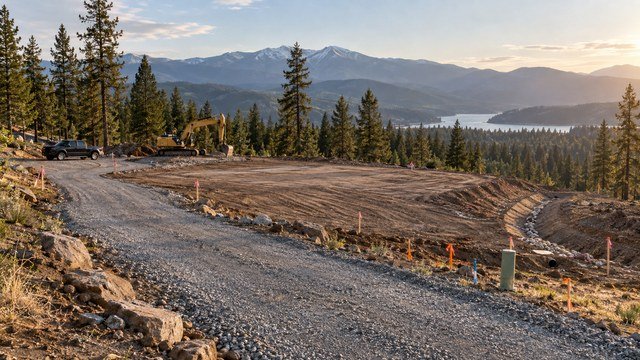
The purchase price is only the first number that matters
A rural Idaho parcel can look affordable until you add the cost of access, water, wastewater, power, grading, drainage, excavation, permits, and site preparation.
The real question is not simply whether you can afford the land. It is whether you can afford to turn that land into a buildable homesite.
For raw acreage, a realistic development budget should be assembled before closing whenever possible so a low land price does not hide a high site-development cost.
A practical 2026 build-ready budget
There is no single statewide number because Idaho properties vary dramatically by terrain, rock, utility distance, soil, groundwater, access, and location.
As a broad screening framework, a relatively straightforward parcel with good access, workable soils, nearby power, conventional septic, and a modest well may need several tens of thousands of dollars in pre-construction development.
A difficult parcel with a deep well, long power extension, steep grading, rock excavation, retaining walls, major driveway work, or advanced septic can move well into six figures before the house itself is built.
Think in systems, not isolated contractor bids
The driveway affects where trucks can reach. The homesite affects power distance. The well and septic system need protected locations. Drainage affects the road, house pad, and retaining walls.
Because the systems interact, the cheapest individual decision is not always the cheapest overall project.
The strongest plan lays out access, house, septic, well, power, drainage, and future buildings before major construction begins.
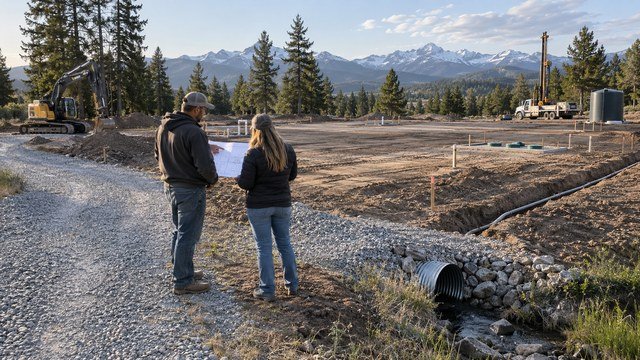
Land clearing can be the first major cost
Light brush clearing can be relatively inexpensive, while dense timber, stump removal, steep terrain, basalt, and haul-off can increase the cost quickly.
For Idaho planning, light clearing may start around the low thousands per acre, while heavy forestry mulching, full grubbing, and construction-ready clearing can cost several thousand dollars per acre or more.
Selective clearing usually saves money and preserves privacy, wind protection, habitat, and mature trees.
Grading determines whether the homesite actually works
Rough grading establishes the house pad, driveway elevations, drainage paths, and general site shape.
Simple residential grading can remain in the low thousands, while substantial cut and fill, imported material, haul-off, basalt, steep slopes, and structural compaction can push rural Idaho grading into the $10,000 to $30,000 range or higher.
Moving the house pad even a short distance can sometimes reduce grading cost materially.
Excavation is where hidden site conditions show up
Foundation digs, basement cuts, utility trenches, drainage work, and pad excavation all add earthwork.
Current 2026 national pricing data places many standard residential excavation projects around $1,658 to $6,712, but raw acreage can exceed that range quickly when rock, deep cuts, long trenches, difficult access, or groundwater are involved.
Idaho basalt and shallow rock are especially important risks because they can require breakers, ripping, larger excavators, and additional haul-off.
A gravel driveway can become a major rural infrastructure project
A short driveway on firm soil may be manageable, but a long rural road can require clearing, excavation, geotextile, several aggregate layers, drainage, culverts, compaction, and a turnaround.
Current 2026 driveway pricing commonly runs about $1 to $10 per square foot, with long rural driveways increasing quickly once site preparation and drainage are included.
Build the driveway for well rigs, concrete trucks, septic equipment, and delivery vehicles rather than only for passenger cars.
Drainage is what keeps the driveway from becoming a recurring expense
Culverts, roadside ditches, crowns, cross-slope, rolling dips, and stable outlets move water off and under the driveway.
Idaho snowmelt and spring thaw can expose weak drainage designs quickly.
It is usually cheaper to build drainage correctly during initial road construction than to repair washed-out gravel, plugged culverts, and saturated road base every year.
A private well can vary from manageable to very expensive
Well cost depends primarily on drilling depth, geology, casing, pump size, pressure system, water treatment, and access for the drilling rig.
A shallow productive well can fit comfortably within a normal rural-development budget, while a deep well in difficult geology can become one of the largest utility costs on the property.
Research nearby well logs and talk with local drillers before using a statewide average as your budget.
Septic cost depends on whether the site supports a conventional system
A conventional septic system is usually far less expensive than a pressure-distribution, enhanced-treatment, or otherwise advanced system.
Soil depth, groundwater, slope, drainfield area, replacement area, and wastewater flow determine what can be approved.
Central District Health's July 2026 fee schedule lists $1,070 for a new septic permit requiring a test hole or site visit and $535 for a speculative site evaluation, before the actual system installation cost.
A septic site evaluation should happen before you commit to the homesite
The site evaluation determines where suitable septic soil exists and whether a conventional or more complex system is likely.
That location can affect where the house, driveway, shop, well, and future guest structures should go.
Protect the approved drainfield and replacement area from grading, compaction, buildings, and vehicle traffic.
Power cost is all about distance and existing infrastructure
A parcel near usable electrical facilities can be relatively straightforward to serve. A parcel requiring hundreds or thousands of feet of new line, poles, transformers, underground trenching, road crossings, or easements can become expensive.
Idaho Power's residential estimator is designed for early planning and distinguishes overhead, overhead-to-underground, and underground options.
Idaho Power also notes that estimator results are preliminary and can exclude service from the transformer to the meter, rights-of-way, permits, easements, rock or frost digging, landscape replacement, and road repair.
Underground electrical service adds trenching and conduit costs
Idaho Power's current cost information shows that underground service charges vary substantially depending on cable size and whether the customer or utility provides the trench and conduit.
The published per-foot charges are only one piece of the electrical budget and should not be confused with the complete cost of extending primary power to previously unserved land.
Ask the utility for a formal project-specific quote once the homesite and meter location are defined.
Retaining walls can change the economics of a sloped parcel
Retaining walls can create usable space for a driveway, house pad, shop, parking area, or yard.
Current 2026 pricing commonly places professionally installed retaining walls around $35 to $65 per square foot of wall face, with engineered structural walls costing more when height, surcharge, drainage, rock, and difficult access are involved.
On steep acreage, moving the homesite may be cheaper than building large structural walls.
Permits and professional services belong in the budget
Development can involve septic permits, building or grading permits, driveway-approach approvals, stormwater requirements, surveys, engineering, geotechnical work, and utility fees.
Idaho DEQ requires construction stormwater coverage for qualifying projects disturbing one acre or more, including clearing, grading, and excavation.
Local cities, counties, and highway districts can add their own permit, drainage, access, and hillside requirements.
Surveying early can prevent expensive mistakes
Boundary, topographic, or construction surveys can help confirm property lines, easements, homesite elevations, road alignment, and drainage.
A survey is often cheaper than relocating a driveway, moving a wall, or discovering that a planned improvement crosses an easement after construction begins.
For complex acreage, a topographic survey can also improve grading and drainage estimates before earthwork starts.
Rock should have its own contingency
Visible surface rock is only part of the risk. Basalt, boulders, and bedrock can appear during foundation excavation, septic work, trenching, retaining-wall construction, and driveway cuts.
Ask contractors for separate breaker, ripping, and rock-haul rates where possible.
A specific rock contingency makes the development budget more realistic than hoping excavation will stay within normal-soil pricing.
Distance from suppliers can matter almost as much as material price
Gravel, concrete, retaining-wall block, pipe, septic materials, and structural fill are heavy and expensive to transport.
Remote acreage can pay more because trucks spend more time traveling and may carry smaller loads on difficult roads.
When comparing parcels, consider how far the property is from gravel pits, concrete plants, equipment rental, contractors, and utility infrastructure.
A 15 to 25 percent site-development contingency is reasonable on uncertain land
Raw land contains more unknowns than a finished residential lot.
Unexpected rock, unsuitable soil, groundwater, deeper wells, longer utility routes, drainage changes, and additional haul-off can all create change orders.
For early planning, carrying a meaningful site-work contingency is usually safer than budgeting every line item at the optimistic end of the range.
A sample build-ready budget for straightforward Idaho acreage
Imagine a parcel with a moderate driveway, light clearing, manageable grading, conventional septic, a normal-depth well, and power relatively close to the homesite.
The combined cost of access, clearing, grading, excavation, well, septic, power, drainage, and permits can still reach several tens of thousands of dollars before foundation construction begins.
The exact number matters less than recognizing that raw-land development is a bundle of infrastructure costs, not one site-prep invoice.
A difficult parcel can exceed $100,000 in development before the house
Now consider a steep parcel with a long gravel road, substantial drainage, retaining walls, basalt excavation, a deep well, advanced septic, and a long power extension.
Those individual problems compound rather than simply add because they can require more equipment, longer schedules, engineering, haul-off, and material delivery.
This is why a lower purchase price does not automatically make difficult acreage the better value.
The best due-diligence sequence reduces uncertainty before closing
You do not need final construction drawings to investigate the biggest cost risks.
- Confirm legal and practical access
- Identify the serving electric utility
- Request preliminary power-extension information
- Review nearby well logs and call local drillers
- Request existing septic records
- Schedule a speculative septic site evaluation where appropriate
- Walk the property with a site-work contractor
- Identify likely homesite and driveway routes
- Estimate clearing and grading needs
- Look for visible rock, drainage, and slope problems
- Check local driveway, grading, hillside, and stormwater requirements
- Build a site-development budget before removing due-diligence contingencies
What should be in your Idaho build-ready budget?
A complete screening budget should include more than the obvious utilities.
- Surveying
- Clearing
- Stump removal and grubbing
- Rough grading
- House-pad preparation
- Foundation excavation
- Rock contingency
- Driveway construction
- Culverts and drainage
- Retaining walls if needed
- Well drilling and pump system
- Water testing or treatment
- Septic evaluation and permit
- Septic installation
- Power extension
- Meter and electrician work
- Communications trenching
- Stormwater and erosion control
- Permit and review fees
- Engineering or geotechnical services
- Material delivery and haul-off
- Temporary construction access or power
- Site-development contingency
The right parcel is the one with the best total project economics
Acreage value is not just price per acre.
A slightly more expensive parcel with good road access, favorable septic soil, a productive well area, nearby power, and a gentle homesite can be cheaper to develop than a bargain parcel with major infrastructure challenges.
Use the build-ready budget to compare properties on the same basis: what will it actually cost to get from raw land to a site where the house can be built?
Keep researching
Acreage Planning resources
Due diligence, development sequencing, utilities, access, and the decisions that shape a rural property project.
Sources & methodology
Where this information comes from
Cost figures are planning references rather than contractor quotes. Permitting, system-selection, and location-specific guidance should be verified with the appropriate local authority or qualified professional. AcreageReady uses source-backed, AI-assisted editorial workflows and remains responsible for the material it publishes. Read how we research, edit, and correct guides.
- Idaho Power: Residential Service Estimator
- Idaho Power: Residential Estimate Disclaimer
- Idaho Department of Environmental Quality: Stormwater Permits
- Central District Health: Septic, Subdivisions & Water
- AcreageReady: Buying Rural Land in Idaho
- AcreageReady: How Much Does It Cost to Drill a Well in Idaho?
- AcreageReady: How Much Does a Septic System Cost in Idaho?
- AcreageReady: Idaho Septic Permits & Site Evaluations
- AcreageReady: How Much Does It Cost to Bring Power to Rural Property in Idaho?
- AcreageReady: How Much Does Land Clearing Cost in Idaho?
- AcreageReady: How Much Does It Cost to Grade Land for a House in Idaho?
- AcreageReady: How Much Does a Gravel Driveway Cost in Idaho?
- AcreageReady: Rural Driveway Drainage in Idaho
- AcreageReady: How Much Does Excavation Cost in Idaho?
- AcreageReady: How Much Does a Retaining Wall Cost in Idaho?
Common questions
Frequently asked questions
How much does it cost to make rural land build-ready in Idaho?
There is no single statewide number. Straightforward acreage may require several tens of thousands of dollars in access, utilities, septic, well, clearing, grading, drainage, and permits, while difficult sites can exceed $100,000 before house construction begins.
What is usually the most expensive part of developing raw land in Idaho?
The largest costs often come from combinations of well depth, septic complexity, power-extension distance, long driveways, major grading, rock excavation, and retaining walls. Which item dominates depends on the specific parcel.
How much contingency should I carry for Idaho site development?
For raw land with meaningful unknowns, a 15 to 25 percent contingency on site-development costs is a practical planning range. Parcels with known rock, steep slopes, groundwater, or uncertain utility routes may justify more.
Should I price utilities before buying Idaho acreage?
Yes. At minimum, identify the serving electric utility, review nearby well information, investigate septic feasibility, and estimate access and grading during due diligence.
Does Idaho require stormwater permits for site development?
Idaho DEQ requires construction stormwater coverage for qualifying projects disturbing one acre or more, including clearing, grading, and excavation. Smaller sites can also qualify when part of a larger common plan of development.
Is cheaper rural land always cheaper to develop?
No. A lower-priced parcel can cost more overall if it needs a deep well, advanced septic, long power extension, major driveway, retaining walls, or significant excavation. Compare total development cost rather than land price alone.
Ready to talk with a local professional?
Share your location and project details so AcreageReady can identify relevant providers as the network grows.
Get a free quote