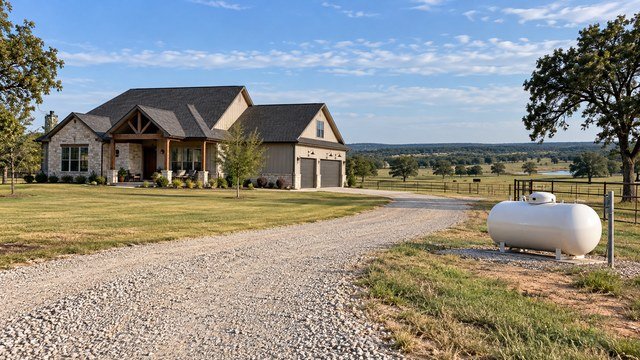
Propane can solve several rural utility problems at once
On Oklahoma acreage without natural-gas service, propane can supply space heating, water heating, cooking, fireplaces, clothes drying, shop heat, pool equipment, and standby generators.
That flexibility can reduce electric load and provide a practical fuel option where extending natural gas is not realistic.
The tradeoff is that the tank, delivery route, piping, appliance load, and refill schedule all need to be planned as part of the site design rather than added at the end.
Start by deciding what propane will actually serve
Tank sizing begins with the appliance list, not the acreage size.
A home using propane only for a cooktop may need far less storage than a home using propane for heat, water heating, a fireplace, dryer, shop heater, and whole-house generator.
List every planned propane appliance and its input rating before asking a supplier to recommend a tank.
Common residential tank sizes
Rural residential propane systems commonly use tanks in the 250-, 500-, and 1,000-gallon class, although smaller and larger containers exist for specific applications.
A larger tank can reduce refill frequency and provide more reserve during cold weather or generator use, but it also requires more site area, higher upfront cost, and appropriate installation access.
The right size depends on annual demand, winter peak load, delivery availability, and whether the tank is owned or leased.
A 500-gallon tank is common, but it is not automatically the right answer
Many rural homes use a 500-gallon tank because it can support multiple household appliances without becoming an unusually large installation.
However, a high-load home with propane heat and a large standby generator may benefit from more storage, while a lightly used system may not need that much capacity.
Ask the supplier to size the system from the combined appliance load and expected usage pattern rather than selecting a tank by habit.
A 1,000-gallon tank can provide useful reserve
Larger storage can be valuable on remote properties, homes with major generator loads, or sites where winter delivery may be less convenient.
It can also allow a homeowner to purchase more fuel when pricing is favorable if the supplier's policies support that strategy.
The larger footprint and installation requirements mean the tank location should be considered early in the site plan.
Propane tanks are not normally filled to their full water capacity
Propane expands as temperature changes, so a storage container needs vapor space rather than being filled completely with liquid.
The usable fuel volume is therefore less than the tank's nominal water-capacity label.
When estimating runtime or refill frequency, use the supplier's usable-capacity assumptions rather than treating a 500-gallon tank as 500 gallons of deliverable propane.
Above-ground tanks are usually simpler to install
Above-ground tanks avoid excavation and make inspection, service, and future replacement easier.
They are also easier to locate and protect from accidental digging.
The visual impact is the main drawback, so many acreage owners use fencing, landscaping, or thoughtful placement to reduce visibility without blocking required service access or ventilation.
Underground tanks can improve appearance
An underground propane tank can preserve views and reduce the visual presence of utility equipment near a rural home.
However, underground installation adds excavation, backfill, corrosion-protection requirements, and future access considerations.
Oklahoma LP Gas Administration forms include cathodic-protection documentation for underground propane tanks, reinforcing that corrosion protection is part of the long-term installation.
Do not place the tank before the final house and driveway plan exists
Tank placement has to work with the home, property lines, ignition sources, overhead electrical lines, driveways, other fuel tanks, and the delivery truck route.
Moving a tank later can require new piping, excavation, permits or inspections, and another mobilization.
Coordinate the propane location with the house pad, septic system, well, generator, utility trenching, gates, and future shop before construction starts.
Oklahoma uses NFPA 54 and NFPA 58 standards
Oklahoma LP Gas Administration rules adopt nationally recognized standards for gas piping, appliances, and LP-gas installations.
The state rules reference NFPA 54 for fuel-gas systems and NFPA 58 for LP-gas storage and handling.
Because separation distances and installation details depend on tank size and site conditions, use a licensed Oklahoma propane professional to lay out the final tank location rather than relying on a generic distance chart.
Large and commercial installations can require plan approval
Oklahoma's LP Gas Administration requires plans to be submitted for certain larger fixed installations, including individual containers with water capacity of 2,000 gallons or more or aggregate capacity above 4,000 gallons, along with certain public-building and dispenser installations.
Typical residential acreage systems are often smaller than those thresholds, but they still must comply with applicable state rules and adopted safety standards.
If the property includes agricultural, commercial, event, or other nonresidential uses, ask the installer whether additional review applies.
Pressure and leak testing should be documented
Oklahoma rules require applicable pressure and leak tests under NFPA 54, NFPA 58, and state rules to be documented on an approved Form 4 or other approved form.
The installer should test the completed piping system before placing it into service.
Keep the homeowner copy of inspection and test documentation with the property records.
Tank foundation and support matter
A propane container is heavy even before fuel is added, so it needs stable noncombustible support appropriate to the tank and installation.
Oklahoma's tank-application materials reference concrete or masonry foundations and NFPA 58 support requirements for fixed containers.
Soft fill, poorly compacted soil, drainage channels, and unstable slopes are poor locations for a tank pad.
The delivery truck needs dependable access
A tank can be legally located yet still be inconvenient or expensive to serve if the delivery truck cannot reach it safely.
Consider driveway width, gate opening, turning radius, grade, overhead branches, mud, soft shoulders, low-water crossings, bridges, and winter conditions.
Ask the propane supplier to review the route before finalizing the tank site on a long rural driveway.
Remote tank placement can create long hose or piping problems
Placing the tank far from both the driveway and house may look attractive on the site plan but can complicate fuel delivery and underground piping.
The delivery company has practical hose-reach limits, while the gas system may need larger piping or different pressure regulation over long runs.
A good location balances appearance, code-compliant separation, delivery access, and piping efficiency.
Own versus lease is an important financial decision
Some Oklahoma propane suppliers lease tanks to customers, while others sell tanks or support customer-owned installations.
Leasing can reduce upfront equipment cost and may include service obligations, but it can also tie the customer to the tank owner's fuel-delivery terms.
Owning the tank can provide more flexibility in choosing suppliers, but the owner takes on the equipment investment and maintenance responsibility.
Read the tank lease before assuming you can shop fuel prices
A leased tank usually remains the propane company's property.
Supplier agreements can restrict who may fill the tank, establish minimum annual purchases, set delivery rules, or include tank-removal charges when service ends.
Compare the long-term agreement, not just the first fill price.
Buying a tank can make sense for a long-term property
A customer-owned tank may be attractive for an acreage owner who expects to stay for many years and wants more control over supplier selection.
The upfront cost is higher, and the homeowner should keep records showing tank ownership, installation, inspection, and maintenance.
Before buying a used tank, verify that a licensed supplier is willing to inspect, install, and fill it under Oklahoma requirements.
Do not buy a used tank before talking to local suppliers
A bargain tank can become expensive if it lacks legible data plates, has corrosion, needs valve replacement, does not meet current requirements, or is a supplier-owned tank being sold without authority.
Underground tanks raise additional corrosion and cathodic-protection questions.
Get the installer to approve the specific container before money changes hands.
Propane piping should be planned with other trenches
Rural construction often involves separate runs for electric, water, communications, propane, and sometimes sewer or septic force lines.
Each utility has its own clearance and installation requirements, so combining trench work does not mean all lines can simply be placed together.
Coordinate routes before excavation so one contractor does not damage another utility or force expensive rework.
Long gas runs may require different pressure and pipe sizing
Gas pressure drops with distance and appliance demand.
A detached shop, outdoor kitchen, generator, pool heater, or guest house hundreds of feet from the tank can require a different regulator and pipe-sizing strategy than a short residential run.
Give the installer the full future load plan, not only the appliances being connected on day one.
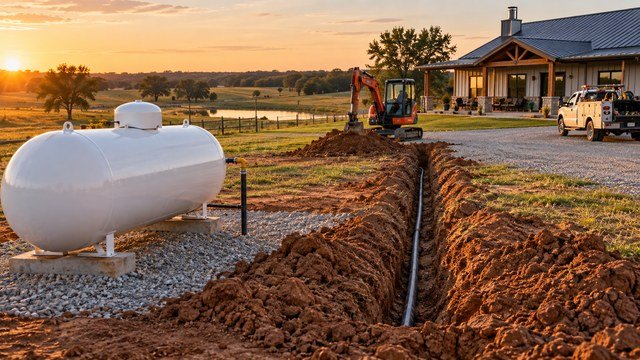
Plan for future buildings before burying the system
If the acreage will eventually have a shop, guest house, pool, outdoor kitchen, or second residence, identify those likely loads now.
It may be cheaper to reserve routes, install sleeves under driveways, or size portions of the system for future expansion during initial construction.
Future propane service should also be coordinated with easements, septic areas, and electrical infrastructure.
Standby generators can dramatically increase propane demand
A whole-house generator can consume propane much faster than normal household appliances during an extended outage.
Generator fuel use depends on generator size and electrical load, so tank sizing should account for the runtime reserve you actually want.
A tank adequate for cooking and water heating may provide disappointing backup duration once a large generator is added.
A generator changes the refill strategy
If the generator is part of the home's emergency plan, do not operate the system with the tank routinely near empty.
Ask the supplier about automatic delivery, remote tank monitoring, minimum delivery quantities, and severe-weather service policies.
A larger tank or earlier refill trigger may be worthwhile where outages and rural delivery delays are realistic concerns.
Propane heating demand is highly seasonal
Space heating can make winter consumption several times higher than summer usage.
That means annual averages can hide the period when the tank must carry the greatest load.
For a propane-heated Oklahoma home, estimate winter usage separately and ask the supplier how often similar homes typically receive deliveries.
Current fuel price is only one part of the budget
EIA publishes weekly Oklahoma residential propane prices during the heating season, and prices move over time.
For example, statewide residential observations in early 2026 were generally in the low-$2-per-gallon range before taxes and other account-specific charges, while wholesale prices were materially lower.
Retail customers should budget from local delivered quotes because tank ownership, volume, delivery method, location, fees, and contract terms can all affect the final price.
Do not compare wholesale and delivered residential prices directly
Wholesale propane prices describe fuel at an earlier stage in the distribution chain.
A rural homeowner's delivered price also supports storage, trucks, drivers, insurance, service, equipment, administration, and local distribution.
Use EIA data to understand market direction, not as a promise of what a specific Oklahoma supplier should charge at your gate.
Ask about pre-buy and price-protection programs
Some propane companies offer budget billing, pre-buy contracts, capped-price programs, or automatic delivery arrangements.
These programs can make winter budgeting more predictable, but terms vary by supplier and year.
Review cancellation rules, unused gallons, fees, ownership requirements, and delivery conditions before committing.
Automatic delivery can be useful on rural acreage
Automatic delivery shifts refill timing to the supplier, often using degree-day estimates, usage history, or tank monitoring.
That can reduce the risk of running out during cold weather, especially for second homes or busy households.
Still verify the minimum level at which deliveries are scheduled and how the company handles extreme weather or inaccessible roads.
Running completely out can create extra service steps
A propane system that loses pressure may require leak checks or other safety procedures before it can be returned to service.
That can turn an avoidable empty-tank event into a service call.
Monitor tank level and understand your supplier's run-out policy, especially during winter and generator operation.
Tank monitors can make remote properties easier to manage
Many suppliers offer wireless or cellular tank monitoring that reports fuel level remotely.
That can be valuable for rural homes, shops, second residences, or properties where the tank is not visible from the house.
Ask whether the monitor belongs to the supplier, whether there is a monthly fee, and whether the homeowner can access the readings.
Protect the tank from vehicles and equipment
A propane tank near a driveway, shop yard, trailer route, livestock area, or equipment parking zone may need collision protection.
Farm trucks, skid steers, trailers, mowers, and delivery vehicles create risks that a suburban installation may not face.
Keep the tank outside normal traffic paths and let the installer determine whether bollards or other protection are required.
Keep drainage away from the tank site
Do not place the tank pad in a swale, flood-prone depression, pond overflow path, or area where runoff will erode the supports.
Underground installations also need drainage and soil conditions suitable for the tank and corrosion-protection system.
Coordinate propane placement with the property's flood and drainage plan.
Vegetation management matters around the tank
Dense brush, tall grass, cedar, and stored materials can obstruct service access and increase fire exposure.
Maintain the area around the tank according to the installer's safety requirements without using landscaping that blocks valves, regulators, or inspection access.
On acreage with heavy eastern redcedar, include the propane area in the ongoing vegetation-management plan.
Propane can be useful for shops and outbuildings
Detached shops may use propane for unit heaters, radiant heat, water heating, or specialty equipment.
The best design may extend gas from the home's main tank or use a separate tank depending on distance, load, and site layout.
Compare the cost of trenching and larger piping with the cost and delivery logistics of a second tank.
A pool or outdoor kitchen can change the load significantly
Pool and spa heaters can have large fuel inputs compared with ordinary household appliances.
Outdoor kitchens, fireplaces, and patio heaters can also add seasonal demand.
Include these future amenities when sizing the main tank so the system does not become undersized after the house is finished.
Questions to ask Oklahoma propane suppliers
Get comparable answers from at least two local suppliers when possible.
- Do you lease tanks, sell tanks, or service customer-owned tanks?
- What tank size do you recommend for my full appliance list?
- What are the installation and trenching charges?
- Is the first fill included?
- Who owns the regulator and piping?
- What separation and access requirements affect my site?
- Will you review the driveway before installation?
- Do you offer underground tanks?
- Who maintains cathodic protection on an underground tank?
- Do you offer automatic delivery or tank monitoring?
- What is the minimum delivery quantity?
- Are there annual tank-rental or low-usage fees?
- Can another supplier fill the tank?
- What happens if I cancel service?
- What fees apply if the tank runs empty?
- Do you offer pre-buy or budget programs?
- How do you handle generator customers during extended outages?
Questions to answer before finalizing the site plan
The propane layout should work with every other rural utility.
- Where will the house, shop, generator, and future guest buildings sit?
- Which appliances will use propane now and later?
- Can the delivery truck reach the tank in wet weather?
- Will the tank interfere with the septic area or well?
- Are there flood or drainage issues at the proposed tank site?
- Will underground piping cross the driveway?
- Is there a sleeve planned under concrete or pavement?
- Is the tank protected from trailers and equipment?
- Is the site accessible for future tank replacement?
- Would owning or leasing the tank fit the long-term plan better?
The bottom line
Propane can be an excellent utility for Oklahoma acreage, especially where natural gas is unavailable and the home needs dependable heating, hot water, cooking, or generator fuel.
The best system starts with the full appliance load and site plan, then works backward to tank size, ownership, placement, delivery access, piping, and refill strategy.
Bring a local licensed propane supplier into the planning process before the driveway, house pad, utility trenches, and landscaping are locked in.
Sources & methodology
Where this information comes from
Cost figures are planning references rather than contractor quotes. Permitting, system-selection, and location-specific guidance should be verified with the appropriate local authority or qualified professional. AcreageReady uses source-backed, AI-assisted editorial workflows and remains responsible for the material it publishes. Read how we research, edit, and correct guides.
- Oklahoma LP Gas Administration: Rules and Regulations, OAC Title 420
- Oklahoma LP Gas Administration: Forms
- Oklahoma LP Gas Administration: LP Gas Tank Installation Application
- Oklahoma LP Gas Administration: Red Book Safety and Installation Guidance
- U.S. Energy Information Administration: Weekly Oklahoma Residential Propane Price
- U.S. Energy Information Administration: Heating Oil and Propane Update
- AcreageReady: Buying Rural Land in Oklahoma
- AcreageReady: Oklahoma Rural Power
- AcreageReady: Oklahoma Flood Zones & Drainage
Common questions
Frequently asked questions
What size propane tank is best for a rural Oklahoma home?
It depends on the appliance load and desired refill frequency. Many rural homes use tanks in the 250-, 500-, or 1,000-gallon class, but the installer should size the system from the home's actual heating, water-heating, cooking, generator, and future loads.
Is a 500-gallon propane tank enough for a house and generator?
Sometimes, but a large standby generator can consume fuel rapidly during a long outage. Have the supplier calculate household demand plus generator runtime before choosing the tank size.
Can I bury a propane tank in Oklahoma?
Yes, underground propane installations are possible, but they require appropriate tank design, excavation, corrosion protection, and compliance with Oklahoma LP Gas Administration rules and adopted NFPA standards.
Should I own or lease my propane tank?
Leasing can reduce upfront cost but may tie you to the tank owner's delivery terms. Owning the tank costs more initially but may provide greater supplier flexibility. Compare the full agreement, maintenance responsibility, and long-term fuel options.
Can any propane company fill a leased tank?
Do not assume so. A leased tank remains the supplier's property, and the lease may restrict who can fill it. Review the written agreement before shopping fuel from another provider.
How much is propane in Oklahoma in 2026?
Prices change throughout the year. EIA's Oklahoma residential series showed early-2026 statewide observations generally in the low-$2-per-gallon range before taxes and account-specific charges. Local delivered quotes can differ based on volume, location, tank ownership, delivery method, and fees.
Does Oklahoma require propane piping to be tested?
Yes. Oklahoma LP Gas Administration rules require applicable pressure and leak tests under NFPA 54, NFPA 58, and state rules to be documented on an approved Form 4 or other approved form.
When should I plan the propane tank during a new rural build?
Before finalizing the house pad, driveway, septic area, generator location, utility trenches, and landscaping. Early planning helps preserve delivery access and prevents expensive piping or relocation work later.
Ready to talk with a local professional?
Share your location and project details so AcreageReady can identify relevant providers as the network grows.
Get a free quote