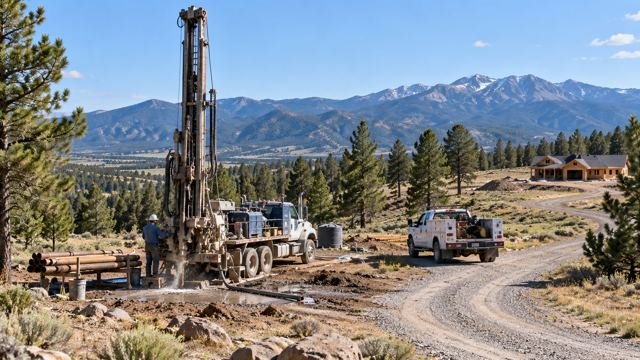
A private well can be a major part of the rural Tennessee development budget
For Tennessee acreage without dependable public water, a private well may be the primary water source for the house, livestock, irrigation, shop, and future improvements.
The hard part is that well cost cannot be estimated from acreage alone. Depth, geology, casing, access, pump size, water yield, electrical work, storage, treatment, and site layout all affect the final number.
A cheap parcel can become expensive quickly if the homesite requires a deep well, difficult drilling access, long trenching runs, or substantial water treatment.
Start with a realistic 2026 cost range
There is no single statewide Tennessee well price because drilling conditions vary substantially by location.
Current national 2026 cost guides place complete residential well systems roughly in the $6,000 to $16,000 range for a typical 200-foot project, while drilling-only pricing is often quoted by the foot. Angi reports a broad national residential drilling range of about $25 to $65 per foot, and HomeGuide reports roughly $30 to $80 or more per foot for a complete installation.
Use those figures only as planning benchmarks. A Tennessee driller who knows the local geology and nearby wells is the better source for a parcel-specific estimate.
Depth is usually the biggest cost driver
Most drilling bids are strongly influenced by how deep the contractor must go before reaching a usable groundwater source.
Each additional foot adds drilling time, casing, labor, and often more powerful pumping requirements.
Tennessee's groundwater conditions vary considerably across the state, so neighboring counties and even nearby parcels can have very different well depths and yields.
Research nearby well records before buying
TDEC provides a Water Well Data Viewer that can help buyers research nearby recorded wells.
The state's viewer includes a Wells Near Me function that can search around a mapped point or address and show nearby well records.
Nearby wells can provide useful clues about depth, construction, and local groundwater conditions, but they do not guarantee that your parcel will produce the same result.
Only Tennessee-licensed well professionals should perform regulated well work
Tennessee requires anyone who manages or supervises water-well drilling or redrilling to hold the appropriate TDEC license.
Pump installers and water-treatment installers are also licensed through the Division of Water Resources.
A general contractor, electrician, or plumber is not automatically authorized to perform regulated well, pump, or water-treatment work unless that person also holds the applicable Tennessee well license.
Ask for the driller's license, insurance, references, and a written scope
TDEC recommends asking the well professional for a written contract, proof of insurance, a license certificate, references, and an itemized explanation of the system cost.
The quote should make clear what is included in drilling, casing, development, disinfection, the pump, pressure tank, trenching, electrical connections, testing, and the state registration fee.
Comparing two quotes is difficult when one contractor prices only the borehole and another prices a complete working system.
Casing type and diameter can change the price
Tennessee well construction varies by region and subsurface conditions.
TDEC notes that many private domestic wells in Middle and East Tennessee use a larger outside diameter than those commonly found in West Tennessee, and steel casing is required in certain bedrock construction situations.
More casing, larger casing, and difficult formations can materially increase material and labor cost.
Rock is not always bad, but difficult geology raises uncertainty
Rocky Tennessee terrain can increase drilling time and wear on equipment, while fractured bedrock may also be where productive groundwater is found.
The important question is not simply whether the parcel has rock. It is how local drillers typically complete wells in that geologic setting and how deep successful nearby wells tend to be.
Ask contractors what formations they expect, how they price unexpected depth, and what happens if the first bore does not produce adequate water.
Yield matters almost as much as depth
A well that reaches water is not necessarily a strong household water source.
TDEC notes that a well producing roughly 3 to 5 gallons per minute can generally serve a household of four to six people when the overall system is designed appropriately.
Lower-yield wells may still be workable with larger pressure or storage capacity, but that should be planned before the home is occupied.
The pump and pressure system are separate cost items
The completed well needs a pump sized to the depth, yield, household demand, and system design.
The pressure tank, controls, wiring, trenching, water line to the house, and any storage equipment also belong in the budget.
A low drilling quote can become misleading if it excludes most of the equipment required to deliver pressurized water to the home.
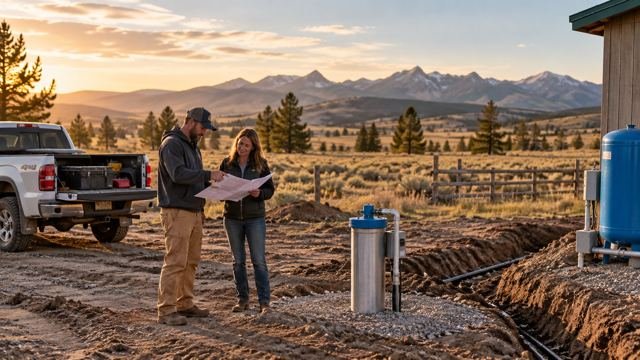
Plan the well location before finalizing the homesite
The well must work with the house, septic system, driveway, power, future shop, livestock areas, and drainage.
TDEC requires minimum separation distances from several potential contamination sources and also restricts proximity to property lines and certain site conditions.
A survey and preliminary site plan make it much easier to avoid placing the house or driveway where the best well location needs to be.
Tennessee requires separation from septic systems and other contamination sources
TDEC's well guidance lists minimum setbacks that protect the water source from contamination.
Examples include at least 50 feet from septic tanks and drain fields, 100 feet from animal pens and feed lots, 75 feet from pit privies, and 10 feet from property lines.
Confirm the current rules with the licensed driller and TDEC before construction because the well and septic layouts need to work together.
Flood-prone well locations need special attention
TDEC states that a well site should not normally be subject to flooding.
Where conditions require a well in a flood-prone location, watertight casing must extend above the 100-year flood elevation according to state guidance.
Low areas, creek bottoms, and drainage channels should therefore be considered carefully during site planning.
Do not place the well where future construction will interfere with it
TDEC advises against constructing wells in pits, basements, or locations where future construction may occur.
The well also needs room for drilling and service equipment to reach it later.
Leaving practical access around the well can make future pump replacement, testing, maintenance, and repairs much easier.
Well development and disinfection should be part of the job
After drilling, the well should be developed to remove sediment, cuttings, and debris introduced during construction.
TDEC also requires the completed well to be disinfected after development.
Ask the contractor to explain both steps and how the well will be protected before the house plumbing is placed into service.
Make sure you receive the Tennessee Water Well Driller's Report
The driller must submit a Tennessee Water Well Driller's Report to the Division of Water Resources after the well is completed.
The report records key information such as the owner, location, completion date, and construction details.
TDEC recommends that the property owner request a copy because it can be useful for future troubleshooting, sale of the property, or replacement work.
Private well water quality is the owner's responsibility
Tennessee regulates private well construction, but the state does not establish drinking-water quality standards for individual private water supplies.
The Tennessee Department of Health recommends testing private drinking water annually for pathogens and at least every other year for chemical contaminants.
Properties near current or former industrial activities may warrant more frequent or more targeted testing.
Water treatment can add meaningful cost
Some wells may produce water that is safe but unpleasant because of hardness, iron, sulfur odor, sediment, or other naturally occurring conditions.
Other water-quality findings may require more significant treatment.
Budget for testing first and treatment second rather than buying equipment before you know what the water actually contains.
Public water should still be priced before you commit to a well
If a public or utility water line is near the parcel, compare the real connection cost with the well option.
Ask the utility whether service is available at the exact parcel, whether capacity exists, what the tap or meter fee is, and whether a line extension is required.
A nearby water line may be cheaper than a deep well, but a long extension or high tap fee can make the private well more attractive.
Access for the drilling rig affects feasibility and price
Water-well rigs are large pieces of equipment and need a workable route to the planned well site.
Steep slopes, soft ground, narrow gates, low tree limbs, creek crossings, and tight turns can complicate mobilization.
Walk the proposed route with the driller before clearing a driveway or locking in the homesite.
Remote homesites can add trenching and electrical costs
A deep homesite may require long runs between the well, pressure equipment, electrical service, and house.
Trenching through rock or steep terrain can become a significant line item even after the drilling itself is complete.
Include these distances when comparing a homesite near the road with one farther back on the acreage.
Questions to ask a Tennessee well driller before hiring
Use these questions to turn a per-foot estimate into a realistic complete-system quote.
- Are you currently licensed by TDEC for the work you will perform?
- How deep are nearby wells you have drilled in this area?
- What yield do those wells commonly produce?
- What is your drilling price per foot?
- What casing is included and how is additional casing priced?
- What happens if the first bore has poor yield?
- Is well development and disinfection included?
- Is the pump included in the quote?
- What size pump and pressure tank do you expect to use?
- Are trenching, electrical work, and water line to the house included?
- Is water testing included?
- Will you provide the completed Tennessee Water Well Driller's Report?
- Can you provide proof of insurance and recent local references?
Tennessee well budget checklist
Price the whole water system instead of treating drilling as the only expense.
- Site visit and contractor mobilization
- Drilling by the foot
- Casing and well cap
- Additional depth allowance
- Well development
- Disinfection
- Pump
- Pressure tank and controls
- Electrical supply
- Trenching and underground water line
- Water testing
- Potential treatment equipment
- Storage if yield is low
- Site access or clearing
- State registration and applicable fees
- Contingency for difficult geology or a deeper-than-expected well
A good well plan starts before closing on the land
The best time to investigate groundwater is during the rural-land due-diligence period, not after the house pad is cleared.
Review nearby well records, contact licensed drillers, sketch the well and septic areas, compare public-water alternatives, and get a realistic range for a complete working system.
That information helps turn the purchase price into a true site-development budget and can prevent a seemingly affordable Tennessee property from becoming an unexpectedly expensive build.
Sources & methodology
Where this information comes from
Cost figures are planning references rather than contractor quotes. Permitting, system-selection, and location-specific guidance should be verified with the appropriate local authority or qualified professional. AcreageReady uses source-backed, AI-assisted editorial workflows and remains responsible for the material it publishes. Read how we research, edit, and correct guides.
- TDEC: Well Water
- TDEC: Well Driller or Installer License
- TDEC: Water Resources Data & Map Viewers
- Tennessee Department of Health: Private Water Supply Guidance
- Angi: How Much Does Well Drilling Cost? 2026
- HomeGuide: Well Drilling Cost
- AcreageReady: Buying Rural Land in Tennessee
- AcreageReady: Tennessee Septic Permits & Soil Evaluations
Common questions
Frequently asked questions
How much does it cost to drill a well in Tennessee?
There is no single Tennessee statewide price. As a broad 2026 planning benchmark, national residential well projects commonly range from several thousand dollars into the mid-five figures depending on depth, casing, pump, geology, access, and treatment. Get local Tennessee quotes for the specific parcel.
How much does well drilling cost per foot?
Current national 2026 guides commonly place residential drilling around $25 to $65 per foot, with complete-system estimates often higher once casing, pump, electrical, trenching, and other components are included.
Does Tennessee require a licensed well driller?
Yes. Tennessee requires people who manage or supervise water-well drilling, pump installation, or water-treatment installation to hold the applicable TDEC license.
How far does a Tennessee well need to be from a septic system?
TDEC's current guidance lists a minimum 50-foot separation from septic tanks and drain fields. Site-specific conditions and other setback rules should be confirmed before construction.
How much water does a household well need to produce?
TDEC notes that a well yielding about 3 to 5 gallons per minute can generally serve a household of four to six people when the overall system is designed properly.
Does Tennessee require private well water testing?
Tennessee regulates well construction but does not establish drinking-water quality standards for individual private supplies. The Department of Health recommends annual pathogen testing and chemical testing at least every other year.
Can I look up nearby Tennessee wells before buying land?
Yes. TDEC provides a Water Well Data Viewer and map tools that can be used to research recorded wells near a property.
Should I compare a private well with public water?
Yes. If public water is nearby, price the meter or tap, line extension, capacity, and trenching before deciding. Either option can be less expensive depending on the parcel.
Ready to talk with a local professional?
Share your location and project details so AcreageReady can identify relevant providers as the network grows.
Get a free quote