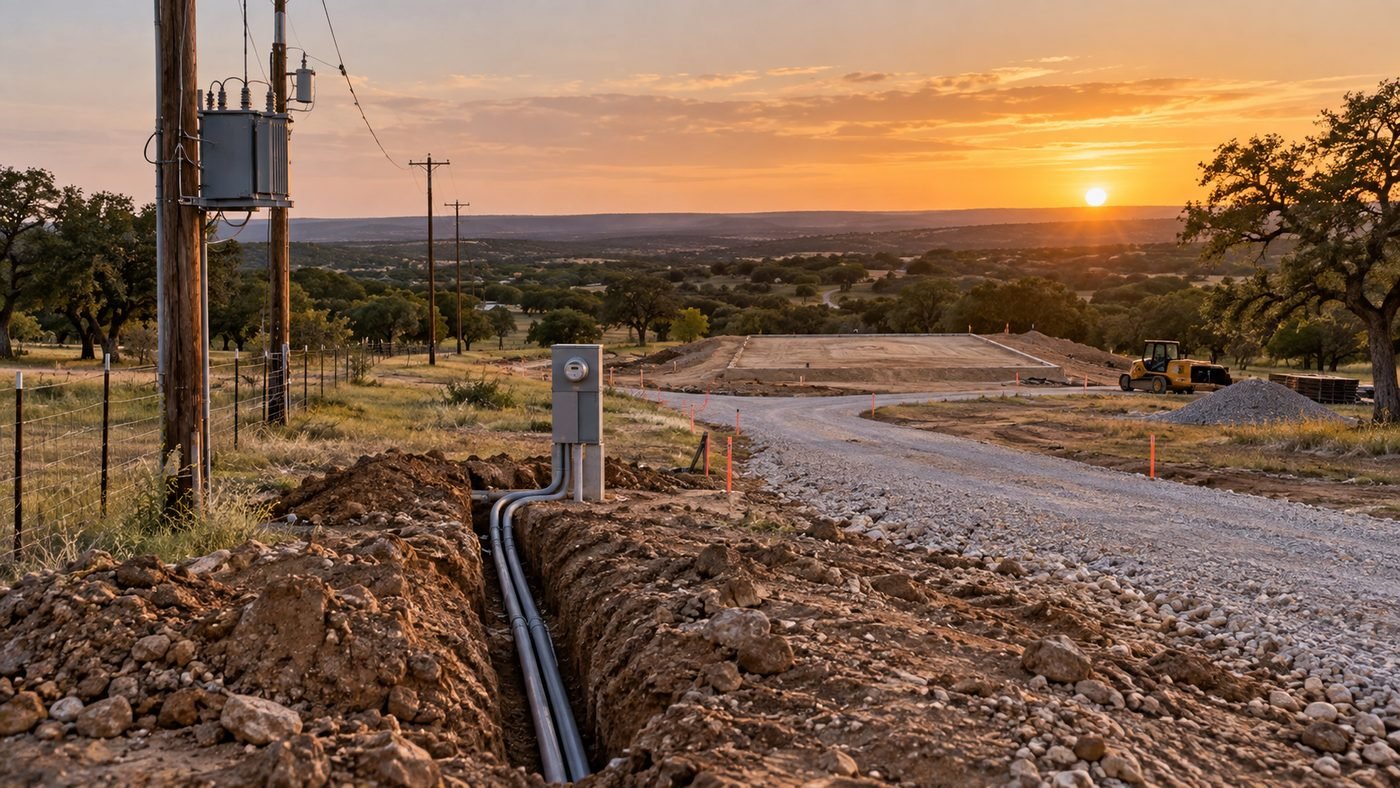
How much does it cost to run power to rural land in Texas in 2026?
For early planning, the cost to bring electricity to rural Texas land can range from a relatively simple $1,000 connection near an existing line to $20,000, $50,000, or more for a long extension, underground construction, difficult trenching, transformers, or substantial new utility infrastructure.
Current 2026 consumer data puts many electrical extensions around $5 to $15 per linear foot when service is near the property, while rural-land planning ranges for overhead extensions can reach roughly $10 to $50 per foot beyond a utility's included allowance. Dallas-area 2026 data places many road-to-house projects around $4,000 to $20,000.
The serving utility's policy matters more than any statewide average. Oncor, CoServ, Pedernales Electric, Tri-County Electric, and other Texas utilities and cooperatives can use different extension allowances, construction standards, transformer rules, easement requirements, and customer contributions.
- Simple connection near an existing line: sometimes around $1,000
- General planning range: roughly $5 to $15 per linear foot for many extensions
- Long rural overhead extensions: often budgeted around $10 to $50 per foot beyond utility allowances
- Dallas-area 2026 road-to-house projects: commonly around $4,000 to $20,000
- Underground service, rock, transformers, easements, and long distances can move the cost much higher
The first question is: which utility actually serves the property?
Before estimating distance or calling an electrician, identify the electric delivery utility or cooperative that serves the parcel. The company that owns the local distribution system controls the line-extension policy, meter location, transformer standards, easements, and construction process.
In competitive retail areas of Texas, the company that delivers electricity may be different from the retail provider that sends the monthly bill. For raw land, the delivery utility is the company you need for extension planning.
Do not rely on a listing that simply says 'electric available.' Ask where the nearest usable distribution facility is and whether enough capacity exists for the planned home, shop, well, gate, and future loads.
Distance from the existing line is usually the biggest cost driver
A house site 75 feet from an existing distribution line is a very different project from a homesite 1,000 feet into the property. Distance affects poles, conductor, trenching, labor, easements, transformers, and voltage-drop considerations.
Using a broad $10 to $50 per foot rural planning range, a 500-foot extension represents roughly $5,000 to $25,000 before special equipment or difficult site conditions. A 1,000-foot extension represents roughly $10,000 to $50,000 using the same screening range.
Those are planning examples only. The utility's actual engineering study determines the customer contribution.
- 500 ft at $10 to $50/ft: roughly $5,000 to $25,000
- 1,000 ft at $10 to $50/ft: roughly $10,000 to $50,000
- Longer runs may also trigger additional poles, transformers, or primary-voltage construction
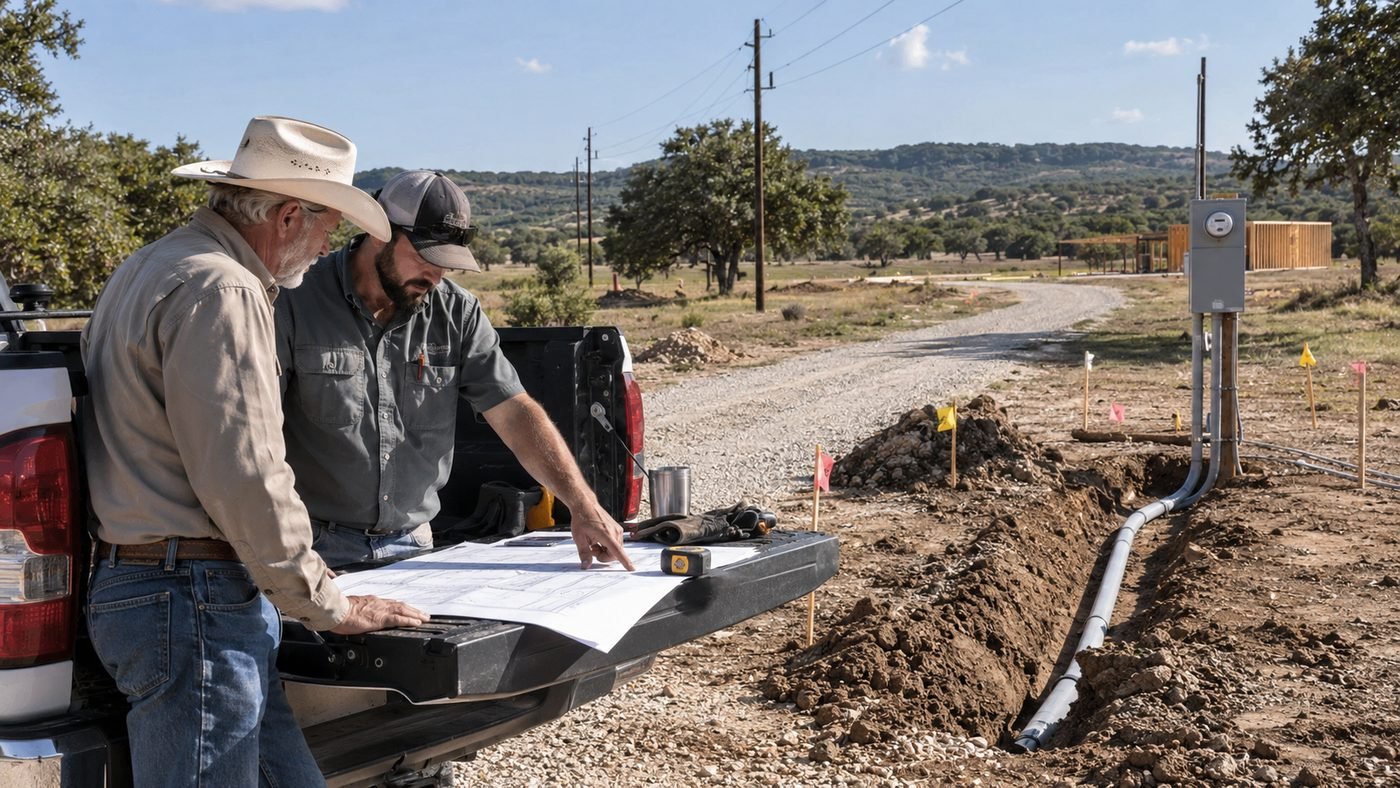
Some Texas utilities include a line-extension allowance
Utility extension policies can materially change the bill. Oncor's current tariff states that qualifying permanent customers with small estimated loads can receive up to 300 feet of overhead single-phase extension without charge. For underground single-phase service, Oncor can provide an extension without charge when the extension cost does not exceed an amount equivalent to 300 feet of overhead radial single-phase circuit.
If the extension exceeds the allowance, the customer can owe a one-time non-refundable contribution based on the estimated construction cost. Other utilities and electric cooperatives use their own policies, which is why a generic cost-per-foot number should never replace a utility estimate.
CoServ, for example, specifically directs customers whose homes, wells, barns, or businesses are too far from existing power lines into its line-extension process under its tariff.
Overhead vs underground power
Overhead construction is often less expensive because it avoids continuous trenching, conduit, and underground cable work. Underground service can provide a cleaner appearance and reduce exposure to tree limbs, but it usually costs more and becomes more sensitive to rock and excavation conditions.
Current 2026 data for Houston shows underground road-to-house service can cost substantially more than overhead service. Broader utility guidance also shows rock trenching can add a large per-foot surcharge.
Ask the utility whether overhead service is allowed at the property, whether underground construction is required in the subdivision or development, and whether the owner can provide trenching to utility specifications.
Trenching and rock can make underground service expensive
A normal trench through workable soil is one thing. Cutting through limestone, caliche, dense rock, retaining areas, driveways, or existing improvements is another.
Current 2026 consumer data puts electrical trenching around $400 to $1,200 per 100 linear feet in many situations. Published cooperative construction pricing outside Texas also shows how dramatically rock can change underground work, with rock-trenching surcharges sometimes priced per foot on top of standard extension charges.
On Texas acreage, rocky Hill Country sites and difficult access deserve extra contingency if underground service is planned.
A transformer may be required
Long extensions or new service locations may require a new transformer. Current 2026 consumer guidance commonly places transformer costs around $3,000 to $7,000, but the utility's design and tariff control what the customer actually pays.
Transformer location can also affect driveway layout, house placement, easements, clearances, and future landscaping. Coordinate the proposed transformer and meter location before finalizing the site plan.
200-amp service, shops, wells, and future loads should be planned together
A rural property may need more than a house panel. Well pumps, shops, welders, compressors, RV connections, gates, barns, pools, HVAC equipment, and future guest homes can materially change the load calculation.
Current Dallas-area 2026 cost guidance notes that upgrading to 200-amp service can add roughly $1,500 to $4,500. A large shop, multiple structures, or three-phase equipment can require a different utility design.
Tell the utility and electrician what the property is expected to become, not only what will be connected on day one.
Meter location can change the total project cost
The utility may end its responsibility at a meter or service point near the road, while the owner is responsible for the electrical run from that point to the home or shop. On another project, the utility may extend its facilities deeper into the property.
Those two arrangements can produce very different bids even when the home is the same distance from the road.
Ask exactly where the utility's point of delivery will be and which side of that point is paid for and installed by the utility versus the property owner.
Easements and right-of-way can delay a rural power project
The shortest electrical route is not always available. The utility may need a recorded easement, tree clearing, access for future maintenance, or permission to cross neighboring property.
An extension that crosses a road, railroad, creek, or third-party property can require additional engineering, permits, and time. Oncor's tariff specifically treats facility placement requiring a road or railroad crossing permit as a line extension.
Resolve utility easements early enough that they do not delay the building schedule.
Power availability should be verified before buying raw land
For undeveloped acreage, electricity belongs in the due-diligence process alongside access, septic, water, flood risk, and driveway cost.
A listing that shows poles nearby does not prove those facilities can serve the proposed homesite economically. The nearest pole may not be the right voltage, may not have available capacity, or may require an extension along a route you do not control.
Ask the utility for a planning estimate or engineering review before the purchase deadline when power cost could change the economics of the land.
- Identify the serving utility
- Locate the nearest usable distribution facility
- Confirm available capacity
- Ask about free extension allowances or customer contribution
- Confirm overhead vs underground options
- Ask whether a transformer is needed
- Confirm meter and point-of-delivery location
- Identify required easements
- Estimate utility construction timeline
How power fits into the larger raw-land budget
Electrical service should be planned with the driveway, well, septic, home, shop, and future buildings. A utility trench may share a corridor with other infrastructure, but required separation and utility standards still have to be followed.
AcreageReady's current raw-land development guide uses roughly $30,000 to $100,000 or more as an early planning range for parcels that need several major systems before the home is built. Power can be a modest line item on one property and the dominant infrastructure expense on another.
The best way to reduce uncertainty is to replace generic allowances with a written utility estimate as soon as the proposed meter and building locations are known.
Questions to ask the utility before you build
The utility should answer the system-design questions. Your electrician should answer the customer-side service and wiring questions. Keeping those responsibilities separate prevents gaps in the project scope.
- Do you serve this parcel?
- Where is the nearest usable distribution line?
- Is there enough capacity for my planned load?
- How much extension is included under your policy?
- What customer contribution should I expect?
- Can service be overhead, underground, or either?
- Who provides trenching and conduit for underground service?
- Will a new transformer be required?
- Where will the meter and point of delivery be located?
- What easements are required?
- What clearances or vegetation removal are required?
- What documents or load information do you need from my electrician?
- What is the current construction lead time?
Questions to ask the electrician
Once the utility defines the delivery point, a licensed electrician can price the customer-owned portion of the system and coordinate the service equipment.
For acreage, make sure the electrician understands future loads and detached structures so the service is not undersized immediately after construction.
- What service size do you recommend?
- Is 200-amp service enough for the home, well, and shop?
- What portion of the run is customer-owned?
- What trench, conduit, wire, grounding, and service equipment are included?
- How will detached buildings be supplied?
- Should future circuits or conduit be installed now?
- What permits and inspections are required?
- What is excluded from the quote?
Keep researching
Rural Power resources
Generators, solar, batteries, electrical planning, and backup power for acreage properties.
Sources & methodology
Where this information comes from
Cost figures are planning references rather than contractor quotes. Permitting, system-selection, and location-specific guidance should be verified with the appropriate local authority or qualified professional. AcreageReady uses source-backed, AI-assisted editorial workflows and remains responsible for the material it publishes. Read how we research, edit, and correct guides.
- Angi: How Much Does It Cost to Get Utilities on Land? 2026 Data
- Angi: Cost to Run Electric From the Road to a House in Dallas, TX, 2026
- Angi: Cost to Run Electric From the Road to a House in Houston, TX, 2026
- Before You Buy Land: Cost to Run Utilities to Rural Land, 2026
- Oncor: Tariff for Retail Delivery Service
- CoServ: Line Extensions
Common questions
Frequently asked questions
How much does it cost to run electricity to rural land in Texas?
A simple connection near an existing line may be around $1,000, while longer rural extensions can easily reach $10,000 to $50,000 or more. Current 2026 planning data often uses roughly $5 to $15 per foot for many connections and $10 to $50 per foot for longer rural overhead extensions beyond utility allowances.
How much does it cost to run power 500 feet in Texas?
Using a broad rural planning range of $10 to $50 per foot, 500 feet represents roughly $5,000 to $25,000. The actual customer contribution depends on the serving utility, line type, transformer needs, terrain, easements, and any included extension allowance.
Is underground power more expensive than overhead?
Usually. Underground service requires trenching, conduit, underground cable, and more excavation. Rock, driveways, drainage crossings, and difficult access can make underground construction substantially more expensive.
Will the utility pay for part of the extension?
Sometimes. Utility policies differ. Oncor's current tariff includes up to 300 feet of qualifying overhead single-phase extension without charge for certain small permanent loads, while other utilities and cooperatives use different allowances and contribution rules.
Do I need a transformer for new rural service?
Possibly. The utility determines whether a new transformer or other distribution equipment is required based on distance, voltage, load, and existing facilities.
Should I verify electric service before buying raw Texas land?
Yes. Identify the serving utility, confirm the nearest usable line, request extension information, and understand the likely customer contribution before relying on a listing that says electricity is available.
Ready to talk with a local professional?
Share your location and project details so AcreageReady can identify relevant providers as the network grows.
Get a free quote