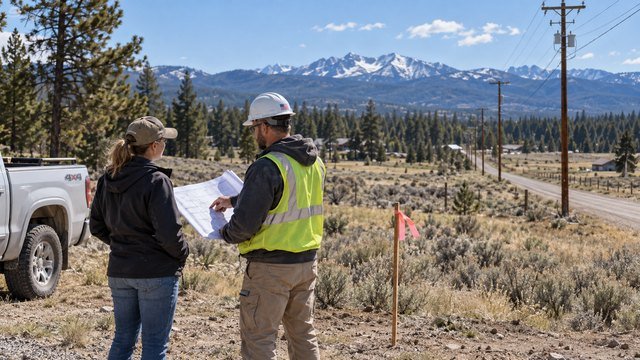
Power can be cheap when the grid is close and expensive when it is not
The cost to bring electricity to rural Idaho property can range from a relatively small service connection to a major land-development expense.
The biggest variable is not the acreage. It is the distance and type of electrical infrastructure between the utility's existing facilities and the meter location for your new home.
A parcel with a usable transformer or secondary facility near the homesite may be straightforward. A parcel that needs hundreds or thousands of feet of new primary line, poles, transformers, trenching, easements, road crossings, or difficult terrain can become much more expensive.
There is no single statewide price for bringing power to Idaho land
Idaho is served by multiple investor-owned utilities, municipal systems, and electric cooperatives, each with its own construction standards, allowances, extension rules, and service territory.
Three major utilities serving Idaho include Idaho Power, Rocky Mountain Power, and Avista Utilities.
Because the utility determines the approved route, equipment, voltage, transformer needs, and customer contribution, the only reliable final number comes from the utility's project-specific design and cost quote.
A practical way to budget before you have a utility quote
For early acreage comparison, separate the project into two categories: the utility line-extension cost and the customer-side work.
If usable electrical facilities are already close to the intended meter location, the utility portion can sometimes remain in the low thousands. Once the project requires a meaningful primary-line extension, new poles or transformers, difficult underground work, or long distances, the budget can quickly move into the tens of thousands of dollars.
For raw land where the exact design is still unknown, carry a meaningful contingency rather than assuming that the visible power line along the road makes the parcel inexpensive to serve.
Start by identifying the electric utility that serves the parcel
Do not assume the utility based only on the nearest town or the power lines you can see from the road.
Utility service territories can change across rural areas, and neighboring parcels may be served by different systems.
Before making a land offer, identify the serving utility and ask whether existing facilities have enough capacity to serve your proposed home and any future shop, well pump, outbuildings, electric heat, EV charging, or other large loads.
Idaho Power provides an online residential service estimator
Idaho Power currently offers a residential estimator that lets customers select a property location and compare potential overhead, overhead-to-underground, and underground service configurations.
The utility notes that its residential online estimates are limited to 200-amp and 400-amp electrical panels and that special site conditions can add cost.
Idaho Power also warns that new service extensions and construction requests may take longer because of service-area growth and possible supply-chain delays.
Idaho Power's 2026 underground service charges show why distance matters
Idaho Power's March 15, 2026 Idaho Cost Information sheet lists a base charge plus a per-foot distance charge for new underground single-phase permanent service up to 400 amps.
When the customer provides the trench and conduit, the published distance charges range from $4.39 per foot for 1/0 service cable to $7.55 per foot for 350 cable.
When Idaho Power provides the trench and conduit, the published distance charges range from $14.87 per foot to $19.86 per foot depending on cable size.
Those charges apply to the underground service segment described by the tariff sheet. They should not be mistaken for the complete cost of a long primary line extension to previously unserved acreage.
An overhead source can add pole-riser charges to underground Idaho Power service
Idaho Power's 2026 cost sheet lists a $30 base charge when underground service begins at an underground transformer, handhole, or pedestal.
When the source is overhead, the published base charge is $1,012 for a 2-inch pole riser or $1,284 for a 3-inch pole riser before the applicable distance charge.
The utility also notes that unusual trenching conditions can create additional charges.
Rocky Mountain Power uses a residential line-extension estimator in Idaho
Rocky Mountain Power provides a ballpark estimator for new single-family residential line extensions in Idaho of less than one-half mile.
The estimator requires the distance from the nearest electrical facility to the proposed meter location and asks what type of facilities already exist at the site.
Rocky Mountain Power makes clear that the tool is only a planning estimate. The actual design and advance payment are established after an estimator reviews the project.
Rocky Mountain Power separates line-extension cost from trenching cost
For underground projects, Rocky Mountain Power states that trenching, conduit, and vault costs are the applicant's responsibility and are not included in its line-extension estimator.
That distinction matters when comparing overhead and underground options because a utility estimate may not include all of the excavation and conduit work you will need to pay for.
The utility also notes that site clearing, unusual terrain, permit costs, easements, and compensation demanded by neighboring property owners are not included in the ballpark estimate.
Rocky Mountain Power applies a residential allowance
Rocky Mountain Power says it applies a state-specific residential allowance credit when determining the cost of a qualifying new-home line extension.
The customer is responsible for the amount above the applicable allowance.
That means two projects with similar distances can still have different customer contributions if the utility design, facilities, or site conditions differ.
Avista's Idaho line-extension tariff also uses construction allowances
Avista's Idaho Schedule 51 governs new electric line extensions in its Idaho service territory.
The tariff requires a written application and gives Avista responsibility for determining the line length, depth, delivery point, route, phases, voltage, capacity, and cost.
Avista's line-extension structure includes construction allowances for new customers, with costs above the applicable allowance paid by the customer as a contribution toward construction.
Easements can become a hidden power-extension problem
A utility may need an easement across your land or neighboring property to install and maintain the line.
Rocky Mountain Power states that the applicant is responsible for obtaining required easements, and Avista requires necessary rights-of-way, easements, and permits to be secured before construction.
If the shortest route crosses property you do not own, investigate access before assuming the project can follow that route.
Overhead power is often simpler, but not always possible
Overhead extensions can reduce trenching and conduit costs, especially across long open areas.
However, pole placement, road crossings, topography, trees, wildfire exposure, clearance requirements, local rules, and utility standards can affect whether overhead construction is practical.
The utility determines the approved design. A buyer should not assume that an overhead line can simply follow the driveway.
Underground power can improve the site but adds customer-side work
Underground electrical service can reduce visual impact and avoid some conflicts with trees and overhead clearances.
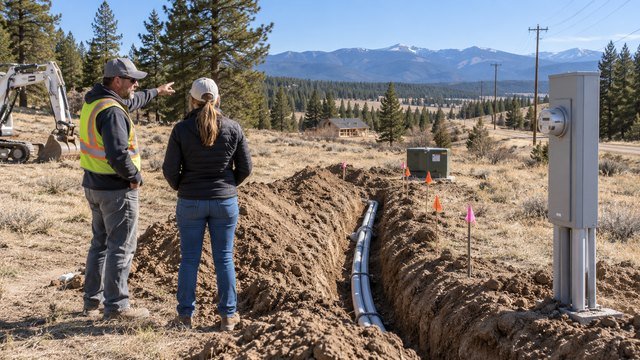
It also introduces trenching, conduit, vaults, bedding requirements, inspections, road or driveway crossings, and restoration costs.
Rocky or frozen ground can make trenching expensive on Idaho acreage, particularly where basalt, boulders, steep terrain, or limited equipment access are present.
The distance you should measure is not always the straight-line distance
A utility extension normally follows an approved constructible route rather than the shortest point-to-point distance on a map.
The line may need to follow a road, property edge, utility corridor, or route that maintains required clearances from septic systems, wells, structures, waterways, and other infrastructure.
When using an online estimator, measure along the most realistic accessible route rather than drawing a straight line through terrain the utility may not be able to use.
A nearby power line does not guarantee cheap service
One of the most common rural-land assumptions is that power will be inexpensive because a distribution line runs along the road.
That line may be the wrong voltage, lack available transformer capacity, be on the opposite side of a major road, require a new transformer, or need system upgrades before it can serve the home.
Ask the utility to evaluate the parcel instead of relying on visual proximity.
Transformer location can change the project
If the utility needs to install or upgrade a transformer, the approved location can affect both the line-extension cost and your site plan.
Transformers need utility access and required working clearances, and underground transformers or equipment may need pads, vaults, or other site preparation.
Do not place permanent landscaping, fences, buildings, or other improvements in a way that blocks future utility access.
Plan the meter location with the house and driveway
The proposed meter location affects the length of both utility-owned and customer-owned electrical facilities.
Placing the home deep into a large acreage parcel may create the privacy you want while adding hundreds of feet to the electrical route.
Before committing to a homesite, compare the cost implications of moving the home closer to existing infrastructure versus paying for a longer extension.
Your electrician's work is separate from the utility extension
The utility quote is not the entire electrical budget.
You may also need a meter base, service equipment, main panel, grounding, temporary construction power, customer-owned feeder, trenching, conduit, inspections, and wiring from the meter to the house or other structures.
Get an electrician involved early enough to understand where utility responsibility ends and customer responsibility begins.
A 400-amp service can make sense for some acreage projects
A larger rural property may eventually serve more than a basic house.
Large shops, welders, HVAC equipment, well pumps, electric vehicle charging, pool equipment, accessory dwellings, electric heat, and other future loads can affect service sizing.
Idaho Power's online residential estimator supports 200-amp and 400-amp panels. If your project needs more than that, the utility directs customers to contact it for a project-specific estimate.
Coordinate electrical work with the well and septic system
The electrical route should be planned alongside the well, septic system, driveway, drainage, and future structures.
Rocky Mountain Power specifically asks applicants to provide an approved site plan showing the house, roads, water and sewer lines or septic and drainfield, well locations, and other infrastructure that may interfere with power lines.
Coordinating these systems early reduces conflicts and helps prevent expensive rework.
Clearing the utility route may be your responsibility
Wooded acreage can add cost even before poles or underground conduit are installed.
Rocky Mountain Power states that clearing a path for electrical facilities is the applicant's responsibility and is not included in its ballpark estimate.
If the route crosses timber, brush, steep ground, or difficult terrain, include clearing and site-access work in the development budget.
Road crossings and long driveways deserve extra attention
A power route that crosses a county road, private road, irrigation feature, drainage, creek, or finished driveway can require special construction and permits.
A long private driveway may also be the logical route for underground service, which means electrical trenching should be coordinated before final gravel, paving, culverts, or landscaping are installed.
Running utilities while the site is already open for road construction can sometimes reduce duplicate excavation.
Electrical inspections can affect the construction schedule
Utility construction is only one part of getting a home energized.
Rocky Mountain Power's process requires the applicant to obtain electrical inspection on the meter base and breaker panel and, where applicable, trench inspection approval before the job can move to construction scheduling.
Coordinate electrician work, inspections, utility requirements, and the home-building schedule so the project does not sit waiting for one incomplete item.
Apply early, but not before the project is defined
Utilities need enough information to design the extension accurately.
Rocky Mountain Power generally recommends applying when you own the land, have the building permit and house footprint available to stake, and expect house construction to begin within roughly three months.
Idaho Power also warns that changes to information after a service-extension request can create delays and additional costs.
Ask about construction timing before closing on remote acreage
A parcel can be physically serviceable and still create a schedule problem if utility construction cannot be completed when you need it.
Idaho Power currently advises that record growth and potential supply-chain delays may lengthen new-service and construction timelines.
If the home build depends on permanent power by a specific date, ask the serving utility about current design and construction timing during due diligence.
What should be included in your rural Idaho power budget?
Build the electrical budget from the complete project rather than one utility estimate.
- Utility line-extension contribution
- New poles if required
- Transformer or equipment charges if applicable
- Underground service cable charges
- Trenching and conduit
- Vaults, pedestals, or equipment pads
- Rock excavation or difficult trenching
- Vegetation and route clearing
- Easements and recording costs
- Road or driveway crossings
- Permits
- Meter base and service equipment
- Electrical panel
- Temporary construction power
- Electrician labor and materials
- Electrical and trench inspections
- Customer-owned feeder beyond the utility delivery point
- Site restoration and final grading
- Contingency for design changes
Questions to ask the utility before buying Idaho acreage
A short utility conversation can eliminate a major unknown in your land-development budget.
- Are you the electric provider for this parcel?
- What existing facilities can serve the property?
- Is there enough capacity for the proposed home?
- Will a new transformer be required?
- What is the likely point of delivery?
- Can the extension be overhead, underground, or either?
- What route would the utility likely use?
- How much of the route is primary versus secondary service?
- What construction allowance applies?
- What costs are the customer's responsibility?
- Will easements be required?
- Are trenching and conduit included in the utility estimate?
- Are road-crossing permits required?
- What information is needed for a formal design?
- What are current design and construction lead times?
Questions to ask your electrician
The electrician can help turn the utility design into a complete customer-side budget.
- Should the project use 200-amp or 400-amp service?
- Where should the meter and main panel be located?
- How far will customer-owned wiring run beyond the meter?
- What trench and conduit specifications should be coordinated with the utility?
- What temporary power will the builder need?
- Will the well pump, shop, EV charging, or future buildings change the service size?
- What electrical inspections are required?
- What work is excluded from the utility's quote?
Compare rural properties by total utility cost, not just land price
A parcel that costs $20,000 less can become the more expensive property if it requires a long electrical extension, deep well, advanced septic system, major driveway work, and heavy grading.
When evaluating Idaho acreage, investigate power at the same time as the well, septic system, access, drainage, and homesite.
The goal is not simply to find land with electricity nearby. It is to understand the complete cost and schedule required to make the property ready to build.
Keep researching
Rural Power resources
Generators, solar, batteries, electrical planning, and backup power for acreage properties.
Sources & methodology
Where this information comes from
Cost figures are planning references rather than contractor quotes. Permitting, system-selection, and location-specific guidance should be verified with the appropriate local authority or qualified professional. AcreageReady uses source-backed, AI-assisted editorial workflows and remains responsible for the material it publishes. Read how we research, edit, and correct guides.
- Idaho Power: Residential Service Estimator
- Idaho Power: Idaho Cost Information, March 15, 2026
- Idaho Power: Installing New Service
- Rocky Mountain Power: Residential Line Extension Estimator
- Rocky Mountain Power: Line Extension FAQ
- Rocky Mountain Power: Line Extension Process Overview
- Avista Utilities: Idaho Schedule 51 Line Extension Tariff
- AcreageReady: Buying Rural Land in Idaho
- AcreageReady: How Much Does It Cost to Drill a Well in Idaho?
- AcreageReady: How Much Does a Septic System Cost in Idaho?
- AcreageReady: Idaho Septic Permits & Site Evaluations
Common questions
Frequently asked questions
How much does it cost to bring power to rural land in Idaho?
There is no single statewide price. A short connection from usable nearby facilities may remain in the low thousands, while projects requiring long primary-line extensions, new poles or transformers, underground trenching, easements, difficult terrain, or road crossings can move into the tens of thousands. The serving utility must provide the final project-specific design and quote.
How much does Idaho Power charge per foot for underground residential service?
Idaho Power's March 15, 2026 cost sheet lists customer-provided trench and conduit distance charges of $4.39 to $7.55 per foot depending on cable size. When Idaho Power provides the trench and conduit, the listed distance charges range from $14.87 to $19.86 per foot. These are service charges for the configurations covered by the sheet, not a complete long-distance line-extension price.
Does Rocky Mountain Power include trenching in its Idaho line-extension estimate?
No. Rocky Mountain Power states that underground trenching, conduit, and vault costs are the applicant's responsibility and are not included in its residential ballpark line-extension estimate.
Can I choose overhead or underground power on rural Idaho property?
Sometimes, but the utility determines the approved design based on existing facilities, terrain, route, clearances, wildfire considerations, utility standards, and other site conditions.
Does the utility pay part of a new line extension?
Depending on the utility and project, an applicable construction or residential allowance may reduce the customer's contribution. Rocky Mountain Power and Avista both use allowance structures in their Idaho line-extension rules. The utility determines the credit and the amount the customer must pay.
When should I contact the electric utility about vacant Idaho land?
Contact the serving utility during land due diligence for feasibility and a preliminary estimate. A formal design generally becomes more practical after the homesite and load are defined, but waiting until construction begins can create budget and scheduling surprises.
Ready to talk with a local professional?
Share your location and project details so AcreageReady can identify relevant providers as the network grows.
Get a free quote