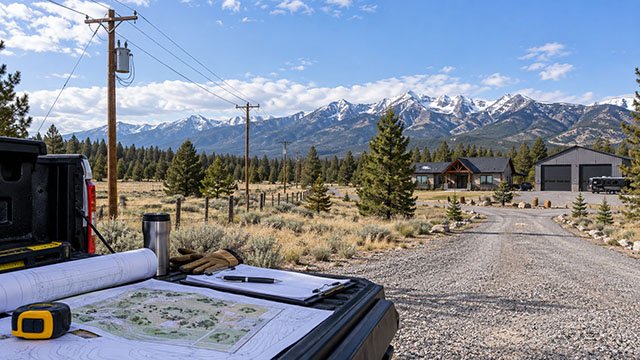
Power at the road does not always mean power is ready for your house
A rural Idaho property can have poles along the road and still require a substantial service-extension project before the home, shop, well, or future buildings can be energized.
The key questions are who serves the parcel, where the nearest usable facility is located, whether that facility has enough capacity, how far the service must travel, whether a transformer or primary extension is required, what easements are needed, and who is responsible for trenching or other site work.
Those questions should be answered during land due diligence, not after closing, because the difference between a simple meter connection and a long utility extension can materially change the development budget.
Start by identifying the correct electric utility
Idaho is served by investor-owned utilities, electric cooperatives, and municipal utilities, so the utility that serves one parcel may be different from the utility serving a nearby town or neighboring area.
The Idaho Public Utilities Commission publishes maps for investor-owned electric service areas and a separate map for electric cooperatives and municipal utilities.
Use those maps as a starting point, then confirm service responsibility directly with the utility before relying on any estimate or making a purchase decision.
The major investor-owned utilities serve different parts of Idaho
The Idaho Public Utilities Commission's service-area map shows Idaho Power, Rocky Mountain Power, and Avista serving different portions of the state.
Those maps are useful for orientation, but they are not a substitute for a parcel-specific service determination.
If the property is near a utility boundary, a city, a cooperative territory, or an area with overlapping infrastructure, confirm the serving utility using the parcel address, legal description, or map location.
Do not assume the nearest visible line belongs to your serving utility
A pole, transformer, or overhead line near the property may not be the facility that can legally or technically serve the parcel.
Electric service territories are regulated, and utilities may have assigned service boundaries that do not match what appears obvious from the road.
Before measuring distances or estimating costs, get confirmation from the serving utility that the nearby facility is part of the system that would actually serve your project.
Ask whether you need a meter connection or a full service extension
The project can be very different depending on whether usable utility infrastructure already reaches the building site.
Idaho Power separates requests where only a meter installation is needed from projects that require a new overhead or underground service extension.
That distinction is important because a line extension can involve utility engineering, new poles, conductors, transformers, conduit, trenching, road crossings, easements, permits, and advance payments.
The nearest pole is not always the real starting point
For rural acreage, the closest visible pole may not have the voltage, phase, transformer capacity, or system configuration needed for the new load.
A utility designer or estimator may determine that the project needs to start farther away at a different transformer, pole, or primary line.
That is why a simple measurement from the property line to a pole is useful for rough planning but should not be treated as a final design.
A transformer can be one of the biggest hidden variables
Some rural parcels already have a transformer close enough to support a short secondary service, while others require a new transformer or a longer primary extension.
Rocky Mountain Power's residential line-extension estimator specifically asks customers to identify nearby electrical facilities and transformer information because the existing configuration affects the likely extension design.
If you see a transformer near the property, note its location and take clear photos, but let the utility determine whether it can support the planned service.
Load planning matters before the utility designs the service
Utilities need to know more than the location of the house. They also need an estimate of the electrical demand the project will place on the system.
Rocky Mountain Power asks for information such as house size, whether the home is all-electric or dual-energy, and the size of air-conditioning or heat-pump equipment.
Idaho Power's current service-extension request also asks about panel amperage, heating source, domestic well pumps, shops, solar, EV charging, large equipment, and other project loads.
A shop, well pump, RV connection, or EV charger can change the design
Rural acreage often has more electrical demand than a typical suburban house.
Large well pumps, welders, compressors, electric heat, hot tubs, RV hookups, shop equipment, vehicle charging, irrigation pumps, and multiple buildings can affect conductor sizing, transformer capacity, service size, and the utility's extension design.
Include future loads during the initial planning discussion whenever they are reasonably foreseeable so the service is not undersized from the beginning.
Decide early whether you want overhead or underground service
Both overhead and underground construction can be used on rural properties, depending on the utility, site, regulations, and project design.
Underground service can reduce visible utility lines and exposure to some weather-related hazards, but it can shift more site-work responsibility to the owner through trenching, conduit, vaults, bedding, backfill, and road-crossing requirements.
Overhead service can avoid long trenches in some situations but may require poles, guying, vegetation clearance, access, and building-clearance considerations.
Underground service often includes owner-provided trenching and conduit
Rocky Mountain Power states that trenching, conduit, and vault costs for underground residential extensions are in addition to its online ballpark line-extension estimate.
Its Idaho line-extension tariff also describes applicant responsibility for trenching, backfilling, imported backfill, conduit, and equipment foundations when underground extensions are requested.
Idaho Power publishes detailed residential underground and joint-trench requirements, so the exact trench depth, conduit, separation, and installation details should be obtained from the serving utility before excavation begins.
Do not dig the trench before receiving the utility design
A utility extension route can be affected by transformer location, property boundaries, easements, roads, septic areas, wells, slopes, drainage, future structures, and other underground utilities.
Excavating early can create expensive rework if the utility later requires a different route or different conduit configuration.
Wait for the approved design and current construction requirements before scheduling excavation.
Easements are a normal part of many rural power projects
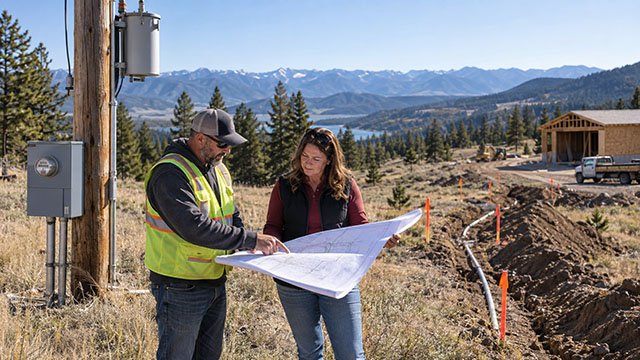
An easement gives the utility the legal right to install, operate, inspect, maintain, and access electric facilities on property it does not own.
Idaho Power explains that its utility easements provide working space and permission to safely install and access facilities, while Rocky Mountain Power states that the applicant is responsible for obtaining required easements.
Avista's Idaho line-extension tariff likewise requires necessary rights-of-way, easements, and permits to be secured before the company constructs the extension.
An easement may need to cross someone else's property
If the shortest or only practical route to the parcel crosses neighboring land, the project may depend on obtaining a recorded easement from that landowner.
That can introduce negotiation, survey, title, legal-description, and recording work that takes longer than the physical construction.
A parcel with apparent nearby power can therefore still be difficult to serve if the utility cannot obtain a legal and maintainable route.
Review existing easements before choosing the building site
Existing utility easements can limit where a house, shop, fence, retaining wall, landscaping, or other improvement can be placed.
Idaho Power notes that its crews must retain access to facilities within easements and that property owners should contact the utility about required clearances near lines and equipment.
Pull the title report, recorded plat, survey, and recorded easement documents during due diligence so the site plan does not conflict with utility rights.
The site plan should show the entire rural development layout
Rocky Mountain Power's extension process asks for an approved site plan showing the home, roads, water and sewer or septic, well locations, and other infrastructure that could interfere with power lines.
That same approach is useful regardless of the serving utility.
The power route should be coordinated with the driveway, well, septic drainfield and replacement area, propane if used, future shop, gates, fences, drainage, and any planned landscaping or livestock areas.
Long driveways make utility planning more important
A home placed far back on acreage can require a long power route even when utility infrastructure runs along the public road.
That distance can increase conductor, trenching, pole, conduit, transformer, and excavation costs.
When comparing potential building sites on the same parcel, include power-route distance as one of the variables along with views, grading, septic feasibility, fire access, and driveway cost.
Road crossings can add complexity
A utility route that crosses a public road, private road, driveway, irrigation feature, or drainage structure can require additional engineering and permitting.
Depending on the location, the project may need boring, sleeves, conduit, traffic control, right-of-way approval, or coordination with a highway district, county, city, or private road owner.
Ask the utility whether the preliminary route includes any crossings before relying on a rough lineal-foot estimate.
Steep terrain and rock can increase owner-side construction costs
Rural Idaho terrain ranges from flat agricultural ground to steep mountain parcels with shallow rock.
Even if the utility's line-extension charge is reasonable, trenching through rock, building access for equipment, crossing slopes, or restoring a long route can add substantial private-contractor cost.
Walk the likely route with both the utility representative and excavation contractor when site conditions are difficult.
Utilities may require electrical inspections before energizing service
Rocky Mountain Power's new-service process requires the applicant to obtain electrical inspection approval for the meter base and breaker panel before construction is fully scheduled and service is completed.
Idaho Power's current customer requirements likewise reference passed inspection by the authority having jurisdiction before reconnection in applicable situations.
Coordinate the electrician, utility, and local or state electrical inspection process so the meter and service are ready when the utility arrives.
A rural project may need temporary power before permanent service
Construction often starts before the permanent house service is ready.
Idaho Power offers separate temporary-service and temporary-to-permanent request paths in its construction portal.
Ask the serving utility and electrician whether temporary service makes sense for the build or whether generators and contractor power are more practical until permanent facilities are installed.
Utility lead times can affect the construction schedule
New electric service is not always a quick final step.
Idaho Power currently warns that service extensions and construction requests may take longer than usual because of growth and potential supply-chain delays.
A rural builder should start utility coordination early enough that engineering, easements, permits, material availability, inspections, payments, and scheduling do not become the critical path for the entire project.
The application should be accurate before design work starts
Idaho Power cautions that changes to information supplied in a service-extension request can cause delays and additional costs.
That is logical because moving the house, changing the meter location, adding a large shop, increasing the service size, or changing from overhead to underground can alter the utility design.
Get the preliminary site layout reasonably stable before asking the utility to complete detailed engineering.
Use utility estimators for planning, not as final bids
Both Idaho Power and Rocky Mountain Power provide tools that can help customers understand potential service-extension costs before a final design is completed.
Rocky Mountain Power explicitly describes its residential estimator as a ballpark tool and notes that specific site conditions can significantly affect actual charges.
Idaho Power similarly describes its service estimator as a general estimate that helps customers decide whether to request a formal cost quote.
A formal utility quote should be part of serious land due diligence
For inexpensive or already-developed parcels, a rough estimate may be enough during an early screening stage.
For remote acreage where the power route could be hundreds or thousands of feet, a utility review or formal quote can be worth obtaining before the contingency period ends.
If the utility cannot issue a final design before closing, at least document the serving utility, nearest usable facilities, probable route, expected extension type, major easement issues, and likely customer responsibilities.
Rocky Mountain Power may require a site meeting
Rocky Mountain Power states that after a customer applies for service, its local office determines whether an on-site meeting with an estimator is needed.
The company asks the customer to have the house location staked and provide basic load data and an approved site plan.
That is a useful model for any Idaho land buyer: a utility estimate becomes more meaningful once the building location and expected loads are known.
Applicant-built line extensions can exist in some utility territories
Rocky Mountain Power offers an applicant-built line-extension process for eligible new, non-energized extensions.
Under that process, the applicant can arrange installation labor and materials under the utility's approved design and standards, while Rocky Mountain Power provides design, inspection, and the final network connection.
This is not a universal Idaho option and does not mean owners can independently construct energized utility facilities, but it is worth asking about when the serving utility offers such a program.
Electric cooperatives and municipal utilities can have different procedures
Not every Idaho parcel is served by Idaho Power, Rocky Mountain Power, or Avista.
Cooperatives and municipal systems can have their own line-extension policies, construction allowances, membership requirements, fees, trenching standards, and scheduling procedures.
Use the Idaho Public Utilities Commission's cooperative and municipal service-area map to identify likely providers, then obtain the current requirements directly from the specific utility.
Do not compare extension quotes without comparing what is included
A utility's construction charge may not include every dollar the owner must spend to energize the property.
Private excavation, conduit, meter equipment, electrician labor, road boring, easement work, survey costs, permits, vegetation clearing, transformer pads, backfill, inspection corrections, and restoration may be separate.
Build the budget from both the utility quote and the owner-side scope so two apparently similar parcels can be compared accurately.
The meter location can affect cost and future convenience
The meter may be mounted on the house, a pedestal, a shop, or another approved location depending on the utility design and local requirements.
A remote meter location can reduce the utility-owned extension in some layouts but may shift more cost to owner-owned conductors between the meter and the home.
Ask the electrician and utility to compare practical meter locations before finalizing the route.
Plan for the well, shop, and future buildings at the same time
If the property will eventually have a detached shop, barn, guest house, RV pad, gate operator, or irrigation system, include those loads in the long-term electrical plan.
It may still make sense to build portions later, but knowing the future demand can influence the initial service size, transformer capacity, conduit routes, and panel strategy.
Oversights are especially expensive on acreage because adding another long trench later can duplicate work that could have been coordinated during initial site development.
Solar and batteries do not automatically eliminate the need for utility research
Some rural buyers consider solar and battery storage as an alternative or supplement to a long grid extension.
That can be a legitimate design path, but it should be based on actual load calculations, winter production, battery autonomy, generator strategy, well-pump starting loads, heating fuel, and the cost of long-term maintenance.
Compare the full grid-extension cost with a properly engineered off-grid or hybrid system rather than assuming one option is automatically cheaper.
Generator planning is valuable even when grid power is available
A rural home may depend on electricity for the well pump, heat, refrigeration, communications, gates, septic controls, and other essential systems.
Backup power can improve resilience during outages, particularly on remote properties where restoration can take longer.
If a generator is planned, coordinate the transfer equipment, fuel supply, service size, and critical loads with the electrician during the initial electrical design.
A practical Idaho rural-power due-diligence checklist
Use this checklist before buying a parcel where electric service is not already established at the intended building site.
- Identify the serving electric utility
- Confirm service territory directly with the utility
- Locate the nearest poles, transformers, and underground facilities
- Ask whether existing facilities can support the project
- Determine whether the project needs a meter connection or line extension
- Estimate the route length to the proposed meter location
- Identify likely overhead and underground options
- Ask whether a new transformer or primary extension is expected
- Provide preliminary house, shop, well-pump, HVAC, EV, and other load information
- Check existing recorded utility easements
- Identify any new easements that may be required
- Determine whether the route crosses neighboring land or public roads
- Coordinate the power route with the driveway, well, septic, and future buildings
- Ask who provides trenching, conduit, vaults, backfill, and equipment pads
- Ask what permits and inspections are required
- Ask about current utility lead times
- Request a planning estimate or formal cost quote when appropriate
- Add private-contractor electrical and excavation costs to the utility estimate
Questions to ask the utility before buying the land
A short conversation with the utility can reveal whether the parcel is straightforward or likely to require a major extension.
- Do you serve this exact parcel?
- Where is the nearest facility that can actually serve my proposed home?
- Is a transformer already available, or would a new one be required?
- Would this likely be secondary service or a primary line extension?
- Can the project be overhead, underground, or either?
- What information do you need to prepare a preliminary estimate?
- What owner-provided trenching or conduit is required?
- Will I need to grant a new easement?
- Will easements across neighboring property be required?
- Are road crossings or permits likely?
- What electrical loads should I provide now?
- How long are design and construction currently taking?
- When should I apply relative to building permits and construction?
- Can you provide a formal quote before I close on the property?
Questions to ask your electrician and excavation contractor
The utility quote is only one part of the installed power system.
- What service size makes sense for the house and future shop?
- Should the meter be at the house or at a remote pedestal?
- What will the meter base, disconnect, panel, and grounding cost?
- What conductor size is required after the utility point of delivery?
- How much trenching is owner responsibility?
- What does rocky excavation cost along the proposed route?
- Are conduit, warning tape, bedding, and compaction included?
- Will other utilities share the trench?
- How should the well pump and future outbuildings be fed?
- Should spare conduit be installed while the trench is open?
Connect the availability check to the full power budget
Once you know the likely service route and utility scope, move to detailed budgeting.
AcreageReady's companion guide, How Much Does It Cost to Bring Power to Rural Property in Idaho?, covers extension length, overhead vs. underground construction, trenching, transformers, meter equipment, and other cost drivers.
For buyers still comparing raw parcels, the Buying Rural Land in Idaho guide ties power availability into the larger due-diligence picture with access, septic, wells, zoning, drainage, and site work.
The cheapest parcel can become the most expensive once power is included
Rural land prices often reflect how easy the property is to develop.
A parcel with a higher purchase price but existing usable utility infrastructure can sometimes be less expensive overall than cheaper acreage requiring a long extension, difficult trenching, new easements, and a transformer.
Compare properties using total build-ready cost rather than land price alone.
Treat electricity as a site-development decision, not a final hookup
Power affects the house location, driveway, well, shop, construction schedule, site plan, easements, and total budget.
Confirm the serving utility, understand the likely extension path, provide realistic loads, review easements, and obtain a site-specific estimate before committing to a difficult parcel.
Doing that work early makes the rest of the rural development plan much easier to price and sequence.
Keep researching
Rural Power resources
Generators, solar, batteries, electrical planning, and backup power for acreage properties.
Sources & methodology
Where this information comes from
Cost figures are planning references rather than contractor quotes. Permitting, system-selection, and location-specific guidance should be verified with the appropriate local authority or qualified professional. AcreageReady uses source-backed, AI-assisted editorial workflows and remains responsible for the material it publishes. Read how we research, edit, and correct guides.
- Idaho Public Utilities Commission: Utility Maps
- Idaho Power: New Service Extension Request
- Idaho Power: Construction Requests
- Idaho Power: Customer Requirements for Electric Service
- Idaho Power: Service Estimator
- Idaho Power: Easement Services
- Rocky Mountain Power: Line Extension Process Overview
- Rocky Mountain Power: Residential Line Extension Estimator
- Rocky Mountain Power: Line Extension FAQ
- Rocky Mountain Power: Applicant-Built Line Extensions
- Avista Utilities: Idaho Schedule 51 Line Extensions
- AcreageReady: How Much Does It Cost to Bring Power to Rural Property in Idaho?
- AcreageReady: Buying Rural Land in Idaho: What to Check Before You Build
Common questions
Frequently asked questions
How do I find out which electric utility serves rural land in Idaho?
Start with the Idaho Public Utilities Commission's electric service-area maps, including the separate map for cooperatives and municipal utilities, then confirm service responsibility directly with the utility for the exact parcel.
If there is a power pole at the road, is the property ready for electric service?
Not necessarily. The nearest visible pole may not have the correct voltage, transformer capacity, phase, or service-territory relationship for the project. The serving utility must determine the actual service point and design.
Who pays for trenching for underground rural power in Idaho?
Responsibility depends on the serving utility and project. Rocky Mountain Power states that applicant trenching, conduit, and vault costs are separate from its residential ballpark extension estimate, while Idaho Power publishes its own underground installation requirements. Confirm the exact owner scope before excavation.
Will I need an easement for a new power line?
Possibly. New utility facilities may require a recorded easement so the utility can install, operate, maintain, and access equipment. If the route crosses another property, an additional easement may be required from that landowner.
Should I choose overhead or underground power for rural Idaho land?
The better option depends on terrain, distance, utility requirements, aesthetics, trenching conditions, easements, vegetation, road crossings, and cost. Ask the serving utility to evaluate both when both are technically available.
When should I contact the utility about new service?
Contact the utility during land due diligence for availability and rough planning, then begin the formal design process once the building location, load information, permits, and construction timing are sufficiently defined. Utility lead times can be significant.
Can a rural shop or well pump change the electric service design?
Yes. Large motors, well pumps, welders, EV charging, electric heat, RV hookups, irrigation pumps, and future buildings can affect service size, transformer capacity, conductors, and the utility extension design.
Are utility online estimators final construction quotes?
No. Idaho Power describes its estimator as a general planning estimate, and Rocky Mountain Power describes its residential tool as a ballpark estimate. Actual design and charges depend on site-specific conditions.
Ready to talk with a local professional?
Share your location and project details so AcreageReady can identify relevant providers as the network grows.
Get a free quote