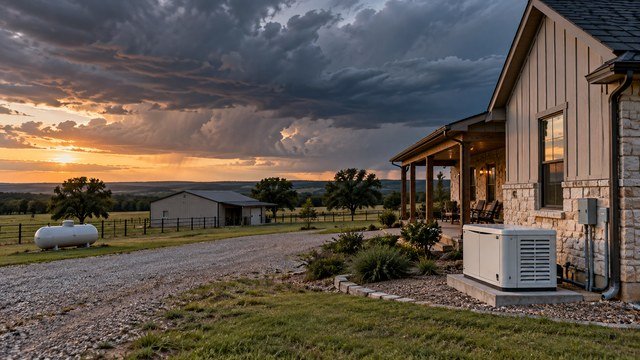
Backup power is more important on rural acreage than it first appears
A rural Oklahoma power outage can affect much more than lights and refrigeration. It can also stop a private well pump, pressure system, aerobic septic equipment, electric heat, gate operators, internet equipment, livestock watering, shop equipment, and other systems that acreage owners depend on.
Oklahoma State University advises country residents to be prepared because rural power may go off more often and remain off longer than service in more densely populated areas.
The right backup-power plan starts by deciding which loads must keep running, how long an outage could reasonably last, and which fuel sources are actually dependable at your property.
Start with essential loads instead of buying the biggest generator you can find
Generator sizing should begin with a load list, not the square footage of the house.
A rural property with a modest home, deep well pump, aerobic septic system, two refrigerators, freezer, propane furnace, gate, and communications equipment can have a very different electrical profile from an all-electric home with heat pumps, electric water heating, induction cooking, a large shop, and an EV charger.
Separating must-run loads from comfort loads can dramatically reduce the generator size and installation cost.
Whole-house power and essential-circuit backup are different strategies
A whole-house system is designed to carry most or all normal household loads, subject to the generator's capacity and any load-management controls.
An essential-circuit system powers a smaller group such as the well, refrigerators, freezer, selected lighting, internet equipment, furnace controls, septic components, and a few receptacles.
For many rural owners, essential-load backup provides the best balance of reliability, fuel consumption, and cost.
A practical 2026 cost range for standby generators
Current 2026 national cost guides place a typical whole-house standby generator installation around $6,000 to $11,000 for many standard projects.
That is a planning range, not an Oklahoma contractor quote. Large generators, long electrical runs, gas piping, propane storage, panel upgrades, trenching, difficult access, and complex load-management systems can push the installed price much higher.
HomeGuide reports that installations above 20 kW or with long utility and fuel runs can move into substantially higher ranges.
Portable generators cost less but require more hands-on operation
Current 2026 pricing guides place many portable generators roughly in the $500 to $2,500 unit range, with additional cost if the system is connected safely to a home's electrical system.
A portable unit may be an effective option for short outages and selected loads, especially when paired with a properly installed transfer switch or other code-compliant transfer equipment.
The tradeoff is that portable units normally require manual setup, fueling, weather protection, extension cords or connection equipment, and more owner involvement during an outage.
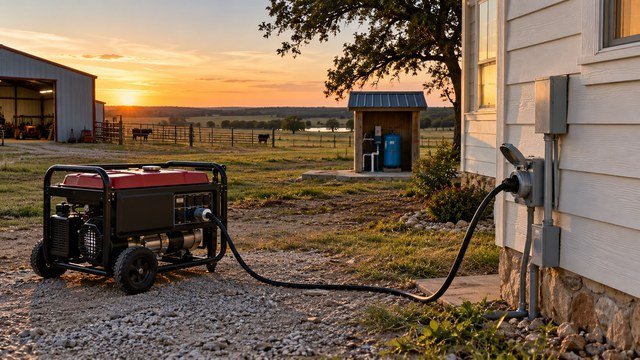
Never backfeed a house through a receptacle
Public Service Company of Oklahoma warns not to connect a generator to a wall outlet or directly energize home wiring without a positive method of isolating utility power.
Improper connections can send electricity back onto utility lines, creating an electrocution hazard for line crews and a fire or equipment hazard at the property.
If a generator will energize building circuits, use properly designed transfer equipment installed for that purpose.
Transfer switches are central to a safe generator installation
A transfer switch separates the home's generator source from the utility source so both cannot energize the same wiring at the same time.
Standby generators commonly use an automatic transfer switch that senses a utility outage, starts the generator, and transfers selected loads automatically.
Portable systems may use a manual transfer arrangement when properly designed and installed. The exact equipment should match the panel, generator output, service configuration, and local electrical requirements.
Oklahoma electrical work should be planned around licensed trade requirements
The Oklahoma Construction Industries Board licenses electrical contractors and journeymen, and trade work remains subject to state and local requirements even in rural areas.
The CIB notes that some smaller or rural jurisdictions may not issue local permits or have an electrical inspector. In those situations, notification to the CIB can still be required when electrical systems are installed, modified, or altered.
Before a generator installation begins, confirm who has jurisdiction, whether a permit or notice is required, and who will perform the electrical work.
Local codes and inspection practices can vary
Oklahoma uses statewide adopted building and trade codes with state amendments, while local jurisdictions may administer permits and inspections.
In September 2026, Oklahoma adopted updated editions of several model building codes, reinforcing why current local requirements should be checked instead of relying on an old installation standard.
Generator placement, electrical work, fuel piping, setbacks, and equipment pads may involve more than one trade or jurisdiction.
Well pumps can be one of the biggest rural generator loads
Thousands of rural Oklahoma residents rely on private wells for drinking water, according to Oklahoma State University.
A well pump may draw substantially more power for a brief period when the motor starts than while it is running normally.
Generator sizing should account for both running load and motor-starting demand so the well can start reliably while other essential loads are already operating.
Know the well pump horsepower before sizing backup power
Do not size a generator from a generic well-pump chart if the actual pump specifications can be found.
Look for the pump horsepower, voltage, control box information, breaker size, and any variable-frequency drive or constant-pressure equipment.
If the pump data is unknown, have the well contractor or electrician identify the equipment before final generator sizing.
Water storage can reduce generator demand
A larger pressure tank or properly designed water-storage system can reduce how often a well pump must cycle during an outage.
Some acreage owners pair a generator with stored potable water or a cistern so every toilet flush, shower, or livestock watering event does not immediately require the well pump to run.
Storage does not replace safe well operation, but it can add useful resilience.
Aerobic septic systems may also need backup power
Oklahoma State University notes that aerobic treatment units depend on electrical equipment such as aerators and dispersal components.
During an outage, continued water use can fill the system while treatment and pumping functions are unavailable. OSU recommends minimizing water use and notes that a backup generator can be used to power the system when available.
If your property will use an aerobic system, include the septic electrical loads in the backup-power plan before construction.
A conventional septic system may have fewer electrical loads
A gravity-fed conventional septic system may continue to function without the same continuous electrical equipment required by an aerobic treatment unit.
However, some conventional installations include pumps, lift stations, alarms, or other powered components.
Do not assume the septic system is power-independent until the final design is known.
Natural gas is convenient where service is available
A standby generator connected to natural gas can run without the owner manually refueling a tank during a typical outage.
That convenience makes natural gas attractive for properties already served by a reliable gas utility.
Many rural Oklahoma tracts do not have natural-gas service, so fuel availability should be verified before selecting a generator model.
Propane is a strong fit for many rural properties
Propane is common on rural acreage because it can serve homes that are beyond natural-gas infrastructure.
A propane standby generator can share the property's fuel strategy with space heating, water heating, fireplaces, or cooking, but the tank and regulator system must be sized for the combined demand.
A generator that looks adequately supplied on paper can still have fuel-delivery problems if the tank, regulator, piping, or cold-weather vaporization capacity is undersized.
Generator planning should happen with the propane plan, not after it
If the home will already use propane, tell the propane supplier that a standby generator is part of the project.
The supplier needs the generator input rating and the other connected appliance loads to size the tank, regulators, and piping.
Planning the generator before the propane trench and house piping are complete can avoid expensive rework later.
Gasoline works for portable generators but creates storage issues
Gasoline portable generators are widely available and can be effective for temporary backup power.
The owner must still plan safe outdoor operation, fuel storage, refueling, fuel rotation, and how the unit will be moved and connected during bad weather.
Long outages can consume more gasoline than many homeowners expect, so the fuel plan matters as much as the generator's wattage.
Diesel may make sense for larger or equipment-heavy properties
Diesel generators are common in agricultural, commercial, and larger standby applications because of their durability and fuel characteristics.
They usually have a higher upfront cost than many residential gasoline, propane, or natural-gas options and require an appropriate on-site fuel-storage plan.
For a rural shop, farm operation, or high-load property, diesel can be worth comparing rather than assuming a residential air-cooled generator is the only option.
Do not size the generator from breaker-panel capacity
A 200-amp electrical service does not mean the property needs a generator capable of reproducing the full theoretical 200-amp service load.
Actual generator sizing should be based on calculated loads, starting currents, simultaneous demand, fuel type, and the owner's outage priorities.
Load management can allow a smaller generator to serve a larger home by preventing several high-demand appliances from running at the same time.
Central air conditioning can dramatically increase generator size
Air-conditioner compressors can have significant starting demand, especially on older or larger systems.
A generator sized comfortably for the well, refrigerators, lights, internet, and furnace blower may not also start multiple large air-conditioning systems.
Soft-start equipment and load-management controls may help in some installations, but the HVAC and generator specifications need to be evaluated together.
Electric heat changes the backup-power equation
Electric resistance heat can require large amounts of generator capacity.
Heat pumps may be more manageable, but auxiliary electric heat strips can create a major load during very cold conditions when backup power may be needed most.
A rural home designed around propane heat, a wood stove, or another non-electric backup heat source may require a smaller generator than an all-electric home.
The shop can overwhelm a residential generator plan
Welders, air compressors, large saws, vehicle lifts, pumps, and other shop equipment can exceed the capacity of a generator sized for the home.
Decide whether the shop must operate during an outage or whether backup power only needs to support lighting, door openers, battery chargers, and basic receptacles.
Keeping heavy shop loads outside the emergency-power plan can materially reduce generator cost.
Livestock systems belong on the load list
Rural properties may depend on electric well pumps, tank heaters, fence energizers, ventilation fans, barn lighting, automatic waterers, or feed equipment.
A backup plan that protects the house but leaves livestock without water may not meet the property's real needs.
Prioritize animal-welfare loads before optional household convenience loads.
Internet and communications loads are small but important
Modems, routers, fixed-wireless equipment, network switches, security cameras, gate controls, and cellular boosters usually use far less power than pumps or HVAC equipment.
They are often easy to keep online with a generator, battery backup, or small uninterruptible power supply.
Maintaining communications during an outage can be especially valuable on rural properties where cellular coverage is inconsistent.
Battery backup can complement a generator
A battery system can carry small loads instantly while a standby generator starts, or it can keep communications, refrigeration controls, and electronics running during a short outage without starting an engine.
Larger battery systems can support selected household loads for hours, depending on capacity and usage.
For long rural outages, batteries are often most useful when combined with a generator or a sufficiently sized solar system rather than treated as unlimited backup.
Solar does not automatically provide power during a utility outage
A grid-tied solar array commonly shuts down during an outage unless the system is specifically designed with islanding capability, battery storage, and compatible controls.
That protects utility workers and prevents unintended energization of the grid.
If outage operation is a goal, tell the solar installer before equipment is selected so the inverter, batteries, transfer controls, and critical-load panel can be designed around that requirement.
PSO requires parallel generation systems to be reviewed
Public Service Company of Oklahoma states that permanent alternative generation and energy-storage systems operating in parallel with its electric system are subject to review and approval.
That requirement applies differently from a properly isolated emergency generator that does not operate in parallel with utility power.
If the property will combine solar, batteries, or other generation with utility service, confirm the serving utility's interconnection process early.
Generator location affects safety, noise, and installation cost
A standby generator needs an outdoor location that complies with manufacturer instructions, electrical requirements, fuel-system requirements, and applicable local codes.
Distance from the electrical panel, propane tank or gas meter, windows, doors, air intakes, and neighboring property can all affect the layout.
Longer conduit and fuel runs can materially increase installation cost.
Carbon monoxide is the biggest portable-generator safety concern
Fuel-burning portable generators produce carbon monoxide and must never be operated inside a home, garage, basement, or other enclosed or partially enclosed space.
National Weather Service safety guidance recommends outdoor generator placement at least 20 feet from doors, windows, and garages when using a portable generator.
Use carbon-monoxide alarms and follow the generator manufacturer's placement and operating instructions.
Bad weather makes portable-generator operation harder
Oklahoma outages often occur during thunderstorms, high winds, ice, or other weather that makes outdoor equipment setup more difficult.
PSO warns against operating portable generators in unsafe wet conditions and recommends appropriate grounding and GFCI protection where required.
If a portable unit is the backup strategy, plan a manufacturer-approved outdoor operating location and safe connection method before the outage happens.
Automatic standby power is most valuable when no one is home
A permanent standby system can protect freezers, well systems, septic components, heating equipment, security systems, and communications even when the owner is away.
That can be especially valuable for second homes, travel-heavy households, livestock properties, or acreage with equipment that should not remain without power for long.
Remote monitoring can also alert the owner if the generator fails to start or requires service.
Maintenance is part of the ownership cost
Standby generators need periodic inspection, exercise cycles, oil and filter service, battery checks, and attention to manufacturer maintenance intervals.
Portable units also need fuel-system care, oil service, battery maintenance where applicable, and periodic test runs.
A generator that has not been exercised or maintained may fail at the exact moment it is needed.
A generator should be tested under realistic loads
Hearing the engine run is not the same as confirming that the system can carry the intended property loads.
Commissioning should verify transfer operation, voltage and frequency, load behavior, well-pump starting, HVAC response if included, and any load-management controls.
Owners should understand which circuits are backed up and what loads should not be used simultaneously.
Plan backup power before trenching utilities
New rural construction creates a valuable opportunity to install generator conduit, control wiring, fuel lines, pads, and transfer equipment while the site is already open.
Even if the generator will be purchased later, inexpensive rough-in work can prevent future excavation across a finished driveway, landscaping, patio, or utility corridor.
Coordinate the generator plan with the electrician, propane supplier, well contractor, HVAC contractor, and builder before final site work.
A good generator quote should define the complete scope
Comparing only the generator model or kW rating can hide major differences between bids.
- Generator make, model, fuel type, and continuous output rating
- Automatic or manual transfer equipment
- Load calculation and load-management strategy
- Electrical panel modifications
- Concrete or composite equipment pad
- Conduit, trenching, and wire lengths
- Gas or propane piping
- Propane tank work if applicable
- Permits, notices, and inspections
- Startup and commissioning
- Remote monitoring
- Battery and cold-weather accessories
- Maintenance plan
- Warranty coverage
- Expected lead time
- Items specifically excluded from the quote
Questions to ask an Oklahoma generator contractor
The installer should be able to explain the system design, not simply recommend a larger machine.
- Which loads did you include in the sizing calculation?
- What starting loads did you account for?
- Will the well pump start while other essential loads are running?
- Is the septic system included?
- Are central air and electric heat included?
- What loads will be shed automatically?
- What transfer equipment is included?
- Who performs the electrical work?
- What permits, notices, or inspections apply here?
- Who handles propane or natural-gas piping?
- How far will the generator be from the panel and fuel source?
- What maintenance is required each year?
- How is the system tested at commissioning?
- Who provides emergency service after installation?
Questions to answer before buying rural land
Backup-power planning can expose hidden infrastructure limitations before closing.
- How reliable is the existing utility service?
- Which electric utility serves the parcel?
- Does the property have natural gas?
- Is propane already installed?
- Does the home use a private well?
- What are the well pump specifications?
- What type of septic system is installed or planned?
- Is the house all-electric?
- How many HVAC systems are present?
- Are there livestock or shop loads that must remain powered?
- Is there an appropriate outdoor generator location?
- Can fuel and electrical lines reach that location economically?
- Would solar or battery storage be part of the future plan?
Budget backup power as part of the utility system, not as an appliance purchase
On rural acreage, a generator affects water, wastewater, heating, refrigeration, communications, security, livestock care, and sometimes access to the property.
The best time to make those decisions is before the house, well, propane system, electrical service, driveway, and landscaping are finalized.
A properly planned system can be smaller, safer, easier to maintain, and less expensive than a generator added after every other utility decision has already been made.
Keep researching
Rural Power resources
Generators, solar, batteries, electrical planning, and backup power for acreage properties.
Sources & methodology
Where this information comes from
Cost figures are planning references rather than contractor quotes. Permitting, system-selection, and location-specific guidance should be verified with the appropriate local authority or qualified professional. AcreageReady uses source-backed, AI-assisted editorial workflows and remains responsible for the material it publishes. Read how we research, edit, and correct guides.
- Oklahoma State University Extension: Moving to the Country?
- Oklahoma State University Extension: Well Water Basics
- Oklahoma State University Extension: Septic Systems - What to Do After Severe Weather
- Public Service Company of Oklahoma: Generator Safety
- Public Service Company of Oklahoma: Installing Generating Equipment
- Oklahoma Construction Industries Board: Electrical Industry
- Oklahoma Construction Industries Board: Frequently Asked Questions
- Oklahoma Uniform Building Code Commission: Codes and Rules
- National Weather Service: Generator and Power Outage Safety
- HomeGuide: Generator Cost 2026
- Angi: Whole-House Generator Cost 2026
- AcreageReady: Oklahoma Rural Power - Utility Availability, New Service & Line Extension Costs
- AcreageReady: Oklahoma Rural Propane - Tank Sizes, Placement, Costs & What to Plan Before Building
- AcreageReady: Oklahoma Water Well Drilling - Costs, Depths & What Rural Land Buyers Should Know
Common questions
Frequently asked questions
How much does a whole-house generator cost in Oklahoma?
For early planning, current 2026 national cost guides commonly place a typical installed whole-house standby generator around $6,000 to $11,000. Oklahoma bids can be lower or much higher depending on generator size, trenching, electrical work, fuel piping, propane storage, panel upgrades, access, permits, and load management.
What size generator do I need for a rural Oklahoma home?
Size the system from the actual loads you need to run, including motor-starting demand from the well pump, HVAC, septic equipment, refrigerators, freezers, and other essential circuits. House square footage or panel amperage alone is not enough to size a generator correctly.
Can a generator run my private well pump?
Yes, if the generator and transfer equipment are sized for the pump's voltage, running load, and starting current. Confirm the actual pump horsepower and electrical specifications instead of relying only on generic charts.
Does an aerobic septic system need generator power?
It can. Oklahoma State University notes that aerobic treatment units depend on powered components and recommends minimizing water use during outages. A backup generator can be used to power the system when available.
Is propane or natural gas better for a rural standby generator?
Natural gas is convenient where pipeline service exists because it does not require on-site refueling. Propane is often more practical on rural acreage without gas service and can share a tank with other appliances. The best choice depends on fuel availability, tank or gas-line capacity, runtime needs, and local installation cost.
Can I plug a portable generator into a wall outlet?
No. PSO warns against plugging a generator into a wall outlet or energizing home wiring without proper isolation from the utility. A generator connected to building circuits needs appropriate transfer equipment designed for that purpose.
Do I need a licensed electrician for a generator in Oklahoma?
A generator connection that modifies or energizes building electrical systems should be handled within Oklahoma's electrical licensing and code requirements. Local permit practices vary, and the Oklahoma Construction Industries Board notes that notice can still be required in some jurisdictions that do not issue permits or perform inspections.
Should I plan a generator before building the house?
Yes. Planning early lets the electrician, propane supplier, well contractor, HVAC contractor, and builder coordinate generator location, conduit, transfer equipment, fuel piping, loads, and trenching before finished site work makes changes more expensive.
Ready to talk with a local professional?
Share your location and project details so AcreageReady can identify relevant providers as the network grows.
Get a free quote