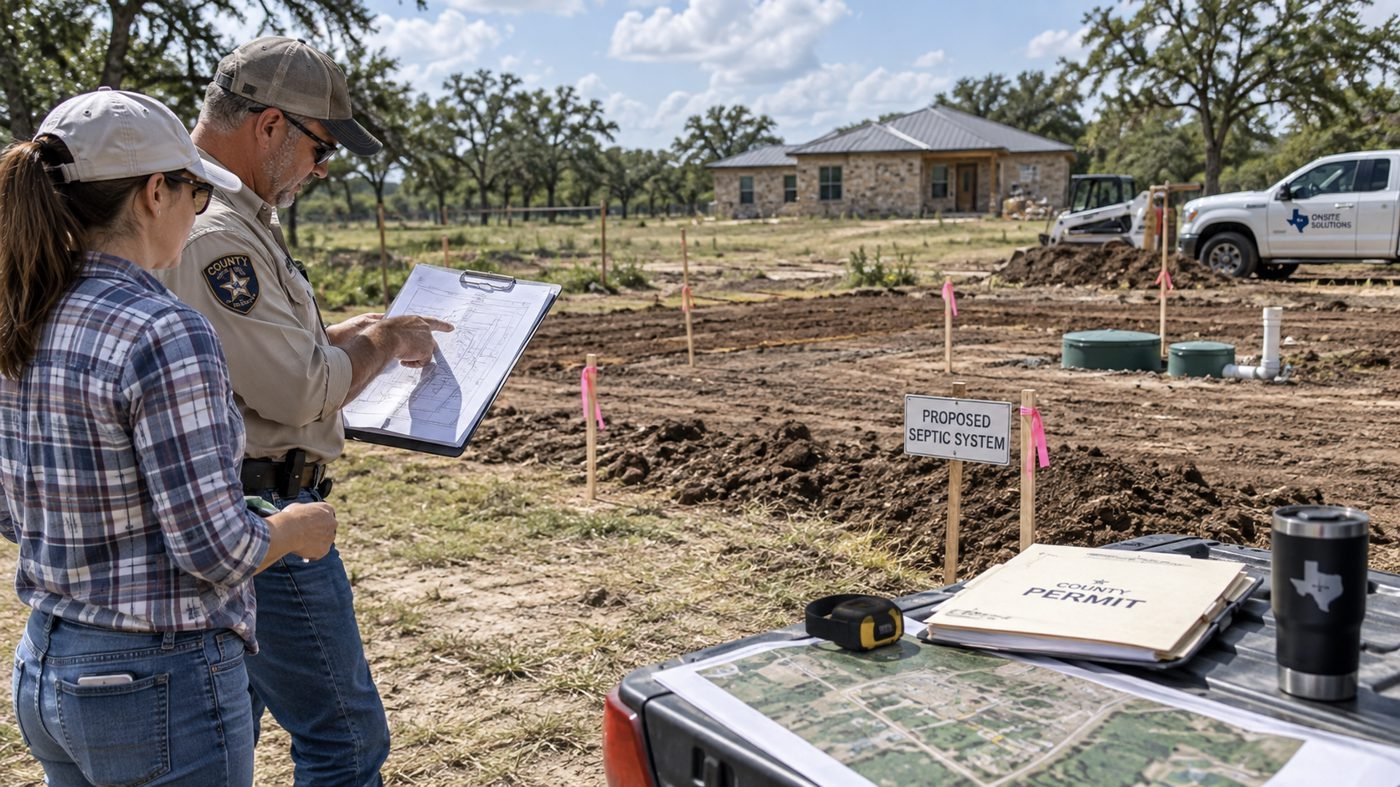
In most cases, yes: Texas septic systems require a permit and approved plan
Texas regulates septic systems as on-site sewage facilities, or OSSFs. TCEQ states that a person generally must have a permit and approved plan to construct, install, alter, extend, repair, or operate an OSSF.
That does not mean every property follows the same process. Most permitting is handled by a local authorized agent such as a county, city, river authority, or other approved local governmental entity. Those local programs can adopt requirements that are more stringent than the state minimum.
The safest rule for a landowner is simple: identify the local permitting authority before doing septic work and confirm what that authority requires for the exact property.
Who actually issues the septic permit?
In many parts of Texas, the permit is administered locally rather than directly by TCEQ. A local governmental entity can become an authorized agent of TCEQ and then review applications, inspect systems, investigate complaints, and administer the local OSSF program.
That means two Texas counties can follow the same statewide framework but still have different application forms, fees, inspection procedures, maintenance requirements, or additional local rules.
- County environmental health department
- City or municipal authority
- River authority or special district
- Other local governmental entity approved as a TCEQ authorized agent
A site evaluation comes before system selection
Before a new OSSF is built, the disposal area has to be evaluated. TCEQ says the site must first be evaluated by a licensed site evaluator or licensed professional engineer before a system is constructed, installed, altered, extended, or repaired.
The evaluation looks at the site conditions that affect wastewater treatment and disposal, including soil, slope, drainage, available area, groundwater concerns, and other features that influence which system types are suitable.
This is why a septic permit is more than paperwork. The permit process ties the system design to the actual property.
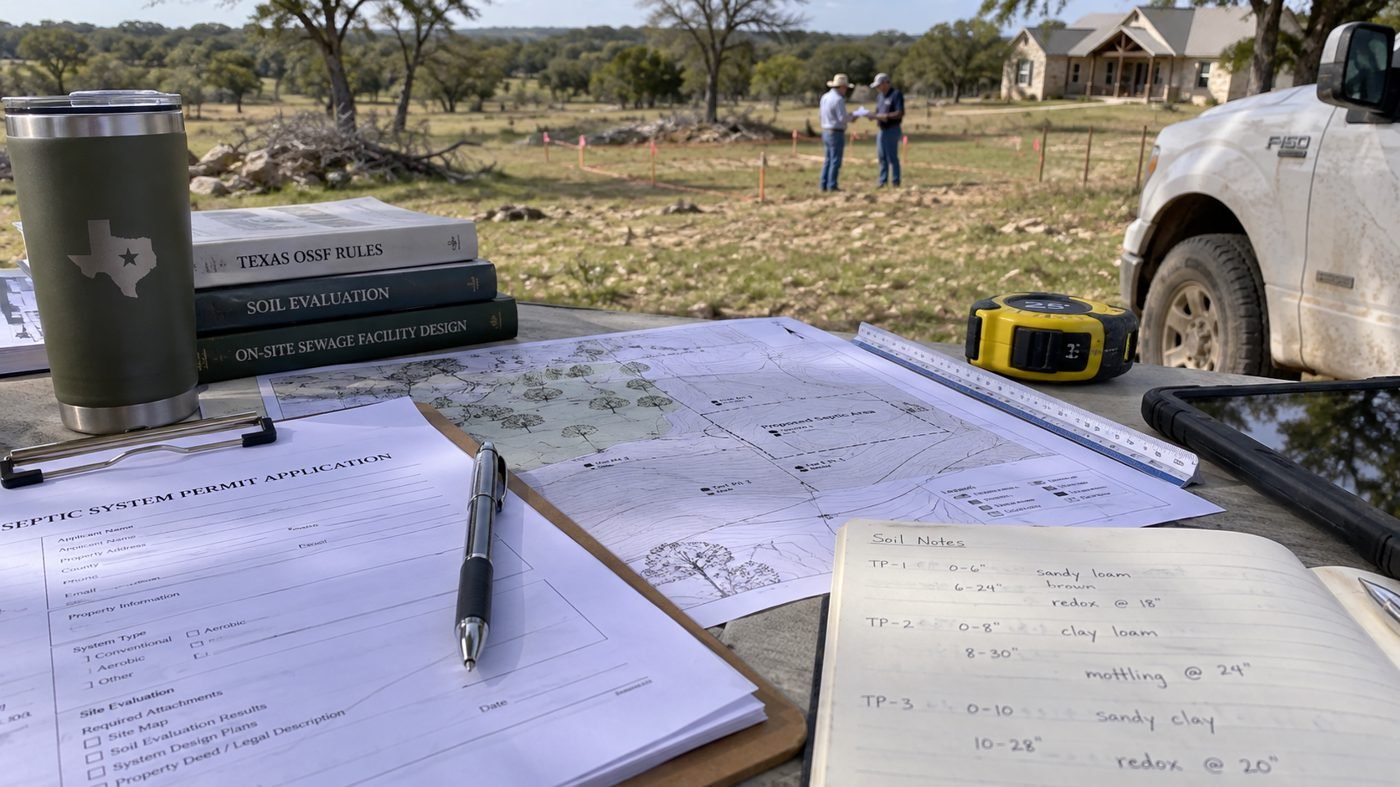
What typically goes into a Texas septic permit application?
The exact paperwork varies by local authority, but TCEQ's current OSSF permit application shows the kinds of information that are commonly required: owner information, site address, legal description, acreage, water source, residence size, number of bedrooms, site evaluator information, and installer information.
The application also calls for verification of the legal description, such as a deed, plat, survey, or similar documentation.
Local programs may require additional site plans, design documents, maintenance agreements, affidavits, easement information, or other supporting materials.
The 10-acre rule is a limited exemption, not a blanket exemption
One of the most misunderstood Texas septic rules is the so-called 10-acre rule. Owning 10 acres does not automatically mean a septic permit is unnecessary.
TCEQ says an OSSF may be exempt from permitting only if it complies with the other planning, construction, and installation requirements and all of the 10-acre-rule conditions are met.
Those conditions include a qualifying site evaluation, a single-family dwelling on a tract of at least 10 acres, no nuisance or groundwater pollution, all OSSF components at least 100 feet from the property line, effluent disposed of on the property, and the single-family dwelling being the only dwelling on the tract.
Why the 100-foot property-line requirement matters
The 10-acre exemption requires every part of the OSSF to be at least 100 feet from the property line. That is much more restrictive than simply owning 10 acres.
A long, narrow tract may contain 10 acres but still have difficulty satisfying that condition once the home, driveway, well, easements, pond, shop, and other improvements are laid out.
Do not assume acreage alone creates an exemption. Have the site evaluated and confirm the rule with the local permitting authority.
The exemption applies to one single-family dwelling
The 10-acre exemption also requires the single-family dwelling to be the only dwelling on the tract. That can matter for acreage owners planning a guest house, second home, rental unit, or additional residence.
If your long-term plan includes multiple dwellings, discuss that plan with the permitting authority before relying on any exemption.
Local rules can be stricter than the state minimum
TCEQ repeatedly advises property owners to check with the local permitting authority because local OSSF programs may impose requirements beyond the state minimum.
A local authority may require a permit even where a landowner believes the 10-acre exemption could apply, or it may have additional design, maintenance, inspection, or documentation requirements.
For that reason, online summaries should never replace a written answer from the authority that has jurisdiction over the parcel.
Do repairs require a septic permit?
Many repairs, alterations, and extensions can require permitting because TCEQ's general rule applies to constructing, altering, repairing, extending, or operating an OSSF.
There is a limited exception for certain emergency repairs. TCEQ says specific emergency repairs can be performed without first obtaining a permit, but they must be reported to the permitting authority in writing within 72 hours after the repair begins.
Examples listed by TCEQ include certain repairs to tank lids, risers, inlet and outlet devices, disinfection equipment, drip tubing, and solid lines. Always verify whether the specific repair qualifies.
What about older systems with no permit?
Some older septic systems may be considered grandfathered rather than currently permitted. TCEQ says a system may qualify as grandfathered if it was installed before the local program had an authorized OSSF program or before September 1, 1989, whichever is earlier, and it is not creating a nuisance, does not need repair, and has not had a significant increase in use or other alteration.
A grandfathered system is not the same as a newly approved system. If you are buying property with an older unpermitted septic system, ask the local authority to confirm the status before closing.
Adding bedrooms or changing use can affect the septic approval
Septic design is tied to wastewater loading. Adding bedrooms, converting a shop into living space, adding a guest house, or otherwise increasing use can affect whether the existing system remains adequate.
Because TCEQ's grandfathering guidance specifically mentions a significant increase in use or alteration, owners should not assume an older system can automatically support a larger household or additional dwelling.
Contact the permitting authority before expanding the residence or changing the use of the property.
Aerobic systems can come with additional maintenance requirements
If the approved system is aerobic or another advanced treatment design, the permit is only part of the ownership obligation. These systems can include service policies, inspections, maintenance agreements, testing, alarms, pumps, aerators, and disinfection requirements.
Local authorized agents can impose maintenance requirements that are more stringent than statewide minimums, so read the approved design and maintenance obligations before accepting an aerobic system proposal.
Do not install first and ask for forgiveness later
Installing septic work without confirming the permit requirement can create expensive problems. The system may have to be uncovered, inspected, redesigned, relocated, or even replaced if it does not meet the approved plan or local requirements.
It can also create issues during a sale, refinance, addition, or future permit application when the county or other authority cannot verify how the system was installed.
What buyers should verify before purchasing rural property
If a property already has a septic system, ask for the permit, approved plan, site evaluation, installation record, inspection records, maintenance history, and any repair or pumping records.
Then confirm with the local permitting authority that the records match the property and that the system is not subject to an unresolved violation or unpermitted alteration.
For aerobic systems, also request the model information, maintenance-provider history, alarm or repair records, and any required service agreement.
- Permit number and approved plan
- Site evaluation
- Installer information
- Inspection and final approval records
- Tank and disposal-area location
- Maintenance contract, if applicable
- Repair and pumping history
- Any record of violations, complaints, or unpermitted alterations
What land buyers should do before closing on an unimproved tract
If there is no existing septic system, identify the local OSSF permitting authority during the option or due-diligence period. Ask what site evaluation is required, whether the property could qualify for any exemption, what fees apply, and what local rules affect the planned home.
If septic feasibility could determine whether the property works for your house, shop, pool, guest house, or future second residence, complete enough site work before closing to understand the likely disposal area and system type.
A simple Texas septic-permit checklist
Before construction or purchase, work through the following items and keep written documentation.
- Identify the local OSSF permitting authority
- Confirm whether a permit is required for the property and project
- Schedule a site evaluation with a licensed evaluator or professional engineer
- Confirm the proposed treatment and disposal method
- Review the site plan with the home, well, driveway, structures, and property lines shown
- If considering the 10-acre exemption, verify every condition with the permitting authority
- Submit the required application, design, and fees
- Use properly licensed professionals for the approved system
- Complete required inspections before covering components
- Keep the permit, approved plan, and final records with the property documents
The permit question should be answered before septic work begins
For most Texas rural projects, the correct approach is to assume the septic system will require a permit and approved plan until the local authority confirms otherwise.
The limited exemptions are valuable where they apply, but they have specific conditions. Verifying the rules early protects the site plan, construction schedule, resale documentation, and the long-term reliability of the wastewater system.
Keep researching
Septic Systems resources
Planning, evaluating, installing, and maintaining septic systems for rural properties.
Sources & methodology
Where this information comes from
Cost figures are planning references rather than contractor quotes. Permitting, system-selection, and location-specific guidance should be verified with the appropriate local authority or qualified professional. AcreageReady uses source-backed, AI-assisted editorial workflows and remains responsible for the material it publishes. Read how we research, edit, and correct guides.
- Texas Commission on Environmental Quality: Getting a Permit for an OSSF
- Texas Commission on Environmental Quality: Advice for an OSSF Owner
- Texas Commission on Environmental Quality: Choosing a Septic System
- Texas Commission on Environmental Quality: OSSF Program
- Texas Commission on Environmental Quality: OSSF Permit Application
Common questions
Frequently asked questions
Do you need a septic permit in Texas?
Generally yes. TCEQ states that a permit and approved plan are generally required to construct, install, alter, extend, repair, or operate an on-site sewage facility. Limited exemptions exist, and local programs can be stricter.
Does 10 acres mean you do not need a septic permit in Texas?
No. The 10-acre rule has multiple conditions, including a qualifying site evaluation, one single-family dwelling, all OSSF components at least 100 feet from the property line, on-site effluent disposal, and compliance with other applicable requirements.
Who issues septic permits in Texas?
Many permits are handled by local TCEQ-authorized agents such as counties, cities, river authorities, or other approved local governmental entities. TCEQ administers the statewide program and rules.
Do septic repairs need a permit in Texas?
Many repairs or alterations can require permitting. Certain emergency repairs are exempt from advance permitting, but TCEQ says they must be reported to the permitting authority in writing within 72 hours after the repair begins.
Can an old septic system be grandfathered in Texas?
Possibly. TCEQ says certain systems installed before the local authorized program or before September 1, 1989, whichever is earlier, may be grandfathered if they are not creating a nuisance, do not need repair, and have not had a significant increase in use or other alteration.
Should I verify a septic permit before buying rural property?
Yes. Ask for the permit, approved plan, site evaluation, installation and inspection records, and maintenance history, then confirm the records with the local permitting authority.
Ready to talk with a local professional?
Share your location and project details so AcreageReady can identify relevant providers as the network grows.
Get a free quote