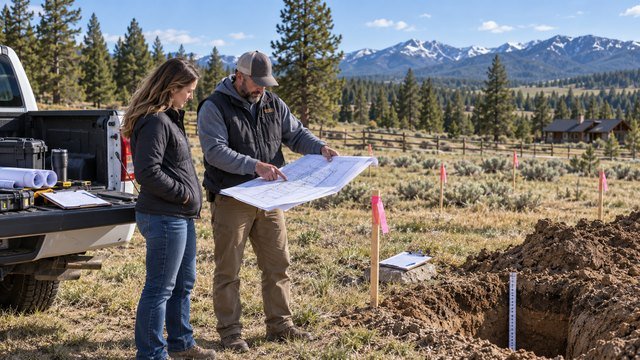
Septic approval is one of the first buildability questions to answer on rural Idaho land
If a rural Idaho parcel is not served by public sewer, the septic system can determine whether the property works for the home, shop, guest house, or other structures you want to build.
The important question is not simply whether there is enough acreage. Idaho septic approval depends on soil, groundwater, slope, usable drainfield area, setbacks, wastewater flow, and the location of the proposed homesite.
For land buyers, the strongest approach is to investigate septic feasibility during due diligence instead of waiting until after closing.
Who handles septic permits in Idaho?
The Idaho Department of Environmental Quality establishes the statewide rules for individual and subsurface sewage disposal systems under IDAPA 58.01.03.
Idaho's seven public health districts administer those rules under an agreement with DEQ. They conduct site evaluations, determine site suitability, issue septic permits, inspect installations, maintain permit records, and answer property-specific questions.
Your first step is therefore to identify the public health district serving the county where the property is located.
A septic site evaluation comes before the final permit
A site evaluation is the technical review used to determine whether the property can support an onsite wastewater system and what type of system may be appropriate.
DEQ specifically recommends having a site evaluation performed by the public health district and involving a licensed septic installer before purchasing property and applying for a permit.
The evaluation can reveal problems that are not obvious from a listing, aerial image, or casual walk of the land.
What does the health district evaluate?
The health district is looking for conditions that affect how wastewater will move through and be treated by the soil.
Important factors include soil texture and structure, usable soil depth, groundwater, restrictive layers, slope, available drainfield area, setbacks, and the relationship between the septic area and the rest of the site.
These conditions influence whether the property can use a conventional system or needs a more complex design.
- Soil type and soil horizons
- Depth to restrictive layers
- Seasonal or shallow groundwater
- Slope and topography
- Fractured bedrock or coarse material
- Usable drainfield area
- Replacement drainfield area
- Setbacks from wells, structures, property lines, water, and other features
- Access for installation and future service
Test holes are a major part of the site-evaluation process
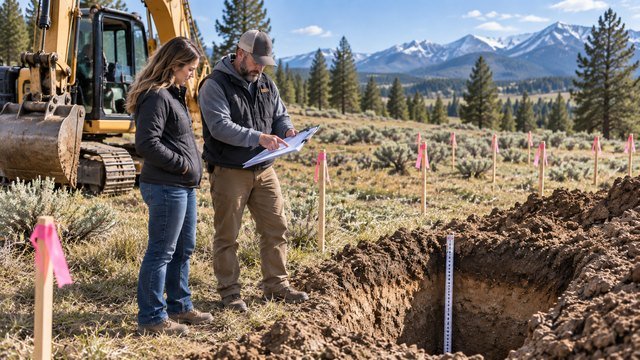
Many Idaho septic evaluations require test holes so the evaluator can see the actual soil profile below the surface.
Current Southeastern Idaho Public Health guidance for speculative onsite evaluations requires the property owner or applicant to provide test holes that are generally 8 to 10 feet deep depending on soil type and located near the proposed drainfield and replacement area.
Requirements can vary by health district and site, so confirm the number, depth, location, and excavation responsibility before scheduling equipment.
A failed site evaluation does not always mean the property is unusable
If a parcel cannot support a standard gravity system in the preferred location, there may still be other options.
The district may identify a different area of the property, a pressure-distribution system, enhanced treatment, or another alternative system depending on the site conditions and applicable rules.
The important point for buyers is that a more complex approval can materially change both the development budget and the amount of usable land.
Groundwater can be the limiting factor
Septic drainfields rely on unsaturated soil to provide treatment before effluent reaches groundwater.
DEQ identifies shallow groundwater as a condition that may require additional technical review, and groundwater ten feet or less below the surface is one of the circumstances that can trigger a nutrient-pathogen evaluation.
Seasonal conditions matter. A parcel that looks dry in late summer can still have a high seasonal water table.
Shallow soil, coarse gravel, and fractured bedrock can also trigger extra review
DEQ notes that shallow soil, a predominance of gravel or coarse-grained sediment, and fractured bedrock near the surface can increase the risk that wastewater reaches groundwater before receiving adequate treatment.
These conditions can lead to more restrictive siting, nutrient-pathogen review, or enhanced treatment requirements.
This is especially important on mountain, canyon, basalt, and high-desert properties where site conditions can change quickly across a parcel.
What is a nutrient-pathogen evaluation?
A nutrient-pathogen evaluation is a technical review of a proposed onsite system's potential impact on groundwater or surface water.
DEQ requires these evaluations for all proposed large soil absorption systems and for certain central systems in nitrate priority areas or over sensitive resource aquifers.
DEQ, a public health district, or a county agency can also require an evaluation where site conditions or existing contamination create additional water-quality concerns.
Most single-family buyers will not need an LSAS, but the threshold matters
DEQ defines a large soil absorption system as a subsurface system designed to receive at least 2,500 gallons of wastewater per day.
A normal single-family home will generally fall well below that threshold, but subdivisions, multiple residences, commercial uses, event facilities, or other high-flow projects can change the regulatory path.
If your long-term plan includes several structures or uses, discuss total wastewater flow before finalizing the site plan.
A speculative site evaluation can be useful before you are ready for a full permit
Several health districts offer a speculative site evaluation for buyers or owners who want to understand septic feasibility before committing to a final building plan.
This can be useful during a land-purchase due-diligence period because it provides more information about the site without requiring the entire construction project to be finalized.
Ask whether the district will credit any speculative-evaluation fee toward a later full permit if you proceed.
Septic fees vary by Idaho public health district
There is no single statewide septic permit fee because the public health districts publish their own fee schedules.
Central District Health lists a July 2026 fee of $1,070 for a new permit requiring a test hole or site visit and $535 for a speculative site evaluation.
Southeastern Idaho Public Health's septic permit application effective January 1, 2026 lists $300 for a speculative onsite evaluation and $925 for a full septic permit including site evaluation and permit fees.
Always verify the current fee for the specific district before budgeting because schedules can change.
What information is commonly required for a septic permit application?
Exact requirements vary by district, but the application usually needs enough information to identify the property, proposed use, and system location.
Southeastern Idaho Public Health's current application requires a completed application, a plot plan drawn to scale, proof of ownership such as a warranty deed or current tax notice, and the correct fee.
The plot plan is important because the district needs to understand how the septic system fits with the house, well, property lines, roads, and other site features.
Do not draw the homesite first and squeeze the septic system into the leftover space
A common rural-development mistake is choosing the house, shop, driveway, and well locations before septic feasibility is known.
The drainfield and replacement area can occupy a meaningful portion of the best buildable ground, and required setbacks can constrain the layout even further.
A better sequence is to identify likely septic areas first, then coordinate the homesite, well, driveway, utilities, and future structures around them.
Protect the replacement drainfield area
The initial drainfield is not the only area that matters. Many projects need space reserved for a future replacement system.
That area should remain available and should not be covered by buildings, pavement, pools, or other improvements that would prevent future use.
When comparing parcels, map both the primary and replacement areas before deciding how much truly usable acreage remains.
Coordinate septic approval with the well location
The well and septic system should be planned together because both need protected locations and adequate separation.
Drilling a well before the septic area is understood can force an awkward site layout or reduce the available drainfield area.
The strongest rural site plan coordinates the well, septic, homesite, driveway, drainage, and utilities as one system.
Future guest houses, apartments, and shop bathrooms should be discussed early
The septic system is sized and approved for the wastewater flow associated with the permitted use.
If you expect a guest house, accessory dwelling unit, apartment over a shop, additional bedrooms, or another structure with plumbing, tell the health district and installer before the initial design is finalized.
Planning only for the first phase can create expensive expansion or redesign work later.
Permit validity and renewal rules can affect construction timing
Permit duration is another reason to coordinate septic approval with the construction schedule.
Southeastern Idaho Public Health's 2026 application states that septic permits are valid for two years from issuance and may be renewed for an additional two years for a renewal fee if the renewal is completed before expiration.
Other districts may use different administrative procedures, so confirm the expiration and renewal rules with the district serving the parcel.
Installation must be inspected
Once a septic permit is issued, the approved system must be installed according to the permit and applicable rules.
DEQ states that individual systems should be installed by a licensed installer and inspected by the public health district.
Do not cover the system before the required inspection is complete. The inspection verifies that the installed components and layout match the approved permit.
Existing septic records can be valuable when buying improved acreage
If the parcel already has a home or an older septic system, ask the public health district for available permit records, site plans, inspection information, repairs, and system modifications.
DEQ directs property owners to their health district for septic permits, system locations, drawings, and property-specific records.
Records can help you understand tank and drainfield locations before planning additions, shops, driveways, pools, or replacement systems.
Older systems may not match today's rules or your future plans
An existing septic system may have been permitted under older standards or sized for a smaller home.
A planned bedroom addition, accessory dwelling unit, shop bathroom, or change in use can trigger questions about capacity and expansion.
Before buying an improved rural property, verify whether the existing system can support the project you intend to build.
What should you do during a land-purchase due-diligence period?
Build septic investigation into the purchase timeline rather than assuming it can be handled after closing.
- Identify the correct public health district
- Ask for existing septic permit and site-evaluation records
- Ask whether a speculative site evaluation is available
- Schedule test-hole excavation if required
- Confirm the likely primary and replacement drainfield areas
- Ask whether seasonal groundwater monitoring is needed
- Discuss the proposed bedroom count and future structures
- Confirm the current district fees
- Get a local licensed installer involved before closing
- Estimate the likely system type and complete installed cost
- Make sure septic approval fits within the contract due-diligence period
Questions to ask the public health district
A short conversation with the district can clarify what the parcel needs before you spend money on a full design.
- Has this parcel been evaluated before?
- Are there existing permits or failed evaluations?
- What test holes are required?
- Who is responsible for digging them?
- Is groundwater monitoring required?
- What type of system appears feasible?
- Is enhanced treatment likely?
- How large must the replacement area be?
- What setbacks will control the layout?
- What documents are required for the permit application?
- What are the current fees?
- How long is the permit valid?
- What inspection is required before the system is covered?
Questions to ask a licensed Idaho septic installer
The health district determines regulatory suitability, while a local installer can help translate that approval into construction cost and site logistics.
- What system type do you expect on this site?
- What does a complete installed system usually cost in this area?
- How does rock or difficult access affect pricing?
- Will the site require a pump or electrical work?
- Who coordinates the permit and inspection?
- What excavation is included?
- How should the site be protected during construction?
- What ongoing maintenance will the system require?
The best outcome is not merely getting a permit
A permit proves that an approved system can be installed under the conditions and design shown. It does not automatically mean the parcel is a good financial fit for your project.
The strongest land-buying decision combines septic feasibility with the cost of the well, driveway, power, grading, drainage, homesite preparation, and future buildings.
When septic is investigated early, you can compare rural properties based on total development cost instead of discovering a major constraint after closing.
Keep researching
Septic Systems resources
Planning, evaluating, installing, and maintaining septic systems for rural properties.
Sources & methodology
Where this information comes from
Cost figures are planning references rather than contractor quotes. Permitting, system-selection, and location-specific guidance should be verified with the appropriate local authority or qualified professional. AcreageReady uses source-backed, AI-assisted editorial workflows and remains responsible for the material it publishes. Read how we research, edit, and correct guides.
- Idaho Department of Environmental Quality: Septic and Septage
- Central District Health: Septic, Subdivisions & Water
- Southeastern Idaho Public Health: 2026 Septic Permit Application
- Idaho Department of Environmental Quality: Public Records Request
- AcreageReady: How Much Does a Septic System Cost in Idaho?
- AcreageReady: Buying Rural Land in Idaho
Common questions
Frequently asked questions
Who issues septic permits in Idaho?
Idaho DEQ establishes the statewide onsite wastewater rules, while Idaho's seven public health districts conduct site evaluations, issue septic permits, inspect installations, and maintain property-specific records.
Should I get a septic site evaluation before buying land in Idaho?
Yes. Idaho DEQ recommends having a public health district site evaluation and involving a licensed septic installer before purchasing property and applying for a permit.
How deep are septic test holes in Idaho?
Requirements vary by district and soil conditions. Southeastern Idaho Public Health's 2026 guidance says test holes for speculative onsite evaluations should generally be 8 to 10 feet deep depending on soil type and located near the proposed drainfield and replacement area.
How much does an Idaho septic permit cost?
There is no single statewide fee. Central District Health lists $1,070 for a new permit with a test hole or site visit as of July 2026, while Southeastern Idaho Public Health's 2026 application lists $925 for a full septic permit. Verify the current fee with the district serving the property.
How long is an Idaho septic permit valid?
Permit validity is administered by the public health district. Southeastern Idaho Public Health's 2026 application states that permits are valid for two years and can be renewed for another two years if renewed before expiration. Confirm the rule for your district.
Can an Idaho septic site require an advanced treatment system?
Yes. Shallow soils, coarse materials, shallow groundwater, fractured bedrock, nutrient-pathogen concerns, or other site conditions can lead to enhanced treatment or additional technical requirements.
Ready to talk with a local professional?
Share your location and project details so AcreageReady can identify relevant providers as the network grows.
Get a free quote