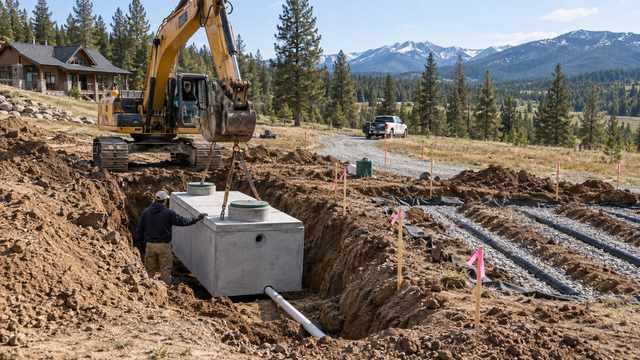
A septic system in Idaho can be a manageable site cost or a major land-development expense
For a rural Idaho property without public sewer, the septic system is one of the first development costs to investigate because the land itself determines what can be installed.
A straightforward site with suitable soil, adequate separation from groundwater, reasonable slope, and easy equipment access may support a conventional gravity system. A more difficult site may require pressure distribution, enhanced treatment, additional engineering, groundwater monitoring, or another alternative design.
That difference can move the project from a relatively predictable five-figure line item to one of the most expensive parts of preparing raw land.
A practical 2026 Idaho septic budget
For early planning, a conventional residential septic system in Idaho can reasonably be budgeted around $7,000 to $15,000 when the site supports a standard design and the scope includes the tank, drainfield, excavation, installation, and typical permitting work.
Pressure-dosed or otherwise more complex systems can move into roughly the $12,000 to $20,000 range, while engineered, mound, enhanced-treatment, or especially difficult systems can reach $18,000 to $30,000 or more.
These are planning ranges, not quotes. Published Idaho estimates vary widely, and the actual cost depends on the approved system type, local contractor pricing, health-district fees, soil, slope, groundwater, rock, access, and the amount of excavation required.
Why published Idaho septic prices vary so much
Different cost guides often describe different scopes. One estimate may cover a basic gravity system on favorable soil, while another includes permitting, site evaluation, pump equipment, difficult excavation, imported material, or an advanced treatment unit.
Current Idaho-oriented references place conventional systems anywhere from the mid-$4,000s into the low five figures, while rural builders and contractors commonly recommend higher allowances when site uncertainty is still unresolved.
For an acreage buyer, it is safer to build a conservative complete-system budget and then reduce it after the site evaluation and installer quotes are available.
Idaho septic systems are regulated statewide but permitted locally
Idaho Department of Environmental Quality rules establish minimum standards for individual and subsurface sewage disposal systems.
The seven Idaho public health districts administer those rules under an agreement with DEQ. They perform or oversee site evaluations, determine site suitability, issue septic permits, inspect installations, maintain permit records, and answer parcel-specific questions.
That means the county where the land is located determines which health district you will work with.
Permit and site-evaluation fees are not the same everywhere in Idaho
Do not use one statewide septic permit fee in your budget. Public health districts publish their own current fee schedules.
For example, Central District Health lists a July 2026 fee of $1,070 for a new permit requiring a test hole or site visit and $535 for a speculative site evaluation. Southeastern Idaho Public Health lists $850 for a basic or complex sewage-disposal permit and $300 for a speculative site evaluation.
Fees can change, and the required service depends on the parcel and project. Verify the current schedule with the health district serving the property before closing or applying.
The site evaluation is one of the most important steps before you buy
A rural parcel should not be assumed buildable for septic simply because neighboring homes have septic systems.
The public health district evaluates conditions that affect wastewater disposal, including soil characteristics, usable soil depth, groundwater, restrictive layers, slope, available drainfield area, and required setbacks.
Idaho DEQ specifically recommends that buyers have a site evaluation performed by the public health district and involve a licensed septic installer before purchasing property and applying for a permit.
Test holes reveal what is under the surface
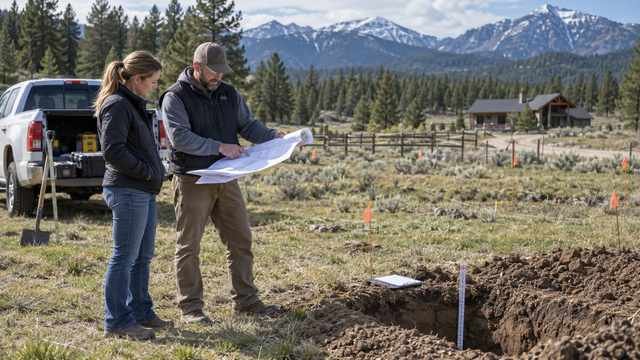
A septic evaluation commonly relies on test holes or soil observations to identify soil horizons, restrictive layers, groundwater indicators, and the depth of usable treatment soil.
The excavation itself may be a separate contractor cost, depending on the health district and local process.
If you are evaluating raw land, ask exactly who is responsible for digging the test holes, how many are needed, what equipment access is required, and whether the holes can be coordinated with other due-diligence work.
Conventional gravity systems are usually the least expensive option
A conventional system typically uses a septic tank followed by a gravity-fed drainfield. Wastewater settles in the tank, then effluent moves to the soil absorption area for additional treatment.
When soil depth, slope, groundwater separation, and layout all cooperate, this is generally the simplest system to install and maintain.
The biggest budgeting mistake is assuming every rural parcel qualifies for this least-expensive configuration.
Pressure distribution adds pumps, controls, and electrical work
Some properties need effluent distributed under pressure rather than by gravity.
A pressure system can require a pump chamber, pump, floats, controls, alarm, wiring, additional piping, and electrical service. Those components increase both installation cost and long-term maintenance responsibility.
If the site evaluation points toward a pressure system, ask for the expected pump replacement cycle, alarm requirements, electrical consumption, and access needed for future service.
Alternative and enhanced-treatment systems can cost substantially more
Idaho recognizes alternative systems for sites where a standard design is not appropriate. These can include extended treatment package systems and proprietary wastewater treatment systems.
Enhanced treatment can be required where site conditions create greater groundwater or surface-water concerns, including shallow soils, coarse materials, shallow groundwater, or other conditions identified through technical review.
These systems can involve mechanical treatment, electricity, annual service, monitoring, and laboratory testing, so the lifetime cost matters as much as the installation price.
Some enhanced systems have ongoing annual obligations
Idaho DEQ requires operation, maintenance, and monitoring for extended treatment package systems.
Those systems need a constant power supply, periodic professional service, and required monitoring to demonstrate treatment performance.
If an advanced system is being considered, ask for the annual service agreement cost before deciding whether the parcel still fits your long-term budget.
Soil can matter more than acreage
A ten-acre parcel is not automatically easier to develop than a two-acre parcel if the usable septic area has poor soil, shallow bedrock, excessive slope, or high groundwater.
The key question is not simply how much land you own. It is how much land has suitable soil in the right location with the required setbacks and access.
This is why septic feasibility belongs near the top of the due-diligence list when comparing rural properties.
Groundwater depth can change the approved design
Septic drainfields rely on unsaturated soil to treat wastewater before it reaches groundwater.
Idaho DEQ identifies shallow groundwater as one of the conditions that can trigger additional review and potentially enhanced treatment.
Seasonal groundwater can be especially important. A site that appears dry during summer may still have limiting conditions during wetter parts of the year.
Rock, basalt, and mountain terrain can increase excavation cost
Idaho properties can include basalt, fractured rock, boulders, steep mountain slopes, and difficult access.
Even when the approved septic design is relatively conventional, excavation can become expensive if equipment must hammer rock, work on steep ground, travel long distances across the parcel, or haul material in and out.
Ask the installer whether the quote includes rock excavation and what unit rate applies if unexpected rock is encountered.
The drainfield and replacement area consume real usable space
Do not plan only for the initial drainfield. Rural site planning should also protect the area needed for a future replacement system when required.
That reserve area can affect where you place the home, shop, driveway, pool, barn, guest house, well, garden, and future additions.
A parcel can look large on a map and still become constrained after septic areas, setbacks, easements, drainage, slope, and access are layered together.
Coordinate septic placement with the well
The well and septic system should be planned together because both require protected locations and separation from potential contamination sources.
Do not drill a well or finalize the homesite before understanding where the septic tank, drainfield, replacement area, and access routes are likely to go.
A coordinated site plan can also reduce unnecessary trenching and help keep heavy construction traffic away from the drainfield.
System size is tied to wastewater flow and home design
The number of bedrooms, expected wastewater flow, home use, and accessory structures can affect system sizing.
If you expect a guest house, apartment, shop bathroom, short-term rental, or other future wastewater source, discuss it before the system is permitted.
Designing only for today's smallest plan can create an expensive expansion problem later.
Large or unusual projects can trigger additional review
Idaho treats very large onsite systems differently from a normal individual residential system. DEQ defines large soil absorption systems as systems designed to receive at least 2,500 gallons per day.
Certain projects and locations can also require a nutrient-pathogen evaluation to assess potential impacts to groundwater or surface water.
Most single-family acreage buyers will not be building an LSAS, but subdivisions, multiple structures, commercial uses, or unusually high flows deserve early discussion with the health district.
Equipment access affects both installation and future maintenance
Excavators, dump trucks, tank-delivery trucks, and pumping equipment need practical access to the system.
Narrow gates, soft roads, steep grades, low branches, weak culverts, deep snow, and spring mud can complicate installation on rural Idaho acreage.
Keep future pump-truck access in mind too. A beautiful landscaping plan that blocks the septic tank can turn routine maintenance into an unnecessary expense.
What should be included in an Idaho septic quote?
Compare contractor bids by complete scope rather than headline price. A lower bid may simply exclude items another installer has included.
- Septic tank size and material
- Tank delivery and setting
- Inlet and outlet components
- Distribution box or pressure components
- Drainfield piping or chambers
- Drain rock or approved media
- Excavation and backfill
- Rock excavation allowance
- Pump chamber, pump, controls, and alarm if required
- Electrical work if required
- Permit coordination
- Test-hole excavation if applicable
- Health-district inspection coordination
- Final grading and site cleanup
- Risers and accessible lids
- As-built documentation
- Warranty terms
- Change-order rates for unexpected conditions
A realistic planning example for rural Idaho
Suppose you are considering a five-acre parcel and do not yet know the approved septic type. Instead of inserting a $6,000 septic line into the land-development budget, carry a larger placeholder until the site evaluation is complete.
A planning allowance of roughly $12,000 to $15,000 gives more room for a standard system, permit fees, excavation uncertainty, and contractor pricing. If the site later qualifies for a simpler system, the savings become contingency for the well, driveway, power, or grading.
If the evaluation requires pressure distribution or advanced treatment, you will know early enough to decide whether the property still works financially.
Questions to ask before buying Idaho acreage
The best time to discover a difficult septic site is during due diligence, not after closing.
- Which public health district serves this parcel?
- Are there existing septic permits or site-evaluation records?
- Has the parcel ever failed or been restricted for septic?
- What type of system appears feasible?
- Will test holes be required?
- Is seasonal groundwater monitoring needed?
- Is there enough room for the primary and replacement drainfield areas?
- How do the septic areas affect the homesite and future shop?
- Are there setbacks from the well, property lines, water, roads, or structures that constrain the layout?
- Could an alternative or enhanced-treatment system be required?
- What is the current permit and site-evaluation fee?
- What does a local installer expect the complete installed system to cost?
The septic decision belongs in your total land-development budget
A cheap parcel can become expensive if it needs a difficult well, advanced septic system, long driveway, major grading, and a large power extension.
Compare rural properties by total development cost rather than land price alone.
For Idaho acreage, the strongest sequence is to evaluate access, septic, water, power, drainage, homesite, and major site work together before committing to a build plan.
Keep researching
Septic Systems resources
Planning, evaluating, installing, and maintaining septic systems for rural properties.
Sources & methodology
Where this information comes from
Cost figures are planning references rather than contractor quotes. Permitting, system-selection, and location-specific guidance should be verified with the appropriate local authority or qualified professional. AcreageReady uses source-backed, AI-assisted editorial workflows and remains responsible for the material it publishes. Read how we research, edit, and correct guides.
- Idaho Department of Environmental Quality: Septic and Septage
- Central District Health: Septic, Subdivisions & Water
- Southeastern Idaho Public Health: Septic Permits
- Angi: How Much Does a Septic System Cost? 2026 Data
- ProMatcher: Idaho Septic Systems Costs & Prices
- AcreageReady: Buying Rural Land in Idaho
- AcreageReady: How Much Does It Cost to Drill a Well in Idaho?
Common questions
Frequently asked questions
How much does a septic system cost in Idaho in 2026?
For early planning, a conventional residential septic system can reasonably be budgeted around $7,000 to $15,000. Pressure or more complex systems may cost roughly $12,000 to $20,000, while engineered or enhanced-treatment systems can reach $18,000 to $30,000 or more. Actual quotes vary by site and system design.
Who issues septic permits in Idaho?
Idaho DEQ establishes the statewide onsite wastewater rules, while Idaho's seven public health districts administer those rules, conduct site evaluations, issue permits, inspect installations, and maintain property-specific records.
How much is an Idaho septic permit?
There is not one statewide permit price. Public health districts publish their own fee schedules. For example, Central District Health lists $1,070 for a new permit with a test hole or site visit as of July 2026, while Southeastern Idaho Public Health lists $850 for a basic or complex sewage-disposal permit. Always verify the current fee for the property's district.
Should I get a septic evaluation before buying rural land in Idaho?
Yes. Idaho DEQ recommends a site evaluation by the public health district and involvement from a licensed septic installer before purchasing property and applying for a permit. Septic feasibility can materially change both buildability and development cost.
What makes an Idaho septic system more expensive?
Common cost drivers include poor or shallow soils, high seasonal groundwater, rock excavation, steep slope, difficult access, larger wastewater flows, pump systems, electrical work, alternative treatment, groundwater monitoring, and ongoing service requirements.
Can I install my own septic system in Idaho?
Idaho generally requires septic systems to be installed by a licensed basic or complex installer. DEQ notes an exception allowing a homeowner to establish a standard/basic system on their own property with no hired help, but the system still must meet permitting, inspection, and technical requirements. Confirm eligibility with the local public health district before doing any work.
Ready to talk with a local professional?
Share your location and project details so AcreageReady can identify relevant providers as the network grows.
Get a free quote