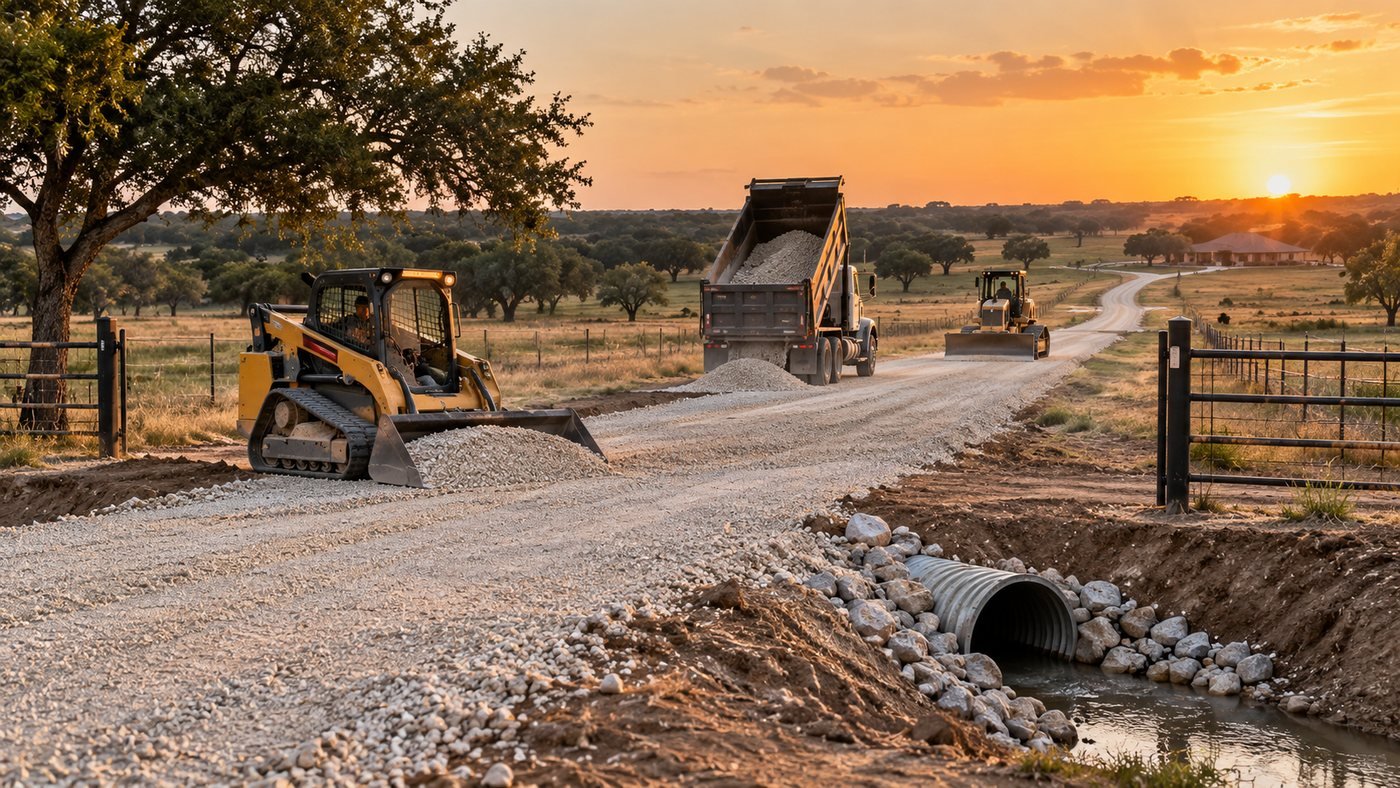
How much does a gravel driveway cost in Texas in 2026?
For early planning, many professionally installed gravel driveways fall around $4 to $10 per square foot when materials and labor are included. Current 2026 consumer data also shows smaller or simpler projects coming in lower, while long rural driveways with excavation, road base, drainage, and culvert work can move well beyond basic driveway averages.
HomeGuide currently uses about $4 to $10 per square foot as an installed gravel driveway range, while Angi reports roughly $1 to $10 per square foot depending on gravel type, driveway size, and site-preparation needs. The difference is a reminder that a refresh of an existing gravel drive is not the same project as building a new rural driveway from raw ground.
For acreage, the most important question is not just the gravel price. It is whether the driveway needs clearing, excavation, subgrade repair, geotextile, road base, drainage shaping, culverts, compaction, and enough width and turning area for construction traffic.
- Installed planning range: roughly $4 to $10 per square foot for many complete gravel driveways
- Existing-drive refreshes can cost less than new construction from raw ground
- Road base, grading, drainage, and culverts can be major cost drivers
- Long rural driveways should be budgeted by actual length, width, depth, and site conditions
What would a 100-foot gravel driveway cost?
A 100-foot-long driveway that is 10 feet wide contains 1,000 square feet. At a planning range of $4 to $10 per square foot, that works out to roughly $4,000 to $10,000 for a professionally installed driveway.
HomeGuide's current 2026 pricing uses the same example and places a 100-foot by 10-foot gravel driveway around $4,000 to $10,000. A driveway that only needs new top gravel may cost much less, while a driveway built from native soil may need excavation, base rock, drainage, and multiple compacted lifts.
Long rural driveways can become a major site-development cost
Acreage driveways are often several hundred feet long, which is why access can become one of the largest site-work line items before a home is built.
A 300-foot by 12-foot driveway contains 3,600 square feet. At $4 to $10 per square foot, the arithmetic planning range is roughly $14,400 to $36,000. A 500-foot by 12-foot driveway contains 6,000 square feet, which produces a planning range of roughly $24,000 to $60,000.
Those figures are intentionally broad. Large projects may achieve better unit pricing, while difficult terrain, rock, wet areas, culverts, imported base, or extensive excavation can push the total upward.
- 300 ft × 12 ft: 3,600 sq. ft., roughly $14,400 to $36,000 at $4 to $10 per sq. ft.
- 500 ft × 12 ft: 6,000 sq. ft., roughly $24,000 to $60,000 at $4 to $10 per sq. ft.
- Measure the full drive, parking area, turnaround, gate apron, and construction staging area before budgeting
Why road base matters more than decorative gravel
A durable rural driveway is built from the bottom up. HomeGuide currently lists road-base gravel around $18 to $31 per ton and notes that compacted base helps prevent native soil from mixing into the surface layer and reduces mud formation.
The exact base design depends on subgrade soil, drainage, traffic, and load. A driveway expected to carry concrete trucks, drill rigs, septic equipment, dump trucks, and building deliveries needs more support than a short residential parking area.
Ask contractors to separate the structural base from the surface gravel in the quote. That makes it easier to understand whether two proposals are actually comparable.
Gravel type changes both price and performance
Different materials behave differently under traffic. Angi's current 2026 data places common gravel products from roughly $10 to $100 or more per ton depending on material, with crushed limestone around $30 to $40 per ton and caliche around $30 to $100 per ton.
For a working rural driveway, angular crushed material generally locks together better than smooth decorative rock. The best material also depends on what local quarries supply economically in your part of Texas.
- Road base or aggregate base for the structural layer
- Crushed limestone for a compactable surface in many Texas markets
- Caliche where locally available and appropriate
- Decorative gravel as a finish layer rather than the primary structural base
Drainage is often the difference between a driveway that lasts and one that washes out
Water is one of the biggest enemies of a gravel driveway. If runoff travels down the driving surface, crosses the driveway without a controlled path, or sits in low areas, the road base can rut, pump, wash away, or become muddy.
The driveway should shed water rather than trap it. That may require crown, cross-slope, roadside swales, turnouts, ditch work, culverts, or additional rock at low crossings.
Drainage work should be part of the driveway design, not an afterthought after the first heavy rain.
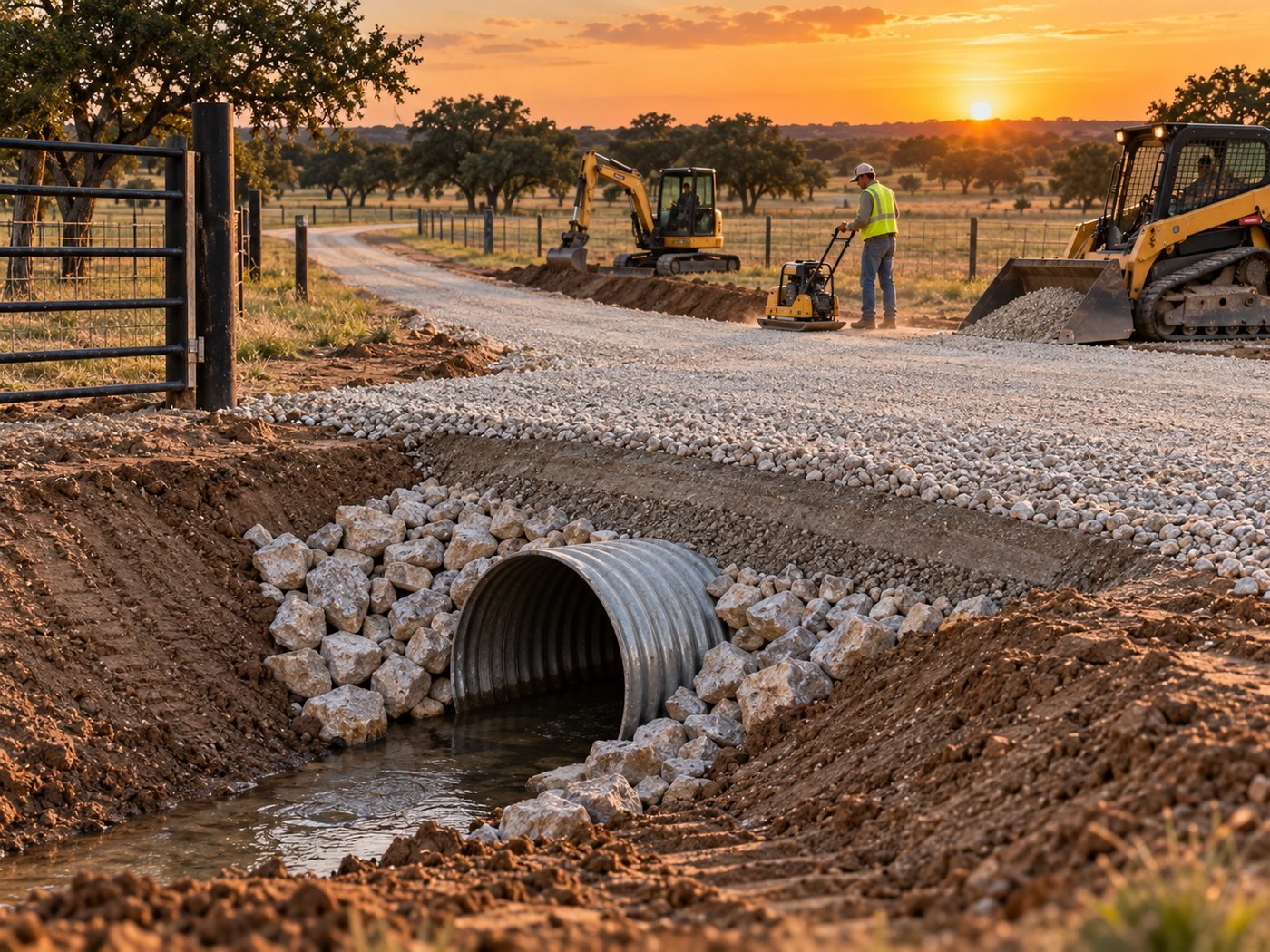
Culverts and road entrances can add meaningful cost
Many rural Texas properties need a culvert where the driveway crosses a roadside ditch. The culvert diameter, length, cover depth, end treatment, and driveway elevation should match the drainage conditions and the road authority's requirements.
If the property fronts a state highway, TxDOT requires a driveway permit before construction or modification of an access driveway on state highway right of way. TxDOT also requires drainage impacts to the state highway system to be coordinated and approved.
County roads and private roads can have different entrance and culvert requirements, so identify the road authority before the driveway contractor mobilizes.
TxDOT access requirements matter on state highways
TxDOT's current Access Management Manual states that a property owner or authorized representative must obtain an executed driveway permit before constructing a new driveway on state highway right of way.
TxDOT's typical farm and ranch driveway guidance calls for a 20-foot throat width and 25-foot return radii, and it notes that the distance between the highway and a gate should be long enough to store the longest anticipated vehicle combination. That is especially relevant for acreage owners who expect trucks and trailers.
These standards do not automatically apply to every county or private road, but they show why rural access geometry should be planned around real vehicle movements instead of only passenger cars.
Construction traffic should influence the driveway design
If you are developing raw land, the driveway will likely be used by heavier vehicles before the home is complete. Concrete trucks, dump trucks, excavator trailers, well-drilling rigs, septic equipment, material deliveries, and cranes can expose weak base areas very quickly.
Some owners build a construction entrance first and add the final surface course later. That can make sense because heavy construction traffic may damage or contaminate a finished top layer.
Coordinate the driveway sequence with clearing, pad construction, utilities, septic, well drilling, and final grading.
Maintenance belongs in the long-term budget
Gravel driveways need maintenance even when the initial installation is good. Traffic moves material, stormwater creates ruts, vegetation can creep into the edges, and low areas can develop over time.
Routine maintenance may include regrading, filling potholes, restoring crown, cleaning ditches and culverts, and adding a new surface layer. A well-designed base usually makes those repairs simpler and less expensive than rebuilding a failed driveway.
Questions to ask a Texas driveway contractor
A good driveway quote should explain the full build-up, not just the number of truckloads of gravel. Ask the contractor how they are preparing the subgrade, what base material and depth they are using, how drainage is being handled, and what finish condition is included.
For raw acreage, make sure the contractor knows what kinds of construction vehicles will use the driveway before the final home is complete.
- How wide will the finished driveway be?
- What excavation or subgrade preparation is included?
- Is geotextile fabric needed on this site?
- What base material will be used and how deep will it be?
- How many compacted lifts are included?
- What surface gravel will be used?
- How will crown and drainage be established?
- Are ditches, swales, or culverts included?
- Is the road entrance or permit work included?
- Will the driveway support construction trucks and trailers?
- Are turnaround and gate areas included?
- What maintenance should I expect after the first year?
A practical way to budget a rural Texas gravel driveway
Measure the full driveway length first, then decide the working width and identify parking, turnaround, gate, and staging areas. From there, separate clearing, excavation, base, surface gravel, drainage, culverts, and permit work.
Do not compare a quote for spreading top gravel over an existing road with a quote for creating a new all-weather driveway from native ground. The structural scope is completely different.
For raw-land development, the driveway is part of the infrastructure system. Plan it alongside the house pad, well, septic, power route, drainage, and construction access rather than treating it as a landscaping item at the end.
Keep researching
Land & Site Work resources
Clearing, grading, drainage, driveways, pads, excavation, and preparing acreage for construction.
Sources & methodology
Where this information comes from
Cost figures are planning references rather than contractor quotes. Permitting, system-selection, and location-specific guidance should be verified with the appropriate local authority or qualified professional. AcreageReady uses source-backed, AI-assisted editorial workflows and remains responsible for the material it publishes. Read how we research, edit, and correct guides.
Common questions
Frequently asked questions
How much does a gravel driveway cost per square foot in 2026?
A useful installed planning range is roughly $4 to $10 per square foot for many complete gravel driveways. Existing-drive refreshes may cost less, while difficult rural sites with excavation, road base, drainage, and culverts can cost more.
How much does a 100-foot gravel driveway cost?
A 100-foot by 10-foot driveway is 1,000 square feet. At $4 to $10 per square foot, the planning range is roughly $4,000 to $10,000 for materials and professional installation.
What is the best gravel for a Texas driveway?
The best material depends on local supply, soil, drainage, and traffic. Many rural driveways use a compactable road-base layer with crushed limestone or another angular aggregate on top rather than smooth decorative gravel.
Do I need a culvert for a rural driveway in Texas?
Many properties need a culvert where the driveway crosses a roadside drainage ditch, but the requirement and design depend on the road authority and site drainage. Check county, municipal, or TxDOT requirements before construction.
Do I need a permit for a driveway on a Texas state highway?
Yes. TxDOT requires a driveway permit before constructing or modifying an access driveway on state highway right of way.
How wide should a rural driveway be?
A common residential working width is around 10 to 12 feet, but gates, curves, turnarounds, and construction access may need more room. TxDOT's typical farm and ranch driveway guidance uses a 20-foot throat width at state-highway access points.
Ready to talk with a local professional?
Share your location and project details so AcreageReady can identify relevant providers as the network grows.
Get a free quote