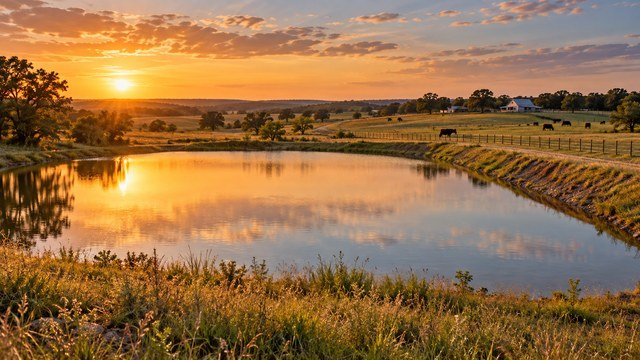
A pond is an earthwork and water-management project, not just a hole in the ground
A well-built rural pond can provide livestock water, fishing, wildlife habitat, fire protection, recreation, stormwater storage, and a major visual feature for Oklahoma acreage.
A poorly planned pond can leak, silt in, wash out a dam, flood downstream property, stay muddy, create erosion, or require repairs that cost more than the original construction.
Oklahoma State University recommends treating a pond as a major investment and evaluating the site, soils, hydrology, dam, spillways, and intended use before excavation begins.
Most Oklahoma farm ponds are watershed ponds
Oklahoma State University notes that many Oklahoma ponds are watershed ponds, where runoff from surrounding land is captured in a basin behind an earthen dam or embankment.
Livestock watering ponds are also sometimes constructed primarily by excavation.
The construction method changes the earthwork quantity, dam requirements, water source, permitting questions, and long-term maintenance.
Start with the purpose of the pond
A fishing pond, livestock pond, wildlife pond, irrigation reservoir, stormwater pond, and scenic backyard pond do not need exactly the same shape, depth, shoreline, water quality, or infrastructure.
The intended use affects how much storage you need, whether livestock should have direct access, whether a drain is valuable, what fish species fit, and how much watershed runoff is desirable.
List the primary and secondary uses before asking contractors for a price.
A practical 2026 cost range can vary enormously
Current 2026 consumer pricing guides place many basic farm pond projects in a broad range around $2,500 to $20,000, while larger or more complex ponds can reach $15,000 to $40,000 or substantially more.
Those figures are only early screening ranges. Rural Oklahoma costs can rise quickly with large dams, rock, unsuitable soils, long haul distances, clearing, dewatering, spillway work, liners, engineering, permits, and difficult access.
A contractor quote based on actual cut-and-fill quantities and site conditions is much more useful than a generic per-acre number.
Earthwork volume is one of the biggest cost drivers
Pond size alone does not tell you how much dirt must be moved.
A site with a natural draw may create substantial storage with a relatively short dam, while a flat site may require far more excavation for the same water surface area.
Ask the designer or contractor to explain approximate cut, fill, dam volume, spoil placement, and whether excavated material is suitable for the embankment.
A cheap site can become expensive if the soils are wrong
Oklahoma State University emphasizes the importance of adequate clay content in the pond basin and dam.
Sand, gravel, fractured rock, shallow bedrock, or permeable soil layers can cause leakage that is difficult and expensive to correct after construction.
Test holes across the proposed basin can reveal hidden problems before the owner commits to major earthwork.
Do test holes before excavation
OSU recommends test holes on a grid through the planned pond basin so subsurface conditions can be evaluated below the final basin elevation.
The goal is to identify whether the pond will have enough suitable material to seal the basin and build a stable dam.
This is especially important on acreage where surface soil looks clay-rich but underlying layers contain sand, gravel, or rock.
Fixing a leaking pond after construction can be extremely expensive
OSU warns that post-construction repairs to leaking ponds may be cost-prohibitive.
Clay liners, membrane liners, bentonite treatments, excavation, recompaction, and dewatering all add cost, and some repair methods still do not guarantee a permanent fix.
Spending money on soil investigation and proper compaction before filling the pond is usually cheaper than trying to repair a failed basin.
The dam needs a properly built core
A stable earthen dam is not simply a pile of excavated soil.
OSU recommends stripping unsuitable topsoil from the dam footprint, excavating a core trench along the dam alignment, and rebuilding with suitable clay-rich material compacted in lifts.
The dam design also needs the correct slopes, crest dimensions, freeboard, and spillway arrangement for the site.
Compaction quality matters as much as soil type
Even good clay can leak or settle if it is placed too dry, too wet, or in thick uncompacted lifts.
Proper pond construction uses appropriate compaction equipment and controls soil moisture as the embankment is built.
Ask the contractor how fill will be placed, moisture-conditioned, and compacted rather than assuming dozer traffic alone is enough.
The watershed determines whether the pond will stay full
A pond depends on the area that drains toward it unless another reliable water source is intentionally provided.
Too little watershed can leave the pond chronically low, while too much uncontrolled runoff can overwhelm spillways and accelerate erosion or sedimentation.
The designer should evaluate watershed size, slope, land cover, expected runoff, and Oklahoma evaporation before finalizing pond volume.
A larger pond is not automatically better
If the watershed cannot reliably refill the pond, increasing surface area can increase evaporation losses and leave more exposed shoreline during dry periods.
A smaller, deeper pond can sometimes provide more dependable water than a broad shallow basin.
Size the pond to the site hydrology and intended use rather than to appearance alone.
Spillways are critical safety features
Every pond needs a safe way to pass water when inflow exceeds storage capacity.
OSU identifies principal and auxiliary spillways as essential pond components because they protect the dam from overtopping.
A poorly sized or eroded spillway can turn a heavy Oklahoma rain event into a dam failure.
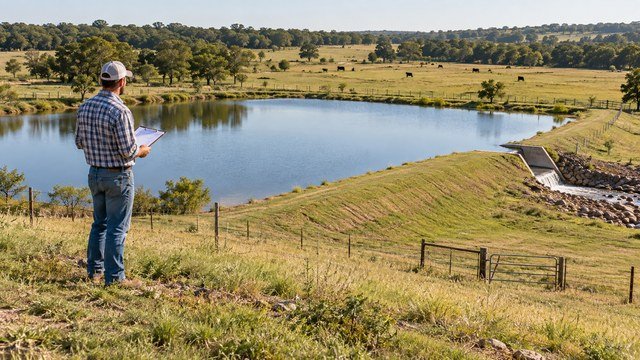
Oklahoma storm intensity should influence spillway design
Oklahoma can receive intense rainfall over short periods, especially during severe thunderstorms and tropical-remnant events.
For regulated dams, the Oklahoma Water Resources Board requires spillway design using current probable-maximum-precipitation criteria.
Even smaller unregulated farm ponds need conservative runoff and spillway planning because overtopping an earthen dam can cause rapid erosion.
Some Oklahoma dams require an OWRB construction permit
The Oklahoma Water Resources Board requires a permit before constructing, enlarging, altering, removing, or repairing a dam that is more than 25 feet high or has a storage capacity greater than 50 acre-feet.
OWRB states that its permit-review process averages about 60 days when complete documentation is submitted.
If the planned dam approaches these thresholds, confirm permit requirements before clearing or excavation starts.
Agriculture-exempt dams have their own criteria
OWRB recognizes an agriculture-exempt category for certain low-hazard dams.
The agency describes an agriculture-exempt dam as less than 25 feet high, with normal storage under 100 acre-feet, used primarily for agriculture, and designed or constructed with assistance from a local conservation district or federal agricultural agency.
Do not assume a farm pond is exempt simply because the property is rural or has livestock.
Hazard classification is separate from pond size
Dam-safety rules consider the consequences of failure, not only dimensions.
A dam above a road, occupied structure, neighboring property, utility, or other vulnerable area may require more careful engineering and regulatory review.
The safest approach is to ask OWRB or a qualified engineer when the downstream consequences are uncertain.
Other permits may still apply even when a dam permit does not
OWRB notes that pond or dam projects may also involve floodplain approval, Oklahoma Department of Environmental Quality requirements, or U.S. Army Corps of Engineers authorization.
Wetlands, streams, floodplains, large disturbed areas, and work affecting waters of the United States can create additional review needs.
A local conservation district, NRCS office, engineer, or permitting specialist can help identify which agencies should be contacted.
Runoff water and stream water are not treated the same way
Oklahoma water law distinguishes diffuse surface runoff from water in a definite stream.
OSU explains that a landowner can capture runoff under specific rules, while water that enters an established stream channel is subject to a different legal framework.
If the planned pond crosses or captures a creek, drainage channel, or streambed, confirm the water-right implications rather than assuming all water on the property can be impounded without restriction.
A dry streambed can still create water-right questions
OSU notes that even a streambed that is dry part of the year may qualify as a definite stream under Oklahoma law.
A dam across that channel can capture both local runoff and stream flow.
The owner may have to allow water beyond lawful uses to continue downstream, making legal and engineering review especially important.
Most non-domestic water uses require an OWRB water permit
The Oklahoma Water Resources Board states that water permits are required for uses other than domestic use.
Domestic use is defined broadly and includes household purposes, normal farm and domestic animal needs, certain small-scale irrigation, fire protection, and agriculture by natural individuals under state law.
Commercial irrigation, industrial use, or other larger uses can require a water-use permit even when the pond itself was lawfully constructed.
Do not assume a pond guarantees an irrigation supply
A pond can be physically capable of storing water while the intended withdrawal still raises water-right or capacity issues.
Irrigation demand can also exceed what the watershed reliably replenishes during dry Oklahoma summers.
If irrigation is a primary goal, calculate water demand, evaporation, expected inflow, storage, and permitting before building.
NRCS can be a valuable planning resource
Oklahoma State University recommends working with the Natural Resources Conservation Service or a private civil engineer for pond site assessment and design.
NRCS can help evaluate soils, hydrology, dam geometry, spillways, and conservation-practice standards.
Availability and scope of assistance can vary, so contact the local service center early rather than after a contractor is already mobilized.
A conservation district can also matter for agricultural ponds
Local conservation districts can provide technical guidance and may be important when pursuing agriculture-exempt dam treatment.
They can also connect landowners with NRCS programs and local conservation resources.
Because cost-share availability changes by program and year, treat financial assistance as a possibility rather than a guaranteed part of the project budget.
Clearing should be limited to what the pond actually needs
A pond site may require removal of trees, brush, topsoil, and unsuitable material from the basin, dam footprint, and spillway areas.
Excessive clearing can increase erosion and sediment loading from the surrounding watershed.
Preserve useful vegetation where it does not interfere with dam construction, access, or future maintenance.
Do not leave trees on an earthen dam
OSU recommends keeping pond dams free of trees and shrubs.
Large roots can create seepage paths as they decay, and uprooted trees can physically damage the embankment.
Maintain a grass cover that allows the dam surface to be inspected for erosion, wet spots, burrows, and settlement.
A pond drain can be worth including during construction
A properly designed drain can make future repairs, shoreline work, fish management, or sediment removal much easier.
Adding a drain after the dam is complete is far more difficult than installing one during original construction.
Discuss drains, siphons, anti-seep measures, valves, and protected outlet structures with the designer before the dam is built.
Plan where excavated soil will go
Pond excavation can generate a huge volume of material that must be used, shaped, or hauled.
Suitable clay may be valuable for the dam, house pad, road shoulders, or other engineered fill, while topsoil and unsuitable material need different handling.
Spoil piles placed carelessly can block drainage, create erosion, or interfere with future buildings and views. Final grading should leave stable slopes and a clear drainage path around the finished pond.
Coordinate the pond with the future house and driveway
A scenic pond can become a liability if the dam blocks the best driveway route, the emergency spillway crosses a building pad, or the house sits in a potential failure path.
Map the home, shop, septic area, well, driveway, utilities, pond, dam, spillways, and drainage corridors together.
The pond should fit the overall acreage master plan instead of being designed in isolation.
Keep the pond away from septic impacts
Septic effluent, failing systems, and nutrient-rich runoff can degrade pond water quality.
OSU identifies septic leakage and fertilizer runoff as potential contributors to excessive pond fertility.
Coordinate the pond watershed with the septic layout so wastewater infrastructure does not drain toward the pond.
Livestock access can damage the pond
OSU notes that cattle walking directly into ponds can erode banks, muddy the water, damage the dam, and create animal-health concerns.
Fencing the pond and supplying water through a protected tank or trough can improve water quality and preserve the shoreline.
If livestock access is necessary, consider a limited hardened access point rather than allowing animals around the entire perimeter.
Livestock water should be part of the pond design
A pond intended for cattle, horses, or other livestock should be planned around reliable access, freeze protection, fencing, pipe routing, and dry-weather water levels.
A through-dam or downstream watering system can reduce direct shoreline damage.
The livestock demand should be compared with expected storage during drought, not only with the pond's full-pool volume.
Fishing goals should be designed into the pond early
Pond depth, shoreline slope, habitat, water quality, drainage, livestock access, and fish species all affect future fishing quality.
OSU notes that ponds around one acre or larger without excessive muddiness can often support largemouth bass, bluegill, and channel catfish management.
Smaller ponds may be better suited to channel catfish or hybrid bluegill rather than a traditional bass-bluegill system.
Oklahoma offers established fish-stocking guidance
OSU's standard recommendation for a general fishing pond is to establish forage fish before predators.
Guidance commonly calls for bluegill and channel catfish in the fall, followed by largemouth bass in the spring, with stocking rates adjusted to pond size and management goals.
Avoid stocking random adult fish from public waters because they can introduce disease, parasites, invasive species, or an unbalanced population.
ODWC may provide fingerlings for qualifying ponds
Oklahoma State University reports that the Oklahoma Department of Wildlife Conservation offers free largemouth bass, bluegill, and channel catfish fingerlings for qualifying private ponds.
Current program conditions include a current fishing license, a pond without an existing fish population, a minimum pond size, and an application and evaluation process.
Availability and program requirements should be confirmed before planning a stocking schedule.
Do not stock fish before the pond is ready
Newly constructed ponds need time to fill, stabilize, and establish suitable water conditions.
Stocking fish into a leaking, chronically muddy, shallow, or unstable pond wastes money and can make later renovation harder.
Correct structural and water-quality problems before trying to create a fishery.
Muddy water often starts with erosion or livestock access
Persistent turbidity can reduce sunlight penetration and limit the food chain that supports fish.
Bare shorelines, cattle access, eroding watershed soil, and suspended clay can all contribute.
Address the source before adding chemicals or other treatments.
Nutrients can create oxygen problems
Fertilizer, livestock manure, septic leakage, and nutrient-rich runoff can trigger excessive algae or phytoplankton growth.
When heavy blooms die, decomposition can consume dissolved oxygen and cause fish kills.
The pond watershed should be managed as carefully as the water itself.
Sediment slowly reduces pond life
Every storm can carry soil into the pond from bare ground, roads, construction sites, cultivated areas, and eroding channels.
Over time, sediment fills shallow areas, reduces storage, increases aquatic-plant growth, and shortens the useful life of the pond.
Stabilize disturbed ground and consider upstream erosion controls before the basin fills.
Inspect the dam after major storms
Heavy rain can expose weak points quickly.
Walk the dam and spillways after major storms to look for overtopping, erosion, slumps, wet spots, animal burrows, debris blockages, and unusual seepage.
Small maintenance issues are usually easier to address before they develop into structural damage.
Existing ponds should be inspected before buying the land
A pond can add value to rural property, but it can also carry hidden maintenance and regulatory liabilities.
Walk the dam, spillways, shoreline, and downstream area. Look for trees on the dam, erosion, chronic low water, obvious leakage, exposed liner, muskrat or beaver activity, sediment, and washed-out structures.
Ask when the pond was built, who designed it, whether permits exist, and whether repairs have ever been required.
Questions to ask before building an Oklahoma pond
A good pond contractor or engineer should be able to explain how the site, water source, dam, and spillways work together.
- What is the primary purpose of the pond?
- How large should the pond be for this watershed?
- How much water storage will it provide?
- What soils are present in the basin and dam footprint?
- Have test holes been dug?
- How much earthwork is required?
- Which excavated materials can be reused?
- How will the dam core be constructed?
- How will fill be moisture-conditioned and compacted?
- What principal and auxiliary spillways are proposed?
- Does the dam require an OWRB permit?
- Could the project qualify as an agriculture-exempt dam?
- Are floodplain, DEQ, or federal permits involved?
- Does the pond cross a definite stream or drainage channel?
- Will a water-use permit be needed for the intended use?
- Will a drain or siphon be installed?
- How will livestock receive water?
- How will erosion and sediment be controlled?
- Where will spoil material be placed?
- What maintenance should I expect after construction?
Questions to ask when buying acreage with an existing pond
An existing pond should be treated as infrastructure during due diligence.
- When was the pond built?
- Who designed or constructed the dam?
- Is the dam shown in the OWRB dam inventory?
- Were permits or exemptions required?
- Has the pond ever overtopped?
- Does it hold water through dry summers?
- Has bentonite, clay, or a liner been added?
- Are there trees growing on the dam?
- Are wet spots visible on the downstream face?
- Are spillways eroded or blocked?
- Is the pond fed only by runoff or by a stream?
- Are downstream neighbors affected by the pond?
- What fish are currently present?
- Does livestock have unrestricted access?
- How much sediment has accumulated?
- Has the pond ever been drained or repaired?
A pond belongs in the acreage master plan
The best Oklahoma farm ponds are coordinated with the land's drainage, soils, roads, home site, utilities, livestock layout, fencing, and long-term goals.
A pond built in the wrong place can complicate every later improvement, while a well-planned pond can become one of the property's most useful assets.
Do the hydrology and soil work first, confirm the water and dam rules that apply, and only then price the excavation.
Keep researching
Land & Site Work resources
Clearing, grading, drainage, driveways, pads, excavation, and preparing acreage for construction.
Sources & methodology
Where this information comes from
Cost figures are planning references rather than contractor quotes. Permitting, system-selection, and location-specific guidance should be verified with the appropriate local authority or qualified professional. AcreageReady uses source-backed, AI-assisted editorial workflows and remains responsible for the material it publishes. Read how we research, edit, and correct guides.
- Oklahoma State University Extension: Building a Pond
- Oklahoma State University Extension: Oklahoma Diffuse Surface Runoff Water Law and Rules
- Oklahoma State University Extension: Pond Management for Livestock, Fish and Wildlife
- Oklahoma State University Extension: Improve Fishing in Your Pond
- Oklahoma State University Extension: Fingerlings for Pond Stocking
- Oklahoma State University Extension: Common Pond Problems
- Oklahoma Water Resources Board: Apply for a Permit to Construct or Modify a Dam
- Oklahoma Water Resources Board: Dam Safety
- Oklahoma Water Resources Board: Water Permitting
- Oklahoma Water Resources Board: Apply for a Water Permit
- Natural Resources Conservation Service: Pond Conservation Practice Standard 378
- Angi: What Does It Cost to Build a Pond? 2026 Data
- AcreageReady: Oklahoma Flood Zones & Drainage
- AcreageReady: Oklahoma Rural Fencing Costs
- AcreageReady: Oklahoma Land Clearing Costs
Common questions
Frequently asked questions
How much does it cost to build a farm pond in Oklahoma?
For early planning, current 2026 consumer guides place many basic farm pond projects around $2,500 to $20,000, with larger or more complex projects often reaching $15,000 to $40,000 or much more. Actual Oklahoma costs depend heavily on earthwork volume, soils, dam size, rock, clearing, spillways, engineering, access, and permit requirements.
Do I need a permit to build a pond in Oklahoma?
Not every small pond needs the same permit. OWRB requires a dam permit when a dam is more than 25 feet high or stores more than 50 acre-feet, while certain qualifying low-hazard agricultural dams may be exempt under specific conditions. Floodplain, DEQ, federal, or water-use approvals can still apply.
Can I dam a creek on my Oklahoma property?
A creek or definite stream raises different water-right questions than simply capturing diffuse runoff. Oklahoma law can require downstream flow to be preserved beyond lawful uses. Contact OWRB or qualified counsel or engineering professionals before damming a stream channel.
What makes a good pond site in Oklahoma?
A good site has suitable clay-rich soils, adequate but manageable watershed runoff, a stable dam location, safe spillway routes, favorable topography, and a layout that does not conflict with homes, roads, septic systems, utilities, or downstream property.
How deep should an Oklahoma farm pond be?
There is no single depth that fits every site. Depth should be based on intended use, watershed size, expected evaporation, fish goals, safety, and excavation efficiency. A designer should evaluate the specific property rather than using a generic depth target.
Can I stock bass and bluegill in my Oklahoma pond?
Yes, many suitable ponds can support largemouth bass and bluegill management. OSU recommends establishing forage fish first and following a planned stocking sequence. Pond size, water quality, existing fish, and management goals should be evaluated before stocking.
Can I get free fish for my Oklahoma pond?
The Oklahoma Department of Wildlife Conservation may provide free largemouth bass, bluegill, and channel catfish fingerlings for qualifying ponds. Current eligibility, pond condition, minimum size, licensing, application timing, and evaluation requirements should be confirmed with ODWC.
Should cattle have direct access to a farm pond?
Unrestricted cattle access can erode banks, muddy the water, damage the dam, and reduce fish and wildlife value. Fencing the pond and watering livestock through a tank, trough, or limited hardened access point is often a better long-term design.
Ready to talk with a local professional?
Share your location and project details so AcreageReady can identify relevant providers as the network grows.
Get a free quote