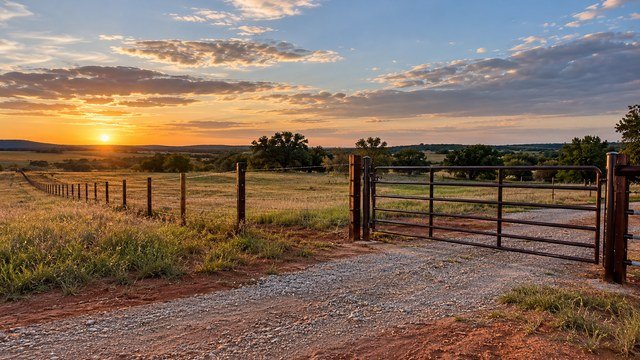
Fence cost starts with purpose, not acreage
A fence built only to mark a boundary is very different from one intended to hold cattle, horses, goats, dogs, or small livestock.
The purpose determines wire type, height, post spacing, bracing, gates, visibility, and how much maintenance the fence will require.
Before pricing Oklahoma acreage fencing, decide what the fence must actually do and which parts of the property truly need to be enclosed.
Linear feet matter more than acres
Fence contractors price materials and labor largely by length, while acreage alone can be misleading because parcel shape changes perimeter dramatically.
A long narrow 10-acre tract can require far more fence than a compact 10-acre square.
Use a survey, county GIS for rough planning, or a mapped property boundary to estimate linear footage before comparing bids.
A practical 2026 barbed-wire planning range
Current 2026 national cost guides place installed livestock barbed-wire fencing around $3 to $6 per linear foot on many standard projects.
That range is useful for early budgeting, but an Oklahoma quote can move materially based on clearing, soil, rock, hills, post type, strand count, braces, access, and gate work.
Treat per-foot figures as screening numbers, not a substitute for a site-specific bid.
Pipe fence costs much more than basic livestock wire
Pipe fence is strong, visible, durable, and popular around entrances, horse areas, corrals, and high-traffic sections.
Angi's 2026 data places typical installed pipe fencing from roughly the mid-teens to much higher per linear foot depending on metal, labor, and location, with Oklahoma City shown around $15 per foot as a location example.
That makes full-perimeter pipe fence a premium choice on large acreage, while many owners reserve it for frontage, gates, corrals, or horse areas.
Woven or field fence sits between simple wire and pipe in complexity
Woven wire, field fence, no-climb horse fence, and heavy livestock mesh use more material and usually more labor than basic barbed wire.
They can be effective for smaller animals and horses when paired with appropriate posts and top rails or sight lines.
Current 2026 wire-fence guides show broad installed material-type ranges because mesh height, gauge, coating, post spacing, and terrain vary significantly.
Barbed wire remains common for cattle
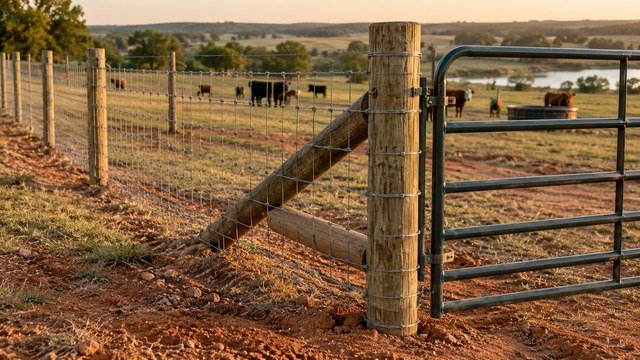
Barbed wire is economical over long pasture boundaries and is widely used for cattle fencing.
OSU notes that livestock fencing design should match the animals being contained and that three- or four-wire designs can be used in some settings, especially where wildlife movement is also considered.
Perimeter requirements and real-world ranch practice may differ from interior-pasture designs, so use the intended livestock and legal boundary role to select the final configuration.
Horse fencing deserves a different standard
OSU specifically notes that barbed wire is not recommended for horses because horses may jump or reach across fences and can be injured by sharp wire.
Pipe, rail, smooth wire, high-visibility mesh, and properly designed electric systems are more common horse options.
If the property may hold horses later, it can be cheaper to design those areas correctly from the beginning rather than replacing a cattle fence.
Goats and sheep can require tighter fencing
Small livestock can pass through openings that easily contain cattle.
OSU notes that exclusion-style fencing such as woven wire or welded mesh may be needed for goats and other smaller livestock.
That usually increases material and labor cost compared with a basic multi-strand cattle fence.
The legal boundary should be verified before expensive fencing
A fence can exist near a property line without being the surveyed boundary.
Before installing a permanent pipe fence, masonry entrance, or other expensive structure, have the boundary and corners verified when there is any uncertainty.
Moving a new fence after a survey dispute is far more expensive than confirming the line before construction.
Oklahoma has statutory standards for a lawful fence
Oklahoma Title 4 includes statutory descriptions of lawful fences, including dimensions and specifications for certain rail, board, and barbed-wire configurations.
Those statutes can matter in boundary and livestock-fence disputes, but they should not be treated as a universal design template for every modern property.
For a disputed line, shared fence, livestock issue, or unusual legal question, use current Oklahoma legal guidance rather than relying only on contractor custom.
Existing fences should be evaluated, not automatically trusted
Old rural fences may have broken braces, loose wire, rotted wood posts, leaning steel posts, buried corners, patched sections, or segments that wander off the legal boundary.
A fence that looks acceptable from the road can require substantial rehabilitation before it will reliably contain livestock.
Walk the full line before deciding whether repair or replacement is the better value.
Corner and brace assemblies are critical
Long tensioned wire runs depend on strong corners, ends, and gate braces.
Weak bracing causes sagging wire, leaning posts, loose gates, and repeated maintenance.
A bid using cheaper line posts can still perform well if the structural assemblies are designed correctly, while a poorly braced fence can fail even with expensive wire.
Gate openings are a major cost and design decision
Each gate adds posts, bracing, hinges, latches, and labor.
Wide equipment gates may need heavier posts and stronger hardware than pasture gates.
Before building fence, map future access for tractors, hay equipment, RVs, trailers, livestock trucks, utility vehicles, septic service, and emergency access.
The main driveway gate should be sized for real vehicles
A gate that works for a pickup may be frustrating for a gooseneck trailer, concrete truck, RV, or equipment hauler.
Set the entrance back far enough from the road so long vehicles can clear traffic while the gate opens.
If the entrance will eventually have columns, an automatic gate, keypad, camera, or intercom, plan power and communications before posts and concrete are installed.
Automatic gates add electrical and communication costs
A powered gate may require trenching, conduit, low-voltage wiring, solar equipment, battery backup, cellular service, or a network connection from the house.
The gate operator also needs appropriate hinges, stops, safety devices, and weather protection.
Treat the gate as a small infrastructure project rather than just another fence opening.
Solar gate operators can be useful on long driveways
Solar-powered gate systems can avoid a long electrical trench where sunlight is adequate and usage is moderate.
Battery size, panel orientation, gate weight, opening frequency, winter conditions, and accessory loads all affect reliability.
Security cameras and Wi-Fi equipment may still require separate power and connectivity planning.
Clearing can cost as much as the fence prep itself
A fence line through cedar, brush, mature trees, old wire, or rocky ground may require forestry mulching, chainsaw work, dozer clearing, or excavation before posts can be set.
Current 2026 fencing guides commonly list site preparation and demolition as separate cost drivers.
Walk the route with both the clearing contractor and fence contractor when vegetation is heavy.
Do not clear a wider corridor than you actually need
A narrow fence corridor may be enough for installation and long-term maintenance while preserving useful shade, windbreaks, and wildlife habitat.
Excess clearing adds cost and can create erosion or weed problems.
Mark corner locations and planned access routes before clearing so the contractor knows what must remain.
Rock changes post-setting economics quickly
Shallow sandstone, limestone, boulders, and hardpan can slow augers and require hydraulic rock equipment or different post-setting methods.
That can push labor far above a simple pasture installation.
Ask how the contractor handles refusal, rock drilling, and additional machine time so the bid does not hide a large change-order risk.
Oklahoma clay can create its own installation problems
Heavy clay can become extremely hard when dry and deeply soft when wet.
Fence work scheduled during poor ground conditions can create ruts and slow post installation.
Contractors may choose seasonal timing, larger equipment, concrete, driven posts, or other methods based on local soil conditions.
Hills increase both material use and labor
Fence lines over rolling terrain require more careful tensioning and can use more wire than a flat map estimate suggests.
Steep slopes also slow equipment and may require hand work in places.
Use the actual route distance rather than straight-line parcel measurements when the terrain is significant.
Creeks and drainage crossings require special treatment
A normal wire fence across a creek can collect debris, wash out, or create a maintenance trap.
Flood gates, breakaway sections, elevated crossings, or other designs may be needed depending on livestock and drainage.
Coordinate creek fencing with the property's flood and drainage plan rather than treating it as a standard fence segment.
Pond fencing can protect both livestock and water quality
Some properties need to control livestock access to ponds, wells, or riparian areas.
Interior fencing can create managed watering points or protect sensitive banks.
OSU recommends considering wildlife movement and access to water when laying out livestock infrastructure.
Wildlife-friendly design can reduce injuries and maintenance
OSU recommends using only as much exclusion fencing as necessary and considering wire spacing, visibility, bottom-wire height, and known travel routes.
Highly visible fences and strategic crossings can reduce wildlife entanglement while still meeting livestock needs.
This is especially relevant on larger Oklahoma acreage with deer, pronghorn in western areas, or active wildlife corridors.
Fire can affect fence planning
Oklahoma properties that use prescribed fire or face wildfire exposure should consider how fence materials and layouts interact with fire management.
OSU has studied the effects of fire on fencing materials and notes that common galvanized barbed wire is manufactured to substantial strength standards.
Wood posts, plastic components, vegetation buildup, and gate equipment may need different protection or replacement planning than wire itself.
Interior cross-fencing can improve pasture management
A single perimeter fence contains livestock, but cross-fencing can make rotational grazing, hay management, breeding separation, and pasture recovery easier.
Interior fences do not always need the same material or permanence as the road frontage or legal boundary.
Electric or lower-cost wire systems can reduce cost when the interior layout may change over time.
Virtual fencing is emerging as another management tool
OSU reported in 2026 that GPS-based virtual fencing is becoming a practical grazing-management tool in some cattle operations.
It can create flexible livestock boundaries without permanent wire, but animals require training and the technology is not a replacement for every perimeter or safety fence.
For larger operations, virtual fencing may reduce some future interior-fence construction while physical perimeter fencing remains important.
Fence only what needs to be fenced first
Acreage buyers often feel pressure to fence the full tract immediately.
If the first goal is building a house and small livestock area, it may make sense to complete road frontage, the house area, a dog yard, and one pasture first, then expand as the land-use plan becomes clearer.
Phased fencing can preserve capital for higher-priority infrastructure such as power, septic, water, driveway, and site work.
Road frontage deserves stronger visual planning
Frontage fence is part of the property's appearance and may include pipe, wood, stone columns, decorative gates, or upgraded wire.
That section can cost several times more per foot than ordinary pasture fence.
Separating the frontage budget from the back and side boundaries makes cost estimates more realistic.
Pipe entrances can create a strong look without fencing the whole property in pipe
Many rural owners use pipe only around the entrance and first stretch of frontage, then transition to barbed or woven wire.
This delivers a durable gate structure and cleaner curb appeal while controlling total cost.
The transition points should be braced correctly so the wire fence does not pull on decorative pipe sections.
Field fence can be useful for dogs and smaller livestock
Woven mesh provides a physical barrier closer to the ground and can be paired with a top board, smooth wire, or electric offset depending on the animals.
Mesh height, wire gauge, opening size, and post spacing all affect cost.
For dog areas near the house, compare field fence with welded-wire panels, wood privacy fence, and purpose-built kennel fencing.
A fence quote should define exactly what is included
Two bids with the same per-foot number may not include the same work.
- Fence type and wire gauge
- Number of strands or mesh height
- Post material and spacing
- Corner and end-brace design
- Concrete use
- Clearing and demolition
- Old-fence removal
- Rock drilling or refusal charges
- Gate quantity and widths
- Gate hardware
- Automatic gate equipment
- Creek or drainage crossings
- Welding and paint for pipe sections
- Mobilization
- Cleanup and debris disposal
- Survey stakes or boundary responsibility
- Warranty and repair terms
Questions to ask an Oklahoma fence contractor
A good contractor should be able to explain why the proposed design matches your property and livestock.
- What fence type do you recommend for my animals?
- What is the installed price per linear foot?
- How are corners and gates braced?
- What post spacing do you use?
- Is clearing included?
- How do you handle rock?
- What happens at creek crossings?
- Is old-fence removal included?
- How wide should my main equipment gate be?
- Can you build pipe frontage and transition to wire?
- Do you install automatic gates?
- Who provides power and communication conduit?
- How do weather delays affect the schedule?
- What repairs or warranty are included?
Questions to answer before closing on fenced acreage
Existing fence condition can affect both purchase price and immediate livestock readiness.
- Is the existing fence actually on the surveyed boundary?
- Which sections are usable now?
- Are corners and braces sound?
- Can the fence contain my planned livestock?
- Are there unsafe barbed-wire sections for horses?
- How many gates need replacement?
- Are there creek or flood crossings?
- How much brush is hiding the fence?
- Will I need road-frontage upgrades?
- What is the likely replacement cost if most of the fence fails?
The bottom line
Oklahoma rural fencing cost depends on linear footage, livestock type, materials, terrain, rock, clearing, post and brace design, gate count, and how much of the property needs premium frontage or pipe work.
Basic barbed-wire pasture fencing remains one of the most economical options, while woven field fence, horse-safe systems, automatic gates, and pipe frontage can raise the budget quickly.
Verify the boundary first, map every gate and drainage crossing, then ask contractors to bid the same specifications so you can compare real project cost rather than just a headline price per foot.
Keep researching
Land & Site Work resources
Clearing, grading, drainage, driveways, pads, excavation, and preparing acreage for construction.
Sources & methodology
Where this information comes from
Cost figures are planning references rather than contractor quotes. Permitting, system-selection, and location-specific guidance should be verified with the appropriate local authority or qualified professional. AcreageReady uses source-backed, AI-assisted editorial workflows and remains responsible for the material it publishes. Read how we research, edit, and correct guides.
- Oklahoma State University: Minimizing Impacts to Wildlife from Livestock Infrastructure
- Oklahoma State University: Fire Effects – Fencing
- Oklahoma State University: Fence Law and Pasture Leasing in Oklahoma
- Oklahoma State University: Virtual Fencing – Cow-Calf Corner June 8, 2026
- Oklahoma Statutes Title 4: Animals, Section 154 Lawful Fence
- HomeGuide: Barbed Wire Fence Cost 2026
- Angi: Barbed Wire Fence Cost 2026
- Angi: Pipe Fence Cost 2026
- Angi: Wire Fence Installation Cost 2026
- AcreageReady: Oklahoma Land Surveys & Property Lines
- AcreageReady: Oklahoma Land Clearing Costs
- AcreageReady: Oklahoma Flood Zones & Drainage
Common questions
Frequently asked questions
How much does barbed-wire fence cost in Oklahoma in 2026?
There is no single statewide rate. Current 2026 national guides commonly place installed livestock barbed wire around $3 to $6 per linear foot, but Oklahoma pricing can vary with terrain, clearing, post type, strand count, rock, gate work, and project size.
How much does pipe fence cost in Oklahoma?
Pipe fence costs substantially more than basic livestock wire. Angi's 2026 data reports a broad installed range and lists Oklahoma City around $15 per linear foot as a location example. Get a local site-specific quote for material thickness, welding, paint, gates, and terrain.
Is barbed wire safe for horses?
OSU does not recommend barbed wire for horses because of injury risk. Pipe, rail, smooth wire, visible mesh, or properly designed electric systems are generally better choices for horse areas.
Should I survey the property before building a new fence?
If the legal boundary is uncertain, yes. A survey can prevent an expensive permanent fence from being installed on the wrong line.
How wide should a rural driveway gate be?
The correct width depends on the vehicles using it. Plan for trailers, RVs, hay equipment, concrete trucks, emergency vehicles, and future construction rather than sizing only for a pickup.
Is woven field fence good for goats and sheep?
Yes, woven or welded mesh can be more effective than widely spaced wire for smaller livestock. The final height, opening size, gauge, and top treatment should match the animals being contained.
Can I use virtual fencing instead of wire fence for cattle?
Virtual fencing is becoming a practical grazing-management tool in some operations, according to OSU, but it requires animal training and is not a universal replacement for physical perimeter, road, or safety fencing.
What makes a rural fence project expensive?
Long perimeter length, dense clearing, rock, steep terrain, frequent corners, creek crossings, pipe frontage, automatic gates, heavy mesh, and old-fence removal are common cost drivers.
Ready to talk with a local professional?
Share your location and project details so AcreageReady can identify relevant providers as the network grows.
Get a free quote