There is no single normal well depth for Texas
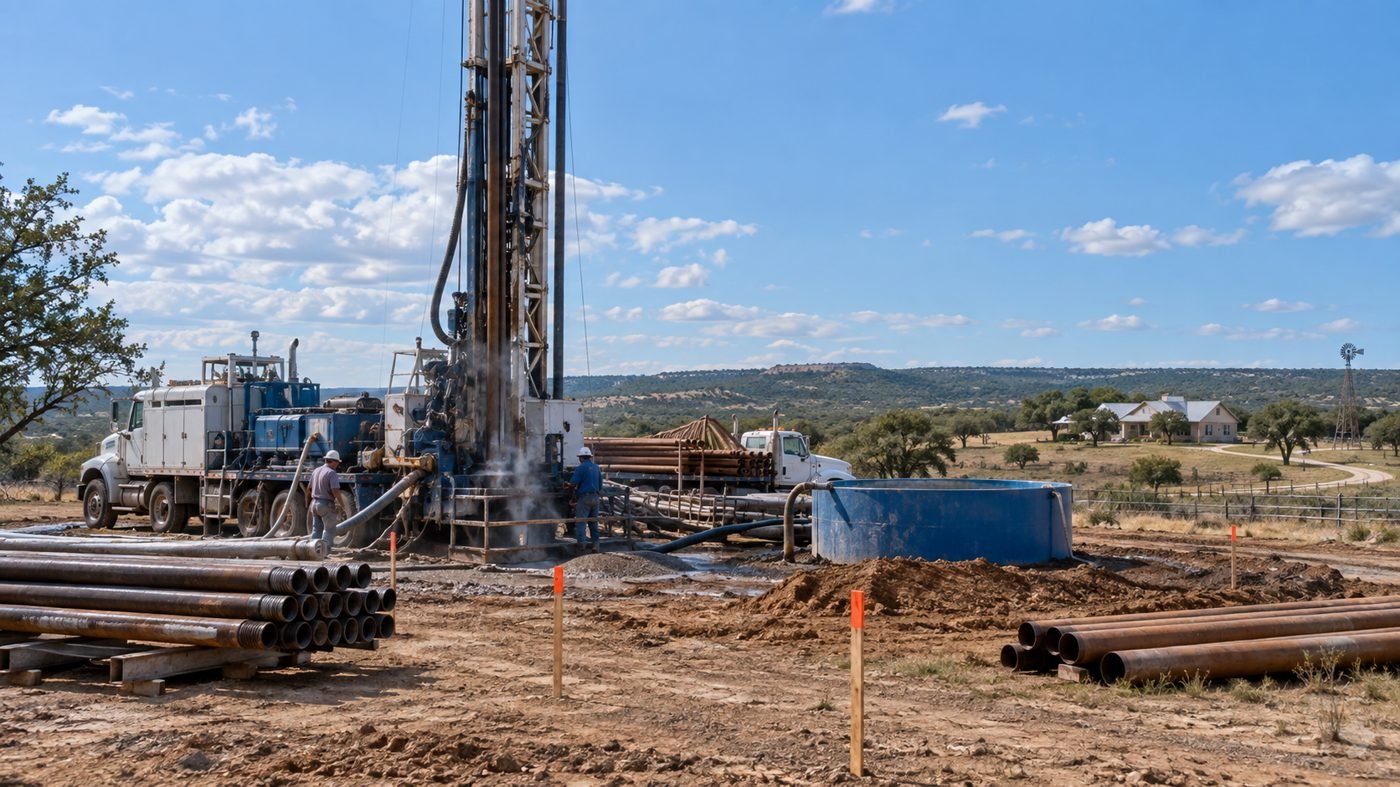
Water wells in Texas can range from relatively shallow domestic wells to wells that extend several hundred feet or more. The depth depends on local geology, the aquifer being used, elevation, water levels, drilling conditions, desired yield, and the construction standard required for the property.
That means a statewide average is much less useful than nearby well records from the same area. A tract in North Texas can have a very different drilling profile from acreage in the Hill Country, East Texas, the Panhandle, or West Texas.
Before budgeting a well, treat depth as a site-specific variable rather than assuming that a neighbor's number will exactly match your property.
Well depth and water level are not the same thing
The total drilled depth of a well is different from the depth where water stands in the well. A well may be drilled several hundred feet deep even though the static water level is much shallower.
The static water level is the level water rises to in the well when the well is not being pumped. The pumping water level is where the water level stabilizes while the pump is operating.
Those numbers matter because they affect pump selection, drawdown, available storage in the well column, and how much water the well can reliably deliver.
Pump setting is also different from total well depth
A submersible pump is usually installed below the normal pumping water level but above the bottom of the well. The correct setting depends on the well construction, water level, expected drawdown, pump design, sediment conditions, and the driller's recommendations.
For that reason, a 400-foot well does not automatically mean the pump is installed at 400 feet.
When comparing drilling estimates, ask for the total drilled depth, estimated static water level, anticipated pump setting, casing depth, and the assumptions used for pump sizing.
Texas well depth varies because the state's groundwater geology is highly diverse
Texas contains multiple major and minor aquifers, each with different geology, recharge characteristics, water quality, and depth. TWDB recognizes major aquifers such as the Ogallala, Gulf Coast, Edwards, Carrizo-Wilcox, Trinity, Seymour, Hueco-Mesilla Bolsons, Pecos Valley, Cenozoic Pecos Alluvium, and others.
Even within the same aquifer, local depth can change as the geologic formation dips, thins, fractures, or changes elevation.
That is why regional aquifer information is useful context, but parcel-level well records are more useful for estimating an actual drilling depth.
Nearby well records are one of the best planning tools
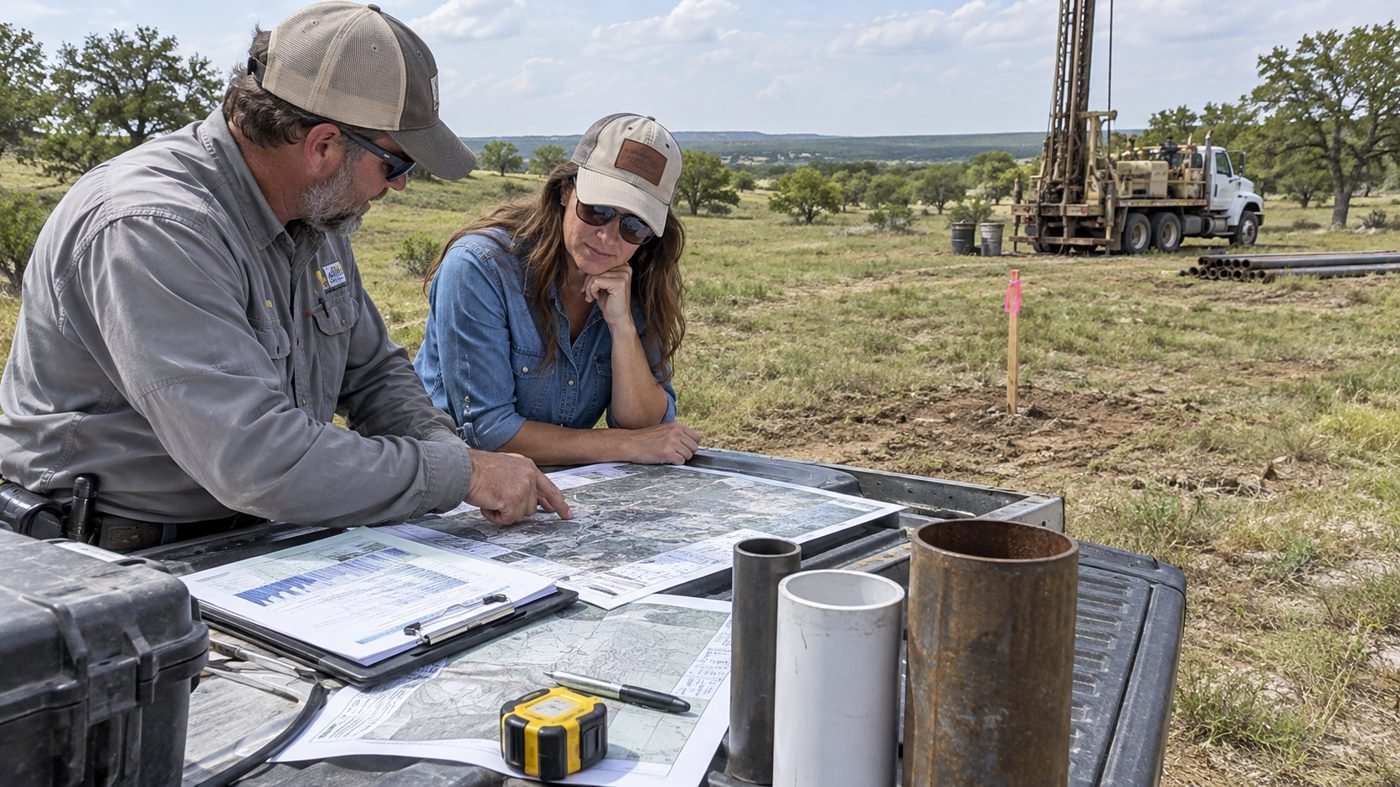
The Texas Water Development Board maintains the Submitted Drillers Report database and groundwater data tools that can help landowners review nearby well records.
Useful records may include total well depth, completion date, casing details, water level, reported yield, drilling method, and the driller who completed the work.
Look at several nearby wells rather than one. A cluster of records gives a better sense of the local range and helps identify outliers.
- Total drilled depth
- Static water level
- Reported yield
- Casing depth and diameter
- Completion date
- Nearby well density
- Driller information
A nearby well does not guarantee the same result on your property
Groundwater conditions can change over surprisingly short distances. Fractures, formation thickness, local elevation, faults, karst features, and historical pumping can all affect the result.
A neighboring well is useful evidence, but it is not a guarantee that your well will have the same depth, flow rate, or water quality.
Use nearby well records as a planning range and ask local drillers what they typically encounter in the immediate area.
Yield matters just as much as depth
A deep well is not necessarily a high-producing well. Yield is typically discussed in gallons per minute, and the amount a property needs depends on household use, irrigation, livestock, storage tanks, guest houses, and other demands.
A lower-yield well may still work for a home if it is paired with adequate storage and the usage pattern is managed. A higher-yield well can provide more flexibility for peak demand.
Ask the driller how yield will be tested and documented before final pump sizing.
Water quality can change with depth
Deeper water is not automatically better water. Groundwater quality depends on the aquifer, local geology, mineral content, nearby land use, and well construction.
Some areas may have naturally elevated hardness, iron, manganese, total dissolved solids, sulfur, salinity, or other constituents. In some locations, a deeper interval can actually have poorer quality than a shallower one.
Budget for water testing after the well is completed and before relying on it for drinking water.
Groundwater districts can affect where and how you drill
Groundwater conservation districts regulate wells in many parts of Texas. TWDB notes that these districts can adopt rules governing well permitting, spacing, production, and other groundwater-management issues.
Before drilling, determine whether the property is inside a groundwater conservation district and what rules apply to domestic wells.
Some domestic wells may qualify for exemptions from certain permitting or production rules, but exemption details vary by district.
The well location should be planned with septic and future improvements
Well placement should be coordinated with septic, the home, driveway, shop, pool, pond, barns, utilities, and future buildings.
The drilling rig needs access, the well needs long-term service access, and the water source needs appropriate separation from potential contamination sources.
Do not place the well only where drilling looks easiest if that location creates a conflict with the septic disposal area or future site plan.
Deeper wells generally cost more, but depth is not the only cost driver
More footage typically means more drilling time, casing, materials, and pump requirements. However, the total cost also depends on geology, casing diameter, grouting, well development, pump size, pressure equipment, electrical service, trenching, water treatment, storage, and site access.
A shallow well through difficult rock can sometimes be more expensive than a deeper well through easier drilling conditions.
Ask for a proposal that separates drilling cost per foot from casing, pump, pressure tank, electrical, trenching, testing, and other system components.
Rocky Texas sites can change the drilling method and cost
Limestone, hard rock, unconsolidated formations, sand, clay, and mixed geology all behave differently during drilling. The driller may use rotary, air rotary, mud rotary, or another method depending on the formation and local practice.
Hard formations can slow drilling, while unstable formations may require more casing or careful completion work.
This is another reason local driller experience is valuable when comparing estimates.
A well log can tell you more than just depth
A good well record can provide information about geologic formations encountered, casing, screen or open-hole intervals, water-bearing zones, static water level, test pumping, and completion details.
Those details help future owners understand the system, select replacement pumps, diagnose changes in performance, and compare the well with nearby records.
Keep the well log with the property documents after construction.
For an existing property, verify the well records before closing
If you are buying acreage with an existing well, ask for the driller's report, pump information, pressure-tank information, water tests, repair history, and any treatment-system records.
Confirm the well's location and compare the documents with TWDB records where available.
If the well's history is unclear, consider a professional inspection and water-quality test before closing.
What should you ask a driller about likely depth?
A local driller should be able to explain what nearby wells look like and what range they commonly encounter, while still making clear that actual depth is not guaranteed until drilling is complete.
- What depths are common within a few miles of this tract?
- Which aquifer or formation are you targeting?
- What static water levels are common nearby?
- What yields do nearby domestic wells typically produce?
- What casing depth and diameter do you expect?
- What drilling method will you likely use?
- What happens if the first water-bearing interval has poor quality or low yield?
- How is additional footage priced?
- How will the completed well be tested?
- What pump setting do you anticipate?
How to estimate well depth before buying land
You cannot know the exact depth before drilling, but you can reduce uncertainty. Start with TWDB well records, identify the groundwater district, speak with local drillers, review the geology and topography, and compare several nearby wells.
If the property purchase depends on a very specific well budget, build contingency into the estimate rather than budgeting only the shallowest nearby well.
- Search nearby TWDB well records
- Review several wells, not just one
- Identify the aquifer and groundwater district
- Ask at least two local drillers about the immediate area
- Budget for a range of depths
- Include pump, pressure tank, electrical, trenching, and testing in addition to drilling
The best answer is local, not statewide
A statewide answer to Texas well depth is useful only as a broad orientation. The more useful answer comes from the wells near the exact property, the aquifer below it, and the experience of drillers who work in that area.
For land buyers, the goal is not to predict the exact number of feet before drilling. It is to understand the likely range, the financial risk if the well goes deeper, and whether the expected groundwater quantity and quality fit the property's intended use.
Keep researching
Wells & Water resources
Water well drilling, pumps, pressure systems, testing, storage, and rural water planning.
Sources & methodology
Where this information comes from
Cost figures are planning references rather than contractor quotes. Permitting, system-selection, and location-specific guidance should be verified with the appropriate local authority or qualified professional. AcreageReady uses source-backed, AI-assisted editorial workflows and remains responsible for the material it publishes. Read how we research, edit, and correct guides.
Common questions
Frequently asked questions
How deep are water wells in Texas?
There is no single typical depth statewide. Texas wells can be relatively shallow or extend several hundred feet or more depending on the aquifer, local geology, elevation, water levels, and desired yield. Nearby TWDB well records are more useful than a statewide average.
How can I find the depth of nearby wells in Texas?
Use Texas Water Development Board groundwater and Submitted Drillers Report tools to review nearby well records. Look at several wells to compare total depth, water levels, casing, reported yield, and completion dates.
Is well depth the same as water depth?
No. Total well depth is how deep the well was drilled. Static water level is where water stands when the well is not pumping, and pump setting is the depth where the pump is installed.
Does a deeper well always produce more water?
No. Yield depends on the water-bearing formation and local groundwater conditions. A deeper well can still have low yield, while a shallower well may produce more water.
Does a deeper well have better water quality?
Not necessarily. Groundwater chemistry changes by aquifer and depth, and deeper water can contain more dissolved minerals or other constituents. Test the completed well water rather than assuming depth equals quality.
Do I need a permit to drill a water well in Texas?
Requirements depend on whether the property is inside a groundwater conservation district and on local rules. Many districts regulate well permitting, spacing, and production, while some domestic wells may qualify for exemptions. Verify the rules for the exact property.
Ready to talk with a local professional?
Share your location and project details so AcreageReady can identify relevant providers as the network grows.
Get a free quote