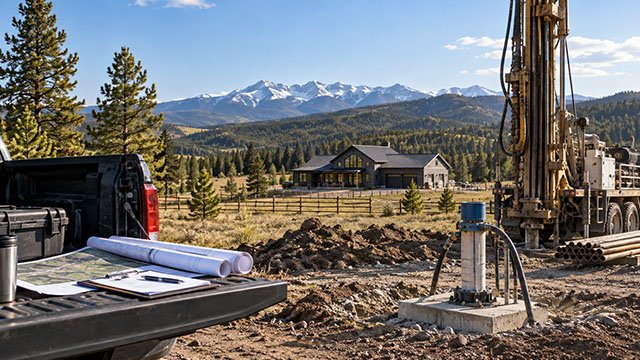
A good Idaho acreage purchase starts with understanding the water source
For rural property buyers in Idaho, a private well can be one of the most important systems on the property. It affects where you can build, how much the site will cost to develop, what the property can support, and whether the household has a reliable long-term water supply.
The biggest mistake is treating a well as a simple construction item. In Idaho, you need to think about well drilling permits, groundwater conditions, nearby well history, water rights, domestic-use exemptions, regulated groundwater areas, water quality, septic separation, power, and the intended use of the water.
A parcel can look perfect on the surface and still become expensive or difficult if the groundwater is deep, nearby wells have poor yields, the property is in a restricted groundwater area, or the planned water use does not fit the domestic exemption.
A drilling permit and a water right are not the same thing
Idaho separates the physical act of constructing a well from the legal right to use groundwater.
IDWR states that a drilling permit must be obtained before drilling a well, and wells must be constructed by a driller who holds a valid Idaho license.
A water right is a separate legal issue. Some domestic uses may qualify for an exemption from the normal water-right permit process, while other uses require an approved water right before a well can be developed for that purpose.
Every new water well still needs an IDWR drilling permit
Idaho Department of Water Resources has statewide authority over well construction and well-driller licensing.
Before drilling begins, the owner or driller must obtain a drilling permit from IDWR. The state applies this requirement to water wells and other artificial openings that fall under its well-construction rules.
That means a domestic well that qualifies for the domestic water-right exemption still needs the separate well drilling permit.
Domestic well drilling permits currently cost $75
IDWR's current drilling permit application lists a $75 fee for domestic wells.
The same application lists higher fees for some non-domestic wells and separate fee structures for monitoring wells.
The permit fee is a small part of the project compared with drilling, casing, pump equipment, trenching, electrical service, pressure systems, and possible treatment, but it should still be part of the preconstruction budget.
Use a licensed Idaho well driller
IDWR requires wells to be constructed by a well driller with a valid Idaho license.
The department maintains a licensed well-driller search that can be filtered by county, city, company, or region.
For rural buyers, using the state directory is useful not only for compliance but also for identifying drillers who regularly work in the geology and groundwater conditions near the property.
Idaho changed its domestic-use rules again in 2026
The domestic exemption is one of the most important water-right concepts for Idaho rural landowners.
The 2025 Legislature changed the statutes governing domestic uses, shared wells, and subdivisions, and Governor Brad Little signed Senate Bill 1222 on February 17, 2026. Those additional changes became effective the same day.
Because the rules have changed recently, buyers should be cautious with older articles, forum posts, or advice that describes Idaho's domestic exemption using outdated limits or subdivision rules.
What Idaho currently calls a domestic use
Under the 2026 version of Idaho Code cited by IDWR, domestic purposes can include water for homes, organization camps, public campgrounds, livestock, and related purposes, including irrigation of up to one-half acre, when total use does not exceed 13,000 gallons per day.
The statute also provides a separate pathway for other uses when the total diversion does not exceed 2.8 acre-feet per year.
Those thresholds matter because they help determine whether a proposed use can qualify for the domestic exemption or whether a formal water-right application may be required.
A normal single-home well may qualify for the domestic exemption
For many individual rural homes, the intended use falls within Idaho's domestic-use definition.
When the exemption applies, the groundwater right for that domestic use can generally be acquired by withdrawal and use rather than by first completing the standard water-right permit process.
That does not eliminate the drilling permit, well-construction rules, inspections, or other local and state requirements that may apply.
The exemption is not unlimited
The domestic exemption is not a blanket right to pump any amount of groundwater for any purpose.
Idaho law places limits on both the type of use and the quantity of water. Certain developments and business uses can fall outside the ordinary domestic definition unless they satisfy the alternative volume limitations.
If the property will include substantial irrigation, commercial activity, multiple dwellings, a subdivision, or another use beyond a typical residence, discuss the planned water use with IDWR before assuming the exemption applies.
Subdivision rules became more important in 2025 and 2026
Recent Idaho legislation specifically addressed domestic wells and new subdivisions.
IDWR's current guidance explains that some new diversions in subdivisions can require a water-right permit when the subdivision application was filed on or after July 1, 2025 and the project is located in a moratorium area, critical groundwater area, or groundwater management area.
The statute contains exceptions for certain in-home uses and livestock watering, so the correct answer depends on the property, the development history, the groundwater designation, and the planned use.
Check whether the parcel is in a regulated groundwater area
IDWR specifically tells landowners to determine whether proposed water use is located in a moratorium area, a critical groundwater area, or a groundwater management area.
Those designations can change how groundwater development is reviewed and whether a particular domestic or subdivision use qualifies for an exemption.
The department provides a mapping tool for moratoriums and regulated groundwater development, and this should be part of rural land due diligence before closing.
Idaho currently has active groundwater moratoriums
Groundwater restrictions are not just a historical issue in Idaho.
For example, IDWR issued a temporary five-year moratorium for the South Canyon County area in March 2026 because of concerns about groundwater availability and development pressure.
IDWR also extended the Boise Front Low Temperature Geothermal Resource Ground Water Management Area moratorium in May 2026, while other moratoriums and management areas remain in effect elsewhere in the state.
Do not assume a neighboring well guarantees your well
A nearby productive well is useful evidence, but it does not guarantee identical conditions on your parcel.
Groundwater depth, geology, aquifer characteristics, fractures, well construction, pumping rate, and seasonal conditions can vary over surprisingly short distances.
Use nearby wells as planning information rather than as a promise of a specific depth or yield.
Idaho's well-log database is one of the best due-diligence tools
IDWR maintains a Well Construction Search that allows buyers to review many historical well-driller reports.
The database contains most well reports from July 1987 to the present and includes older records where they are available.
These reports can provide well depth, casing size, geology, depth to water, water levels, reported flow rate, construction method, and scanned copies of historical documents.
Search several nearby wells, not just one
A single well log can be misleading if it happens to be unusually shallow, unusually deep, or located in a different geologic feature.
For a better planning picture, review multiple nearby wells and compare their completed depths, static water levels, reported yields, drilling dates, and geologic notes.
The goal is not to predict an exact drilling depth. The goal is to understand the range of outcomes that are common around the property.
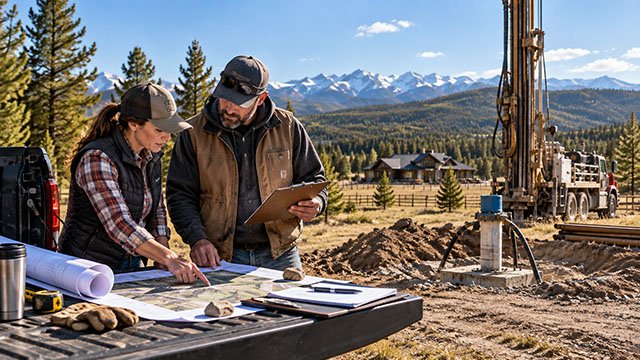
Well logs can help improve a drilling budget
If nearby domestic wells commonly finish at 150 to 250 feet, that creates a very different budget conversation than a neighborhood where many wells exceed 600 feet.
The logs can also reveal whether local drillers regularly encounter basalt, hard rock, sand, clay, or other formations that affect drilling speed and casing requirements.
Use those records when requesting preliminary estimates from local drillers so the discussion starts with real conditions rather than a statewide average.
The Find a Well map adds useful geographic context
IDWR's Find a Well map displays mapped wells along with other groundwater information.
The state notes that the map can show wells together with areas of drilling concern, nitrate priority areas, groundwater management areas, and other relevant layers.
This is particularly useful when evaluating acreage because it combines nearby well locations with broader regulatory and water-quality context.
Reported flow rate is not the same as long-term water availability
Well logs often contain a reported flow rate from drilling or testing, but buyers should not treat one number as a guaranteed year-round production rate.
The useful capacity of a domestic well depends on aquifer behavior, pump sizing, well storage, drawdown, household demand, seasonal conditions, and how the original test was performed.
For an existing well, a proper inspection and pump or flow test can provide much more relevant information than relying only on the historical drilling record.
Static water level matters too
The completed depth of a well does not tell you how far the pump actually has to lift water.
Static water level, pumping water level, drawdown, and the pump-setting depth all influence pump size, energy use, equipment cost, and performance.
When comparing nearby logs, note both total well depth and water-level information when it is available.
Existing wells deserve their own inspection during a property purchase
If the acreage already has a well, verify more than whether water comes out of a faucet.
Identify the well tag if present, obtain the well log, inspect the wellhead and visible components, review the pressure system, confirm the pump and electrical condition, and test both flow and water quality.
An older functioning well can still need a pump replacement, pressure-tank work, electrical repairs, treatment equipment, or rehabilitation.
Private well water is the owner's responsibility
Idaho Department of Health and Welfare notes that groundwater from private wells is not regulated like a public water system.
Private well owners are responsible for maintaining the well and making sure the household water is safe.
Water can look, smell, and taste normal while still containing contaminants, so laboratory testing is an important part of ownership.
Idaho recommends annual bacteria and nitrate testing
Idaho Department of Health and Welfare recommends testing private well water for bacteria and nitrates once each year.
The department also recommends testing for other metals and chemicals every three to five years.
Additional testing can make sense after flooding, well repairs, changes in taste or odor, nearby contamination events, or when local groundwater data identifies a specific concern.
Use local groundwater-quality data to decide what else to test
The Idaho Private Well Drinking Water Map helps homeowners review groundwater-quality information from sampled wells.
The state's map can show results for contaminants such as arsenic, fluoride, nitrate, selenium, uranium, and other constituents where data is available.
A nearby result does not replace testing your own well, but it can help you and the laboratory choose an appropriate testing panel.
Free private-well testing is available in Idaho in fall 2026
Idaho Department of Health and Welfare is offering a free private-well testing program in fall 2026.
The program includes testing for a broad group of potential contaminants and provides residents with information about their results and possible next steps.
Because program availability and processing times can change, confirm current enrollment details with the state before relying on it for a real-estate contingency or closing deadline.
Arsenic, nitrate, uranium, and other contaminants can affect treatment cost
Water treatment can add meaningful cost to a rural home even when the well produces enough water.
Different contaminants require different treatment methods, and some systems require ongoing filters, media replacement, salt, membranes, monitoring, or maintenance.
For a property purchase, test first and price the treatment solution based on actual laboratory results rather than assuming a generic whole-house filter will solve every problem.
Well and septic locations must be planned together
A rural homesite often needs both a private well and an onsite septic system.
The well, septic tank, drainfield, replacement area, house, shop, driveway, and property boundaries all compete for buildable space and are subject to applicable separation requirements.
Do not lock in the house pad or drill the well without coordinating the septic layout and future site plan.
Shared wells need more due diligence than a private well
A shared well can reduce development cost, but it also creates long-term dependence on other owners and shared infrastructure.
Before buying property served by a shared well, review the recorded agreement, ownership of the well and equipment, easements, maintenance responsibilities, electrical costs, repair cost allocation, connection rights, water-use limits, and procedures for disputes or replacement.
Recent Idaho law also changed parts of the domestic-use framework affecting shared wells and subdivisions, which makes current documentation especially important.
A verbal shared-well arrangement is a major warning sign
If several properties rely on one well but responsibilities are handled only by handshake or tradition, future disputes can become expensive.
The agreement should clearly describe who can use the well, how costs are allocated, who owns the equipment and land under the well, how access is provided, and what happens if the well fails.
Have the title company and an appropriate Idaho real-estate or water-right professional review the recorded documents when a shared system is material to the purchase.
Irrigation can change the water-right analysis
Many acreage buyers want a large lawn, garden, orchard, pasture, livestock area, or small agricultural use.
Idaho's domestic-use definition includes irrigation of up to one-half acre within the specified domestic-use limits, but larger irrigation demand can move the project beyond a simple domestic well analysis.
If the property's value depends on watering several acres, do not assume a domestic well can legally supply the plan. Confirm the existing water rights or determine what authorization would be required.
Existing irrigation rights should be verified, not assumed
A ditch, pump, old well, canal crossing, or irrigated-looking field does not by itself prove that the property has a valid transferable water right for the use you expect.
Review the water-right records, point of diversion, place of use, priority date, purpose, quantity, and any conditions associated with the right.
If irrigation is a major reason for buying the acreage, make water-right verification part of the purchase due diligence rather than a post-closing project.
Power to the well is part of the water-system budget
A drilled well is not a complete domestic water system.
The project can also require a submersible pump, drop pipe, wire, control box or variable-frequency drive, pressure tank, trenching, power service, pitless adapter, water line to the house, frost protection, and possibly treatment equipment.
If the well is located far from the house or electrical service, trenching and wiring can materially increase cost.
A storage tank can help on lower-yield wells
Some properties have wells that produce water slowly but consistently.
A properly designed storage system can allow the well to recover over time while providing the home with higher short-term flow through a booster pump and pressure system.
That can be a practical solution in some locations, but it does not fix a legal water-right issue or a well that is physically failing.
Questions to ask before buying Idaho land that needs a well
Use these questions before the due-diligence period ends so water risk is part of the purchase decision.
- Is there an existing well on the parcel?
- Can I locate the well tag and well-driller report?
- How deep are nearby wells?
- What static water levels and reported yields are common nearby?
- Is the parcel in a moratorium, groundwater management area, critical groundwater area, or area of drilling concern?
- Will my intended use qualify for Idaho's current domestic exemption?
- Will I irrigate more than one-half acre?
- Is the property part of a subdivision affected by the 2025 or 2026 domestic-use changes?
- Is the well private or shared?
- If shared, is there a recorded agreement and easement?
- What does recent water-quality data show nearby?
- What tests should be included before closing?
- Where can the well be placed relative to septic and the house?
- How far will power and water lines need to run?
- What do local licensed drillers say about likely depth and geology?
Questions to ask an Idaho well driller
Local drillers can provide information that statewide cost averages cannot.
- How many wells have you drilled in this immediate area?
- What depths have you seen recently?
- What geology do you expect?
- What casing diameter and material do you recommend?
- What is included in the per-foot drilling price?
- What happens if the hole encounters difficult rock or collapsible material?
- Is casing priced separately?
- Is development or flow testing included?
- Does the quote include the pump, pressure tank, wiring, trenching, and controls?
- Who obtains the IDWR drilling permit?
- How long is the current scheduling backlog?
- What information will appear on the final well-driller report?
A practical due-diligence sequence
Start with the parcel address and legal description, then review the IDWR Find a Well map and nearby well logs.
Next, check regulated groundwater areas and the domestic-exemption guidance, identify local licensed drillers, and request preliminary feedback on depth and drilling conditions.
If an existing well is present, obtain the historical record, inspect the system, conduct appropriate flow testing, and order laboratory water-quality tests before the contingency period expires.
Tie the legal review to the construction budget
A parcel can be physically drillable but still require a different water-right strategy than the buyer expected.
It can also be legally eligible for a domestic well but cost substantially more to develop because of depth, rock, power distance, treatment, or storage requirements.
Evaluate the legal path and the physical construction budget together so the water system is not treated as an afterthought.
Use the well-cost guide for the next level of budgeting
Once the basic water-right and permit questions are understood, move to the project budget.
AcreageReady's companion guide, How Much Does It Cost to Drill a Well in Idaho?, covers drilling depth, casing, pumps, pressure tanks, trenching, electrical work, treatment, and other cost drivers.
For buyers who are still evaluating parcels, the Buying Rural Land in Idaho guide provides the broader due-diligence framework for access, septic, power, zoning, topography, and site development.
The safest assumption is that every parcel needs its own water research
Idaho has highly varied geology, groundwater conditions, development pressure, and water-right history.
There is no single statewide well depth, no single statewide groundwater condition, and no one rule that makes every rural parcel equally easy to develop.
Use IDWR records, current 2026 domestic-exemption guidance, local licensed drillers, water-quality testing, and parcel-specific due diligence before relying on a private well for a major land purchase.
Keep researching
Wells & Water resources
Water well drilling, pumps, pressure systems, testing, storage, and rural water planning.
Sources & methodology
Where this information comes from
Cost figures are planning references rather than contractor quotes. Permitting, system-selection, and location-specific guidance should be verified with the appropriate local authority or qualified professional. AcreageReady uses source-backed, AI-assisted editorial workflows and remains responsible for the material it publishes. Read how we research, edit, and correct guides.
- Idaho Department of Water Resources: Domestic Exemption
- Idaho Department of Water Resources: Well Construction & Drilling
- Idaho Department of Water Resources: Wells Overview
- Idaho Department of Water Resources: Find a Well Map
- Idaho Department of Water Resources: Moratorium Orders
- Idaho Department of Water Resources: Application for Drilling Permit
- Idaho Department of Health and Welfare: Drinking Water and Private Wells
- IDWR Research Portal: Well Construction Search
- AcreageReady: How Much Does It Cost to Drill a Well in Idaho?
- AcreageReady: Buying Rural Land in Idaho: What to Check Before You Build
Common questions
Frequently asked questions
Do I need a permit to drill a private well in Idaho?
Yes. IDWR requires a drilling permit before a well is drilled, even when the proposed domestic water use qualifies for an exemption from the normal water-right permit process.
How much is an Idaho domestic well drilling permit?
IDWR's current drilling permit application lists a $75 fee for a domestic well.
Do I need a separate water right for a domestic well in Idaho?
Many qualifying domestic uses can obtain a groundwater right through Idaho's domestic exemption rather than the standard water-right permit process, but the exemption has quantity, use, subdivision, and regulated-area limitations. Confirm the current rules for the specific parcel and intended use.
What changed with Idaho domestic wells in 2026?
Senate Bill 1222, signed February 17, 2026, further revised Idaho's statutes governing domestic uses, groundwater wells, subdivisions, and the domestic exemption.
How can I find nearby Idaho well depths?
Use IDWR's Well Construction Search or Find a Well map. Historical well-driller reports can include well depth, geology, static water level, flow rate, construction method, and scanned well documents.
How often should I test private well water in Idaho?
Idaho Department of Health and Welfare recommends annual testing for bacteria and nitrates and testing for other metals and chemicals every three to five years.
Can I irrigate acreage with a domestic well in Idaho?
Idaho's domestic-use definition includes irrigation of up to one-half acre within the applicable domestic-use limits. Larger irrigation plans may require a different water-right analysis.
Can a groundwater moratorium affect a rural Idaho property?
Yes. Idaho has active moratoriums and groundwater management areas, and recent laws can affect how new domestic diversions in some subdivisions are treated. Check the IDWR regulated-groundwater mapping tools for the exact parcel.
Ready to talk with a local professional?
Share your location and project details so AcreageReady can identify relevant providers as the network grows.
Get a free quote