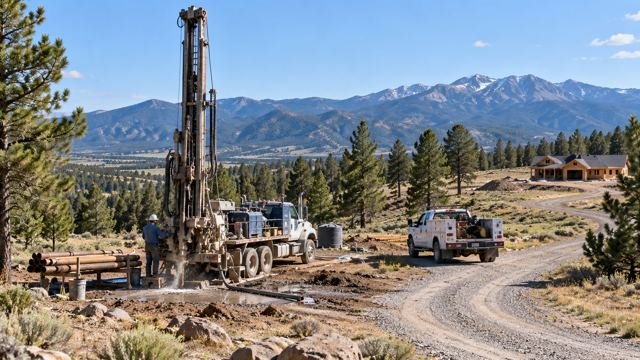
Idaho well costs can vary dramatically from one parcel to the next
There is no single reliable flat price for drilling a residential well in Idaho because the biggest cost driver is depth, and depth can change quickly with geology and location.
A parcel with accessible groundwater and easy drilling conditions can cost far less than a nearby property that requires deeper drilling, more casing, difficult rock work, or a long trench to the house.
For acreage buyers, the safest approach is to treat a well as a system with several separate cost components rather than one drilling quote.
A practical 2026 planning range
Recent Idaho-oriented cost references commonly place drilling and casing somewhere around $25 to $65 per foot, with complete residential systems often landing substantially higher once the pump, pressure tank, electrical work, trenching, controls, permits, and water testing are included.
A rough statewide planning range for a complete rural residential well is often around $10,000 to $30,000, but difficult or deep wells can exceed that amount.
Do not use a statewide average as a quote. Use it only as a budget placeholder until a licensed Idaho driller reviews the property and nearby well records.
What does a 200-foot well cost?
At a broad drilling-and-casing range of $25 to $65 per foot, a 200-foot bore could represent roughly $5,000 to $13,000 before the rest of the water system.
Once the pump, pressure tank, electrical work, trenching, wellhead equipment, permit, and testing are added, the complete project can move into the low-to-mid five figures.
A 200-foot example is useful for estimating, but many Idaho wells are shallower or deeper.
What does a 300-foot well cost?
At the same broad per-foot planning range, drilling and casing for a 300-foot well can roughly span $7,500 to $19,500.
A complete 300-foot system can cost considerably more after pump sizing, pressure storage, wiring, trenching, and site-specific work are included.
The deeper the water level and pumping lift, the more important pump selection and electrical design become.
What does a 500-foot well cost?
A 500-foot well can push drilling and casing alone into roughly the $12,500 to $32,500 range using broad published per-foot rates.
At that depth, the complete system can move well beyond a simple starter budget because the pump, wire, drop pipe, casing, drilling time, and mobilization all increase.
Mountainous and remote parcels can add additional cost if the drilling rig has limited access.
Depth is the biggest variable
The driller does not know the final well depth with certainty before drilling begins.
Nearby well logs can show patterns, but groundwater depth can vary across short distances due to geology, elevation, fractures, aquifer conditions, and previous development.
This is why a neighbor's well depth is useful evidence but not a guarantee.
Use Idaho well logs before you buy
The Idaho Department of Water Resources maintains well construction records that can help buyers understand nearby drilling history.
These records may include total depth, static water level, well construction details, geology, and reported yield.
Pull several nearby logs rather than relying on one. A cluster of neighboring wells can provide a better picture of the likely drilling environment.
Drilling cost and complete-system cost are different
A per-foot drilling quote may cover only the borehole and casing.
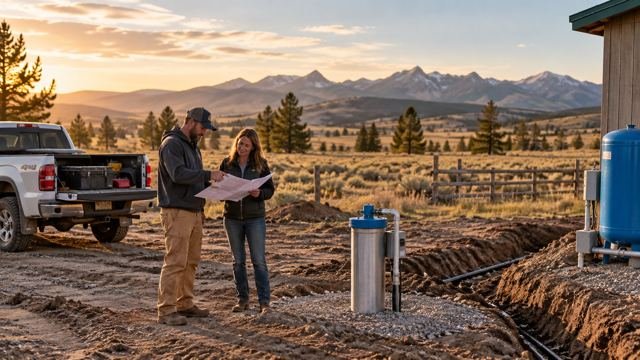
A usable household system can also require a submersible pump, pressure tank, controls, drop pipe, wiring, pitless adapter, trenching, pressure line to the house, water testing, and sometimes treatment equipment.
Ask every contractor exactly what is included in the quoted per-foot price.
Casing can materially change the price
Casing keeps unstable formations out of the well and helps protect groundwater quality.
The required casing depth and material depend on the geology and the well design.
A project requiring extensive steel casing can be significantly more expensive than one with simpler construction.
Pump size depends on the well, not just the house
Pump selection depends on total well depth, static water level, pumping water level, required pressure, flow demand, and elevation to the house.
A deeper setting usually means more pump head, longer wire, more drop pipe, and potentially a larger or more expensive pump.
For homes with irrigation, livestock, guest housing, or large families, peak demand also matters.
Pressure tanks and controls are part of the real budget
The pressure tank reduces pump cycling and helps maintain consistent household pressure.
Larger homes and higher water demand can justify larger tanks or more sophisticated variable-speed controls.
Ask whether the quote includes the pressure tank, pressure switch, controls, gauges, and installation.
Trenching from the well to the house can add more than buyers expect
The well may be hundreds of feet from the house because of access, septic separation, terrain, or the location of the best drilling site.
That distance can increase trenching, pipe, wiring, excavation, backfill, road crossings, and restoration costs.
Plan the well, septic system, driveway, power, and homesite together instead of treating each system separately.
Idaho requires a drilling permit
The Idaho Department of Water Resources requires a drilling permit before a well is drilled.
Domestic wells must be constructed by a well driller with a valid Idaho license.
The current IDWR drilling permit application lists a $75 fee for domestic wells and a higher fee for certain non-domestic wells.
A drilling permit is not the same as a water right
A permit to construct the well does not automatically answer whether the proposed use requires a water right.
Idaho revised its domestic exemption statutes in 2025 and again in 2026.
For many normal household uses, the domestic exemption may apply, but subdivision development and regulated groundwater areas can have additional requirements. Verify the current IDWR rules for the parcel and intended use.
Water quality testing belongs in the well budget
A newly completed well should be tested before the water is relied on for household use.
Private wells are not routinely monitored like public water systems, so testing and ongoing maintenance become the owner's responsibility.
The right test panel can vary by location, geology, nearby land use, and known regional concerns.
Treatment equipment can change the final project cost
Some private wells need no significant treatment beyond standard filtration, while others may need equipment for iron, hardness, sediment, odor, arsenic, nitrate, bacteria, or other water-quality issues.
Do not assume treatment cost until laboratory results are available.
If nearby wells commonly use softeners, iron filters, reverse osmosis, or other systems, include a placeholder in the budget.
Geology changes drilling speed and cost
Idaho includes basalt, volcanic formations, sedimentary deposits, granite, fractured rock, alluvial valleys, and mountain terrain.
Different formations can change drilling methods, penetration rates, casing needs, and the likelihood of finding productive fractures.
Local drillers who regularly work in the county are often better positioned to interpret nearby well logs and likely conditions.
Rig access matters on rural property
A well-drilling rig is large and heavy.
Steep roads, narrow gates, tight curves, soft ground, low branches, weak culverts, and limited turnaround space can increase mobilization difficulty.
Before closing on a remote parcel, make sure the likely well site is actually reachable by drilling equipment.
Season and weather can affect scheduling
Snow, frozen ground, spring mud, wildfire conditions, and rural road restrictions can affect drilling access and timing in Idaho.
In fast-growing rural markets, contractor schedules can also be long.
If the well is on the critical path for your build, contact drillers early rather than waiting until the foundation is underway.
Do not choose the well location by convenience alone
The well location must work with septic setbacks, property boundaries, access, drainage, utility routes, future structures, and the homesite.
The shortest trench to the house is not always the best drilling location.
Coordinate well placement with the septic designer and site plan before drilling begins.
How to estimate your Idaho well before buying land
Start by identifying several completed wells near the parcel and recording their depth, static water level, yield, and construction details.
Then call two or three licensed drillers who work in that area and ask how they would budget a comparable project.
Ask for both a likely range and the unit pricing that applies if the well goes deeper than expected.
- Drilling price per foot
- Casing price and included casing depth
- Mobilization or setup fee
- Pump and controls
- Pressure tank
- Drop pipe and wire
- Pitless adapter and wellhead
- Trenching to the house
- Electrical hookup
- Permit fee
- Water testing
- Well development and disinfection
- Treatment equipment if needed
- Extra cost if drilling exceeds the expected depth
Questions to ask an Idaho well driller
A detailed conversation before drilling can make the final invoice easier to understand.
- How many wells have you drilled in this immediate area?
- What depths are you seeing nearby?
- What is your drilling rate per foot?
- What casing is included?
- What happens if you encounter difficult rock?
- Is mobilization included?
- Is the pump included?
- Is the pressure tank included?
- Who handles the electrical connection?
- Who files the IDWR drilling permit?
- Is trenching to the house included?
- Is water testing included?
- What flow rate do you consider acceptable for the intended use?
- How do costs change if the well goes deeper than expected?
A realistic planning example
Suppose nearby logs suggest wells around 250 to 350 feet. Rather than budgeting only the drilling footage, build a complete-system allowance that includes drilling, casing, pump, pressure tank, electrical work, trenching, permit, testing, and contingency.
If the well comes in shallower, you keep budget flexibility for other site work. If it goes deeper, you are less likely to derail the project.
This approach is especially useful when comparing two rural parcels with different groundwater histories.
The cheapest land can become expensive if the well is difficult
A parcel priced $20,000 below another property is not automatically the better value if the well, septic, driveway, and power extension are substantially harder.
Rural land should be compared by total development cost, not just purchase price.
A deeper well may still be perfectly reasonable if the rest of the parcel fits the project and the cost is understood before closing.
Keep researching
Wells & Water resources
Water well drilling, pumps, pressure systems, testing, storage, and rural water planning.
Sources & methodology
Where this information comes from
Cost figures are planning references rather than contractor quotes. Permitting, system-selection, and location-specific guidance should be verified with the appropriate local authority or qualified professional. AcreageReady uses source-backed, AI-assisted editorial workflows and remains responsible for the material it publishes. Read how we research, edit, and correct guides.
- Idaho Department of Water Resources: Wells Overview
- Idaho Department of Water Resources: Well Construction and Drilling
- Idaho Department of Water Resources: Domestic Exemption
- Idaho Department of Water Resources: Drilling Permit Application
- Idaho Well Data: Cost Methodology and IDWR Well Records
- AcreageReady: Buying Rural Land in Idaho
- AcreageReady: What Utilities Should You Check Before Buying Rural Land?
Common questions
Frequently asked questions
How much does a well cost in Idaho in 2026?
A broad planning range for a complete rural residential well is often around $10,000 to $30,000, but depth, geology, casing, pump requirements, access, trenching, and treatment can push projects below or above that range. Local quotes are essential.
How much does Idaho well drilling cost per foot?
Recent planning references commonly show drilling and casing in Idaho around $25 to $65 per foot. Some contractors may price above or below that range depending on location, geology, casing, and market conditions.
How deep are residential wells in Idaho?
Depth varies widely. Some wells are under 100 feet while others exceed 500 feet. IDWR well logs are the best starting point for understanding nearby depths, but no nearby record guarantees the depth on a new parcel.
Do I need a permit to drill a well in Idaho?
Yes. IDWR requires a drilling permit before construction, and the well must be drilled by an Idaho-licensed well driller.
What is the Idaho domestic well drilling permit fee?
The current IDWR drilling permit application lists a $75 fee for domestic wells. Verify the current fee when applying because forms and fees can change.
Does an Idaho domestic well need a water right?
Some domestic uses qualify for Idaho's domestic exemption, but the law changed in 2025 and 2026 and certain subdivision or regulated-groundwater situations may require additional approval. Check current IDWR guidance for the exact parcel and intended use.
Ready to talk with a local professional?
Share your location and project details so AcreageReady can identify relevant providers as the network grows.
Get a free quote