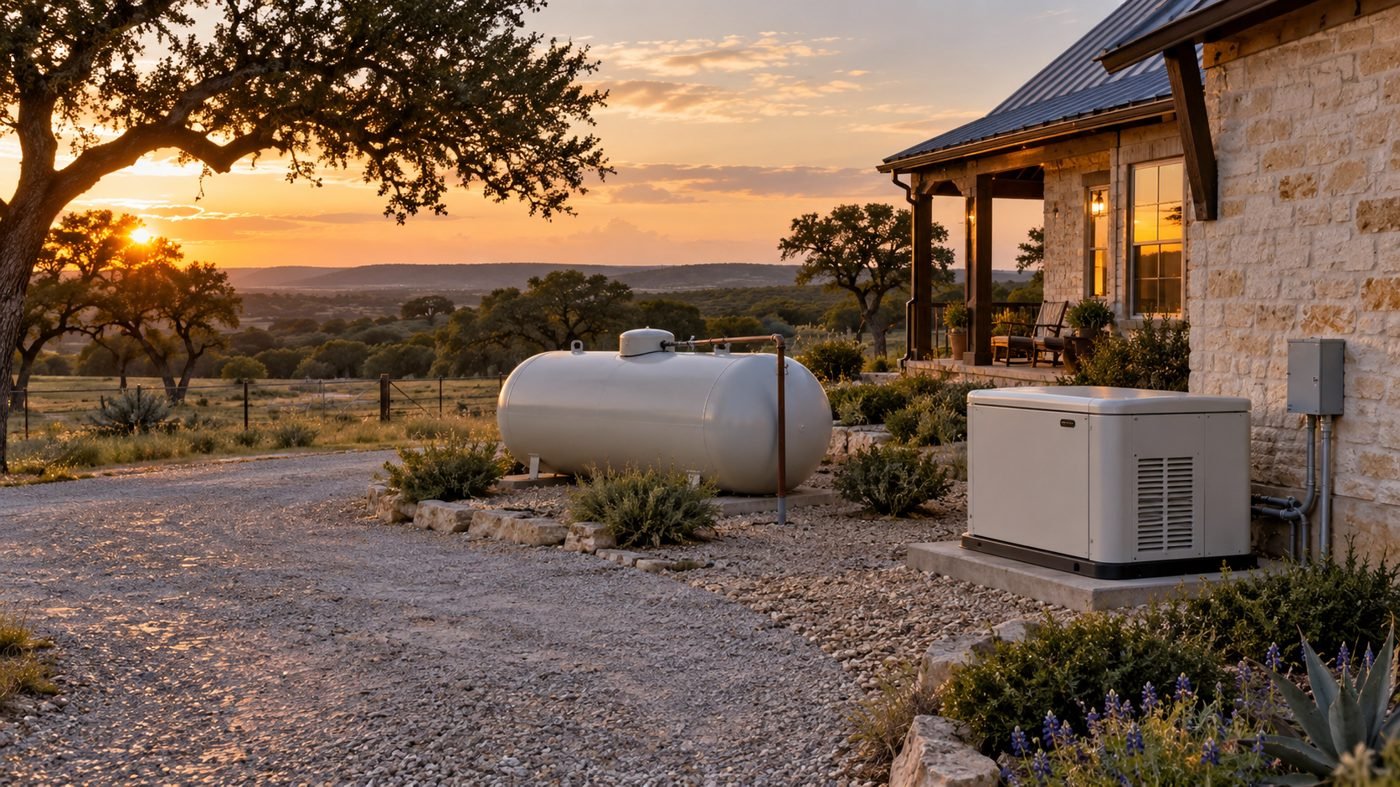
A 500-gallon propane tank can support several days of generator runtime
For a rural home, a 500-gallon propane tank can provide meaningful backup-power runtime, but the answer is not simply 500 divided by the generator's gallons per hour. Propane tanks are normally filled below their total water capacity to leave room for liquid expansion, and generator fuel use changes with electrical load.
As a practical planning example, if a nominal 500-gallon tank contains about 400 gallons at a typical maximum fill level, a generator consuming around 2.4 gallons per hour would theoretically have about 167 hours of fuel, or just under seven days, if consumption stayed constant. At roughly 4 gallons per hour, the same fuel volume represents about 100 hours, or a little over four days.
Start with usable propane, not the tank's nameplate size
A tank labeled 500 gallons does not normally hold 500 gallons of liquid propane in service. Propane storage requires vapor space so the liquid can expand as temperature changes. For planning, many owners use roughly 80 percent of nominal tank capacity as a full-tank estimate, which would be about 400 gallons in a 500-gallon tank.
The actual gallons available to your generator depend on the tank's current percentage, the supplier's fill practices, temperature, and how much reserve you choose to leave. Your propane supplier can tell you the actual usable volume and gauge interpretation for the installed tank.
- 500-gallon nominal tank
- About 400 gallons at an 80% fill example
- 300 gallons at a 60% gauge reading example
- 200 gallons at a 40% gauge reading example
- Do not plan to operate the tank completely empty
Generator load has a major effect on propane consumption
Standby generators do not burn the same amount of fuel every hour. Fuel use rises as electrical load increases. That means a home running refrigeration, well equipment, lighting, and a few essential circuits may use less propane than a home simultaneously running large air conditioners, electric appliances, pumps, and shop loads.
Current manufacturer data provides useful examples. Champion lists its 26 kW standby generator at about 2.39 gallons of propane per hour at half load and about 3.95 gallons per hour at full load. Generac lists its current 28 kW standby unit around 2.23 gallons per hour at half load and about 3.97 gallons per hour at full load.
500-gallon tank runtime examples
Using 400 gallons as a simple full-tank planning example, the following estimates show how dramatically load changes outage duration. These are mathematical screening examples, not guaranteed runtimes, because generator load varies throughout the day and you should normally preserve fuel reserve.
- 2.0 gal/hr: about 200 hours, or 8.3 days
- 2.25 gal/hr: about 178 hours, or 7.4 days
- 2.4 gal/hr: about 167 hours, or 6.9 days
- 3.0 gal/hr: about 133 hours, or 5.6 days
- 3.5 gal/hr: about 114 hours, or 4.8 days
- 4.0 gal/hr: about 100 hours, or 4.2 days
A half-full tank changes the answer quickly
The most common mistake is calculating runtime as though the tank will always be full when an outage starts. If the tank is sitting around 50 percent on the gauge, the available fuel may be roughly half of the full-tank planning amount.
Using 200 gallons as an example, a generator averaging 2.4 gallons per hour would have about 83 hours of theoretical runtime, or roughly three and a half days. At 4 gallons per hour, 200 gallons represents only about 50 hours, a little over two days.
A generator rarely stays at one exact load for days
Real homes cycle equipment on and off. Well pumps run intermittently. Refrigerators and freezers cycle. Heating and cooling demand changes with weather. Water heaters, dryers, ranges, shop equipment, and pool systems may be used only occasionally.
Because of that, an actual generator may spend much of an outage below its full-load fuel rate. But using only the half-load number can also be too optimistic if the property has heavy HVAC, pump, or electric-appliance demand. For outage planning, model a conservative average and keep a reserve.
Air conditioning can dominate summer fuel use
On Texas acreage, summer outages can coincide with the highest electrical demand of the year. Central air conditioning may become one of the largest continuous generator loads, especially during extreme heat.
Reducing thermostat demand, cooling only occupied areas where practical, or using load-management controls can significantly change generator load and propane runtime. A system designed to back up every electrical load without prioritization may consume fuel much faster than an essential-load strategy.
Well pumps create surge demand but do not usually run continuously
A well pump can require a substantial startup surge, which matters when sizing the generator, but the pump usually operates intermittently rather than continuously. That makes the well important to generator capacity without necessarily making it the largest daily fuel consumer.
Pressure-tank size, household water use, irrigation, livestock watering, and storage-tank systems can all change how frequently the pump operates.
Propane appliances and the generator may share the same tank
If the same propane tank also supplies a furnace, water heater, range, fireplace, pool heater, or shop equipment, the generator is not the only appliance consuming fuel during the outage.
A winter outage can be especially important because space heating may draw heavily from the same tank while the generator is operating. Ask the propane supplier and generator installer to account for the combined BTU demand and expected fuel use.
Keep an outage reserve instead of planning to zero
A theoretical runtime calculation that uses every gallon in the tank is not a good operating plan. Weather, road conditions, delivery delays, generator load, gauge accuracy, and emergency demand can all reduce the margin.
A practical strategy is to establish a minimum tank percentage at which you reduce discretionary loads or arrange a refill. The right reserve depends on how quickly your supplier can reach the property and how critical the generator is to water, medical equipment, livestock, refrigeration, heating, or communications.
Tank size should match the outage goal
A 500-gallon tank may be plenty for a property that needs a few days of backup and has dependable propane delivery. A more remote property that wants a week or more of autonomy may need a larger tank, a second tank where permitted, more aggressive load management, or a smaller essential-load generator.
The correct tank size should be chosen alongside the generator rather than after it. Generator kW rating, expected average load, propane consumption, other propane appliances, delivery access, and desired outage duration all belong in the same calculation.
How to estimate your own propane-generator runtime
You can create a useful first-pass estimate with three numbers: the usable gallons currently in the tank, the generator's expected gallons-per-hour consumption, and the reserve you do not want to consume.
Divide the gallons available for generator use by the expected gallons per hour. Then divide the result by 24 to convert hours into days. Use the generator manufacturer's fuel-consumption table instead of a generic number whenever possible.
- Available generator fuel = usable gallons minus desired reserve
- Runtime hours = available generator fuel ÷ gallons per hour
- Runtime days = runtime hours ÷ 24
- Run more than one scenario using half-load and heavier-load consumption
- Update the estimate whenever the tank percentage changes
Example outage plan for a rural Texas home
Suppose a 500-gallon tank begins an outage near 80 percent, giving an illustrative starting volume of about 400 gallons. The owner decides to preserve 80 gallons as reserve, leaving 320 gallons for planned generator operation.
At an average of 2.5 gallons per hour, 320 gallons represents about 128 hours, or roughly 5.3 days. If heavy summer loads push the average closer to 3.5 gallons per hour, the same 320 gallons represents about 91 hours, or roughly 3.8 days.
That difference is why generator runtime should be planned as a range rather than a single promise.
Questions to ask your generator installer and propane supplier
The most reliable runtime estimate combines the generator manufacturer's consumption data with the propane supplier's usable-capacity and delivery information.
- What is the generator's propane use at 25%, 50%, 75%, and 100% load?
- How many usable gallons are in this tank at a normal maximum fill?
- What tank percentage should trigger a refill request?
- How quickly can deliveries reach the property during a regional outage?
- What other appliances share the propane tank?
- Is the tank, regulator, and piping sized for simultaneous generator and appliance demand?
- What reserve should be maintained in winter or severe-weather season?
- Would a larger tank materially improve outage resilience?
Keep researching
Rural Power resources
Generators, solar, batteries, electrical planning, and backup power for acreage properties.
Sources & methodology
Where this information comes from
Cost figures are planning references rather than contractor quotes. Permitting, system-selection, and location-specific guidance should be verified with the appropriate local authority or qualified professional. AcreageReady uses source-backed, AI-assisted editorial workflows and remains responsible for the material it publishes. Read how we research, edit, and correct guides.
Common questions
Frequently asked questions
How long will a 500-gallon propane tank run a whole-house generator?
A common planning example uses about 400 gallons of propane in a nominal 500-gallon tank. At roughly 2.4 gallons per hour, that represents about 167 theoretical hours, or just under seven days. At 4 gallons per hour, it is about 100 hours, or a little over four days. Actual runtime depends on starting tank level, generator load, other propane appliances, and reserve.
How much propane does a whole-house generator use per hour?
It depends on generator size and load. Current 26 to 28 kW standby examples from Champion and Generac use roughly 2.2 to 2.4 gallons per hour around half load and close to 4 gallons per hour at full load.
How many gallons of propane are in a 500-gallon tank?
A nominal 500-gallon propane tank is not normally filled with 500 gallons of liquid. A common full-tank planning example is about 80 percent of nominal capacity, or roughly 400 gallons, but your propane supplier should confirm the actual usable amount for your installation.
Will a 500-gallon propane tank last a week on a generator?
It can under some load conditions. Around 400 gallons divided by roughly 2.4 gallons per hour is about 6.9 days theoretically. Heavier average loads, other propane appliances, lower starting tank level, and maintaining a reserve can shorten that significantly.
Does a generator use less propane at night?
Only if the electrical load falls. Standby-generator fuel use generally changes with load, so fewer active appliances and lower HVAC demand can reduce consumption.
Should I get a bigger propane tank for a whole-house generator?
Possibly. A larger tank can increase outage autonomy and reduce refill frequency, but the right size depends on generator consumption, household propane use, delivery access, desired reserve, site constraints, and local installation requirements.
Ready to talk with a local professional?
Share your location and project details so AcreageReady can identify relevant providers as the network grows.
Get a free quote