There is no single Texas acreage minimum that works for every septic system
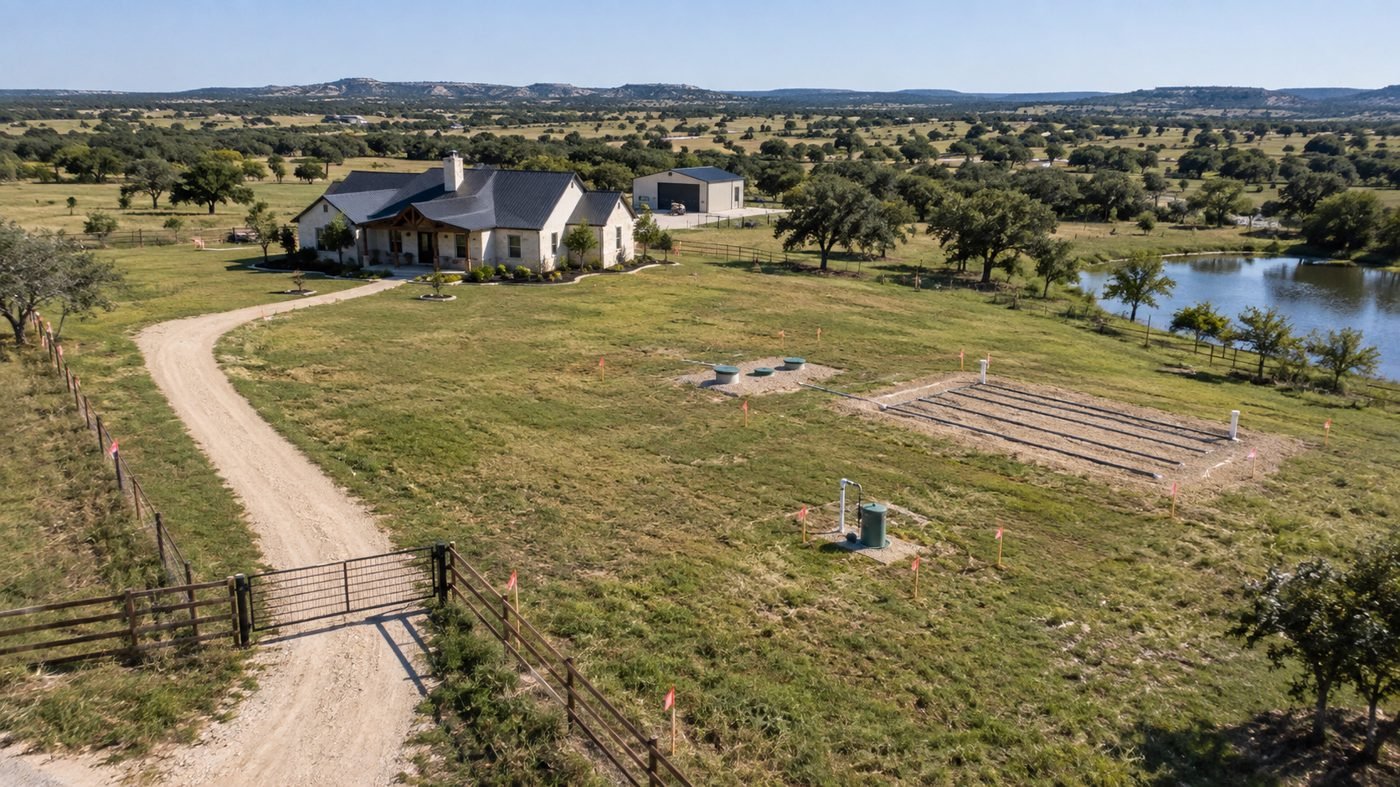
The amount of land you need for a septic system in Texas depends on the usable part of the property, not simply the total acreage shown on the deed. Soil, slope, drainage, wastewater flow, disposal method, setbacks, wells, property lines, easements, flood-prone areas, and the placement of buildings can all reduce the area available for an on-site sewage facility.
A one-acre tract can sometimes support a properly designed system, while a much larger tract can still have a difficult septic layout if the usable soil area is limited or the property is narrow, rocky, steep, wet, heavily constrained by easements, or already crowded with other improvements.
TCEQ requires the site to be evaluated before the system is selected, which is why septic feasibility should be treated as a land-use question rather than a simple acreage rule.
Think in terms of usable septic area, not total acres
The septic system needs more than a place to bury a tank. It also needs an approved disposal area, access for installation and maintenance, required separation from other features, and enough room for the system type selected for the property.
A tract may advertise five or ten acres, but part of that land may be occupied by the house, driveway, pond, creek, floodplain, utility easements, well, steep slopes, rock, barns, shops, or future structures.
The practical question is: how much suitable, buildable, legally usable land remains after those constraints are mapped?
Bedroom count affects the wastewater design
Residential septic systems are sized around expected wastewater flow, and bedroom count is one of the common design inputs used for single-family homes. A larger home with more bedrooms generally creates a larger design flow and can require more treatment or disposal capacity.
That means a property that works for a two-bedroom home may not automatically work for a five-bedroom home with the same site layout.
Before buying land, compare your actual house plan with the septic assumptions rather than evaluating the property using a generic residential system.
Soil may matter more than acreage
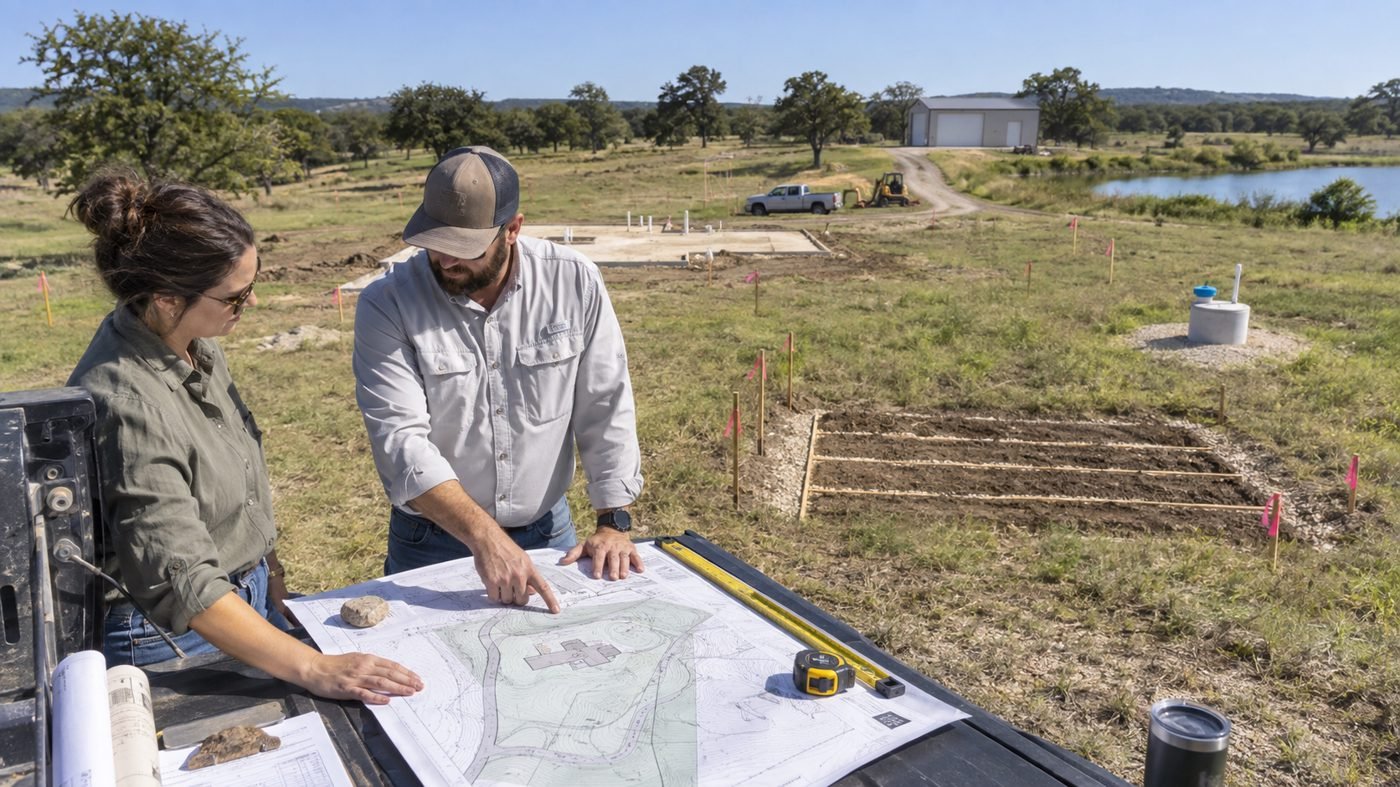
A conventional septic system relies heavily on the soil in the disposal area. TCEQ's site-evaluation process considers soil conditions because different soils accept and treat wastewater differently.
Deep, suitable soils can support disposal methods that may not work on shallow, rocky, restrictive, or poorly drained ground. Where the site does not support a simple conventional design, the property may require aerobic treatment, drip dispersal, low-pressure dosing, or another approved method.
More acreage does not fix unsuitable soil everywhere on the tract. What matters is whether enough suitable area exists in the right location.
Setbacks can remove large portions of the site from consideration
Septic components must be separated from wells, property lines, structures, water features, and other site elements according to the approved system and applicable rules.
Those separation requirements can create large no-build or no-disposal zones around features that look small on a survey. A well, pond, creek, driveway, house, shop, pool, and neighboring property line can collectively squeeze the available septic area.
This is why a scaled site plan is more useful than simply knowing the lot size.
A narrow tract can be harder than a wider tract with the same acreage
Two ten-acre properties can perform very differently for septic planning. A square or wide tract may provide several possible locations for the house, well, and disposal area. A long, narrow tract may have far fewer options once property-line setbacks and the driveway are accounted for.
The geometry of the tract matters because septic, well, house, and future improvements all need to fit together without creating conflicts.
The 10-acre rule does not mean every 10-acre property has unlimited septic freedom
Texas has a limited permit exemption often referred to as the 10-acre rule, but it is frequently misunderstood. Owning at least 10 acres does not automatically eliminate septic requirements.
TCEQ says the exemption applies only when all qualifying conditions are met. Those conditions include a single-family dwelling, a qualifying site evaluation, no nuisance or groundwater pollution, effluent disposed of on the property, and all OSSF components located at least 100 feet from the property line.
The 100-foot property-line condition alone can make many narrow or irregular ten-acre parcels ineligible.
A one-acre property may support septic, but do not assume it will
Small-acreage rural homes are common in Texas, and many use septic. But whether a one-acre lot works depends on the actual site conditions and the local permitting rules.
On a small tract, the house footprint, driveway, well, setback areas, utility routes, and future improvements consume a larger percentage of the available land. There is less room to relocate the disposal area if the preferred spot fails the site evaluation.
Before purchasing a small tract, make septic feasibility one of the highest-priority due-diligence items.
Two to five acres usually gives more layout flexibility
Acreage in the two-to-five-acre range often gives owners more room to separate the home, well, septic, driveway, shop, and outdoor features, but acreage alone still does not guarantee an easy system.
Poor soil, rock, floodplain, drainage, easements, or a bad tract shape can still make the septic layout difficult.
The benefit of additional acreage is flexibility: if one portion of the land is unsuitable, another portion may work.
Large acreage can still have septic conflicts
Owners of ten, twenty, or more acres sometimes assume septic placement will be easy. Large properties usually provide more options, but the homesite may still be concentrated in one attractive area near views, utilities, trees, or road access.
If the well, pool, shop, barn, pond, driveway, guest house, and main home are all clustered in that same area, the usable septic footprint can become tight even on a large tract.
Plan the complete compound rather than assuming the remaining acreage will solve every conflict.
Wells and septic need to be planned together
A private well and septic system can coexist on the same property, but their locations must be coordinated. The water source must be protected from potential wastewater contamination, and the site plan should preserve the required separation between the well and septic components.
The well also needs access for a drilling rig, service vehicles, electrical power, and future pump maintenance.
Do not pick the well location in isolation and then try to fit septic into whatever land is left.
Driveways can remove usable disposal area
TCEQ advises property owners not to build driveways, barns, storage buildings, sidewalks, patios, or other structures over an OSSF because compaction and structural loads can damage components and interfere with treatment.
That means the driveway layout should be coordinated with the septic area before base material and final surfacing are installed.
On narrow lots, a long driveway down one side of the property can substantially reduce the remaining design flexibility.
Pools, shops, barns, and guest houses should be shown on the septic plan
A future improvement can create a problem even if it is not part of the first construction phase. Pools, decks, shops, barns, RV pads, guest houses, garages, and second driveways can occupy or block access to the disposal area.
Show future improvements on the preliminary site plan before approving the septic location.
Moving a future pool on paper is easy. Relocating an installed septic system is not.
A second dwelling can change the wastewater plan
Adding a guest house, rental unit, second residence, or apartment can increase wastewater flow and may require a different septic design or a separate permitted system.
The limited 10-acre exemption is also tied to one single-family dwelling, so multi-dwelling plans deserve early review with the local permitting authority.
If you expect parents, adult children, renters, or guests to eventually occupy a second home on the property, plan for it before the first system is installed.
Reserve area is worth thinking about even when it is not separately required
A long-term rural site plan should consider where a replacement disposal area could go if the original field eventually fails or reaches the end of its useful life.
Even where a specific reserve field is not required by the local program, preserving an additional suitable area can make future repairs much easier.
Do not permanently cover every remaining suitable area with buildings, concrete, ponds, or landscaping that would make replacement difficult.
How much land should you reserve around the septic system?
There is no universal acreage number that can be applied across Texas because disposal methods and site conditions vary. Instead, reserve the entire approved disposal area plus access, required setbacks, and enough buffer that routine maintenance can occur without disturbing other improvements.
For planning purposes, treat the septic zone as protected infrastructure rather than leftover yard space.
What to do before buying land if septic feasibility matters
If the property will rely on septic, identify the local OSSF authority and complete enough site evaluation during the option or due-diligence period to understand the likely system type and disposal area.
A low purchase price can be misleading if the property requires a much more expensive system or if the preferred homesite conflicts with the only suitable disposal area.
- Identify the local OSSF permitting authority
- Obtain the survey and legal description
- Mark the proposed home, well, driveway, shop, pool, and future buildings
- Have the likely disposal area evaluated
- Ask what system types are suitable
- Confirm the likely permit path and local rules
- Understand how much of the property must remain protected for septic use
A practical acreage-planning rule
The more complex your rural property plan, the more usable land you should preserve around the wastewater system. A basic home on two open acres may have plenty of room. A home, shop, pool, guest house, well, barn, pond, RV pad, and multiple driveways on the same two acres may not.
The goal is not to buy the maximum acreage possible. It is to buy enough suitable acreage that the home and infrastructure can be arranged without forcing one system to compromise another.
Septic land-planning checklist
Before finalizing a land purchase or site plan, work through these questions with the evaluator and permitting authority.
- How many bedrooms will the home have?
- What wastewater flow is the system being designed for?
- Which areas of the property have suitable soil?
- What disposal methods are approvable?
- Where are the property lines and easements?
- Where will the well be located?
- Where will the driveway go?
- Are there ponds, creeks, flood-prone areas, or drainage features?
- Where will the shop, barn, pool, guest house, and future structures go?
- Is there enough room for service access and future repair?
- Could a second dwelling be added later?
- If relying on the 10-acre exemption, does the tract actually satisfy every condition?
Keep researching
Septic Systems resources
Planning, evaluating, installing, and maintaining septic systems for rural properties.
Sources & methodology
Where this information comes from
Cost figures are planning references rather than contractor quotes. Permitting, system-selection, and location-specific guidance should be verified with the appropriate local authority or qualified professional. AcreageReady uses source-backed, AI-assisted editorial workflows and remains responsible for the material it publishes. Read how we research, edit, and correct guides.
- Texas Commission on Environmental Quality: Choosing a Septic System
- Texas Commission on Environmental Quality: Getting a Permit for an OSSF
- Texas Commission on Environmental Quality: Advice for an OSSF Owner
- Texas Commission on Environmental Quality: On-Site Sewage Facilities
- AcreageReady: Septic System Planning Checklist for Texas Acreage
Common questions
Frequently asked questions
How much land do you need for a septic system in Texas?
There is no single statewide acreage requirement that fits every property. The amount of usable land depends on soil, wastewater flow, system type, setbacks, wells, buildings, drainage, and local rules. A site evaluation is required to determine what system and disposal area fit the property.
Can you put a septic system on one acre in Texas?
Sometimes. Many one-acre properties use septic, but feasibility depends on the site evaluation, available disposal area, soil, setbacks, well location, house placement, and local permitting requirements.
Is two acres enough for a septic system?
Often it can be, and two acres usually provides more layout flexibility than a one-acre tract. But acreage alone does not guarantee approval. Soil, tract shape, floodplain, drainage, easements, and other improvements still matter.
Do you need 10 acres for septic in Texas?
No. Ten acres is associated with a limited permit exemption, not a minimum lot size for septic. Many permitted Texas septic systems are installed on much smaller tracts.
Does owning 10 acres mean I do not need a septic permit?
No. The 10-acre exemption has multiple conditions, including one single-family dwelling, a qualifying site evaluation, on-site effluent disposal, and all OSSF components at least 100 feet from the property line. Local rules may also be stricter.
Can I build a shop or driveway over my septic field?
TCEQ advises owners not to build driveways, barns, storage buildings, sidewalks, patios, or other structures over an OSSF because compaction and loads can damage the system and interfere with treatment.
Ready to talk with a local professional?
Share your location and project details so AcreageReady can identify relevant providers as the network grows.
Get a free quote