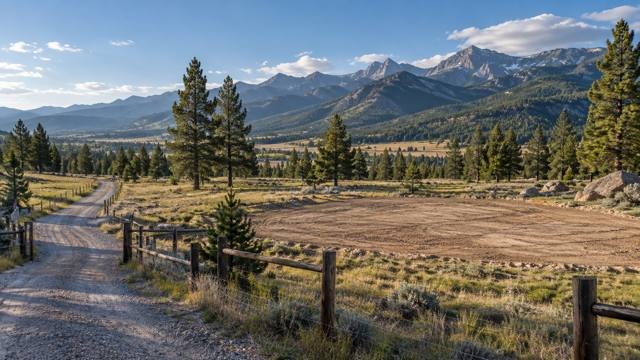
Idaho acreage can look simple until you start asking development questions
A parcel can have mountain views, open ground, trees, and plenty of acreage while still being difficult or expensive to build on.
Before buying rural land in Idaho, evaluate the property as a complete system: legal access, road conditions, zoning, septic feasibility, water, power, wildfire exposure, drainage, topography, winter access, and the location of the actual homesite.
The goal is not to find land with zero complications. The goal is to understand the complications before they become your construction budget.
1. Confirm legal access before anything else
Physical access and legal access are not the same thing. A visible dirt road crossing a neighboring parcel does not automatically mean you have a permanent right to use it.
Review the deed, title commitment, recorded easements, subdivision documents, and survey information to confirm how the parcel connects to a public road.
If access depends on a private road or shared easement, determine who maintains it, how costs are divided, whether heavy construction vehicles are allowed, and whether the easement is wide enough for the use you intend.
2. Check whether the road works in winter
A road that is easy in July may be a very different road in January.
Ask who plows the road, how quickly snow is typically removed, whether there are steep shaded sections, and whether spring thaw creates mud or load restrictions.
For remote or elevated parcels, winter access can affect daily living, construction schedules, emergency response, propane delivery, septic service, and whether large trucks can reach the homesite.
3. Identify who controls the road entrance
If the parcel connects directly to an Idaho state highway, driveway or road access may require an Idaho Transportation Department approach or encroachment permit.
County roads and private roads can have different requirements, so identify the road authority before designing the entrance.
A steep ditch, narrow shoulder, poor sight distance, or required culvert can make the entrance more expensive than it first appears.
4. Verify county zoning and land-use rules
Idaho land-use rules vary significantly by county and city. Do not assume that rural zoning means every use is automatically allowed.
Check the parcel's zoning designation, minimum lot size, setbacks, building-height limits, accessory dwelling rules, livestock rules, home-business restrictions, subdivision requirements, and any overlay districts.
Some counties regulate rural land lightly while others have more detailed zoning and development standards. The correct answer is always property-specific.
5. Check private covenants even when county rules are flexible
CC&Rs, road agreements, architectural rules, and subdivision restrictions can be more restrictive than county zoning.
Look for limits on manufactured homes, barndominiums, shops, livestock, RV storage, short-term rentals, fencing, building materials, minimum square footage, and additional dwellings.
A parcel can be legally buildable under county rules and still have private restrictions that conflict with your plan.
6. Confirm which building permits and inspections apply
Idaho building-code administration depends on jurisdiction. Local governments that enforce building codes issue permits under their applicable ordinances, while state agencies retain responsibility for certain systems and jurisdictions.
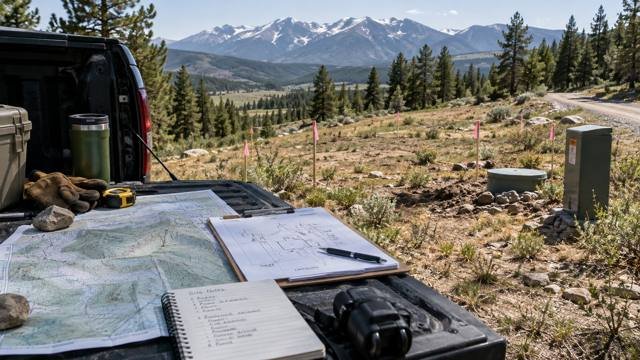
Before closing, contact the county or city building department and ask which permits apply to the exact parcel and proposed structures.
Also verify electrical, plumbing, HVAC, manufactured-home, and modular-building requirements rather than assuming one permit covers the entire project.
7. Treat septic feasibility as a purchase issue, not a construction issue
Most rural parcels outside sewer service need an onsite wastewater system.
Idaho's public health districts administer individual septic permitting under state rules. They perform site evaluations, issue permits, inspect installations, and maintain permit records.
Idaho DEQ recommends having the site evaluated before purchasing property when septic feasibility is important to the project.
8. Soil, groundwater, slope, and rock can change the septic design
A large parcel does not guarantee a simple drainfield.
Shallow soil, coarse gravel, high groundwater, fractured bedrock, steep slopes, and sensitive groundwater conditions can affect whether a conventional system works or whether an alternative design is needed.
The best homesite is sometimes not the best septic location, so evaluate the house, driveway, well, and drainfield together.
9. Protect room for the replacement drainfield
Do not use every open area near the house for buildings, shops, driveways, pools, or landscaping before understanding the septic layout.
A properly planned rural site should preserve the initial drainfield and any required replacement area.
This is especially important on irregular parcels or sites constrained by slope, waterways, rock, or property setbacks.
10. A private well requires more research than asking how deep nearby wells are
The Idaho Department of Water Resources regulates well construction and licenses well drillers statewide.
A drilling permit is required before a new well is drilled, and the well must be constructed by an Idaho-licensed driller.
IDWR's well-construction database can be useful during due diligence because nearby records may show well depth, geology, depth to water, static water levels, flow information, and construction details. Nearby logs are useful clues, not guarantees for your parcel.
11. Understand Idaho's domestic well and water-right rules
A well drilling permit and a water right are related but different issues.
Idaho revised its domestic-use and domestic-well statutes in 2025 and again in 2026. IDWR now provides specific guidance explaining when proposed domestic groundwater use qualifies for the domestic exemption and when a water-right permit may still be required.
The rules can be especially important for subdivisions and parcels located in moratorium areas, critical groundwater areas, or groundwater management areas. Check the current IDWR guidance for the exact property and intended water use.
12. Test existing private well water
If the property already has a well, do not stop at confirming that water comes from the faucet.
Idaho's Department of Health and Welfare notes that private wells are not routinely regulated or monitored like public water systems, making the owner responsible for water quality.
Ask for the well log, pump information, production history, recent laboratory results, and any treatment-system records, then arrange appropriate testing for the local area.
13. Separate household water from irrigation expectations
A residential well that serves a home is not automatically authorization for unlimited irrigation, multiple future houses, commercial use, or every agricultural use.
If you plan extensive irrigation, multiple dwellings, a business, a large livestock operation, or another high-demand use, verify the applicable water-right requirements with IDWR before assuming the water supply can support the plan.
When an existing irrigation right is represented as part of the sale, verify the right itself, point of diversion, place of use, priority, and whether any transfer would be required.
14. Price the electrical extension before choosing the homesite
Rural electrical service can be inexpensive when usable infrastructure is near the building site and very expensive when poles, transformers, trenching, road crossings, or long underground runs are required.
Contact the serving utility with the parcel number and a realistic proposed meter location. Ask what infrastructure exists, what portion of the extension you pay for, and whether capacity or easements could affect the project.
Moving a homesite hundreds of feet for a view can also move the electric, driveway, water, and trenching budget hundreds of feet.
15. Verify internet and cell service at the parcel
Online coverage maps are useful screening tools, but rural terrain can create major differences between nearby properties.
Test cellular service at the likely house location and check fixed-wireless, fiber, cable, DSL, and satellite options.
If remote work or security cameras are important, confirm the service at the actual address rather than relying only on a provider's broad coverage area.
16. Look at wildfire exposure as part of site planning
Many Idaho acreage properties sit in or near wildland vegetation where wildfire planning matters.
Evaluate vegetation around the proposed homesite, slope, prevailing access routes, evacuation options, emergency-vehicle access, water supply, and how much defensible space can realistically be maintained.
Local fire districts and jurisdictions may have additional access, addressing, water-supply, or construction requirements. Those requirements should be understood before finalizing a remote homesite.
17. Trees can be an asset and a development cost
Wooded Idaho parcels offer privacy, shade, wind protection, and character, but clearing can affect the driveway, septic area, power route, fire mitigation, and construction staging.
Identify trees you want to preserve before equipment arrives and account for stump removal, slash disposal, grading, and erosion control.
A homesite that preserves every tree may not be compatible with safe access, defensible space, septic placement, or solar exposure.
18. Topography changes almost every development cost
Slope affects foundation design, excavation, retaining walls, driveway grade, drainage, septic placement, utility trenching, and equipment access.
A parcel with 10 acres on paper may have a much smaller area that is practical for a house, shop, septic system, driveway, and outdoor use.
Walk the property with topographic information and, when the project justifies it, have a surveyor or site contractor help evaluate the likely development envelope.
19. Check drainage, flood mapping, and seasonal water
Snowmelt, irrigation water, hillside runoff, creeks, and seasonal drainage can behave differently from what you see during a dry showing.
Review mapped flood hazards, culverts, swales, low areas, and signs of erosion or standing water.
Ask sellers and neighbors what happens during spring runoff and after heavy storms, but verify conditions independently when they could affect the homesite or access road.
20. Understand irrigation ditches and canal corridors
Some Idaho properties are crossed by irrigation ditches, canals, laterals, or associated easements.
Do not assume an irrigation feature on the property belongs exclusively to the parcel or can be relocated.
Review recorded rights and easements and determine who maintains the facility, what access they have, and whether the feature constrains fences, buildings, driveways, or septic placement.
21. Check property boundaries before planning improvements
Fence lines, old roads, irrigation features, and visible occupation lines do not always match recorded boundaries.
Review the legal description and survey information before locating a house, shop, well, drainfield, driveway, or fence near a boundary.
Boundary certainty becomes more important when the parcel is irregular, wooded, mountainous, or crossed by easements.
22. Plan for construction access before designing the house
A finished pickup truck may reach the property easily while a concrete truck, truss delivery, excavator, crane, well rig, or septic truck cannot.
Measure narrow gates, bridge widths, tight curves, steep grades, overhead branches, and turnaround areas.
A difficult construction route can increase costs even when the final driveway is acceptable for everyday use.
23. Verify emergency-service access
Rural living often means longer response distances and more dependence on private roads.
Ask the local fire district or emergency-services provider about addressing, driveway width, vertical clearance, turnarounds, bridge or culvert capacity, and gate access.
Emergency access is worth considering when comparing a homesite close to the road with a more private site deep inside the parcel.
24. Budget the whole development path, not just the land price
A lower-priced parcel can become the more expensive property after access, clearing, grading, power, well, septic, driveway, foundation work, snow management, and fire mitigation are added.
Create a development budget before closing and obtain local estimates for any line item large enough to change your decision.
Leave contingency for unknown rock, poor soil, long utility runs, difficult drilling, drainage work, and seasonal access problems.
25. Bring contractors onto the property before closing when the risks are meaningful
Online research can identify red flags, but a local excavator, well driller, septic professional, surveyor, builder, or utility representative may see issues that are difficult to recognize from maps.
If a property's value depends on a particular homesite, driveway, well, septic area, or shop location, investigate those assumptions before your due-diligence period ends.
The best rural-land purchase is not necessarily the parcel with the fewest constraints. It is the parcel whose constraints fit your plan and budget.
Idaho rural land due-diligence checklist
Before committing to acreage in Idaho, work through the following items and save the answers with your property records.
- Recorded legal access and road easements
- Private-road maintenance agreement
- Winter plowing responsibility
- State or county driveway requirements
- Zoning and allowed uses
- Setbacks and minimum lot requirements
- CC&Rs and private restrictions
- Building permit jurisdiction
- Septic site evaluation and permit history
- Potential replacement drainfield area
- Nearby IDWR well logs
- Well drilling permit requirements
- Domestic exemption and water-right status
- Existing irrigation or water rights
- Private-well water testing
- Electric service and extension estimate
- Internet and cellular service
- Wildfire exposure and defensible space
- Local fire-district access requirements
- Topography and usable acreage
- Drainage and flood hazards
- Irrigation ditch or canal easements
- Survey and boundary issues
- Construction-truck access
- Full site-development budget
Keep researching
Acreage Planning resources
Due diligence, development sequencing, utilities, access, and the decisions that shape a rural property project.
Sources & methodology
Where this information comes from
Cost figures are planning references rather than contractor quotes. Permitting, system-selection, and location-specific guidance should be verified with the appropriate local authority or qualified professional. AcreageReady uses source-backed, AI-assisted editorial workflows and remains responsible for the material it publishes. Read how we research, edit, and correct guides.
- Idaho Department of Environmental Quality: Septic and Septage
- Idaho Department of Water Resources: Wells Overview
- Idaho Department of Water Resources: Well Construction and Drilling
- Idaho Department of Water Resources: Domestic Exemption
- Idaho Department of Water Resources: Water Rights
- Idaho Department of Health and Welfare: Drinking Water and Private Wells
- Idaho Division of Occupational and Professional Licenses: Building Code Board
- Idaho Division of Occupational and Professional Licenses: Building Statutes and Rules
- AcreageReady: How to Evaluate Raw Land Before Building a House
- AcreageReady: What Utilities Should You Check Before Buying Rural Land?
- AcreageReady: How to Lay Out 5, 10, or 20 Acres
Common questions
Frequently asked questions
Do you need a permit to drill a well in Idaho?
Yes. The Idaho Department of Water Resources requires a drilling permit before a well is drilled, and wells must be constructed by an Idaho-licensed well driller. Whether the proposed water use also requires a water-right permit is a separate question.
Do Idaho domestic wells require a water right?
Some domestic groundwater uses can qualify for Idaho's domestic exemption, but the rules were revised in 2025 and 2026. Requirements can differ for subdivisions and regulated groundwater areas, so buyers should review current IDWR guidance for the property and intended use.
Who issues septic permits in Idaho?
Idaho's seven public health districts administer individual septic permitting under state rules. They perform site evaluations, issue permits, inspect installations, and can help with property-specific permit records.
Are private wells in Idaho tested by the state?
Private wells are not routinely monitored like public water systems. Idaho health officials advise private-well owners to test and maintain their water supply.
Do rural Idaho homes need building permits?
Permit and inspection responsibility depends on the jurisdiction and the type of work. Local governments that enforce building codes issue permits under local ordinances, while state agencies retain jurisdiction for certain systems. Check the county or city that governs the exact parcel.
What should I check before buying mountain property in Idaho?
In addition to normal title and zoning review, pay special attention to winter road access, slope, construction-truck access, wildfire exposure, emergency response, well feasibility, septic placement, power distance, drainage, and the amount of truly usable acreage.
Ready to talk with a local professional?
Share your location and project details so AcreageReady can identify relevant providers as the network grows.
Get a free quote