How much does land clearing cost in Texas in 2026?
For early planning, many Texas land-clearing projects fall somewhere around $1,200 to $6,500 per acre, while broader national 2026 cost guides put professional land clearing around $1,200 to $8,000 per acre. The range is wide because clearing light brush is a very different job from removing mature timber, grubbing stumps, hauling debris, and preparing a building site.
Current 2026 pricing data from Angi puts professional land clearing at roughly $1,396 to $6,174 per acre nationally, while HomeGuide reports about $1,200 to $8,000 per acre depending on vegetation, terrain, access, and project size. Texas-specific contractor guides commonly cluster around roughly $1,200 to $6,500 per acre for many residential and acreage jobs.
Use these numbers as planning references, not quotes. The finish condition matters just as much as acreage. A contractor leaving mulch in place is pricing a different scope than a contractor who removes trees, grubs roots, hauls debris, rough-grades the site, and prepares it for construction.
- Light brush and simple clearing can sit near the low end
- Dense timber, large trees, steep terrain, rock, and difficult access push costs higher
- Forestry mulching is often priced differently from full clearing and haul-off
- Building-site preparation usually requires more than vegetation removal
The biggest factors that change the price
The largest price driver is usually what is actually growing on the property. Grass, yaupon, cedar saplings, mesquite, mature hardwoods, dense pines, and old fence-line growth all require different equipment and production rates.
Terrain and access also matter. A flat open tract with a wide gate is easier to work than a rocky hillside, wet ground, narrow access road, or property where equipment must work around structures, utilities, fences, or trees that must be preserved.
- Vegetation density and tree diameter
- Number of mature trees and stumps
- Rock, slope, wet areas, and soil conditions
- Equipment access and mobilization distance
- Whether debris is mulched, piled, burned where allowed, or hauled away
- Selective clearing versus complete clearing
- Required finish: brush reduction, pasture, driveway, building pad, or construction-ready site
- Erosion-control and drainage requirements after disturbance
Forestry mulching vs. full land clearing
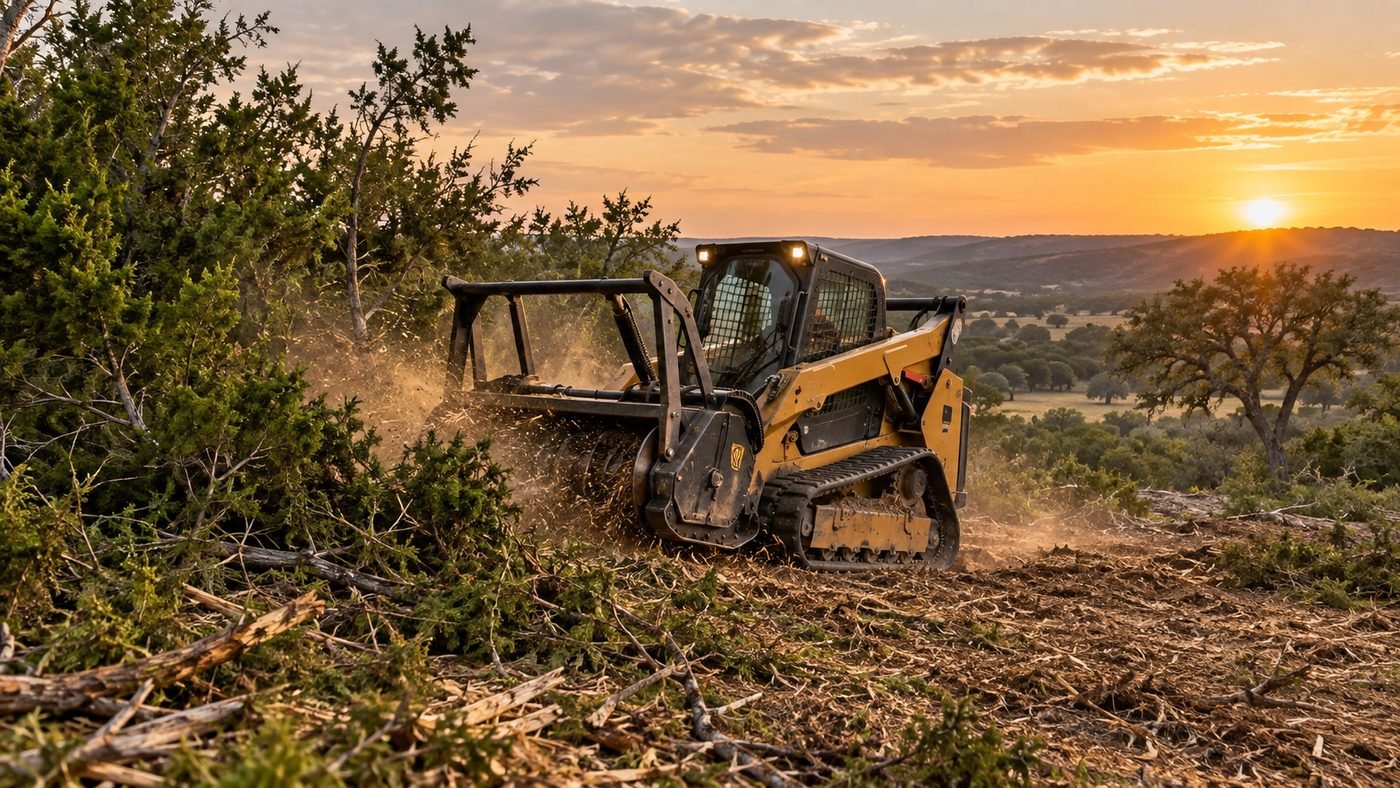
Forestry mulching uses a mulching head to cut and grind brush and smaller trees into material that stays on the property. It can be a good fit for brush reduction, trails, fence lines, visibility, selective clearing, and areas where preserving soil structure matters.
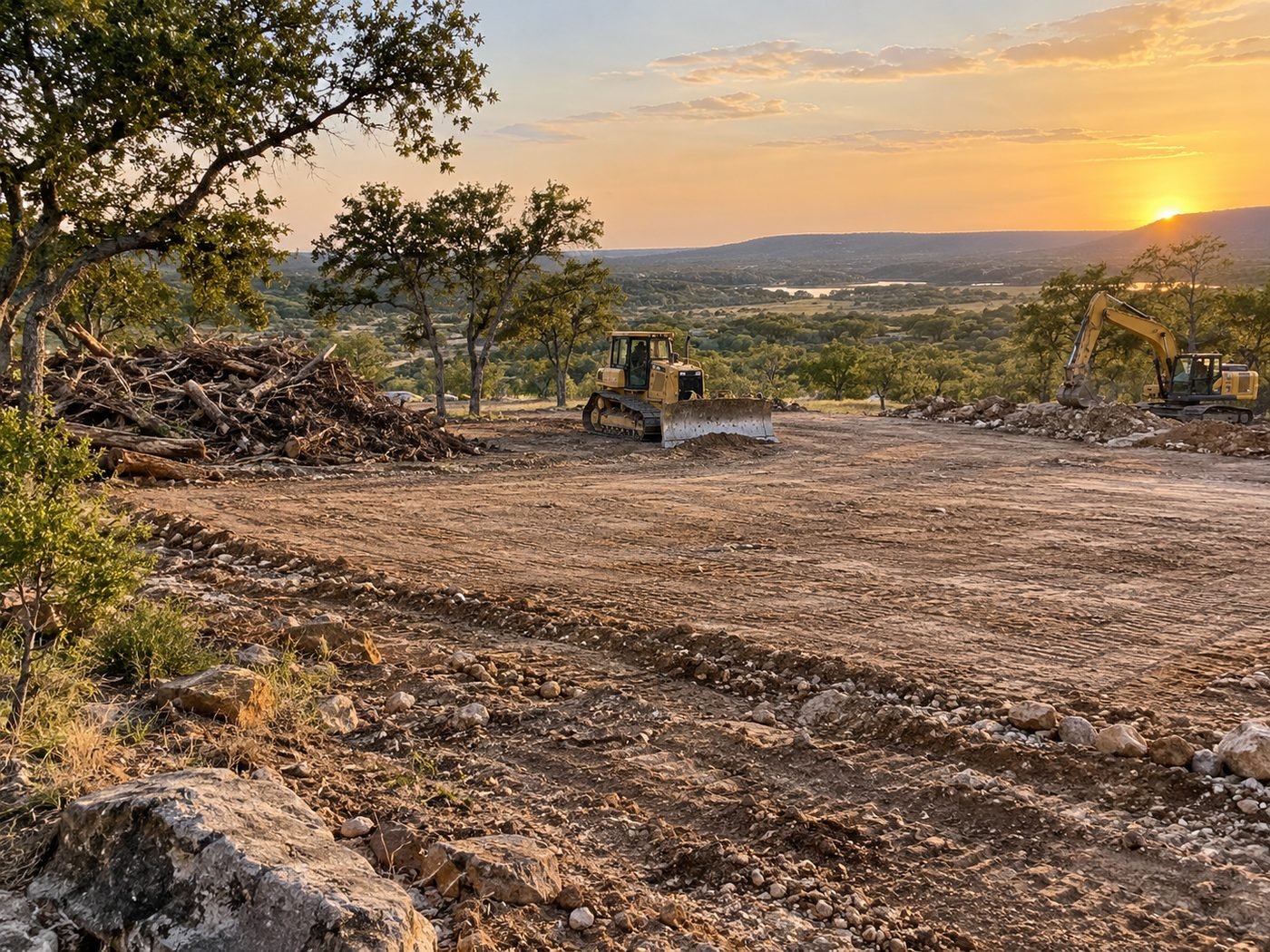
Full clearing is a broader scope. It can include pushing or cutting trees, removing stumps and roots, piling or hauling debris, stripping unsuitable material, and leaving the site ready for grading or construction.
Texas contractor pricing for forestry mulching varies widely. Some current 2026 guides show light-to-moderate work around $800 to $2,500 per acre, while denser Central Texas vegetation can reach roughly $1,500 to $6,000 per acre. The right method depends on what the cleared ground must support next.
What does it cost to clear 1, 5, or 10 acres?
Per-acre pricing often improves on larger jobs because mobilization and equipment setup are spread across more acreage, but vegetation density can outweigh that benefit. Five heavily wooded acres may cost much more than ten acres of scattered brush.
Using a broad Texas planning range of $1,200 to $6,500 per acre, one acre might represent roughly $1,200 to $6,500, five acres roughly $6,000 to $32,500, and ten acres roughly $12,000 to $65,000. Those are arithmetic planning examples, not estimates for a specific property.
A contractor should inspect the site before you rely on a per-acre number for budgeting. Photos and drone imagery can help, but they do not always show slope, rock, drainage, access restrictions, or the true density of understory growth.
Stump removal, grubbing, and root work can change the scope
If the area will become a homesite, shop pad, road, pond, utility trench, or other construction area, simply cutting vegetation at ground level may not be enough. Stumps, large roots, organic material, and disturbed soils can conflict with excavation, compaction, and foundation work.
Ask whether the proposal includes stump grinding, complete stump removal, grubbing, root raking, topsoil stripping, or disposal. Those tasks may be priced separately from basic clearing or forestry mulching.
Debris disposal can be a major cost driver
One of the easiest ways for two land-clearing bids to look different is debris handling. One contractor may mulch material on site, another may push it into burn or brush piles, and another may load and haul it away.
Haul-off can become expensive because it adds loading, trucking, disposal time, and possibly tipping or dump fees. Before comparing bids, make sure each contractor is pricing the same end condition.
- Mulch left in place
- Logs stacked for owner use
- Brush piled on site
- Material burned only where legal and appropriate
- Debris hauled off property
- Stumps and root balls removed separately
Clearing is not the same as grading
Landowners often use clearing, grading, excavation, and site preparation interchangeably, but they are different scopes. Clearing removes vegetation and obstacles. Grading reshapes soil elevations and drainage. Excavation removes or moves soil, rock, and unsuitable material.
HomeGuide's current 2026 cost data notes that leveling and grading can add thousands of dollars beyond basic clearing, especially where rock, major elevation changes, drainage work, or building-pad preparation are involved.
If your goal is a house pad, barn, driveway, or shop, ask for clearing and grading as separate line items so you understand what is actually included.
Texas brush management is not always about complete removal
Texas A&M AgriLife notes that brush management should match the landowner's objective. Mechanical approaches can include bulldozing, grubbing, root plowing, disking, and other methods, while selective treatment can make more sense when the goal is pasture improvement, wildlife habitat, visibility, or managing specific invasive species.
That matters because the cheapest way to remove everything may not be the best long-term land-management plan. Before clearing a large tract, decide what vegetation you want to preserve, what the land will be used for, and whether erosion, shade, habitat, or screening matters.
Questions to ask a Texas land-clearing contractor
A strong proposal should define exactly what the contractor will remove, what will stay, where the work boundary is, what equipment will be used, and what the site will look like when the crew leaves.
Mark trees and areas to preserve before equipment arrives. If the work supports a future building project, coordinate the clearing limits with the survey, septic plan, driveway, well, drainage, and proposed building locations.
- Is the quote per acre, per day, per machine hour, or a fixed project price?
- What vegetation size and density assumptions are included?
- Are stumps and roots removed or left in place?
- What happens to logs, brush, mulch, and debris?
- Is haul-off included?
- Are rock, wet areas, steep slopes, or access issues excluded?
- Will you protect marked trees and no-go areas?
- Does the scope include rough grading or only clearing?
- How are change orders handled if site conditions differ?
- What cleanup and finish condition should I expect?
How to budget a Texas acreage clearing project
Start by defining the finish you need. If the goal is simply to reclaim overgrown acreage, forestry mulching or selective brush management may be enough. If the goal is a house, shop, driveway, or pond, budget separately for clearing, stump and root removal, excavation, grading, drainage, and compaction.
The best budgeting approach is to walk the site with contractors using the same marked work area and the same written scope. That makes bids easier to compare and reduces the chance that the lowest number simply excludes work that another contractor included.
Keep researching
Land & Site Work resources
Clearing, grading, drainage, driveways, pads, excavation, and preparing acreage for construction.
Sources & methodology
Where this information comes from
Cost figures are planning references rather than contractor quotes. Permitting, system-selection, and location-specific guidance should be verified with the appropriate local authority or qualified professional. AcreageReady uses source-backed, AI-assisted editorial workflows and remains responsible for the material it publishes. Read how we research, edit, and correct guides.
Common questions
Frequently asked questions
How much does land clearing cost per acre in Texas?
For early planning, many Texas projects fall around $1,200 to $6,500 per acre, while broader 2026 national guides report roughly $1,200 to $8,000 per acre. Vegetation density, terrain, access, debris disposal, stump removal, and required finish can move the price substantially.
Is forestry mulching cheaper than traditional land clearing?
It can be, especially for light to moderate brush where material can be mulched and left in place. Full clearing may cost more when trees, stumps, roots, and debris must be removed or hauled away. The methods also produce different finished conditions.
How much does it cost to clear 5 acres in Texas?
Using a broad planning range of $1,200 to $6,500 per acre, five acres works out to roughly $6,000 to $32,500. That is only a budgeting example. Dense timber, large trees, steep terrain, rock, and haul-off can raise the price.
Does land clearing include grading?
Not necessarily. Clearing removes vegetation and obstacles, while grading changes elevations and drainage. Ask contractors to separate clearing, excavation, grading, and compaction in the proposal.
Should stumps be removed before building?
For construction areas, stumps, major roots, and organic material often need additional removal or grubbing so the area can be properly excavated and compacted. Confirm the requirements with the site contractor, builder, or engineer responsible for the finished work.
What is the cheapest way to clear brush on acreage?
For some properties, selective brush management or forestry mulching may be less expensive than full clearing and haul-off. The cheapest method depends on vegetation, terrain, and what you need the land to support afterward.
Ready to talk with a local professional?
Share your location and project details so AcreageReady can identify relevant providers as the network grows.
Get a free quote