Land clearing is not one line item
On Oklahoma acreage, clearing can mean mowing light brush, mulching dense cedar, removing mature trees, pulling stumps, hauling debris, stripping topsoil, grading a homesite, or preparing a driveway corridor.
Those jobs use different equipment, create different disposal problems, and can vary dramatically in cost.
Before requesting bids, define exactly what areas must be cleared and what condition the land should be left in when the work is finished.
A practical 2026 planning range
Current 2026 consumer cost guides show broad land-clearing ranges because project conditions vary so much. Angi's regional examples place many per-acre clearing jobs from a few hundred dollars to several thousand dollars per acre depending on vegetation and terrain.
Forestry mulching projects are commonly quoted by project, acre, or machine hour, with Angi reporting many standard projects around $1,000 to $4,000 nationally in 2026.
Treat these as early planning ranges only. Oklahoma contractor pricing depends on vegetation density, machine access, rock, slope, haul distance, disposal, and the final site condition you require.
Light brush is very different from mature timber
A pasture with saplings, sumac, briars, and scattered small cedar can often be cleared much faster than a wooded tract with mature hardwoods and large stumps.
The same acreage number can therefore produce very different bids.
Contractors need to see vegetation height, trunk diameter, density, terrain, and access before a meaningful estimate can be developed.
Forestry mulching is often a good fit for selective clearing
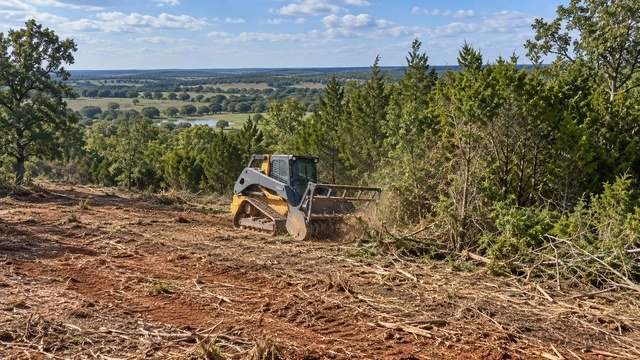
Forestry mulching uses a tracked or wheeled machine with a cutting head to shred brush and smaller trees into mulch where they stand.
It can be useful for opening trails, clearing fence lines, thinning cedar, reclaiming overgrown pasture edges, and creating visibility without stripping the entire site bare.
Because the organic material stays on site, mulching can also reduce hauling compared with conventional clearing.
Mulching does not remove every stump
A mulcher can grind stems and low stumps, but the finished result is not the same as excavating every root system.
If the area will become a house pad, driveway, slab, septic field, pond dam, or other structural site, additional excavation may be needed.
Tell the contractor which areas only need vegetation control and which areas must be fully grubbed and ready for construction.
Eastern redcedar deserves its own clearing plan
Eastern redcedar is native to Oklahoma but has expanded into many grasslands and Cross Timbers areas where frequent fire historically limited its spread.
Oklahoma State University notes that controlling cedar while trees are still small is far easier and less expensive than restoring a dense mature stand.
On heavily infested land, buyers should treat cedar removal as a long-term land-management issue rather than a one-time cosmetic cleanup.
Small cedar can be controlled more economically
OSU guidance identifies prescribed fire as one of the most economical tools for controlling smaller eastern redcedar when adequate fuel and safe burning conditions exist.
Mechanical methods become more important when trees are larger, dense, close to structures, or located where prescribed fire is not practical.
The longer a cedar problem is ignored, the more expensive restoration can become.
Large cedar often requires mechanical treatment first
Mature eastern redcedar may need chainsaws, hydraulic saws, skid steers, excavators, dozers, mulchers, or other equipment before the area can be restored.
OSU's recent guidance recommends considering tree size and drought conditions when deciding how mechanical treatment and prescribed fire should be combined.
Dense mature stands can also create major fuel loads, so debris handling needs to be planned carefully.
Prescribed fire is land management, not debris disposal
Oklahoma supports prescribed fire as a legitimate land-management tool, but it requires planning, adequate firelines, manpower, equipment, and legal compliance.
ODAFF states that the person conducting the burn must be legally entitled to burn the property, provide adequate firelines and firefighting capability, and remain with the fire until extinguished.
In designated protection areas of eastern Oklahoma, Forestry Services approval is required before burning under the applicable state rules.
Open-burning rules still matter
The Oklahoma Department of Environmental Quality allows certain land-management burning when applicable procedures are followed, and the state has a smoke-management framework for prescribed fire.
A contractor offering to simply burn brush piles should still address legality, weather, smoke, fire control, local restrictions, and liability.
Do not assume that rural location means unrestricted burning.
Brush piles can create their own hazards
Large piles concentrate heat and can throw embers farther than a well-planned prescribed burn.
OSU specifically warns that piling cut redcedar can increase firebrand risk.
If debris will be piled, chipped, burned, buried, hauled, or left in windrows, define that in the clearing contract before work begins.
Haul-off can materially change the price
Removing logs, brush, stumps, demolition debris, and rock requires loading, trucking, disposal time, and sometimes tipping fees.
A bid that looks inexpensive may assume all debris stays on the property.
Ask where every material category will end up when the job is complete.
Stump removal is often priced separately
Tree felling and stump removal are different operations.
Stumps can be ground below grade, excavated, pushed, pulled, or left in place depending on the project.
House pads, driveway subgrades, septic areas, and future slabs usually require more complete root and stump removal than pasture restoration.
Excavated stumps create large disposal piles
A stump can be much larger below ground than buyers expect, and the attached soil makes it heavy to move.
Dozens of removed stumps can quickly create a substantial disposal problem.
Decide whether they will be hauled away, buried where legally and practically appropriate, burned under lawful conditions, or stored in a designated area.
Rock can turn a simple clearing job into excavation
Oklahoma geology varies widely, and some properties have shallow sandstone, limestone, large surface rock, or buried ledges.
Mulching vegetation over rocky ground can be slower and harder on equipment, while grubbing and grading may require excavators, hydraulic hammers, or heavy dozers.
Ask whether the bid includes a rock allowance or treats unexpected rock as extra work.
Slope affects both production and safety
Steep terrain reduces machine speed and can limit which equipment can safely operate.
Side slopes also influence erosion, drainage, and where cleared debris can be placed.
A low-cost per-acre estimate from flat pasture may not translate to wooded ravines or steep Cross Timbers terrain.
Wet ground can stop heavy equipment
Tracked equipment handles soft conditions better than many wheeled machines, but saturated Oklahoma clay can still become deeply rutted.
Working too early after rain can damage soil structure, bury mulch, and create expensive restoration work.
Ask the contractor what ground conditions are required and whether mobilization charges apply if work must be postponed.
Clearing the whole property is rarely necessary
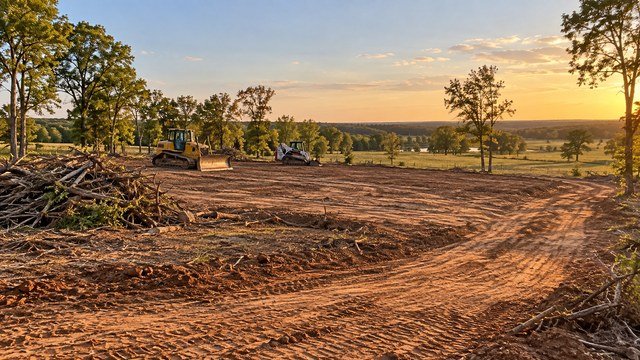
Many acreage buyers only need to clear the homesite, driveway, septic area, utility corridors, shop pad, fence lines, and defensible space around structures.
Leaving selected trees and natural areas can reduce cost, preserve habitat, reduce erosion, and maintain privacy.
A marked clearing plan prevents equipment operators from making irreversible decisions in the field.
Mark the trees you want to keep
Valuable oaks and shade trees can be damaged by root disturbance, bark injury, grading, or equipment traffic even when they are not cut.
Identify preservation areas before machinery arrives and keep heavy equipment away from critical root zones where practical.
Selective clearing is easier when the contractor knows which trees are non-negotiable.
Do not clear the septic area blindly
A future septic area should be coordinated with soil evaluation and system design.
Aggressive excavation or deep grading can alter soil conditions that the wastewater system depends on.
Before grubbing a large area, identify the likely primary and reserve septic locations.
The driveway corridor should be wider than the finished road
Construction vehicles need room for drainage, ditches, shoulders, utility work, sight distance, and occasional passing or turnouts.
Clearing only the final gravel width can force a second mobilization later.
Plan the road corridor, ditching, culverts, gates, utility routes, and overhead clearance at the same time.
Utility corridors may overlap with clearing work
Electric, water, fiber, propane, and other utilities often need vegetation cleared along their routes.
Coordinate those routes before clearing so the same strip does not have to be reopened later.
Utility providers may also have their own easement widths and vegetation-clearance requirements.
Drainage should guide the final grade
Removing trees and brush changes how rain reaches the soil, while grading changes where water flows.
A contractor should not simply make the site flat if that creates standing water or sends runoff toward the house pad.
Preserve or redesign swales, culverts, ditches, and natural drainage paths as part of the clearing plan.
Erosion control belongs in the clearing budget
Bare red dirt can erode quickly during Oklahoma thunderstorms.
Mulch, retained vegetation, temporary seeding, wattles, rock checks, silt fencing, and staged clearing can reduce soil loss depending on the project.
Large construction disturbances may also trigger stormwater requirements, so clearing should be coordinated with the broader site-development plan.
Forestry mulch can help protect disturbed soil
Mulched woody material can provide short-term surface protection and reduce exposed soil in some applications.
But thick mulch can interfere with grading, compaction, seed establishment, or septic work where a clean mineral-soil surface is needed.
Use mulch where it helps and remove or redistribute it where structural work will occur.
Wildfire risk is another reason to manage cedar
Oklahoma State University notes that eastern redcedar creates volatile fuel and can increase wildfire intensity.
Clearing or thinning cedar around structures, access roads, fence lines, and other critical areas can be part of a broader wildfire-risk strategy.
Land management after clearing is important because cedar and brush can return if the property is simply abandoned again.
Maintenance keeps clearing from becoming restoration again
A freshly cleared tract can quickly begin to regrow with cedar seedlings, hardwood sprouts, brush, and invasive vegetation.
OSU emphasizes recurring management, including appropriate fire and grazing practices where suitable, to prevent expensive re-encroachment.
Budget for mowing, spot cutting, prescribed burning, grazing management, or other follow-up rather than treating clearing as permanent.
Budget examples for Oklahoma acreage
These are screening examples, not statewide contractor quotes. Actual bids depend on vegetation, terrain, machine access, disposal, and the finished condition.
- Light brush and pasture edge cleanup: often toward the low end of per-acre clearing ranges
- Forestry mulching of moderate brush and small trees: often priced by acre, project, or machine day, with current national projects commonly around $1,000 to $4,000
- Dense cedar or mature tree removal: can reach several thousand dollars per acre or more depending on size and disposal
- Full grubbing for a house pad or road: typically costs more than vegetation-only clearing because stumps and roots must be removed
- Rock excavation, steep terrain, major haul-off, or difficult access can push a project well above ordinary clearing ranges
What should be included in a clearing quote?
A useful bid describes the finished condition, not just the equipment that will arrive.
- Exact acres or mapped clearing limits
- Trees and vegetation to remain
- Maximum tree diameter included
- Forestry mulching versus cutting and grubbing
- Stump treatment
- Brush and log disposal
- Burning, chipping, hauling, or stockpiling assumptions
- Rock and boulder handling
- Topsoil stripping
- Rough grading
- Finish grading
- Erosion-control measures
- Fence removal or protection
- Gate and road access requirements
- Utility marking
- Mobilization charges
- Machine-hour or overage rates
- Weather-delay policy
- Cleanup standard
Questions to ask an Oklahoma clearing contractor
The contractor should be able to explain both production and site impact.
- What equipment will you use and why?
- How many acres per day do you expect on this vegetation?
- Which trees can the mulcher handle efficiently?
- Will stumps remain?
- What happens to logs and debris?
- Is haul-off included?
- How do you handle large cedar?
- How do you protect trees I want to keep?
- What happens if you encounter rock?
- How do you avoid rutting wet ground?
- Is grading included after clearing?
- What erosion control is included?
- Are burning permits or notifications my responsibility or yours?
- Do you carry liability and equipment insurance?
- What work would trigger additional charges?
Questions to answer before buying the property
Heavy vegetation can hide significant development costs.
- How many acres actually need clearing?
- Is the homesite already partly open?
- How dense is eastern redcedar?
- Are mature hardwoods mixed with the brush?
- Is there shallow rock?
- Can heavy equipment reach the site?
- Are slopes safe for mulching or dozer work?
- Where will debris go?
- Can prescribed fire be used legally and safely?
- Will clearing affect the septic area or drainage?
- How much ongoing vegetation management will the property need?
The bottom line
Oklahoma land clearing costs are driven less by acreage alone than by vegetation density, tree size, terrain, rock, access, stump requirements, disposal, and the final condition required for construction.
Forestry mulching can be efficient for selective brush and smaller trees, while dense mature cedar, large timber, full grubbing, and rock work require heavier equipment and larger budgets.
Before closing on overgrown acreage, map the areas that actually need clearing, identify cedar and large-tree density, get a contractor to walk the site, and build follow-up vegetation management into the long-term plan.
Keep researching
Land & Site Work resources
Clearing, grading, drainage, driveways, pads, excavation, and preparing acreage for construction.
Sources & methodology
Where this information comes from
Cost figures are planning references rather than contractor quotes. Permitting, system-selection, and location-specific guidance should be verified with the appropriate local authority or qualified professional. AcreageReady uses source-backed, AI-assisted editorial workflows and remains responsible for the material it publishes. Read how we research, edit, and correct guides.
- Oklahoma State University: Eastern Redcedar Control and Management Best Management Practices
- Oklahoma State University: Eastern Redcedar and Climate Change in Oklahoma's Cross Timbers Forests
- Oklahoma State University: Cut and Stuff Practices for Enhanced Cedar Control with Prescribed Fire
- Oklahoma State University: Firebreaks for Prescribed Burning
- Oklahoma Department of Agriculture, Food and Forestry: Prescribed Fire
- Oklahoma Department of Environmental Quality: Smoke Management
- Angi: Forestry Mulching Cost 2026
- Angi: Land Clearing Cost Regional 2026 Data
- AcreageReady: Buying Rural Land in Oklahoma
- AcreageReady: Oklahoma Flood Zones & Drainage
- AcreageReady: Oklahoma Rural Driveway Costs
Common questions
Frequently asked questions
How much does land clearing cost per acre in Oklahoma?
There is no dependable statewide rate. Current 2026 regional cost guides show broad ranges from a few hundred dollars to several thousand dollars per acre depending on vegetation, terrain, tree size, stump removal, rock, haul-off, and grading. Get a site-specific Oklahoma contractor quote.
How much does forestry mulching cost in Oklahoma?
Forestry mulching is commonly priced by project, acre, or machine time. Angi reports many 2026 projects nationally around $1,000 to $4,000, but dense cedar, large trees, steep ground, and difficult access can increase Oklahoma pricing.
Is forestry mulching cheaper than bulldozing?
It can be for brush and smaller trees because it processes vegetation in place and may reduce hauling. Bulldozers or excavators may be more appropriate when full stump and root removal, heavy grading, or large-tree clearing is required.
What is the best way to remove eastern redcedar in Oklahoma?
The best method depends on tree size, density, fuel, terrain, and land-use goals. OSU recommends managing cedar while it is small and identifies prescribed fire as a cost-effective control tool where it can be used safely and legally. Larger trees often require mechanical treatment.
Can I burn cleared brush in Oklahoma?
Burning is regulated. Oklahoma requires lawful authority to burn, adequate firelines, manpower and equipment, and compliance with applicable state and local rules. Certain eastern Oklahoma protection areas require Forestry Services approval before burning.
Does forestry mulching remove stumps?
It can grind stems and some stump material near the surface, but it does not provide the same result as excavating roots and stumps. Construction pads and structural areas may require additional grubbing.
Should I clear land before the septic test?
Avoid unnecessary excavation in likely septic areas before the soil and wastewater plan are established. Heavy grading can alter soils and reduce usable septic options.
Should I clear the whole property before building?
Usually not. Many buyers can limit initial clearing to the house, driveway, septic, utilities, shop, fence lines, and safety zones while preserving useful trees and natural areas.
Ready to talk with a local professional?
Share your location and project details so AcreageReady can identify relevant providers as the network grows.
Get a free quote