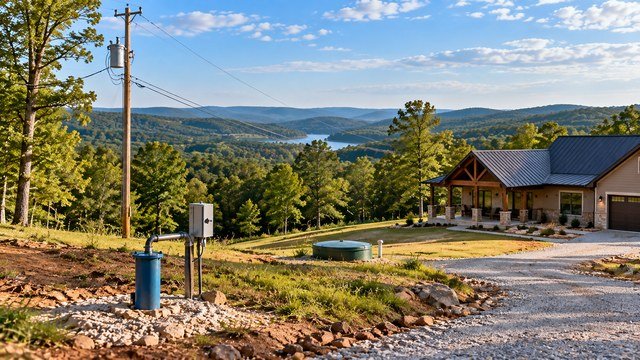
Utilities can determine whether Arkansas acreage is truly build-ready
A rural Arkansas parcel can look affordable until the utility plan is priced. Electricity may stop hundreds or thousands of feet from the homesite, a private well may require deeper drilling than expected, the preferred building area may not support a conventional septic system, and an internet provider's coverage map may not reflect service at the exact address.
Treat utilities as part of land due diligence, not as work to solve after closing. A practical utility plan identifies the provider or system for each service, the route to the homesite, major site constraints, likely approvals, and a contingency for unknown conditions.
Start with the homesite, driveway and utility corridor
Before collecting quotes, sketch the likely house location, driveway entrance, septic area, well location, electric route and any detached buildings. Long distances across acreage can increase trenching, conductor, water-line and driveway costs.
A homesite chosen only for the view can create expensive utility runs. Compare several possible building areas before committing to one location.
Do not assume a nearby power line means inexpensive electric service
The line visible along a county road may not be the correct voltage, may not belong to the utility serving the parcel, or may require an extension, transformer or additional construction. Ask the serving utility to evaluate the actual property and proposed service point.
Arkansas rules provide that regulated electric utilities make extensions according to their Arkansas Public Service Commission-approved extension tariffs. When an applicant must pay extension costs, the agreement is supposed to describe the route, facilities, costs and estimated construction timing.
Identify the electric utility before buying
Arkansas has investor-owned utilities, electric cooperatives and municipal systems. The Arkansas Public Service Commission regulates many electric utilities, but not every municipal utility. Service rules and extension charges therefore depend on the utility serving the exact parcel.
Get the provider name from a neighboring meter only as a starting point. Confirm the parcel is actually inside that provider's service territory and request a written service evaluation when possible.
Electric extension cost depends on the route and required facilities
For regulated service, Arkansas rules state that extension cost is based on the most economically feasible route from the utility's nearest point of connection to the applicant's point of delivery, consistent with sound engineering design. That makes route length and site layout important early decisions.
Ask whether the quote includes poles, transformer work, underground or overhead construction, easements, clearing, trenching, meter equipment and any customer-owned work. Avoid comparing quotes that include different scopes.
Plan temporary and permanent power together
Construction may need temporary power before the permanent home service is complete. Ask the utility and builder where temporary service should be located and whether that location works with the final meter and transformer plan.
Early coordination can prevent paying to relocate temporary equipment or trench across finished driveways and landscaping.
Private wells are common, but groundwater is site-specific
A neighboring well is useful evidence, not a guarantee. Arkansas drilling depth, yield and geology can vary across short distances, especially where fractured rock controls groundwater movement.
Build a complete well budget that includes drilling, casing, grout, pump, pressure tank, controls, electrical work, trenching to the house, testing and any treatment indicated by actual water-quality results.
Use a properly authorized Arkansas water-well contractor
Arkansas has construction rules governing water wells and requirements for authorized water-well constructors. Confirm the contractor is appropriately authorized for the work and ask how the proposed well will comply with current state requirements.
A detailed proposal should explain how drilling footage, casing, mobilization, pump equipment, unsuccessful drilling and abandonment are charged.
Coordinate the well and septic locations before drilling
Well placement cannot be planned independently from wastewater. Arkansas Department of Health guidance says the space needed for an onsite wastewater system depends on soil suitability and bedroom count, and its FAQ identifies a 100-foot setback from water wells.
Have the septic concept and well location coordinated before either contractor mobilizes. This is especially important on narrow parcels, steep sites, waterfront property and acreage with limited usable soil.
Septic feasibility should be established early
Arkansas Department of Health administers the state's onsite wastewater program and reviews permit applications through its environmental health system. The Department explains that soil pits are used to evaluate conditions including depth to rock, impervious layers and anticipated seasonal groundwater.
A parcel with poor soil may still be developable, but the system type, usable area and cost can change significantly. Do not treat a listing statement such as 'septic possible' as a substitute for site evaluation.
Protect both the primary and replacement wastewater areas
The septic area is valuable buildable infrastructure. Keep driveways, shops, pools, heavy equipment traffic and future additions from consuming the space needed for the approved system and any required replacement area.
Mark the proposed wastewater area on the same site plan used for the home, well and utilities so conflicts are found on paper instead of during construction.
Large acreage does not automatically eliminate septic requirements
Arkansas Department of Health describes a permit exemption for a single residence on ten or more acres when every part of the sewage system is more than 200 feet from any property line, including roads. The Department also makes clear that this is only an exemption from obtaining the permit and that the system must still meet state requirements and avoid creating a nuisance.
Verify whether a specific property qualifies instead of assuming that acreage alone creates an exemption.
Public water can be valuable, but verify the actual tap opportunity
A water main near a property does not prove a residential tap is available at the desired location. Ask the water provider whether service is available, what meter or capacity is offered, what fees apply, and who pays for road crossings or line extensions.
If public water and a private well are both realistic, compare the full installed cost and long-term operating considerations rather than comparing only a tap fee with a drilling price.
Propane can fill gaps where natural gas is unavailable
Many rural homes use propane for space heating, water heating, cooking, fireplaces or backup generation. The important planning questions are tank location, delivery-truck access, ownership versus lease, appliance load and the route from the tank to the house.
Keep the propane plan coordinated with the driveway, septic field and future structures. Get installation requirements from the selected supplier before final grading or landscaping.
Internet availability must be checked at the exact location
The Arkansas State Broadband Office provides a state broadband map and address-level resources, while the FCC National Broadband Map shows provider-reported fixed and mobile availability. The FCC notes that its map shows availability, not actual network performance or affordability.
Check the exact address or location, then confirm directly with the provider. For undeveloped acreage without an established address, ask how the provider verifies a new serviceable location.
Fiber, cable, fixed wireless and satellite require different planning
Fiber or cable can offer strong performance but may stop before the parcel. Fixed wireless depends on provider infrastructure and local signal conditions. Satellite can reach many remote sites but requires suitable sky exposure and has different equipment and service characteristics.
Do not design a home office or remote-work plan around a provider logo on a regional map. Verify the service technology, installation path and current plan at the specific property.
Plan cellular coverage as a separate utility
Mobile coverage matters for daily use, emergencies, construction coordination, security cameras and backup internet. Coverage can change with terrain, tree cover and the location of the house on the parcel.
Test multiple carriers at the actual homesite when possible. A phone showing service at the road does not establish reliable indoor coverage hundreds of feet away.
Trenching is an opportunity to coordinate infrastructure
When site conditions and utility requirements allow, coordinated trench planning can reduce repeated excavation. Water, electric, communications and propane each have their own installation and separation requirements, so coordination does not mean placing everything in one trench.
Ask each provider and contractor for required depths, separation, conduit and inspection requirements before excavation starts.
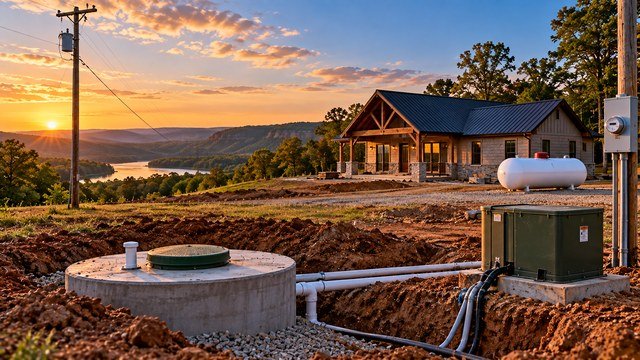
Easements can control where utilities are allowed to go
A legal right to drive to a parcel does not automatically establish a utility easement. Review recorded easements and title documents to determine whether electric, water and communications facilities can legally cross any intervening property.
If a new easement is required, solve that issue before paying for construction that depends on the route.
Utility timing can affect the entire construction schedule
Electric extensions, well drilling, septic approvals and broadband construction do not necessarily happen on the builder's preferred schedule. Weather, engineering, permitting, contractor availability and utility construction queues can all affect timing.
Sequence the work around dependencies. For example, the septic area should be protected during clearing, utility routes should be known before final grading, and the permanent service plan should be coordinated before expensive site finishes are installed.
Build a parcel-specific utility budget
Use separate line items for electric extension, customer electrical work, well drilling and equipment, septic evaluation and installation, public-water fees if applicable, propane, internet installation, trenching, clearing, driveway crossings, permits and contingency.
Avoid a single generic 'utilities' allowance. Itemized assumptions make it easier to compare two parcels and reveal which unknowns could materially change the project.
Compare raw acreage with partially improved land
A higher-priced parcel with a documented well, approved septic system, nearby electric service and verified internet can sometimes be less expensive to develop than cheaper raw land. Existing infrastructure still needs inspection and verification, but it has measurable value.
Compare properties on estimated build-ready cost rather than purchase price alone.
Related: Arkansas raw land development cost guide · Arkansas septic system cost guide
Arkansas rural utility due-diligence checklist
Before closing, identify the electric provider and request extension information, verify water strategy, evaluate septic feasibility, map the home and utility corridor, review access and easements, check address-level broadband, test cellular coverage and collect written estimates for the largest unknowns.
Keep the utility findings with the survey, title work and development budget. The goal is not perfect certainty. It is to replace major assumptions with enough property-specific information to make a rational land decision.
Sources & methodology
Where this information comes from
Cost figures are planning references rather than contractor quotes. Permitting, system-selection, and location-specific guidance should be verified with the appropriate local authority or qualified professional. AcreageReady uses source-backed, AI-assisted editorial workflows and remains responsible for the material it publishes. Read how we research, edit, and correct guides.
- Arkansas Public Service Commission - Electric Utilities
- Code of Arkansas Rules - 23 CAR § 463-302 Extension of Facilities
- Code of Arkansas Rules - 23 CAR § 455-303 Extension of Service
- Arkansas Department of Health - Onsite Wastewater
- Arkansas Department of Health - Onsite Wastewater FAQs
- Code of Arkansas Rules - Arkansas Water Well Construction Rules
- Arkansas State Broadband Office
- FCC - How to Use the National Broadband Map
Common questions
Frequently asked questions
How do I know which electric company serves rural land in Arkansas?
Confirm the service territory for the exact parcel with the utility. A neighboring meter can be a clue, but it is not a substitute for provider confirmation.
Does a power line at the road mean electricity will be cheap to connect?
No. The utility may need an extension, transformer, engineering work, easements or customer-funded construction. Request a property-specific service evaluation.
Can I drill a private well anywhere on Arkansas acreage?
Well placement must comply with Arkansas construction requirements and should be coordinated with contamination sources and the septic plan. Use an appropriately authorized water-well contractor.
How far should an Arkansas septic system be from a water well?
Arkansas Department of Health's onsite wastewater FAQ identifies a 100-foot setback from water wells when discussing space required for a sewage system. Confirm the current site-specific requirements during design.
Does ten acres automatically exempt an Arkansas property from septic permitting?
No. ADH describes a limited exemption for a single residence on ten or more acres only when all parts of the sewage system are more than 200 feet from every property line, including roads. Other state requirements still apply.
Should I choose public water or a private well?
Compare actual availability and complete installed costs. Public water may require a tap or extension, while a well budget should include drilling, casing, pump equipment, electrical work, trenching, testing and possible treatment.
How can I check internet on undeveloped Arkansas land?
Use the Arkansas State Broadband Office and FCC broadband maps as starting points, then verify the exact location directly with providers. Provider-reported availability does not guarantee actual performance.
Is satellite internet enough for rural acreage?
It can be a practical option for many remote properties, but compare service characteristics, equipment needs and sky exposure with any available wired or fixed-wireless options.
What utilities should I price before buying Arkansas acreage?
At minimum, investigate electricity, water, wastewater, internet and any planned propane or backup-power infrastructure. Include trenching, clearing, easements and customer-owned equipment where applicable.
What is the best way to compare two rural Arkansas parcels?
Compare estimated build-ready cost. Add purchase price to the likely cost of access, site work and utilities, then account for the uncertainty remaining in each major item.
Ready to talk with a local professional?
Share your location and project details so AcreageReady can identify relevant providers as the network grows.
Get a free quote