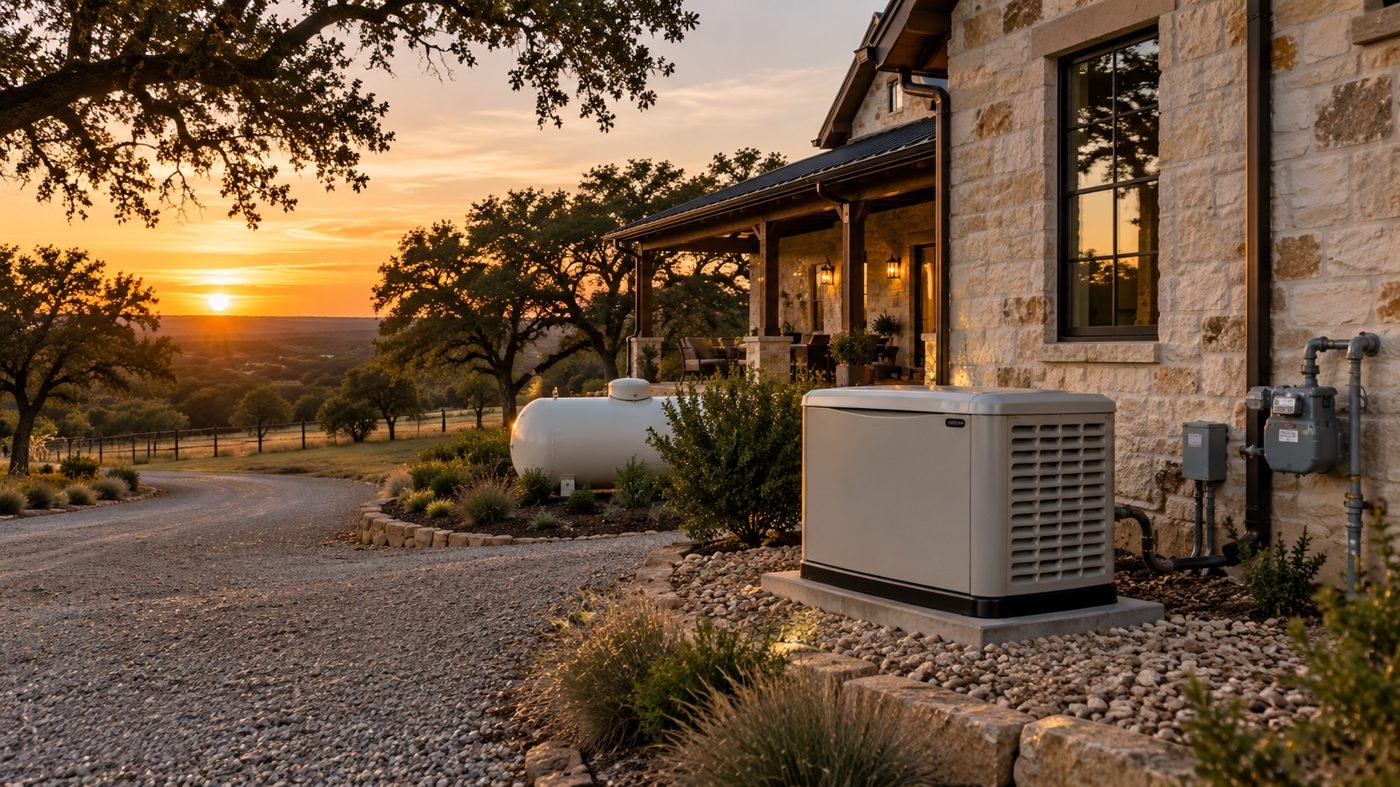
The best fuel is the one your property can actually rely on
For a rural property, the propane-versus-natural-gas decision is less about which fuel is universally better and more about which one is dependable at your specific site. Natural gas can be convenient when a properly sized utility line already serves the property. Propane is often attractive on acreage because the fuel is stored on site and does not depend on a buried gas main reaching the home.
Both fuels can power modern automatic standby generators, and many residential models are designed to operate on either liquid propane or natural gas. The right choice depends on fuel access, generator size, expected outage duration, available storage, site layout, and whether other appliances already use the same fuel.
Natural gas offers continuous utility-supplied fuel when service is available
A natural-gas standby generator connects to the home's gas service, so there is no separate fuel tank to refill during normal operation. For a property with reliable gas service and enough meter and pipe capacity, that can simplify long outages because the generator can continue operating without waiting for a propane delivery.
The limitation is availability. Many rural parcels do not have natural-gas mains nearby, and extending gas service can be impractical or impossible. Even where gas is available, the meter, regulator, and piping still have to support the generator's demand in addition to furnaces, water heaters, ranges, pool equipment, and other gas appliances.
Propane gives rural properties their own stored fuel supply
Propane is stored in a tank on the property, which gives the owner a dedicated energy reserve. The Propane Education & Research Council highlights on-site fuel storage as one of propane standby power's main resilience advantages because generator operation does not depend on real-time fuel delivery through a utility gas network.
That independence matters on acreage where natural-gas service is unavailable. It also makes the amount of backup energy visible: the owner can monitor the tank and decide how much reserve to maintain before severe-weather seasons.
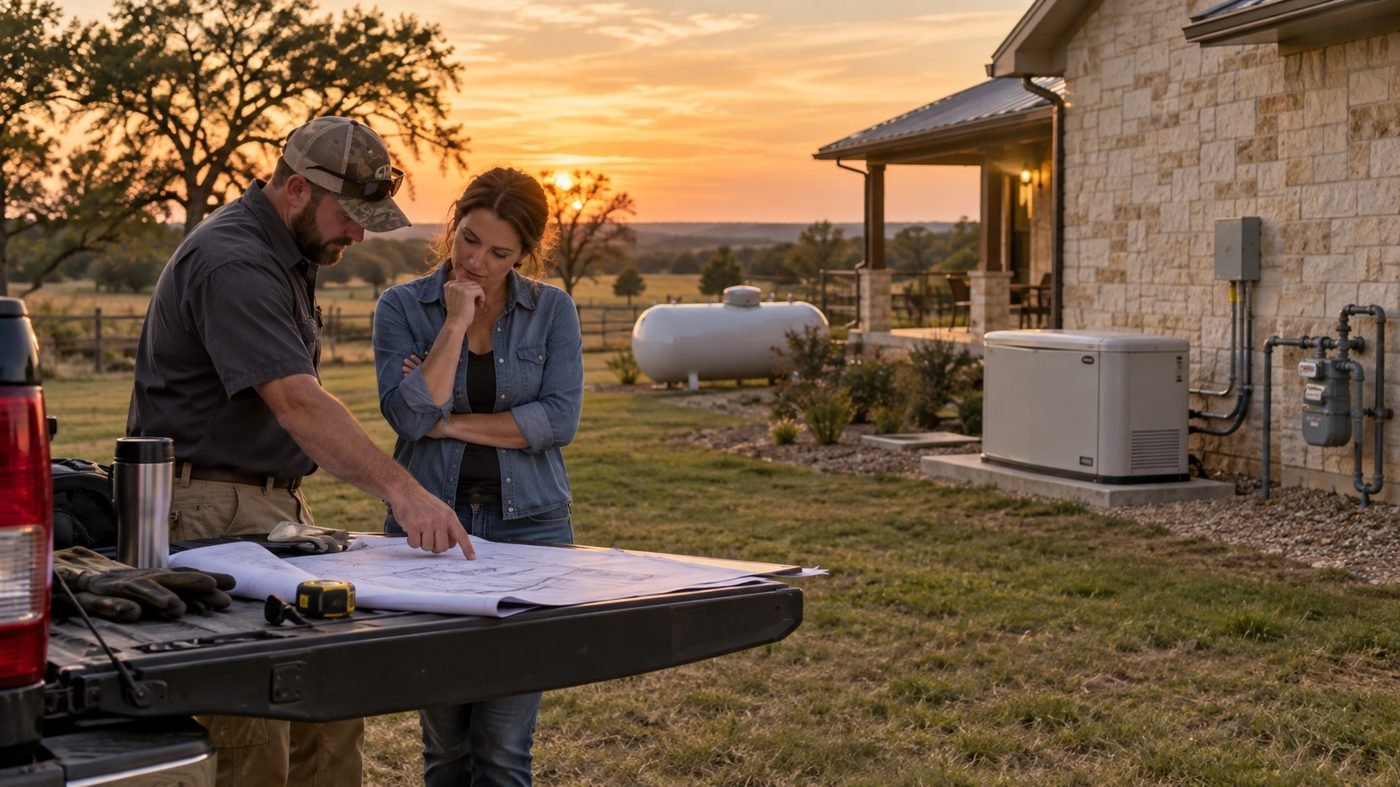
Many dual-fuel generators produce more power on propane
Do not assume a generator has the same electrical rating on both fuels. Current manufacturer specifications show that some standby models are rated higher on liquid propane than on natural gas.
For example, Champion's current 26 kW whole-house model is rated at 26,000 watts on propane and 23,400 watts on natural gas. Generac's current 28 kW model is rated at 28 kW on propane and 25 kW on natural gas. The difference varies by model, so compare the exact LP and NG ratings before sizing the system.
- Compare the manufacturer's propane kW rating
- Compare the natural-gas kW rating separately
- Confirm the generator can start the home's largest motor loads on the selected fuel
- Do not size from the model name alone
Fuel consumption determines how long a propane tank will last
Propane runtime is not determined by generator size alone. Fuel use changes with electrical load, engine design, weather, and model. Manufacturer fuel-consumption tables are the best starting point for estimating runtime.
Champion's current 26 kW standby generator lists propane consumption of about 2.39 gallons per hour at half load and 3.95 gallons per hour at full load. Generac's current 28 kW unit lists about 2.23 gallons per hour at half load and 3.97 gallons per hour at full load.
Real outages rarely hold a generator at one exact load for every hour, so tank-runtime estimates should be treated as planning ranges rather than guarantees.
A 500-gallon propane tank does not contain 500 usable gallons
Propane tanks are not normally filled completely with liquid. Space is left for propane expansion, so the usable fuel volume is less than the tank's nominal water capacity. Your propane supplier should provide the actual fill level and usable-gallon assumptions for the installed tank.
For generator planning, calculate runtime from usable gallons rather than the tank nameplate. Then leave an operating reserve instead of planning to run the tank to empty.
Think in days of outage, not just gallons per hour
A rural backup-power plan should answer a practical question: how long do you want the property to operate before fuel delivery becomes necessary? A generator that burns 2.5 gallons per hour would consume about 60 gallons over 24 hours if it stayed at that rate continuously. At 4 gallons per hour, the same 24-hour period would consume about 96 gallons.
Actual consumption will rise and fall with load, but those examples show why large whole-home generators can use a substantial amount of propane during multi-day outages. Load management, thermostat settings, and choosing essential circuits can materially extend stored-fuel runtime.
Natural-gas generators still require proper fuel sizing
Natural gas may feel unlimited because there is no tank on the property, but the generator still requires a specific gas pressure and flow rate. Undersized piping, a small meter, excessive distance, or too many simultaneous appliances can prevent the engine from receiving the fuel it needs.
Current Generac specifications illustrate the scale of the demand. Its 28 kW standby generator lists natural-gas consumption around 182 cubic feet per hour at half load and 297 cubic feet per hour at full load. The gas utility and installer should verify the available service and pipe sizing before the generator is selected.
Propane can serve the rest of the rural property too
A propane tank installed for a generator can also supply other properly designed propane appliances. Rural homeowners may use propane for space heating, water heating, cooking, fireplaces, pool heating, or shop equipment.
Using propane for major heating loads can also reduce the electrical load the generator must carry. PERC notes that shifting key building loads from electricity to propane can allow a smaller standby generator in some designs.
Fuel storage changes the site plan
A propane system needs an approved tank location, regulator arrangement, delivery access, and piping route to the generator and other appliances. Tank placement must account for applicable clearances, grading, drainage, vehicle protection, and the ability of a delivery truck to reach the fill point.
Natural gas removes the storage tank from the site plan, but it replaces that issue with utility-service location, meter capacity, regulator requirements, and gas-piping design.
Long rural outages can favor different strategies on different properties
A property with dependable natural-gas service may benefit from not having to manage stored generator fuel. A property without gas service may find propane far more practical because the owner can keep a substantial energy reserve on site.
Neither fuel eliminates outage planning. Propane owners need a refill strategy and enough storage. Natural-gas users should understand that generator operation still depends on the gas distribution system remaining available and delivering the required pressure and flow.
Compare installation cost as a complete system
Do not compare only the generator price. A propane installation may require a tank, pad, regulators, underground or above-ground gas piping, trenching, and delivery access. A natural-gas installation may require a meter upgrade, regulator changes, larger piping, trenching, or utility coordination.
The electrical side is similar for both fuels: generator pad, transfer switch, service modifications, load-management controls, permits, wiring, commissioning, and maintenance all belong in the project budget.
- Generator and transfer switch
- Electrical installation and permits
- Fuel piping
- Propane tank and regulators, if applicable
- Natural-gas meter or service upgrades, if applicable
- Trenching and restoration
- Load-management equipment
- Startup, testing, and maintenance
Propane vs. natural gas: a practical rural-property comparison
Natural gas is usually easiest to live with when the property already has adequate utility gas service. Propane is often the more flexible acreage option because it can be installed where no gas main exists and keeps the fuel supply physically on the property.
Generator output can also tilt the decision. Some dual-fuel standby models make more rated power on propane, so a system that barely meets the home's load on LP may not provide the same margin when switched to natural gas.
- Natural gas: no on-site tank and no routine generator-fuel deliveries
- Natural gas: requires an available and adequately sized utility service
- Propane: works on properties without natural-gas mains
- Propane: provides visible, on-site stored energy
- Propane: requires tank space, delivery access, and refill planning
- Either fuel: verify exact generator output and consumption using the selected model's specifications
Questions to ask before choosing the fuel
The generator installer, propane supplier, gas utility, and electrician may each control a different part of the project. Resolve the fuel plan before the generator size and site layout are finalized.
- Does the property have natural-gas service now?
- Can the existing gas meter and piping support the generator at full demand?
- What is the generator's rated output on propane versus natural gas?
- What is the fuel consumption at half load and full load?
- How many days of propane runtime do I want stored on site?
- What propane tank size and location are practical?
- Can the tank also serve heating, water heating, or cooking?
- Can a fuel truck reach the tank during wet or winter conditions?
- What transfer switch and load-management equipment are included?
- What maintenance and exercise schedule does the manufacturer require?
Keep researching
Rural Power resources
Generators, solar, batteries, electrical planning, and backup power for acreage properties.
Sources & methodology
Where this information comes from
Cost figures are planning references rather than contractor quotes. Permitting, system-selection, and location-specific guidance should be verified with the appropriate local authority or qualified professional. AcreageReady uses source-backed, AI-assisted editorial workflows and remains responsible for the material it publishes. Read how we research, edit, and correct guides.
Common questions
Frequently asked questions
Is propane or natural gas better for a whole-house generator?
Neither is always better. Natural gas can be convenient when adequate utility service already reaches the property. Propane is often more flexible for rural acreage because the fuel can be stored on site where no natural-gas main is available.
Do generators make more power on propane than natural gas?
Some do. Current dual-fuel standby models from Champion and Generac show higher rated output on propane than natural gas. Check the exact ratings for the model you are considering rather than assuming the output is identical.
How much propane does a whole-house generator use?
Consumption depends on generator size and load. Current 26 to 28 kW residential standby examples list roughly 2.2 to 2.4 gallons per hour around half load and close to 4 gallons per hour at full load. Use the selected manufacturer's fuel table for planning.
How long will a 500-gallon propane tank run a generator?
Runtime depends on usable gallons in the tank and the generator's actual fuel consumption. A nominal 500-gallon tank is not operated as 500 gallons of usable liquid fuel, and generator demand varies by load. Ask the propane supplier for usable capacity and combine it with the manufacturer's gallons-per-hour data.
Can I switch a standby generator from propane to natural gas later?
Many residential standby generators are designed for either LP or natural gas, but conversion procedures, regulator settings, fuel-system configuration, and rated output vary by model. Have the installer follow the manufacturer's instructions.
Is propane a good choice for rural property?
It can be, especially when natural-gas service does not reach the property. Propane allows fuel to be stored on site and can also serve other home systems, but the owner must plan tank placement, deliveries, and outage runtime.
Ready to talk with a local professional?
Share your location and project details so AcreageReady can identify relevant providers as the network grows.
Get a free quote