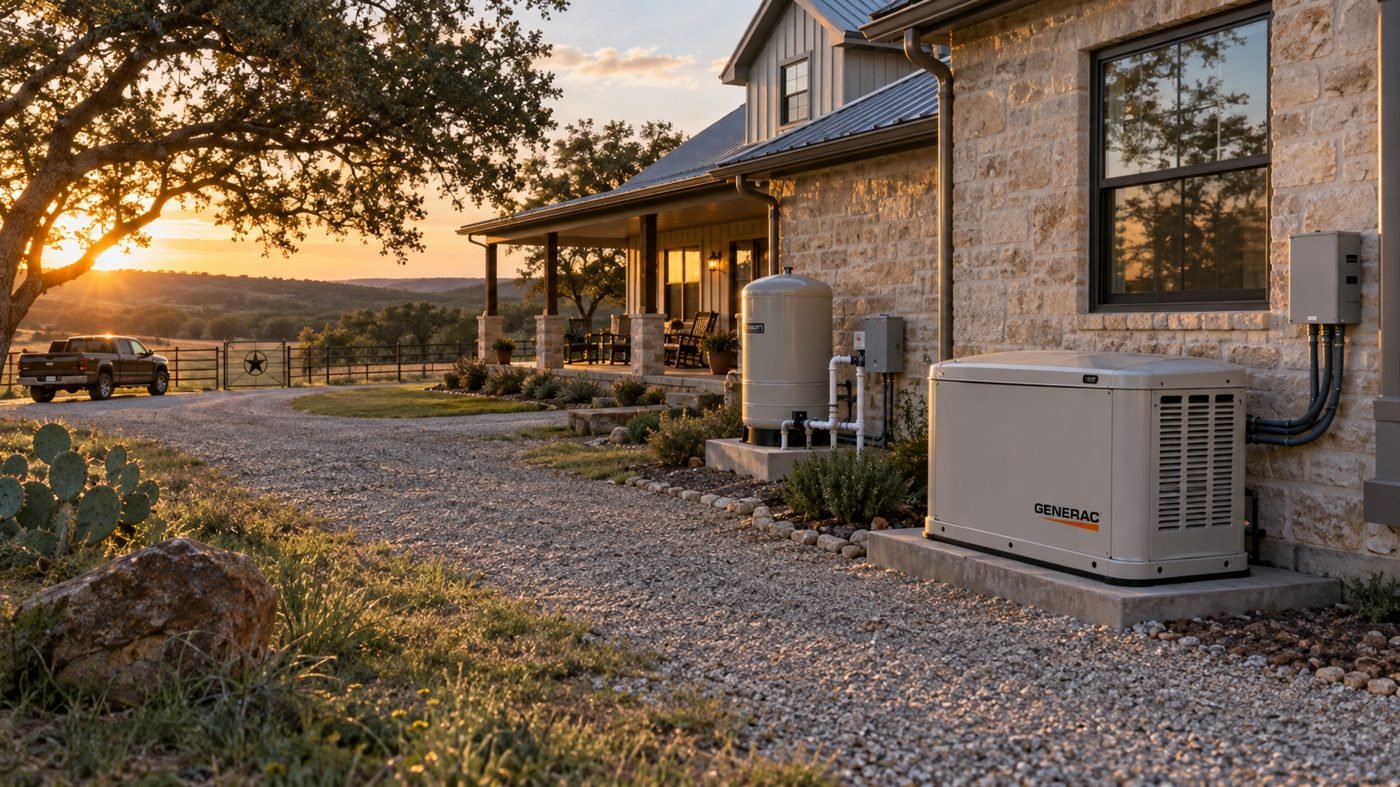
The well pump is often the load that changes the generator calculation
A rural home can look modest on a generator worksheet until the well pump is added. Pumps are motor loads, and motors can require substantially more power for a few seconds at startup than they use once they are running.
That means a generator that can comfortably run lights, a refrigerator, internet equipment, and a few outlets may still struggle or trip when the well pump starts. Generator sizing for acreage should account for both the steady running load and the largest motor-starting surge you expect the system to handle.
Start with the pump nameplate, not a generic horsepower estimate
The most useful information is on the pump motor, control box, electrical panel schedule, or installation paperwork. Record the pump horsepower, voltage, phase, full-load amperage, and any locked-rotor, starting-current, or surge information available from the manufacturer.
Many residential submersible well pumps use 230- or 240-volt single-phase motors. If your pump requires 240 volts, the generator and transfer setup must be able to supply the correct voltage. A 120-volt-only portable generator cannot directly serve a 240-volt well pump.
- Pump horsepower
- Required voltage
- Single-phase or three-phase
- Running or full-load amps
- Starting current, locked-rotor amps, or manufacturer surge data
- Control-box model if the pump uses one
Typical well-pump wattage ranges are only a starting point
Current generator reference data from Champion lists a 1/2-horsepower well pump at roughly 750 to 1,000 running watts and about 1,500 to 2,000 starting watts. A 1-horsepower well pump is listed around 1,000 to 2,000 running watts and roughly 2,000 to 4,000 starting watts.
Those ranges are useful for screening, but they are not a substitute for the actual pump data. Pump design, depth, controls, voltage, motor efficiency, pressure settings, and system conditions can all change the electrical demand.
- 1/2 HP example: about 750 to 1,000 running watts and 1,500 to 2,000 starting watts
- 1 HP example: about 1,000 to 2,000 running watts and 2,000 to 4,000 starting watts
- Use the actual motor or pump documentation whenever available
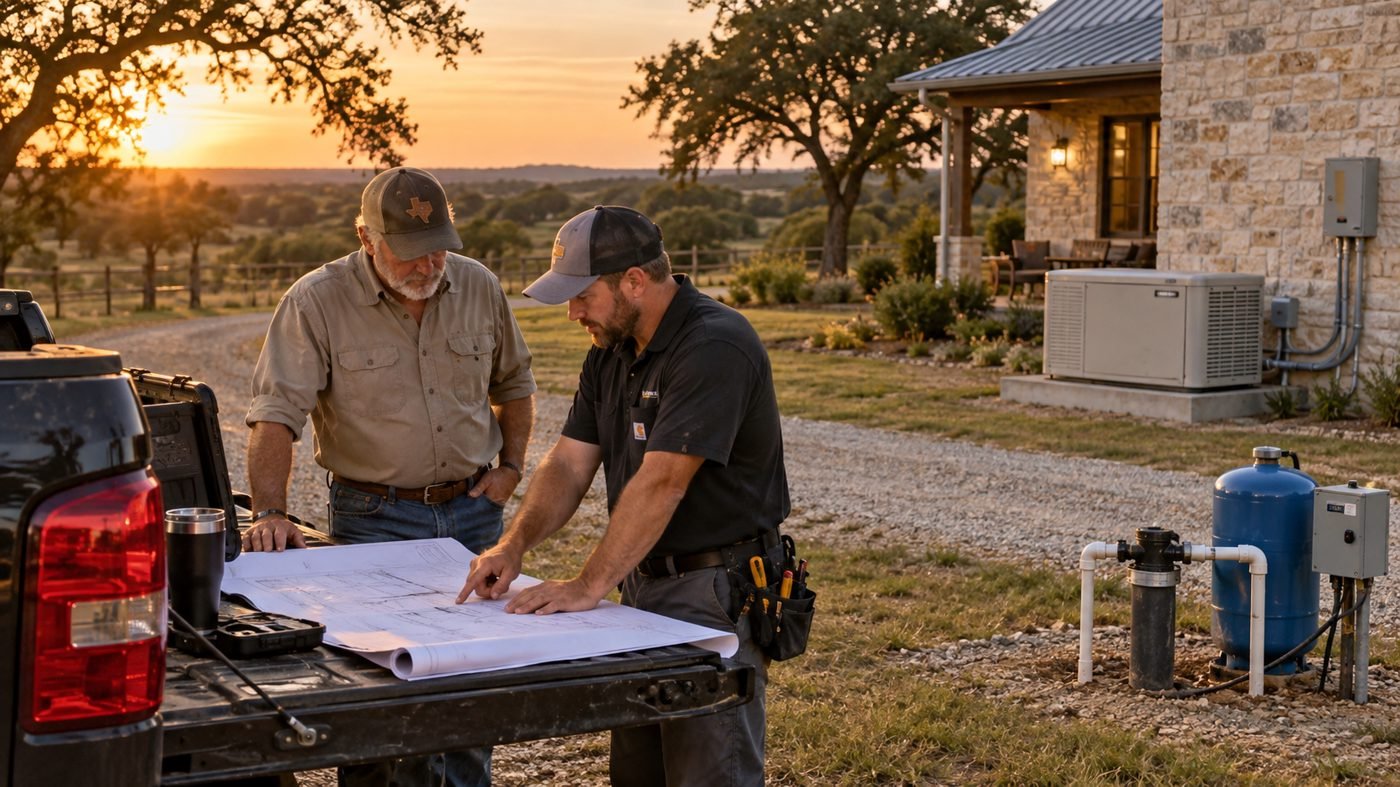
Running watts and starting watts are different calculations
Running watts represent the power needed after equipment is already operating. Starting watts are the short surge required to start motors and compressors.
Cummins recommends adding the running watts for the loads you plan to power, then accounting for the single largest starting load rather than simply adding every appliance's starting surge together. That reflects a more realistic scenario where the generator is already carrying normal loads when one major motor starts.
A simple sizing method for a rural house
First, list the loads that must operate during an outage. Add their running wattage. Then identify the largest motor-starting requirement among the well pump, air conditioner, heat pump, refrigerator, freezer, sump pump, or other motor loads.
Add that largest starting requirement to the running-load total and leave reasonable capacity for uncertainty and future loads. Cummins recommends multiplying the rough result by at least 1.25 as a safety and expansion margin when sizing a standby generator.
- Step 1: total the running watts of the loads you want available
- Step 2: identify the largest single motor-starting requirement
- Step 3: add that starting requirement to the running-load total
- Step 4: add margin rather than sizing the generator exactly to the calculated minimum
- Step 5: verify the final design with the generator manufacturer, electrician, and pump data
Example: essential rural-home loads with a 1 HP well pump
Consider a property where the owner wants the well pump, refrigerator, freezer, lights, internet, a few receptacles, and basic furnace controls during an outage. If those steady loads total roughly 3,000 watts and the well pump can require up to about 4,000 watts during startup, the generator must be able to carry the existing loads while also absorbing the pump's startup surge.
This is why a generator should not be selected from running watts alone. A model rated only slightly above the home's steady demand may still be too small when the pump starts.
Air conditioning can be a bigger starting load than the well pump
On many Texas properties, central air conditioning becomes the largest generator-sizing challenge. Champion's current reference chart places a 3-ton central air conditioner around 3,000 to 3,500 running watts and roughly 5,000 to 6,000 starting watts, while a 4-ton unit can be around 4,000 to 5,000 running watts and 6,500 to 8,000 starting watts.
If the generator is expected to start the air conditioner and the well pump, load sequencing becomes important. An electrician or generator installer may use load-management controls so the largest motors do not start at the same time.
Electric heat, water heating, dryers, and ranges can quickly push you toward a larger system
Resistance-heating loads do not usually have the same motor-starting surge, but they consume a large amount of steady power. Electric water heaters, clothes dryers, ranges, electric furnaces, and auxiliary heat strips can dramatically increase the generator size required for whole-home operation.
A rural home that uses propane for space heating, water heating, and cooking may have a much smaller electrical backup requirement than an otherwise similar all-electric house.
Portable generator vs. standby generator
A portable generator can be a practical solution when the goal is to power selected essential circuits during occasional outages. The system still needs a safe transfer method, and the generator must provide the voltage and surge capacity required by the well pump.
A permanently installed standby generator is designed for automatic operation and can be paired with an automatic transfer switch and load-management equipment. Champion currently describes home standby products in roughly the 8.5 kW to 26 kW range, which covers many residential backup scenarios, but the correct size still depends on the actual load calculation.
Do not backfeed a house through an outlet
A generator should connect to the home's electrical system through equipment designed for that purpose. Transfer switches, interlocks, inlet equipment, grounding and bonding details, conductor sizing, and overcurrent protection should be selected and installed for the specific system.
Improvised backfeeding can energize utility lines, expose workers and neighbors to dangerous voltage, damage equipment, and create fire or shock hazards. Have a licensed electrician design or verify the connection method.
The well system may need more than the pump itself
Depending on the property, backup power may also need to support pressure controls, booster pumps, storage-tank pumps, treatment equipment, freeze protection, or a well-house heater. A well with a cistern or storage tank can have a different electrical profile than a direct-pressure system.
List the entire water system, not only the submersible motor, before finalizing the generator size.
Plan around what you actually need during a long outage
Whole-home backup is convenient, but it is not always the most cost-effective target. Many acreage owners can reduce generator size by prioritizing water, refrigeration, communications, lighting, selected HVAC, septic controls, and a limited number of receptacles.
An essential-load strategy can also make fuel last longer during extended outages. On the other hand, properties with medical equipment, livestock systems, large pumps, gates, shops, or critical climate-control requirements may justify a larger automatic system.
- Well pump and pressure equipment
- Refrigerator and freezer
- Septic pumps or controls
- Internet, phones, and security
- Heating or selected air conditioning
- Medical equipment
- Gate, barn, livestock, or water-system loads that cannot remain off
Questions to answer before buying a generator
Generator sizing is much easier when the electrical loads and priorities are documented before shopping. Bring the pump information, panel information, and outage priorities to the electrician or generator installer.
- What horsepower and voltage is the well pump?
- What are its actual running and starting requirements?
- Does the generator provide 120/240-volt output if the pump requires 240 volts?
- Which loads must operate at the same time?
- Will central air conditioning or a heat pump be included?
- Are there electric water heaters, dryers, ranges, or heat strips?
- Will load-management controls be used?
- Is the goal essential-load backup or whole-home backup?
- What transfer equipment is required?
- How much future load should be reserved for a shop, guest house, larger pump, or other expansion?
Keep researching
Rural Power resources
Generators, solar, batteries, electrical planning, and backup power for acreage properties.
Sources & methodology
Where this information comes from
Cost figures are planning references rather than contractor quotes. Permitting, system-selection, and location-specific guidance should be verified with the appropriate local authority or qualified professional. AcreageReady uses source-backed, AI-assisted editorial workflows and remains responsible for the material it publishes. Read how we research, edit, and correct guides.
Common questions
Frequently asked questions
What size generator do I need for a house with a well pump?
It depends on the pump and the other loads you want to run. Start with the pump's actual voltage, running load, and starting requirement, add the home's simultaneous running loads, account for the largest motor-starting surge, and leave additional capacity rather than sizing exactly to the minimum.
Can a 5,000-watt generator run a well pump?
Sometimes, but not universally. A 1 HP well pump can have a starting requirement in the range of several thousand watts, and the generator must also carry whatever other loads are already running. Check the pump data and the generator's continuous and surge ratings.
Can a portable generator run a 240-volt well pump?
Yes, if the generator provides the required 120/240-volt output, has enough starting capacity, and is connected through properly designed transfer equipment. A 120-volt-only generator cannot directly power a 240-volt pump.
Is a 10,000-watt generator enough for a house with a well?
It may be enough for many essential-load setups and some larger combinations, but the answer depends on the well pump, air conditioning, heating, water heating, and other simultaneous loads. Calculate the actual running and starting requirements before choosing a size.
Why does my generator bog down when the well pump starts?
The pump motor may be demanding a startup surge that exceeds the generator's available starting capacity, especially when other loads are already operating. Voltage drop, wiring, generator condition, and pump-system issues can also contribute.
Should I size the generator for the well pump or the air conditioner?
Size around the complete load plan. The largest starting load may be the well pump, but on many Texas homes the central air conditioner has the larger starting requirement. Load-management controls can prevent major motor loads from starting simultaneously.
Ready to talk with a local professional?
Share your location and project details so AcreageReady can identify relevant providers as the network grows.
Get a free quote