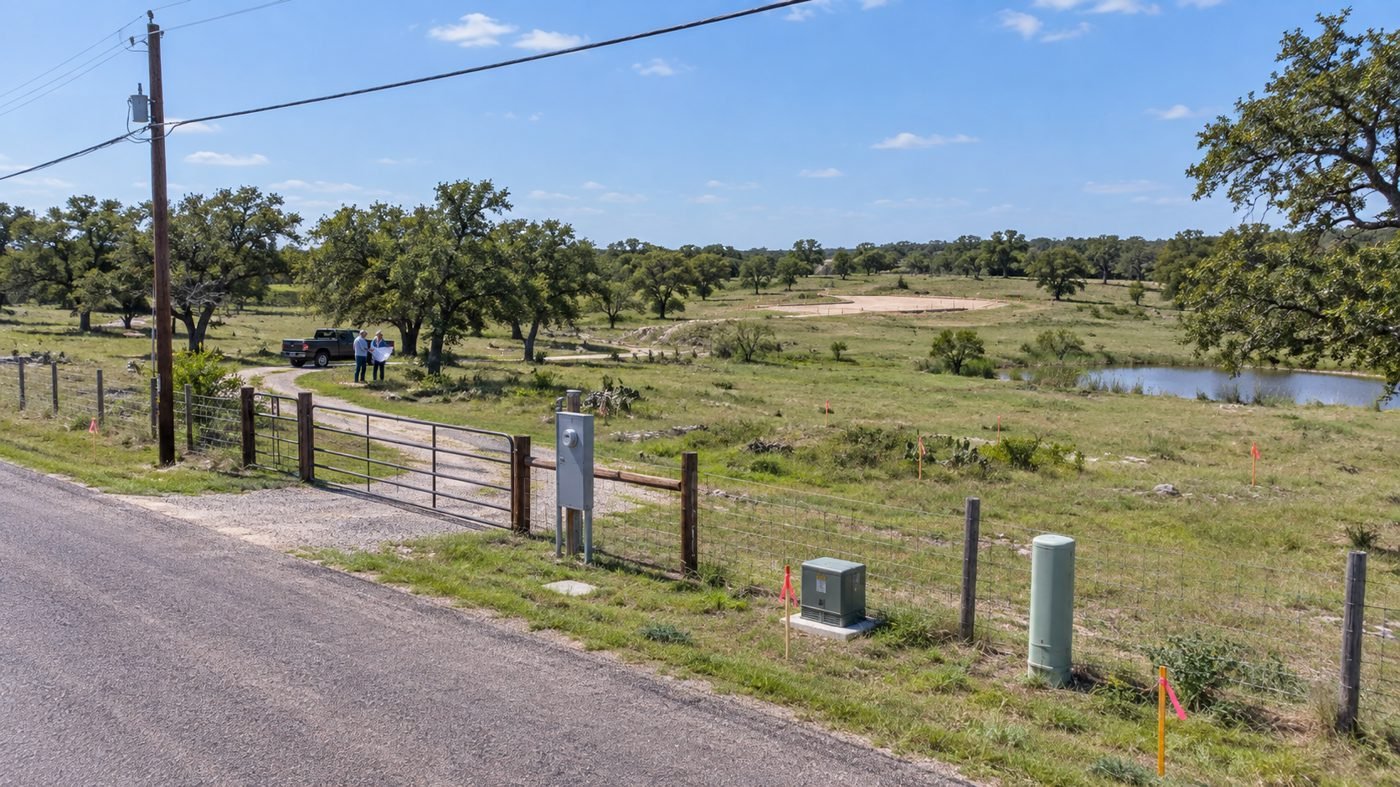
Check utilities before you fall in love with the acreage
A rural property can look perfect on a map and still become difficult or expensive to develop if the basic utilities do not work for the homesite you have in mind.
The biggest mistake is treating a listing phrase such as 'utilities available' as proof that electricity, water, wastewater, and internet are already practical for the parcel. In rural areas, a service may exist somewhere nearby while the owner is still responsible for a long extension, new equipment, trenching, easements, testing, or an entirely different system.
Before the purchase deadline, verify each utility independently and tie the answer to the exact parcel, proposed driveway, and likely homesite.
Start with a utility due-diligence map
Before calling providers, mark the road frontage, proposed driveway, likely house location, possible shop or barn location, septic area, well area, and any visible utility lines or easements.
Distance matters. A service at the road can be inexpensive for a homesite near the frontage and much more involved for a house several hundred or several thousand feet into the acreage.
A simple site sketch also helps you spot conflicts early, such as a septic area occupying the best building site or an electrical route crossing a future pond, gate, or shop.
- Property boundaries and road frontage
- Likely driveway and homesite
- Existing power poles, meters, or transformers
- Known water lines or existing wells
- Existing septic components or likely disposal area
- Utility and access easements
- Creeks, flood-prone areas, steep slopes, and rock
- Future shop, barn, guest house, pool, gate, or RV area
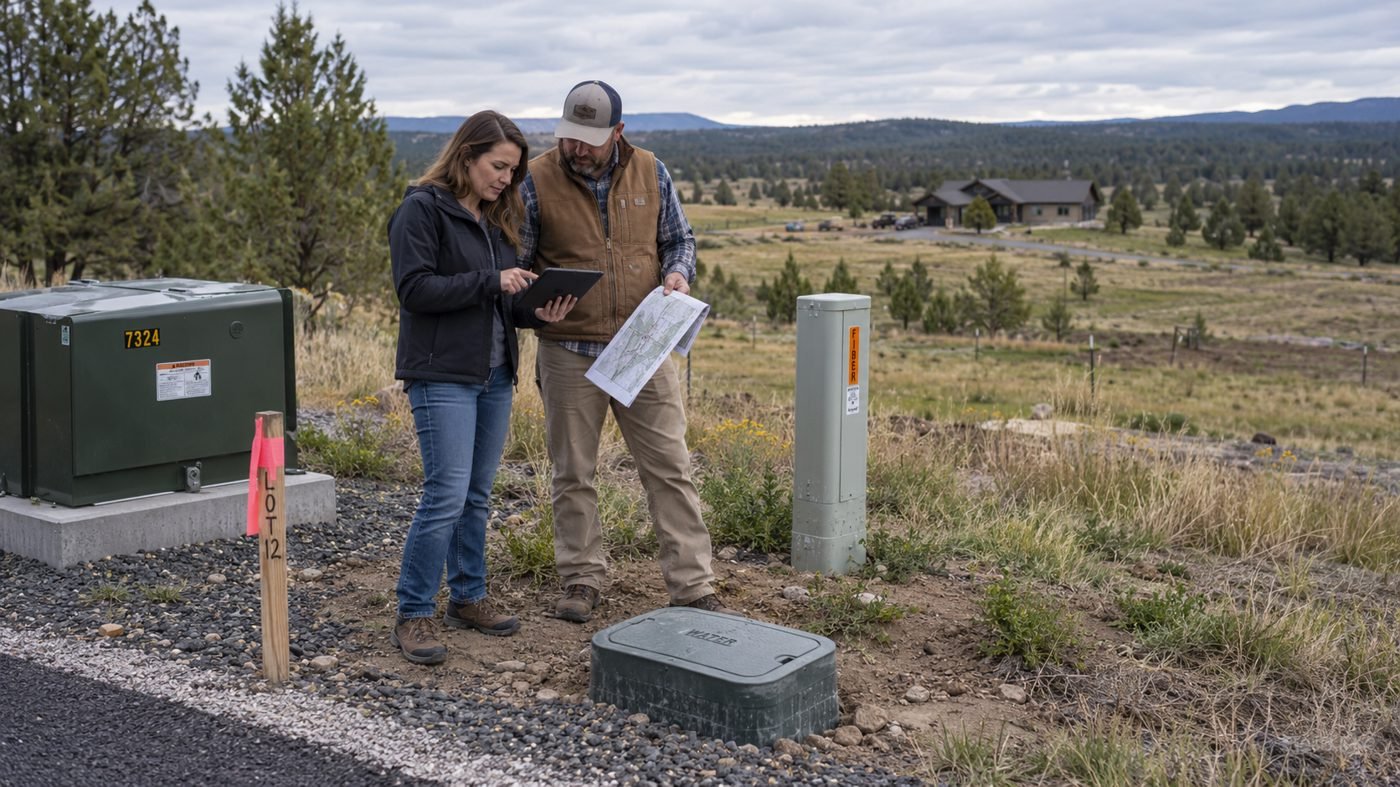
1. Electricity: identify the serving utility and the real point of connection
Electricity is usually the first utility to verify because the serving utility controls where it can connect, whether new poles or underground facilities are required, where the meter can be placed, and whether a transformer or line extension is needed.
Do not stop at seeing a power pole near the property. Ask the utility whether that specific facility can serve the parcel and whether enough capacity exists for the planned house, well pump, HVAC, shop, gate, RV connection, pool equipment, and future structures.
Also ask where the utility's responsibility ends. A meter near the road can leave the landowner responsible for a long customer-owned run to the homesite.
- Which utility or electric cooperative serves the parcel?
- Where is the nearest usable distribution line?
- Is sufficient capacity available for the planned load?
- Will a transformer or line extension be required?
- Can service be overhead, underground, or either?
- Where will the meter and point of delivery be located?
- What easements, clearing, trenching, or conduit are required?
- Can the utility provide a written planning estimate before closing?
2. Water: determine whether you have public water, a private well, or neither
Rural properties may be served by a municipal system, a special utility district, a rural water supply corporation, a private well, or no existing water source at all.
If a public or rural water line is nearby, confirm that the provider will actually issue a new connection for the parcel. Ask about meter availability, tap or impact fees, line-extension requirements, pressure, meter location, and whether additional easements are needed.
If the property depends on a private well, review nearby well records and local groundwater conditions before assuming that drilling will produce the quantity and quality you need.
Private-well due diligence in Texas
The Texas Water Development Board recommends that buyers of property with a private well locate the well report when possible and understand the local groundwater rules. In Texas, private well registration requirements can vary when a property is inside a groundwater conservation district.
Texas also requires water-well drilling and pump installation work to be performed under the state's licensing rules. Local ordinances or groundwater districts may add permitting or registration requirements even when there is no statewide site permit for a typical private well.
For an existing well, obtain the well report, test water quality, confirm the pump and pressure system operate correctly, and ask about the well's age, depth, production history, and maintenance.
- Locate the State of Texas Water Well Report if one exists
- Check whether the parcel is inside a groundwater conservation district
- Test water quality rather than relying on appearance or taste
- Inspect the pump, pressure tank, wiring, casing, and wellhead
- Ask about depth, yield, age, repairs, and periods of low production
- For vacant land, get local drilling input before budgeting a new well
3. Septic or sewer: verify what the property can legally support
Many rural parcels are outside public sewer systems and require an onsite wastewater system. That makes septic feasibility a land-use question, not simply a future contractor expense.
Soil, lot size, setbacks, slope, drainage, groundwater conditions, bedroom count, and local rules can influence the type and location of an onsite system.
If a septic system already exists, do not assume it is functional or properly permitted. EPA guidance for homebuyers emphasizes having an existing septic system inspected before purchase.
- Is public sewer actually available to this parcel?
- If not, what local authority regulates onsite wastewater?
- Is there enough suitable area for the primary disposal field and any required replacement area?
- Where are the setbacks from wells, structures, property lines, water features, and easements?
- Does an existing septic system have permits, plans, maintenance records, and inspection history?
- Will the intended bedroom count or future guest house change the system requirements?
4. Internet: verify the exact address, not the ZIP code
Rural broadband availability can change from one road or even one address to the next. The FCC National Broadband Map lets buyers search a location and review provider-reported fixed and mobile broadband availability, technologies, and advertised speeds.
Use the map as a starting point, then call the provider with the exact parcel or service address. The FCC notes that the map reports availability, not actual network performance, affordability, or adoption.
For vacant land without a recognized address, ask the county or addressing authority how a service location will be established and contact providers directly to determine whether construction is required.
- Fiber
- Cable
- DSL
- Fixed wireless
- Satellite
- Mobile broadband
5. Cellular coverage: test it on the property
Carrier maps are useful for screening, but rural terrain, trees, metal buildings, hills, and distance from a tower can change real-world service.
Walk or drive the property with the phones and carriers your household actually uses. Test calls and data near the road, proposed homesite, low areas, and any place where you expect to work.
If cellular service is important for remote work, security cameras, gates, equipment monitoring, or backup internet, test before closing instead of assuming a booster will solve every coverage problem.
6. Propane and natural gas: confirm what is realistic
Many rural homes use propane because natural-gas distribution does not reach the property. If a listing mentions gas, identify the provider and confirm whether it means a true natural-gas line or simply that propane service is common in the area.
For propane, determine where a tank and delivery truck can safely access the property. The driveway, gates, overhead clearances, tank location, and planned landscaping can all affect installation and delivery.
If you plan to use propane for heating, cooking, a generator, pool equipment, or a shop, size and placement should be considered during the site-planning stage.
7. Easements can matter as much as the utility itself
A utility route may require a recorded easement across your parcel, and an existing easement may restrict where you can place a home, shop, fence, pond, trees, or other improvements.
Review the title commitment, survey, plats, and recorded documents rather than relying only on what is visible on the ground.
Also determine whether the shortest utility route crosses neighboring property. If it does, the project may depend on rights you do not currently have.
8. Ask what happens when the homesite is far from the road
Long rural driveways are appealing, but distance can multiply infrastructure cost. Electricity, water lines, private electrical feeders, communications conduit, propane delivery access, and future repair work all become more involved as the homesite moves deeper into the acreage.
Before selecting a homesite, compare at least two possible locations. A beautiful spot at the back of the property may still be worth it, but the decision should include the infrastructure cost instead of treating that cost as a surprise after closing.
9. Plan for the property you want five years from now
Utility planning should include more than the first house. Rural properties often add a shop, barn, RV pad, pool, guest house, gate, irrigation, livestock water, outdoor kitchen, or backup-power system later.
Tell the electric utility, well contractor, septic designer, and other providers about likely future loads and structures. Oversizing selected infrastructure or installing spare conduit during the first phase can be far cheaper than reopening finished driveways and landscaping later.
10. Get answers in writing before the option or due-diligence period ends
The strongest utility due diligence replaces assumptions with written information. Save emails, utility sketches, service estimates, well records, septic documents, broadband screenshots, and notes from provider calls.
If a utility cost or feasibility question could change whether you buy the property, resolve it before the contractual deadline whenever possible.
A verbal 'should be fine' is not the same as a utility confirming that it can serve the parcel under the conditions you expect.
A rural-land utility checklist you can use before closing
Use this checklist as a starting point for every undeveloped or partially developed parcel.
- Electric utility identified and parcel serviceability confirmed
- Nearest usable electric facility and meter location identified
- Line-extension, transformer, trenching, and easement requirements reviewed
- Public or rural water provider confirmed, or private-well feasibility investigated
- Existing well records and water-quality testing reviewed when applicable
- Public sewer availability confirmed, or septic feasibility investigated
- Existing septic permit, maintenance, and inspection records reviewed
- FCC broadband map checked and internet providers contacted directly
- Cellular service tested at the actual homesite
- Natural gas or propane plan confirmed
- Utility easements reviewed on survey and title documents
- Long-distance runs from road to homesite included in the budget
- Future shop, barn, guest house, gate, pool, RV, and backup-power needs considered
- Important estimates and provider answers saved in writing
The best rural land is not just buildable. It is serviceable.
Utilities are part of the land itself because they determine what the parcel can support and how much work is required before construction starts.
A cheaper piece of acreage can become the more expensive choice if it needs a major power extension, difficult well, engineered septic system, and costly broadband solution. A slightly more expensive parcel with straightforward infrastructure can sometimes be the better development site.
The goal is not to find land with every utility already installed. It is to understand the real path, cost, and constraints before you own the problem.
Keep researching
Acreage Planning resources
Due diligence, development sequencing, utilities, access, and the decisions that shape a rural property project.
Sources & methodology
Where this information comes from
Cost figures are planning references rather than contractor quotes. Permitting, system-selection, and location-specific guidance should be verified with the appropriate local authority or qualified professional. AcreageReady uses source-backed, AI-assisted editorial workflows and remains responsible for the material it publishes. Read how we research, edit, and correct guides.
- FCC: How to Use the National Broadband Map
- FCC: What's on the National Broadband Map
- EPA: New Homebuyer's Brochure and Guide to Septic Systems
- Texas Water Development Board: General Groundwater and Private Water Well FAQ
- Texas Department of Licensing and Regulation: Water Well Drillers and Pump Installers
- AcreageReady: How Much Does It Cost to Run Power to Rural Land in Texas? 2026 Guide
- AcreageReady: The Right Order for Developing Rural Land
Common questions
Frequently asked questions
What utilities should I check before buying rural land?
At minimum, verify electricity, water, sewer or septic, internet, cellular service, and any natural-gas or propane needs. Also review utility easements, the distance from the road to the homesite, and whether future structures will require additional capacity.
What does utilities available mean on a rural land listing?
It can mean only that a utility exists somewhere near the property. It does not guarantee a meter, connection, capacity, affordable extension, or service at your planned homesite. Verify each utility directly with the provider.
How do I check internet before buying rural property?
Start with the FCC National Broadband Map for the exact location, then contact the listed providers directly. The FCC map reports provider-submitted availability, while actual performance and construction requirements still need to be verified.
Should I test a private well before buying rural property?
Yes. Review the available well report, test water quality, inspect the well and pump system, and understand local groundwater-district requirements. For vacant land without a well, research nearby wells and consult local licensed drillers before setting a budget.
Should a septic system be inspected before buying?
Yes. EPA guidance for homebuyers recommends inspecting an existing septic system before purchase. Also review permits, maintenance records, system location, and whether the system is appropriate for the intended use of the property.
Why does homesite location affect utility cost?
A house farther from the road may require longer electrical, water, communications, and access runs. Distance can add trenching, conductor, pipe, conduit, equipment, easements, and future maintenance cost.
Ready to talk with a local professional?
Share your location and project details so AcreageReady can identify relevant providers as the network grows.
Get a free quote