The property usually decides which septic system makes sense
For Texas acreage, the choice between a conventional septic system and an aerobic treatment unit is not simply a preference between cheaper and more expensive equipment. The right system depends on the site's soil, slope, drainage, usable disposal area, wastewater load, setbacks, groundwater conditions, and local permitting requirements.
TCEQ advises property owners to have the proposed disposal area evaluated first and then select the treatment and disposal method based on the site. That means a conventional system may be the simplest option on favorable land, while another property may need aerobic treatment or a different engineered solution.
What is a conventional septic system?
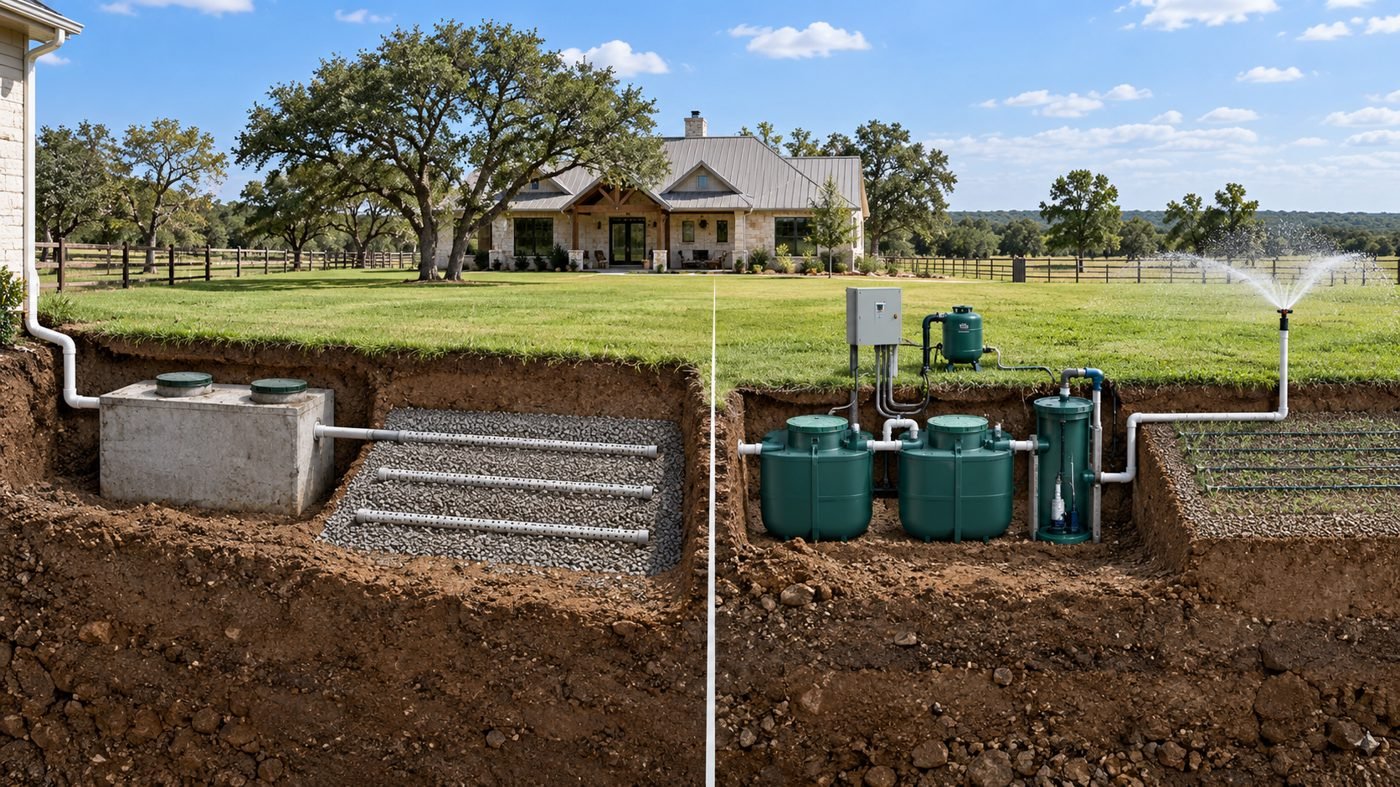
A conventional septic system typically uses a septic tank for primary treatment and relies on soil in the disposal field to complete much of the wastewater treatment and dispersal process.
Because there are fewer mechanical components, a conventional system can be comparatively simple to operate when the property has suitable soil and enough usable area. The tradeoff is that the site itself has to support the disposal method.
- Septic tank provides primary treatment
- Wastewater leaves the tank and enters an approved disposal area
- Soil conditions are a major part of treatment and dispersal
- Usually has fewer pumps, controls, and mechanical components than an aerobic system
What is an aerobic septic system?
An aerobic treatment unit adds secondary treatment by introducing oxygen and using a mechanical treatment process before wastewater is sent to the disposal system. TCEQ lists proprietary aerobic treatment units as a secondary-treatment option.
Because the wastewater receives additional treatment before dispersal, an aerobic system can be useful on sites where a simpler conventional design is not appropriate. It also introduces more equipment, controls, electrical demand, alarms, and maintenance.
- Uses mechanical aeration and secondary treatment
- Typically includes pumps, controls, alarms, and electrical components
- May use surface application, drip irrigation, or another approved disposal method
- Requires more ongoing attention than a basic gravity system
Conventional systems usually cost less to install
When the site supports a straightforward conventional design, installation cost is often lower because the system has fewer mechanical components and less treatment equipment.
Our current Texas cost guide uses a rough planning range of about $3,000 to $8,500 for many conventional or anaerobic systems. That range is useful for early budgeting, but actual bids depend on the site evaluation, tank size, excavation, disposal-field design, permits, access, and local labor.
Aerobic systems usually have a higher upfront cost
Aerobic treatment adds tanks or treatment chambers, aeration equipment, pumps, controls, alarms, disinfection where required, electrical work, and more specialized installation.
Current planning references commonly place aerobic systems around $10,000 to $20,000. Difficult excavation, engineered disposal, larger wastewater loads, extensive electrical work, or complex site constraints can push the total higher.
The cheapest system is not automatically the best system
If a conventional system is suitable and approvable, it may offer lower installation cost and simpler ownership. But forcing a conventional design onto a site that does not support it is not a legitimate way to save money.
The practical goal is to install the simplest system that fits the evaluated site, meets the rules, and supports the long-term use of the property.
Soil is one of the biggest factors in the decision
A conventional disposal field depends heavily on the soil's ability to accept and treat wastewater. Soil texture, structure, depth, restrictive layers, rock, seasonal wetness, and drainage conditions can all affect which disposal methods are appropriate.
TCEQ's site-evaluation process is intended to identify those conditions before the system is selected. That is why a neighboring property having a conventional system does not guarantee your tract will qualify for the same design.
Usable land area can push a property toward a different system
A large tract can still have limited usable septic area once the house, well, driveway, shop, pond, floodplain, easements, property-line setbacks, and future improvements are considered.
Conventional disposal areas can require significant usable soil area. Aerobic or alternative disposal methods may fit different site constraints, but they still need approved space and separation from other improvements.
Plan the septic area before finalizing the pool, shop, guest house, driveway, barn, or second residence.
Aerobic systems need electricity
An aerobic treatment unit depends on mechanical equipment such as an aerator and, depending on the design, pumps, controls, alarms, and disinfection components. Those systems require electrical service.
For rural properties that experience outages, septic should be included in the backup-power plan. A short outage may not create an immediate problem, but extended loss of power can affect treatment and pumping depending on the system design and wastewater use.
Conventional systems generally have fewer mechanical failure points
A basic conventional gravity system has fewer electrical and mechanical components than an aerobic treatment unit. That usually means fewer motors, control panels, alarms, and treatment components to inspect or replace over time.
The system still requires responsible use, periodic pumping, and protection of the disposal field. Simpler does not mean maintenance-free.
Aerobic systems require more active maintenance
TCEQ's maintenance guidance distinguishes aerobic treatment units from conventional systems because aerobic systems include treatment equipment that needs ongoing attention.
Texas rules provide for an initial two-year service policy on certain aerobic and other advanced systems. After that period, owners of qualifying single-family systems may be able to maintain the unit themselves or obtain a maintenance contract, but local permitting authorities can impose stricter requirements.
Before buying or installing an aerobic system, ask what maintenance contract, testing, reporting, disinfection, inspection, and owner-training rules apply in that county or permitting area.
Conventional tanks still need pumping
TCEQ recommends pumping conventional septic tanks every three to five years to reduce the risk of solids carrying over and interfering with treatment.
Actual pumping frequency depends on tank size, household use, solids accumulation, garbage-disposal use, and system condition. The recommendation is a starting point, not a guarantee that every system can wait five years.
Aerobic pumping frequency is based more on sludge accumulation and manufacturer guidance
TCEQ notes that aerobic treatment units do not follow the same simple three-to-five-year pumping recommendation as conventional tanks. Pumping depends on sludge depth and the manufacturer's requirements.
That is another reason to keep the model information, operating instructions, service records, and maintenance history for an aerobic system.
Aerobic systems can include disinfection requirements
Some aerobic systems that discharge treated wastewater through surface application require disinfection as part of the treatment process. TCEQ specifically warns owners to use approved wastewater-disinfection chlorine products when chlorine tablets are used and not swimming-pool tablets.
The exact disinfection method and maintenance obligations depend on the approved system and local requirements.
Permitting applies to both system types
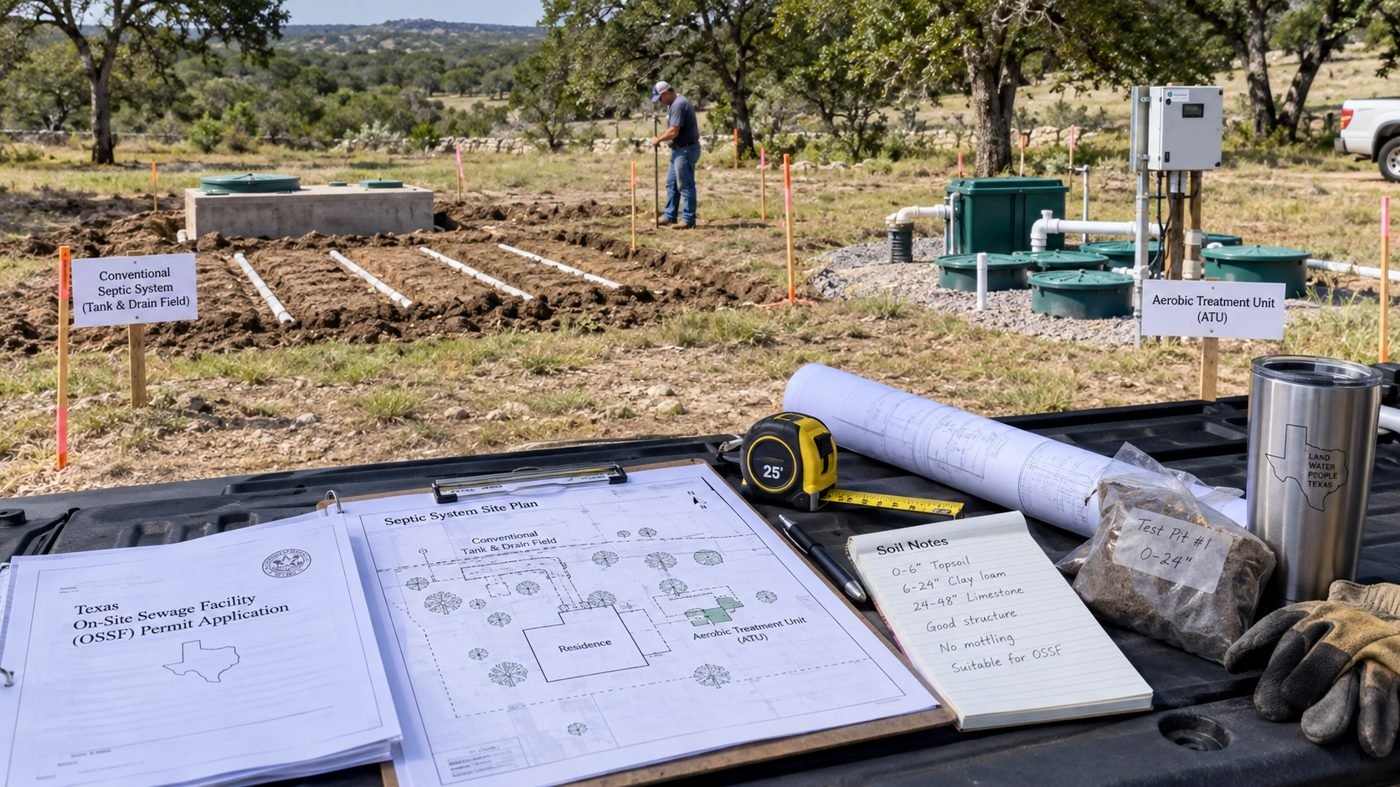
TCEQ states that a permit and approved plan are generally required to construct, alter, repair, extend, or operate an on-site sewage facility. Most homeowners work through a local authorized agent or permitting authority.
The permitting authority reviews the site evaluation and planning materials to determine whether the proposed treatment and disposal system can be approved. Local programs can also adopt requirements that are more stringent than the statewide minimum.
Aerobic secondary treatment requires a more specialized installer
TCEQ's system-selection guidance states that secondary treatment systems such as proprietary aerobic treatment units must be designed by a professional engineer or professional sanitarian and can only be installed by an Installer Class II.
That is different from a basic primary-treatment system and is one reason aerobic installations involve a more specialized design and installation process.
Which system is better for a rural Texas property?
If the site has favorable soil, adequate area, and an approvable conventional design, the conventional system is often attractive because of its lower complexity and lower ownership burden.
If the site cannot support a simple conventional disposal method, an aerobic or other approved alternative system may make the property workable. That additional capability comes with higher installation cost, electricity use, mechanical components, and more active maintenance.
The better system is the one that fits the evaluated property and your willingness to maintain it.
- Conventional may fit: suitable soil, enough disposal area, simpler ownership goals
- Aerobic may fit: challenging site conditions, need for secondary treatment, alternative disposal requirements
- Either system: must match the approved site evaluation and local permit requirements
Buying a property with an existing conventional system
Ask for the permit, installation record, tank size, pumping history, repairs, inspection records, and a diagram showing the tank and disposal area. Look for evidence of surfacing wastewater, slow drains, sewage odors, lush or saturated patches, crushed access covers, or vehicles and structures over the disposal field.
Have the system evaluated as part of the property due diligence rather than assuming that normal indoor plumbing proves the entire system is healthy.
Buying a property with an existing aerobic system
In addition to the normal septic records, request the aerobic-unit model, maintenance contract or service history, inspection reports, alarm history, pump and aerator repairs, disinfection records where applicable, and the control-panel information.
Confirm whether the current maintenance arrangement transfers to the buyer and what the local permitting authority requires after ownership changes.
Questions to ask before choosing conventional or aerobic
The site evaluator, designer, installer, and permitting authority should be able to explain why a specific design is being recommended. Do not accept an expensive system without understanding the site condition that drives it.
- What did the site evaluation find?
- Is a conventional system approvable on this property?
- Why is aerobic treatment being recommended, if applicable?
- What disposal method is proposed?
- How much usable land will the system occupy?
- What electrical equipment is required?
- What maintenance contract or reporting is required?
- What are the expected annual maintenance costs?
- What components typically wear out or require replacement?
- What areas of the property must remain protected from structures and vehicle traffic?
- How does the septic layout affect a future pool, shop, guest house, or second driveway?
Keep researching
Septic Systems resources
Planning, evaluating, installing, and maintaining septic systems for rural properties.
Sources & methodology
Where this information comes from
Cost figures are planning references rather than contractor quotes. Permitting, system-selection, and location-specific guidance should be verified with the appropriate local authority or qualified professional. AcreageReady uses source-backed, AI-assisted editorial workflows and remains responsible for the material it publishes. Read how we research, edit, and correct guides.
- Texas Commission on Environmental Quality: Choosing a Septic System
- Texas Commission on Environmental Quality: Advice for an OSSF Owner
- Texas Commission on Environmental Quality: OSSF Maintenance
- Texas Commission on Environmental Quality: On-Site Sewage Facilities
- AcreageReady: Septic System Cost in Texas - Complete 2026 Guide
Common questions
Frequently asked questions
Is an aerobic septic system better than a conventional system in Texas?
Not automatically. A conventional system can be simpler and less expensive when the property has suitable soil and enough disposal area. An aerobic system can be appropriate where additional treatment or a different disposal method is needed. The site evaluation and permitting authority determine what fits the property.
Why would a Texas property need an aerobic septic system?
Aerobic treatment may be recommended when site conditions or the approved disposal method call for secondary treatment. Soil, usable area, slope, drainage, setbacks, and other site constraints all influence the design.
Are aerobic septic systems more expensive?
Usually. Current planning ranges commonly place many conventional systems around $3,000 to $8,500 and aerobic systems around $10,000 to $20,000, although actual Texas pricing depends heavily on the property and scope.
Does an aerobic septic system need electricity?
Yes. Aerobic treatment uses mechanical equipment such as aerators, pumps, controls, or alarms, depending on the approved design.
How often does a conventional septic tank need to be pumped in Texas?
TCEQ recommends pumping conventional septic tanks every three to five years. Actual frequency depends on tank size, wastewater use, solids accumulation, and system condition.
Do aerobic septic systems require a maintenance contract in Texas?
Texas rules include an initial service-policy period for qualifying aerobic and advanced systems. After that, some single-family homeowners may maintain their own systems or use a maintenance provider, but local permitting authorities can impose stricter requirements. Verify the rules where the property is located.
Ready to talk with a local professional?
Share your location and project details so AcreageReady can identify relevant providers as the network grows.
Get a free quote