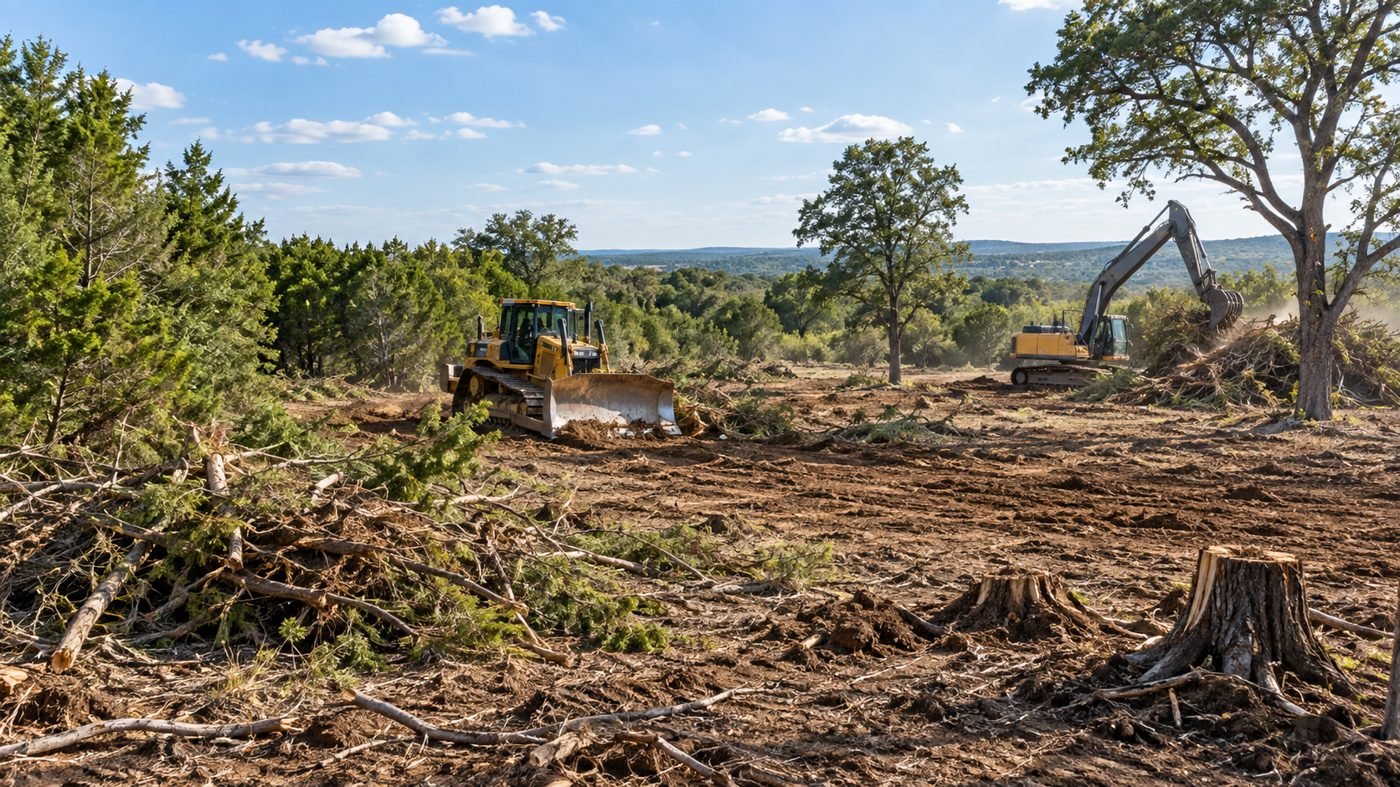
Land clearing in Texas can range from a few hundred dollars per acre to several thousand
The cost to clear rural land in Texas depends less on the number of acres by itself and more on what is growing on those acres, how difficult the terrain is, whether stumps must be removed, what happens to the debris, and how accessible the site is to heavy equipment.
Current 2026 national guidance from Angi places basic land clearing around $500 to $5,600 per acre, while HomeGuide uses a broader average of about $1,200 to $8,000 per acre. Texas metro data can fall below or above those ranges depending on local conditions.
For acreage planning, it is more useful to budget light, moderate, and heavy-clearing scenarios than to multiply one statewide average by the number of acres.
A practical 2026 Texas planning range
For many rural Texas properties, a rough early-stage planning range is about $1,000 to $6,000 per acre for conventional clearing, with lightly vegetated land at the lower end and heavily wooded, rocky, or difficult property at the higher end.
That range is intentionally broad. Current 2026 Angi data lists Dallas clearing around $300 to $3,300 per acre and Houston around $550 to $6,200 per acre, while national data extends higher for heavily forested sites.
Use those numbers as screening allowances until a contractor walks the property.
- Light brush and small growth: often near the low end
- Mixed brush and scattered trees: middle of the range
- Dense timber, large stumps, rock, or poor access: upper end or above
- Finished building-site preparation usually costs more than simple vegetation clearing
How much does it cost to clear 1 acre in Texas?
For one acre, a reasonable screening range is roughly $1,000 to $8,000 depending on vegetation, tree size, terrain, stump removal, and disposal.
A lightly overgrown acre that can be handled with a skid steer, brush cutter, or mulcher may fall well below a heavily wooded acre that requires chainsaw work, excavator time, stump grubbing, hauling, and rough grading.
Small jobs can also carry a higher per-acre cost because equipment mobilization is spread across fewer acres.
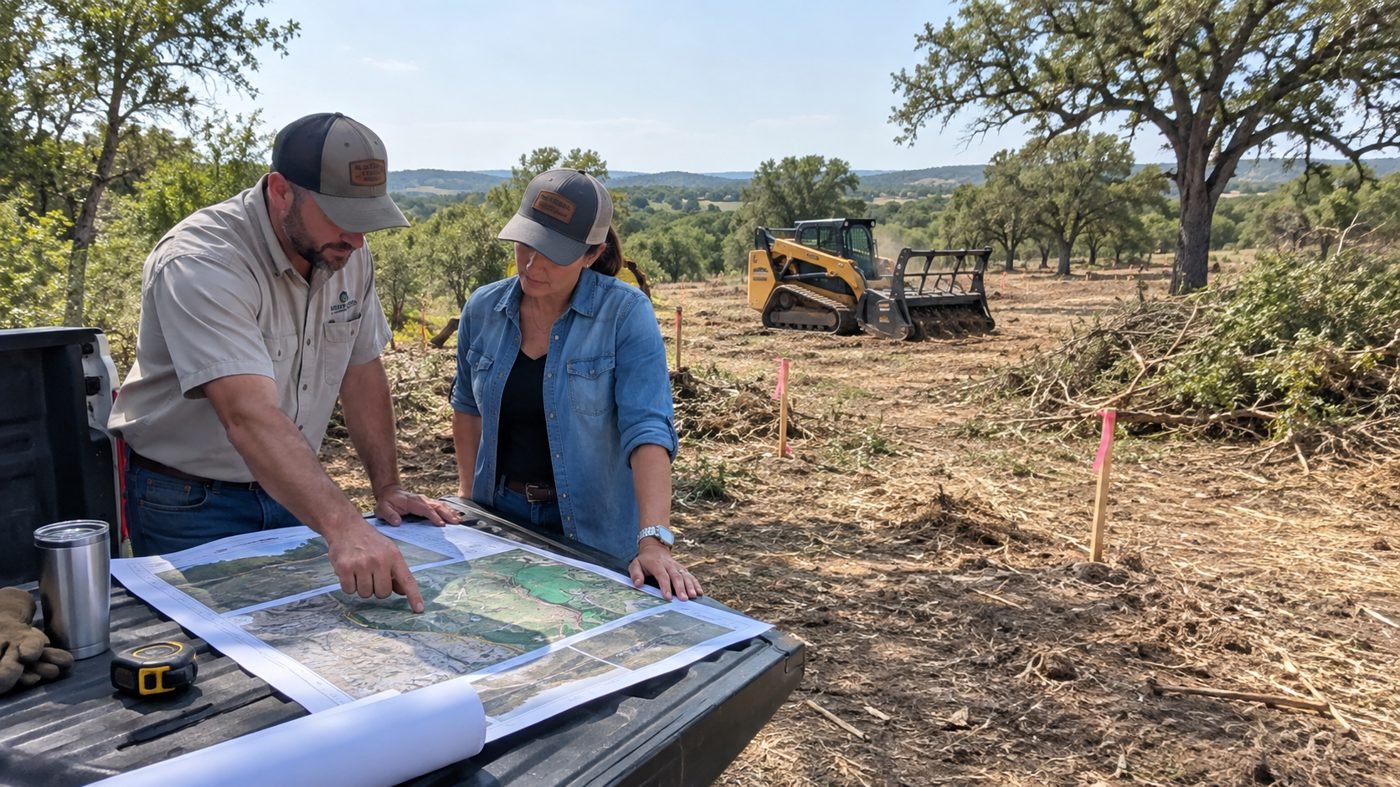
How much does it cost to clear 5 acres in Texas?
For five acres, a practical screening range is roughly $5,000 to $35,000, although difficult properties can exceed that.
HomeGuide's 2026 national data lists about $4,500 to $35,000 for five acres, while Angi's 2026 Houston data shows about $2,800 to $30,800 for five acres.
Larger projects often have a somewhat lower per-acre cost because equipment mobilization and setup are spread across more acreage.
How much does it cost to clear 10 acres in Texas?
Ten acres can vary dramatically. A rough planning allowance might be $10,000 to $60,000 or more depending on whether the contractor is simply reclaiming brush or fully clearing dense timber and removing stumps for development.
If the property is lightly wooded and forestry mulching is appropriate, the total may stay well below a full conventional clearing job. If the goal is to turn heavily wooded land into a clean building site, pasture, or road network, the total can climb quickly.
For ten-acre tracts, define exactly how much of the property truly needs clearing before pricing the entire parcel.
You may not need to clear every acre
One of the easiest ways to overspend is clearing an entire rural tract simply because the equipment is already there.
Many acreage projects only need a driveway corridor, homesite, septic area, utility routes, shop pad, fence lines, firebreaks, and selected pasture areas cleared.
Selective clearing can preserve shade, privacy, habitat, erosion control, and resale character while reducing cost.
Light clearing is very different from heavy clearing
Light clearing generally means grass, brush, saplings, vines, and smaller growth that can be handled quickly with mowing, brush cutting, or forestry mulching.
Heavy clearing can include mature trees, large root systems, dense timber, deadfall, large stumps, buried debris, boulders, steep slopes, and material that must be hauled or burned.
Two five-acre parcels can have completely different bids even if they are next door to each other.
Forestry mulching can be a cost-effective option
Forestry mulching uses a machine to grind brush and smaller trees in place, leaving shredded organic material on the ground.
It can be a good fit for selective clearing, trail creation, fence lines, pasture reclamation, visibility improvement, and reducing dense undergrowth without hauling large amounts of debris.
It is not the same as construction clearing. Stumps and root systems may remain, and areas intended for a house pad, driveway base, slab, or other structural work may still need additional excavation.
Tree size has a major effect on price
Acreage filled with cedar, mesquite, yaupon, and small saplings can be much faster to process than acreage with mature oaks, large elms, heavy hardwoods, or oversized dead trees.
Large trees require more cutting time, larger equipment, more careful handling, and often more disposal work.
If the property contains valuable mature trees, mark the ones you want preserved before equipment arrives.
Stump removal can add significant cost
Cutting a tree at ground level is not the same as removing the stump and root ball. If the site will become a building pad, road, driveway, utility trench, or heavily graded area, stump removal may be necessary.
Current 2026 Houston data from Angi lists stump removal around $110 to $170 per stump as a general consumer range.
On heavily wooded acreage, per-stump pricing can become expensive, so contractors may instead price grubbing and excavation as part of the overall clearing scope.
Debris disposal changes the bid
Ask what happens to the trees, brush, and stumps after they are removed. Common options include mulching, chipping, burning where legal and appropriate, stacking, hauling off site, or processing material for firewood.
Haul-off usually increases cost because it adds loading, trucking, disposal fees, and time.
A low clearing bid can become expensive if debris disposal is excluded and the owner is left with large piles to manage later.
Rock and caliche can raise the cost quickly
Texas clearing projects can encounter limestone, caliche, boulders, and shallow rock that slow excavation and stump removal.
Angi's 2026 Houston data places large-rock removal around $700 to $1,300 per acre and smaller rock removal around $130 to $170 per hour as general consumer ranges.
Rock also matters later for driveway construction, grading, septic, foundations, wells, and utility trenching, so note it during the clearing phase.
Terrain and drainage affect equipment productivity
Flat, dry, open land is faster to clear than steep, wet, deeply rutted, or erosion-prone terrain.
Creeks, drainage channels, low areas, soft ground, and steep slopes can limit where equipment can operate and may require a different machine or additional restoration afterward.
Do not clear natural drainage features blindly. The site plan should preserve or intentionally redesign how stormwater moves across the property.
Access can determine which equipment can reach the property
A contractor may need room for skid steers, excavators, dozers, mulchers, loaders, haul trucks, fuel trucks, and trailers.
Narrow entrances, weak culverts, tight gates, low branches, soft roads, and steep approaches can add time or require temporary access improvements before clearing begins.
If the future driveway is not yet built, discuss construction access with the clearing contractor before mobilization.
Clearing is not the same as grading
Land clearing removes vegetation, trees, brush, stumps, and debris. Grading reshapes the soil and establishes elevations and drainage.
A property can be completely cleared and still be nowhere near ready for a house pad, driveway, slab, or shop.
Current 2026 Angi guidance lists grading and leveling around $1,000 to $3,300 on many projects, but larger rural sites or major earthwork can cost much more.
Construction clearing requires a different standard than pasture cleanup
If the goal is a building pad, driveway, or slab area, the contractor may need to remove organic material, roots, stumps, unsuitable soil, and debris more thoroughly than for pasture or recreational clearing.
Leaving buried wood beneath a future structure or road can create settlement as the material decomposes.
Tell the contractor exactly what each cleared area will be used for.
A 1-acre homesite inside a 10-acre tract can save a lot of money
Suppose you own ten wooded acres but only need one acre for the home, driveway, septic, utilities, and immediate yard. Selectively clearing that development envelope while mulching trails and thinning other areas can cost far less than completely clearing all ten acres.
This approach also gives you time to live with the property before deciding which additional areas should become pasture, orchard, shop space, or open lawn.
Example clearing budgets for 1, 5, and 10 acres
These are screening examples rather than quotes, but they show how the scope can change the budget.
- 1 acre, light brush and saplings: roughly $1,000 to $2,500
- 1 acre, heavy timber and stump removal: roughly $4,000 to $8,000+
- 5 acres, moderate mixed clearing: roughly $7,500 to $20,000
- 5 acres, heavy clearing with haul-off: roughly $20,000 to $35,000+
- 10 acres, selective or moderate clearing: roughly $12,000 to $30,000
- 10 acres, heavy timber, grubbing, rock, and disposal: $40,000 to $60,000+
What should be included in a land-clearing quote?
Ask contractors to define the finish condition, not simply the equipment and hours. One contractor may quote tree cutting while another includes stump removal, debris disposal, rough grading, and cleanup.
A detailed scope makes bids easier to compare.
- Acres or specific areas to be cleared
- Tree-size limits
- Brush and understory removal
- Stump removal or stump height
- Debris mulching, burning, stacking, or haul-off
- Rock removal
- Fence removal
- Structure or trash removal
- Rough grading and backfill
- Final cleanup
- Mobilization charges
- Hourly rates for unexpected work
Questions to ask a Texas land-clearing contractor
The right contractor should be able to explain which equipment fits the property and what the finished site will look like.
- Do you price by acre, day, hour, or project?
- What equipment will you use?
- Are stumps removed or cut flush?
- What size trees are included?
- What happens to debris?
- Is haul-off included?
- How do you handle rock?
- Will you protect marked trees?
- Is rough grading included?
- What access do your machines require?
- How do weather delays affect pricing?
- Do you carry appropriate insurance?
The best clearing plan starts with the final site plan
Before clearing begins, know where the house, driveway, septic, well, shop, utilities, pond, future guest house, and major drainage paths are likely to go.
That prevents paying to clear areas you later wish you had preserved and reduces the chance of damaging trees or ground that would have been valuable to the finished property.
For acreage projects, clearing should support the site plan rather than become the site plan.
Keep researching
Land & Site Work resources
Clearing, grading, drainage, driveways, pads, excavation, and preparing acreage for construction.
Sources & methodology
Where this information comes from
Cost figures are planning references rather than contractor quotes. Permitting, system-selection, and location-specific guidance should be verified with the appropriate local authority or qualified professional. AcreageReady uses source-backed, AI-assisted editorial workflows and remains responsible for the material it publishes. Read how we research, edit, and correct guides.
Common questions
Frequently asked questions
How much does it cost to clear 1 acre of land in Texas?
A practical 2026 screening range is roughly $1,000 to $8,000 per acre depending on vegetation density, tree size, stump removal, terrain, rock, access, and debris disposal.
How much does it cost to clear 5 acres in Texas?
A rough planning range is about $5,000 to $35,000. Current 2026 national and Texas metro data shows large variation based on vegetation and site difficulty.
How much does it cost to clear 10 acres in Texas?
A rough planning range is about $10,000 to $60,000 or more. Selective clearing and forestry mulching can reduce cost, while dense timber, stump removal, rock, steep terrain, and haul-off can push the total higher.
Is forestry mulching cheaper than traditional land clearing?
Often it can be for brush, small trees, selective clearing, trails, and pasture reclamation because material is processed in place. It is not a substitute for complete grubbing and excavation where building pads, roads, or slabs require roots and organic material to be removed.
Does land clearing include stump removal?
Not always. Some contractors cut trees near ground level while others include grubbing or stump removal. Confirm the finish condition in the written scope.
Should I clear my entire acreage before building?
Usually not unless the final property use requires it. Many owners save money and preserve privacy and mature trees by clearing only the driveway, homesite, septic area, utility routes, shop area, and selected pasture or recreation zones.
Ready to talk with a local professional?
Share your location and project details so AcreageReady can identify relevant providers as the network grows.
Get a free quote