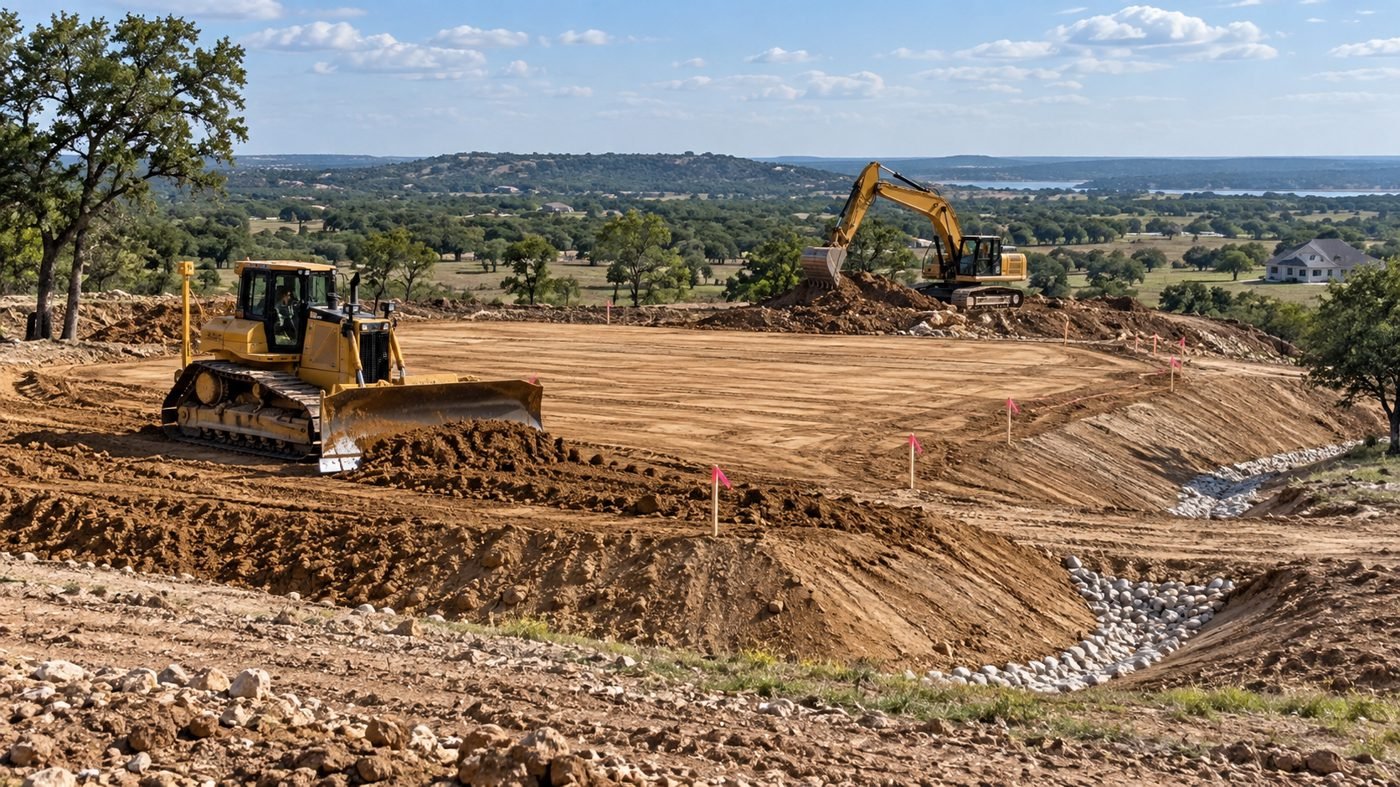
Land grading can cost a few thousand dollars or become a major site-work expense
The cost to grade land for a house in Texas depends on how much dirt must be moved, the slope of the site, whether fill has to be imported or removed, the soil and rock conditions, drainage requirements, and how precise the finished elevations need to be.
For a relatively simple homesite, grading may be a few thousand dollars. A steep or difficult property that needs major cut and fill, retaining work, drainage improvements, imported structural fill, or extensive compaction can cost tens of thousands.
The most useful way to budget grading is to separate rough site work, house-pad preparation, drainage, and finish grading instead of treating them as one line item.
A practical 2026 planning range for Texas
For early budgeting, a basic residential grading job may fall roughly in the $1,500 to $6,000 range, while a larger rural homesite with substantial earthwork can reach $10,000 to $30,000 or more.
Current 2026 consumer pricing guides commonly place small residential grading jobs in the low thousands and more extensive excavation or regrading well above that, especially where fill must be imported, rock is encountered, or drainage work is included.
Rural acreage can be more expensive because the graded area may include the house pad, driveway tie-in, drainage swales, utility corridors, septic access, shop areas, and transitions across a much larger site.
Rough grading and finish grading are different jobs
Rough grading is the heavy earthwork stage. It establishes the general shape of the site, removes high spots, fills low areas, forms the building pad, and creates the major drainage pattern.
Finish grading happens later and brings the site to final elevations around the home, driveway, patios, drainage structures, and landscaping.
A contractor may quote both together or price them separately, so confirm which phase is included before comparing bids.
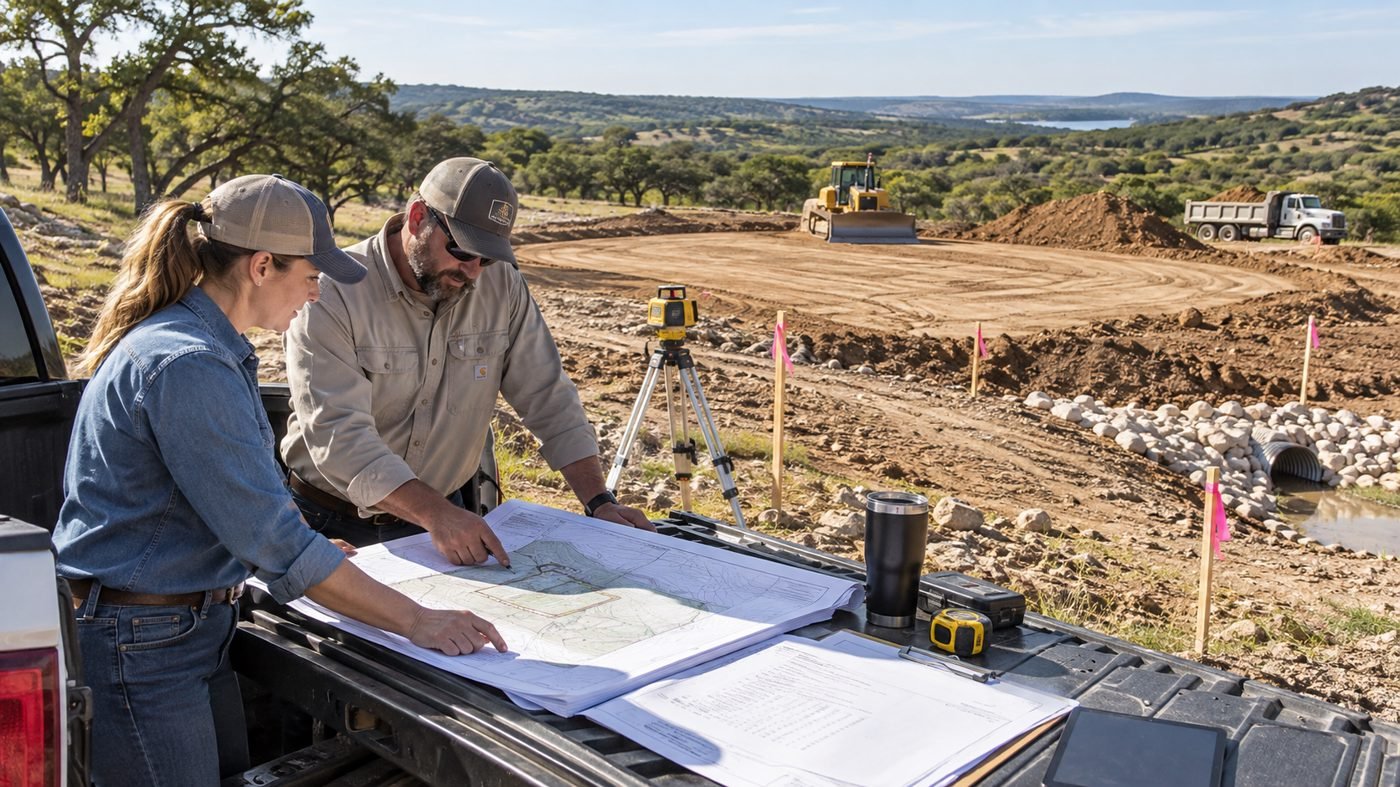
The house pad can be the most important grading area
A house pad is not simply a flat area for construction. It needs the correct elevation, dimensions, material, moisture content, compaction, and drainage so the foundation is supported consistently.
Poorly compacted fill, buried organic material, oversized clods, or uncontrolled placement can create settlement problems later.
The site contractor, foundation contractor, engineer, and builder should agree on pad requirements before major earthwork begins.
- Pad dimensions
- Finished elevation
- Required fill material
- Lift thickness
- Moisture conditioning
- Compaction target
- Testing requirements
- Drainage away from the foundation
Cut and fill drives a large part of the grading cost
Cut and fill refers to removing soil from higher areas and placing it in lower areas to create the desired elevations.
A well-balanced site can reuse excavated material on the property, reducing truck traffic and material cost. An unbalanced site may need imported fill or may generate excess soil that must be hauled away.
The farther material must be moved and the more times it must be handled, the more expensive the job becomes.
Importing fill can add thousands of dollars
If the site does not have enough suitable native material, the contractor may need to bring in select fill, base material, or another specified soil.
Imported material adds the cost of the dirt itself plus trucking, spreading, moisture conditioning, compaction, and testing.
On large house pads, a small change in required elevation can translate into many truckloads of fill.
Hauling excess dirt away also raises the price
If the project generates more soil than the property can use, the excess may have to be loaded, transported, and disposed of or placed elsewhere.
Haul-off costs depend on truck capacity, haul distance, disposal location, loading time, and whether the soil is clean and reusable.
A contractor who can balance cut and fill on site can often save the owner substantial money.
Slope can turn a simple grading job into major earthwork
Flat or gently sloping land is usually easier to grade than a steep homesite that requires large cuts, deep fills, stepped pads, retaining walls, or long drainage transitions.
Steep sites can also require additional erosion control and more careful access for equipment.
Before choosing the homesite, compare the grading implications of several possible locations on the property.
Rock and caliche can change the equipment and schedule
Texas properties can contain limestone, caliche, hardpan, boulders, and shallow bedrock that slow excavation and grading.
Rock may require larger excavators, hydraulic breakers, ripping, specialized attachments, or additional haul-off.
If rock is visible at the surface or nearby construction has encountered it, include a contingency rather than assuming normal dirt-moving rates.
Soil type affects how the pad is built
Clay, sand, silt, expansive soils, loose fill, and mixed native materials behave differently under load and moisture changes.
Some soils may be suitable for structural fill with proper moisture and compaction, while others may need to be removed or blended with better material.
Where the foundation design depends on soil conditions, coordinate grading with the geotechnical recommendations instead of treating earthwork as a separate decision.
Compaction testing can be worth the extra cost
Compaction testing provides documentation that fill was placed and compacted to the specified standard.
Testing is especially important where the home pad contains significant fill or where the engineer or foundation contractor requires verification.
Skipping testing can save a small amount upfront while leaving uncertainty about the quality of the pad beneath the foundation.
Drainage should be designed before grading begins
Good grading moves stormwater away from the house without creating new problems elsewhere on the property.
The contractor may need to build swales, berms, ditches, culvert approaches, shallow channels, or other features that direct runoff around the home and driveway.
Changing the land without understanding the natural drainage pattern can send water toward the foundation, septic area, neighbor, road, or low point.
Driveway grading should connect to the house pad
The driveway elevation and slope should be coordinated with the house pad so the approach is usable, drains properly, and does not trap water near the home.
A steep transition can create vehicle-clearance problems, while a flat transition without drainage can hold water.
Plan the road entrance, culvert, driveway grade, house elevation, and parking areas as one system.
Grading around septic and wells needs coordination
Do not reshape the site in a way that buries, compacts, floods, or blocks access to septic components or the well.
The septic disposal area may have strict elevation, soil, and drainage considerations, while the wellhead should remain protected from runoff.
Show both systems on the grading plan before heavy equipment starts moving soil.
Finish grading happens near the end of construction
Heavy trucks, concrete deliveries, framing crews, utility trenches, septic work, and material storage can damage finished grades.
For that reason, many rural projects establish rough elevations early and wait until heavy construction is nearly complete before doing final shaping around the house.
Finish grading should leave the site ready for landscaping, final driveway surfaces, drainage stabilization, and erosion control.
Grading by the hour, day, or project
Contractors may price grading by the hour, by the day, by cubic yard, or as a lump-sum project.
Hourly or daily pricing can work well when the scope is uncertain, but the owner carries more risk if difficult conditions slow the job.
A lump-sum quote is easier to budget when the plans, elevations, quantities, and finish condition are clearly defined.
Equipment size affects both speed and cost
Small skid steers are efficient for light shaping and finish work, while dozers, excavators, scrapers, loaders, compactors, and graders are better suited to larger earthmoving jobs.
The cheapest hourly machine is not always the cheapest overall if it takes much longer to move the required volume.
Ask the contractor why the proposed equipment fits the site and scope.
Example grading budgets for rural Texas homesites
These examples are only screening ranges, but they help show how the site can change the total.
- Simple pad on gently sloping land: roughly $2,000 to $6,000
- Moderate cut and fill with drainage shaping: roughly $5,000 to $12,000
- Large pad with imported fill and compaction: roughly $10,000 to $20,000+
- Steep, rocky, or heavily engineered site: $20,000 to $40,000+ is possible
- Retaining walls, major drainage structures, and long driveway grading can add substantial cost beyond these ranges
What should be included in a grading quote?
The best quotes define quantities, elevations, finish conditions, and exclusions so you know what happens if the project changes.
- Clearing or stripping of topsoil
- Rough grading
- House-pad dimensions and elevation
- Cut and fill quantities
- Imported fill allowance
- Haul-off allowance
- Moisture conditioning
- Compaction
- Testing
- Drainage swales and berms
- Driveway tie-in
- Rock excavation
- Finish grading
- Erosion-control measures
- Mobilization
- Hourly rates for extra work
Questions to ask a Texas grading contractor
A good grading contractor should be able to explain how the site will drain and how the pad will be built, not just how many hours the machine will run.
- What elevations are you building to?
- How will you establish and protect benchmarks?
- What fill material will be used?
- How will fill be placed and compacted?
- Is compaction testing included?
- How much import or haul-off is included?
- How do you handle rock or unexpected soil?
- What drainage features are included?
- Does the quote include rough grading, finish grading, or both?
- Who is responsible for accepting the pad before foundation work?
The cheapest grading bid can become expensive later
Grading affects the foundation, drainage, driveway, utilities, septic, landscaping, and nearly every other site improvement.
A low bid that omits compaction, proper fill, drainage, testing, or finish work can create downstream costs that dwarf the initial savings.
For a rural home build, grading should be treated as engineered site preparation, not simply moving dirt until the lot looks flat.
Keep researching
Land & Site Work resources
Clearing, grading, drainage, driveways, pads, excavation, and preparing acreage for construction.
Sources & methodology
Where this information comes from
Cost figures are planning references rather than contractor quotes. Permitting, system-selection, and location-specific guidance should be verified with the appropriate local authority or qualified professional. AcreageReady uses source-backed, AI-assisted editorial workflows and remains responsible for the material it publishes. Read how we research, edit, and correct guides.
Common questions
Frequently asked questions
How much does it cost to grade land for a house in Texas?
A simple residential grading job may cost a few thousand dollars, while a larger rural homesite with significant cut and fill, imported material, drainage work, or rock can reach $10,000 to $30,000 or more.
How much does a house pad cost in Texas?
A simple pad on favorable terrain may cost roughly $2,000 to $6,000, while larger pads requiring imported structural fill, compaction, testing, or major elevation changes can cost $10,000 to $20,000 or more.
What is the difference between rough grading and finish grading?
Rough grading establishes the overall site shape, major elevations, and drainage. Finish grading happens later and brings the area around the home, driveway, and landscaping to final elevations.
Does grading include compaction?
Not always. Compaction, moisture conditioning, and density testing may be separate scope items. Confirm them in writing when the graded area will support a foundation or other structural work.
Does grading include drainage work?
It can, but not automatically. Swales, berms, culvert approaches, ditches, and other drainage features should be specifically included in the grading scope.
Should grading happen before or after the house is built?
Rough grading and pad preparation happen before the foundation. Final grading is usually completed near the end of construction after heavy equipment and utility work are mostly finished.
Ready to talk with a local professional?
Share your location and project details so AcreageReady can identify relevant providers as the network grows.
Get a free quote