
A beautiful property is not automatically a good building site
Raw land should be evaluated as a complete development project, not just as acreage, views, trees, or price per acre. Two properties with similar purchase prices can have dramatically different total costs once you account for access, utilities, septic, water, drainage, grading, soil conditions, easements, and site preparation.
The goal before buying is to answer one question: can this property support the house and lifestyle you want at a total cost you can actually afford?
That means evaluating the parcel from the road all the way to the proposed homesite, then estimating what must happen before the foundation can be built.
1. Start with legal access
Before worrying about the house location, confirm that the property has legal and practical access from a public road.
A driveway visible on satellite imagery does not automatically prove legal access. Review the deed, title commitment, survey, recorded easements, subdivision plat, and county road information.
Also evaluate whether the access is physically usable for construction traffic, concrete trucks, utility crews, septic equipment, emergency vehicles, and future deliveries.
- Is the property directly connected to a public road?
- If access crosses another parcel, is there a recorded easement?
- How wide is the access easement?
- Can the entrance meet county or state driveway requirements?
- Will a culvert be required?
- Are there steep grades, drainage crossings, gates, or narrow turns?
- Can large construction equipment reach the homesite?
2. Identify the best homesite before estimating anything else
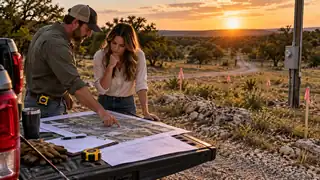
The best location for the house affects nearly every other cost. Moving a homesite several hundred feet can change driveway length, power-extension cost, well piping, trenching, grading, drainage, and septic layout.
Walk several possible building areas and compare them instead of locking onto the first attractive spot.
A slightly less dramatic homesite may save tens of thousands of dollars if it has better elevation, easier access, shorter utility runs, and simpler drainage.
- Distance from the road
- Natural elevation
- Slope and drainage
- Tree removal
- Rock exposure
- Utility distance
- Septic suitability
- Views and orientation
- Future shop, barn, pool, guest house, or RV area
3. Verify electricity instead of assuming the nearest pole will work
Seeing utility poles near a rural property is encouraging, but it does not prove that service can be extended economically to your proposed homesite.
Identify the serving utility or electric cooperative and ask where the nearest usable distribution facility is, whether capacity is available, whether a transformer is required, and where the meter or point of delivery would be located.
The distance from the road to the house can matter just as much as the distance from the existing utility line to the property.
4. Determine the water plan
Rural land may use municipal water, a rural water supply corporation, a special utility district, a private well, or another approved source.
If a public or rural water system serves the area, confirm that a new meter is actually available for the parcel and ask about tap fees, line extensions, meter location, pressure, easements, and current connection timelines.
If a private well will be required, research nearby well records, groundwater conditions, local groundwater-district rules, and typical drilling depths before setting a budget.
5. Confirm septic feasibility before deciding where the house goes
Many rural properties require an onsite wastewater system. Septic feasibility depends on local rules, soil, slope, groundwater, setbacks, lot configuration, and the size of the proposed home.
The septic system also consumes land. The tank, treatment equipment, disposal area, setbacks, and any required reserve area can affect where the house, well, driveway, pool, and future buildings can go.
Do not treat septic as a contractor decision that can wait until after closing. When a property depends on onsite wastewater, septic feasibility belongs in the purchase due-diligence process.
6. Check flood risk and natural drainage
A parcel does not have to sit inside a mapped high-risk flood zone to have drainage problems. Look for creeks, draws, low areas, ponding, erosion, culverts, upstream runoff, and evidence that water crosses the property after storms.
FEMA's Flood Map Service Center is the official public source for flood-hazard information, but a flood map is only one part of the evaluation.
Walk the land after rain when possible and ask neighbors, the seller, and local contractors where water moves during heavy storms.
- FEMA flood zones
- Creeks and drainage channels
- Low spots and ponding
- Road and driveway drainage
- Existing culverts
- Erosion
- Water flowing from neighboring land
- Potential house-pad elevation
7. Study the soil before designing the site
Soil affects foundations, septic systems, roads, drainage, agriculture, erosion, and grading.
USDA's NRCS Web Soil Survey provides current soil maps and interpretations for land-use planning. It can help identify mapped soil characteristics, but NRCS also notes that onsite investigation may still be necessary for engineering and site-specific decisions.
For a home build, a geotechnical investigation can provide much more specific information about the actual building area and foundation conditions.
8. Look for rock, caliche, shallow bedrock, and difficult excavation
Surface rock can be a warning that trenching, grading, septic installation, well drilling, foundation work, and utility installation may cost more.
Texas properties can contain limestone, caliche, hardpan, expansive clay, and shallow bedrock. Conditions can change substantially even within the same parcel.
Ask local excavation, well, septic, and foundation contractors what they typically encounter in that specific area.
9. Estimate clearing before assuming you need to clear everything
Tree cover can be an asset, but heavy vegetation can hide slope, drainage, trash, old fencing, abandoned structures, wells, utility lines, and uneven terrain.
Estimate the clearing required for the driveway, homesite, septic area, utility corridors, construction staging, and future structures.
Selective clearing is often more economical than clearing the entire property and can preserve privacy, shade, wildlife habitat, and mature trees.
10. Understand the grading and house-pad requirements
A property that looks nearly flat may still require substantial earthwork to create a stable house pad and positive drainage.
Estimate how much cut and fill may be required, whether suitable material can be reused onsite, whether fill will have to be imported, and whether excess soil will need to be hauled away.
Steep slopes, drainage corrections, retaining walls, rock, and engineered fill can move grading from a modest site-work item into a major project expense.
11. Price the driveway as infrastructure
On acreage, the driveway is not just a finishing detail. It may be the first improvement required so surveyors, drillers, clearing crews, concrete trucks, utility contractors, and builders can reach the site.
Measure the likely driveway length and consider clearing, excavation, drainage, culverts, geotextile, base material, gravel, gates, and turnaround space.
Long driveways can become one of the largest early site-development costs.
12. Review surveys, easements, and property boundaries
A current survey helps show the relationship between the boundaries, improvements, roads, easements, and other features that can affect development.
Utility, pipeline, drainage, access, conservation, and other easements can restrict where structures, fences, ponds, trees, or other improvements can be placed.
Do not assume a fence marks the legal property line. Compare the survey, title documents, plats, and physical occupation of the land.
13. Check deed restrictions, subdivision rules, and local regulations
Rural does not always mean unrestricted. Properties can be subject to deed restrictions, subdivision covenants, architectural controls, minimum home sizes, building setbacks, livestock restrictions, mobile-home restrictions, commercial-use limitations, or other private rules.
Counties and special districts may also regulate driveway access, floodplain development, septic systems, drainage, fire access, and other parts of the project.
Verify the rules for the exact parcel before designing a house, barndominium, shop, guest home, RV setup, or livestock layout.
14. Check internet and cellular coverage
Internet is increasingly part of rural infrastructure. The FCC National Broadband Map allows buyers to review provider-reported fixed and mobile broadband availability at a location.
Use the map as a screening tool, then verify service directly with the provider because construction requirements, actual performance, and installation availability can differ.
Also test cellular service at the proposed homesite, road entrance, shop area, and low parts of the property.
15. Look for environmental and physical red flags
Walk the entire property instead of evaluating it only from the road.
Look for illegal dumping, buried debris, burn piles, abandoned tanks, old wells, deteriorated structures, standing water, unusual odors, dead vegetation, erosion, old equipment, or signs of previous industrial or agricultural activity that may require additional investigation.
If the property's history or visible conditions create environmental concerns, professional environmental review may be appropriate.
16. Plan the property as a whole, not one structure at a time
A rural property often evolves. A house may be followed by a shop, pool, barn, guest house, RV storage, pond, livestock area, garden, gate, or backup-power system.
Sketch these future uses before finalizing the first driveway, well, septic field, transformer, or house location.
Good early planning can prevent a well from occupying the future shop site, a septic field from blocking the pool, or a driveway from cutting through the best pasture.
17. Build a complete development budget before comparing properties
The purchase price is only the beginning. Compare properties based on total acquisition and development cost.
A more expensive parcel with straightforward access, power, water, septic, drainage, and grading may ultimately cost less than cheaper raw acreage with difficult infrastructure.
Create a line-item budget before closing and replace generic allowances with local quotes whenever a cost could materially affect the purchase decision.
- Purchase price and closing costs
- Survey and engineering
- Driveway and culvert
- Clearing
- Grading and house pad
- Electric service
- Water meter or well
- Septic system
- Internet or communications
- Drainage work
- Permits and inspections
- Fencing and gates
- Construction access
- Contingency for rock, soil, weather, and unknown conditions
18. Get contractor input before you own the problem
One of the strongest due-diligence moves is getting local professionals onto the property before closing when the contract timeline allows.
A driveway contractor may immediately recognize drainage problems. A septic professional may identify a difficult disposal area. A well driller may know the local drilling depths. An excavation contractor may recognize shallow rock. An electrician or utility representative may identify an expensive service route.
You do not need every final construction bid before buying, but you do want enough real-world information to identify the expensive unknowns.
A raw-land evaluation checklist
Use this checklist before the option or due-diligence period expires.
- Legal access verified
- Driveway location and approximate cost reviewed
- Potential homesites compared
- Electric provider and extension requirements confirmed
- Water source confirmed
- Well feasibility researched if needed
- Septic feasibility reviewed
- Flood maps checked
- Natural drainage inspected
- Soils reviewed
- Rock and excavation risk considered
- Clearing scope estimated
- Grading and house-pad needs estimated
- Survey and boundaries reviewed
- Easements reviewed
- Deed restrictions and local rules reviewed
- Broadband providers checked
- Cellular service tested
- Future buildings and land uses sketched
- Total development budget created
- Major unknowns reviewed with local contractors
The best land purchase is the one with fewer expensive surprises
Raw land does not have to be easy to be a good purchase. A difficult site can still make sense when the location, acreage, privacy, or long-term value justify the extra work.
The important part is understanding those challenges before closing.
Evaluate the land as a system: access, homesite, utilities, water, wastewater, soils, drainage, grading, restrictions, and future use. When those pieces work together, the building process becomes far more predictable.
Keep researching
Acreage Planning resources
Due diligence, development sequencing, utilities, access, and the decisions that shape a rural property project.
Sources & methodology
Where this information comes from
Cost figures are planning references rather than contractor quotes. Permitting, system-selection, and location-specific guidance should be verified with the appropriate local authority or qualified professional. AcreageReady uses source-backed, AI-assisted editorial workflows and remains responsible for the material it publishes. Read how we research, edit, and correct guides.
- USDA NRCS: Web Soil Survey
- USDA NRCS: Soil Survey
- EPA: New Homebuyer's Guide to Septic Systems
- FEMA: Flood Map Service Center
- FCC: National Broadband Map
- AcreageReady: What Utilities Should You Check Before Buying Rural Land?
- AcreageReady: The Right Order for Developing Rural Land
- AcreageReady: How Much Does It Cost to Run Power to Rural Land in Texas? 2026 Guide
Common questions
Frequently asked questions
What should I check before buying raw land to build a house?
Check legal access, homesite location, electricity, water, septic, flood risk, drainage, soil, rock, clearing, grading, driveway requirements, easements, surveys, deed restrictions, internet, cellular coverage, and the total development budget.
How do I know if raw land is buildable?
Buildability depends on legal access, local rules, septic or sewer feasibility, water availability, flood and drainage conditions, soils, setbacks, easements, and whether a practical homesite can be served by utilities and construction access. Verify each of these for the exact parcel.
Should I test soil before buying land?
Start with USDA NRCS soil mapping, but site-specific investigation may still be needed. Septic evaluation and geotechnical testing can provide more detailed information for wastewater and foundation decisions.
How do I check whether land is in a flood zone?
Use FEMA's Flood Map Service Center for official flood-hazard information, then also inspect natural drainage, creeks, low areas, culverts, erosion, and evidence of ponding or stormwater flow on the property.
Should I get contractor estimates before buying raw land?
For major unknowns, yes. Local contractors can help identify expensive issues involving driveways, clearing, grading, rock, wells, septic, and utility extensions before you commit to the property.
Is cheaper raw land always the better deal?
No. A lower purchase price can be offset by expensive power extensions, difficult septic conditions, long driveways, wells, clearing, grading, rock, drainage, or easement problems. Compare total development cost rather than price per acre alone.
Ready to talk with a local professional?
Share your location and project details so AcreageReady can identify relevant providers as the network grows.
Get a free quote