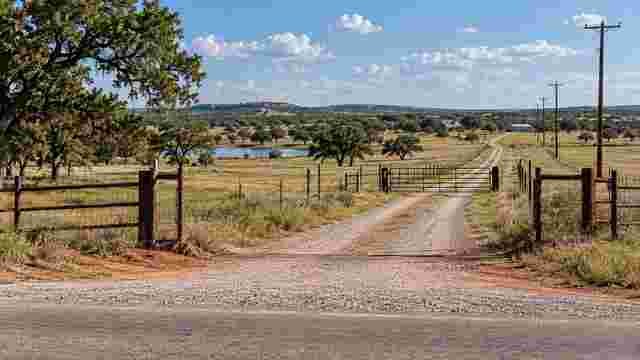
A visible road does not automatically mean you have legal access
One of the most expensive rural-land mistakes is assuming that a driveway, ranch road, or gate proves a permanent right to reach the property.
The physical route may cross neighboring land under a recorded easement, an old agreement, informal permission, historic use, a section-line road, or no documented right at all.
Before closing, verify both the physical access route and the legal right to use it.
Oklahoma law recognizes rights-of-way as easements
Oklahoma property statutes identify a right-of-way as one of the servitudes that may be attached to land as an easement.
That means access rights can be legally significant interests in real property, not merely informal arrangements between neighbors.
The exact scope of an easement depends on the creating document, surrounding facts, and applicable law, so buyers should review the recorded instrument rather than relying on a summary in a listing.
The title commitment is the starting point
A title commitment can identify recorded easements, rights-of-way, road agreements, utility corridors, restrictions, and exceptions affecting the tract.
Ask for copies of every access-related document referenced in the commitment, not just the exception number.
The goal is to understand who benefits from the easement, who is burdened by it, where it runs, what uses are allowed, and whether maintenance obligations are addressed.
Access should be reviewed together with the survey
A survey shows where the physical road, boundary, and easement corridor fit on the ground.
Oklahoma's minimum surveying standards require physical evidence of roadways providing access to or through the property to be shown or noted, and recorded subdivision easements and rights-of-way to be shown on the survey drawing.
When non-subdivision easements need to be located, provide those title documents to the surveyor so they can be plotted when appropriate.
A private road can cross several properties
Long rural access roads often serve multiple tracts and may cross several ownerships before reaching your parcel.
The fact that every current owner uses the road does not guarantee that each property has the same recorded rights or responsibilities.
Trace the entire route from the public road to the property and confirm that every segment is legally covered.
The easement description should match the road you actually use
A recorded easement may describe a strip that does not perfectly match the existing gravel road.
The road may have drifted around trees, drainage, gates, or terrain over time, or a newer route may have been built outside the recorded corridor.
If the physical road and legal easement do not line up, resolve the discrepancy before investing in major improvements.
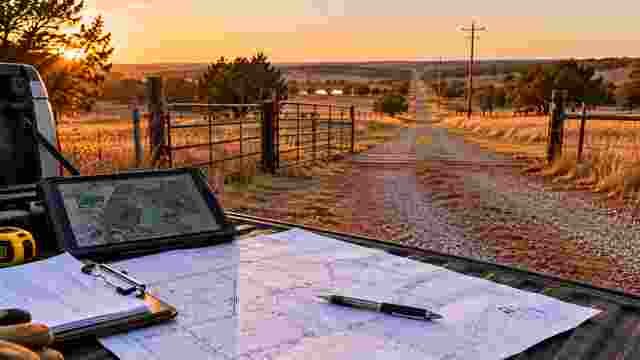
Width matters
A narrow easement may be adequate for a pickup but impractical for a concrete truck, manufactured-home delivery, fire apparatus, utility construction, or future subdivision traffic.
Read the stated width and any restrictions in the recorded document.
For a buildable parcel, confirm that the legal corridor is wide enough for the actual access you will need.
An easement can limit more than vehicle access
Access documents may address gates, utilities, drainage, road improvements, livestock control, speed, maintenance, snow or debris removal, and who may use the road.
Some easements are limited to ingress and egress, while others include broader rights.
Do not assume an access easement automatically gives permission to install electric, water, fiber, or other utilities in the same corridor.
Utility access should be verified separately
A property can have legal vehicle access but still lack a clear utility route.
Electric, water, gas, telecommunications, and pipeline providers may require separate easements before extending facilities across private land.
If the homesite is far from the public road, coordinate legal access and utility easements early so the driveway and utility plan do not conflict.
Shared-road maintenance can become a long-term expense
A private road may need grading, gravel, culvert repair, mowing, drainage work, gate maintenance, and storm repairs.
If several owners use the road, look for a recorded maintenance agreement or association rules that explain how costs are allocated.
Without a clear agreement, disputes can arise over who pays for repairs and what standard the road should be maintained to.
Ask who can authorize road improvements
Widening a private road, adding gravel, replacing a culvert, removing trees, or changing drainage can exceed the rights granted by an easement.
The owner of the burdened land may retain important rights over the corridor.
Before making improvements, confirm what the easement allows and whether additional written consent is needed.
Gates can be legal and practical issues
Rural easement roads often cross working farms or ranches where gates are used for livestock control.
The easement document may address whether gates are permitted, who maintains them, and whether they must remain locked or unlocked.
For buyers planning frequent construction traffic, delivery access, or automated gates, this detail matters.
A landlocked parcel deserves extra due diligence
If a tract has no direct public-road frontage and no clearly documented access easement, treat access as a major title issue.
Oklahoma law recognizes private ways of necessity through its eminent-domain statutes, but obtaining a legally enforceable access route can involve legal proceedings, cost, delay, and uncertainty.
Do not buy a landlocked tract assuming that a future legal remedy will be simple or inexpensive.
A private way of necessity is not a substitute for clean access at closing
Oklahoma Title 27 authorizes private persons, firms, or corporations to exercise eminent-domain rights for private ways of necessity under the statute.
That provision can be important in true access disputes, but buyers should not treat it as a routine planning tool.
A recorded, usable access right in place before closing is generally far preferable to relying on litigation or condemnation later.
Section-line roads require careful verification
Oklahoma has a long history of section-line highways and road rights, but not every section line is an open, maintained public road.
Some section lines may be unopened, reserved, obstructed, affected by federal or tribal land issues, or subject to local road decisions.
A line on a township map is not enough to prove practical public access.
An unopened section line is not the same as a driveway-ready road
Even where a legal section-line right exists, the route may have no constructed roadway, bridge, culvert, grading, or all-weather surface.
Building access along it can require county coordination, permits, drainage work, and substantial construction expense.
Verify whether the road is officially open, maintained, and suitable for the planned use.
County-maintained and private roads are very different
A county road may be graded or maintained by public crews, while a private road generally places maintenance responsibility on private owners.
Do not rely on the road's appearance alone.
Ask the county commissioner or road authority whether the road is accepted into the public system and what maintenance, if any, the county provides.
Road names and emergency addresses do not prove public status
A private road can have a road name, mail delivery, emergency addressing, and multiple homes while still remaining privately maintained.
Those services are useful but do not replace title evidence or official road-status confirmation.
Verify road ownership and maintenance responsibility separately.
Recorded ingress and egress may still have use limits
An easement created for residential access may not automatically support commercial truck traffic, an RV park, event venue, contractor yard, or multiple future homes.
Increasing the intensity or character of use can create conflict depending on the easement language and circumstances.
If future development is part of the plan, have the access rights reviewed for that intended use.
Future subdivision can strain an old access easement
An easement that works for one rural home may be inadequate for four lots, multiple guest homes, or a business.
Additional traffic can create road-width, maintenance, emergency-access, and legal-scope issues.
If you plan to divide the property, evaluate the access rights before assuming the original easement can serve every future parcel.
Emergency access should be part of the review
Long or narrow private roads can be difficult for fire apparatus, ambulances, delivery trucks, and construction vehicles.
Gate width, bridge capacity, turnaround space, overhead clearance, grade, and road surface all matter.
A legally valid easement may still need physical upgrades to function as reliable emergency access.
Bridges and culverts on private access roads can be hidden liabilities
Shared roads sometimes include old culverts, low-water crossings, cattle guards, or bridges with unknown capacity.
Major repairs can be expensive and may not be clearly assigned to one owner.
Inspect critical access structures and review any maintenance agreement before closing.
Drainage rights can exist independently of road access
Some easements allow drainage, flooding, water flow, or ditch maintenance across private land.
Oklahoma property statutes recognize several water-related servitudes in addition to rights-of-way.
A drainage easement can affect where you build, fill, fence, or alter a ditch even if it is not used as a road.
Pipeline and transmission easements can cross the interior of the tract
Oil, gas, pipeline, electric transmission, and utility corridors are common on rural acreage.
These easements can include rights to enter the property, clear vegetation, repair facilities, or restrict structures within the corridor.
Review the recorded width and terms instead of estimating the easement from the visible line or pipeline marker.
Blanket easements deserve attention
Older utility documents sometimes grant rights over broad portions of a property rather than describing a narrow, surveyed corridor.
A blanket easement can be more difficult to plan around because its practical location may depend on existing facilities or historical use.
Ask the title company and surveyor how the document affects the tract and whether the actual facilities can be located.
Access rights can survive a sale
Recorded easements can continue to burden or benefit property after ownership changes.
That is one reason buyers should understand them before closing rather than treating them as the seller's issue.
If an easement benefits neighboring land, your purchase may include ongoing obligations to respect that access.
The neighbor's use of your road may be legitimate
A private road through your property can serve another tract under a valid recorded easement.
The presence of another owner's traffic is not necessarily an encroachment.
Use the title documents and survey to determine the legal corridor and scope before trying to restrict access.
Conversely, your driveway may depend on a neighbor's land
A driveway that starts on your property can cross outside the boundary farther down the route.
This is especially easy to miss on curved roads, wooded parcels, or tracts with irregular lines.
Compare the full road alignment to the surveyed boundary and easement, not just the entrance.
Informal neighbor permission is fragile
A handshake agreement may work for years while neighboring owners have a good relationship.
But ownership changes, estates, lenders, insurance issues, or development can expose the weakness of an undocumented arrangement.
When access is essential to the property, a properly documented and recordable right is much safer than permission that can be disputed later.
Do not assume long use automatically creates a permanent easement
Claims based on historic use can involve fact-specific legal doctrines and evidence.
The outcome may depend on how the road was used, whether permission was given, how long the use continued, and other circumstances.
If access depends on an unrecorded historical claim, obtain Oklahoma legal advice rather than treating continued use as guaranteed.
Title insurance does not replace due diligence
A title policy can provide important protection, but it does not turn an uncertain road into a documented, buildable access route.
Exceptions in the policy can exclude matters that are visible, unrecorded, survey-related, or otherwise outside coverage.
Read the title commitment and survey together, and ask questions before exceptions become final.
Lenders may require reliable legal access
A parcel can be difficult to finance if the lender is not satisfied with the access rights.
Construction lenders may also need evidence that contractors and utility providers can reach the homesite.
Confirm lender requirements early if the property relies on a private easement or unusual road arrangement.
Insurance and resale also favor clear access
Future buyers, appraisers, lenders, insurers, and title companies may scrutinize the same road questions you face today.
A clean, documented access arrangement can reduce friction at resale.
An unresolved access issue can become harder to fix after structures and improvements are already in place.
Questions to ask the title company
Access due diligence should produce clear documents, not just verbal reassurance.
- Is there recorded legal access from a public road to this parcel?
- What document creates the access right?
- Who benefits from the easement?
- Who owns the land under the road?
- What is the easement width?
- Does it allow utilities as well as vehicle access?
- Are there maintenance obligations?
- Are there road-use restrictions?
- Do any other properties have rights over this road?
- Are there pipeline, utility, drainage, or conservation easements affecting the tract?
- Which easement documents should be provided to the surveyor?
Questions to ask the surveyor
The survey should connect the paperwork to the physical site.
- Does the existing driveway stay within the property or recorded easement?
- Can the access easement be plotted?
- Does the easement reach a public road?
- Are gates, culverts, bridges, or road improvements inside the easement corridor?
- Do neighboring roads or driveways cross the property?
- Are section-line rights-of-way relevant?
- Do utility or pipeline easements conflict with the proposed homesite?
- Is there any visible encroachment or mismatch between the road and recorded access?
Questions to answer before closing
A rural access review is complete only when you know both the legal and practical answer.
- Can I legally reach the property from a public road?
- Can construction trucks use the route?
- Can utilities reach the homesite?
- Who maintains the road?
- Who pays for gravel, culverts, gates, and repairs?
- Can the road be widened if needed?
- Are there restrictions on gates?
- Can future family homes or a lot split use the same access?
- Are there any weak bridges or low-water crossings?
- Would a lender or title company object to the current arrangement?
The bottom line
For Oklahoma rural land, access should never be assumed from a gate, gravel road, aerial map, or long history of use.
Verify the recorded easement or public-road status, compare it with the survey and physical road, understand maintenance and utility rights, and make sure the access can support the property you intend to build.
If the tract is landlocked or depends on uncertain historical access, resolve that issue before closing rather than assuming it will be easy to fix later.
Keep researching
Acreage Planning resources
Due diligence, development sequencing, utilities, access, and the decisions that shape a rural property project.
Sources & methodology
Where this information comes from
Cost figures are planning references rather than contractor quotes. Permitting, system-selection, and location-specific guidance should be verified with the appropriate local authority or qualified professional. AcreageReady uses source-backed, AI-assisted editorial workflows and remains responsible for the material it publishes. Read how we research, edit, and correct guides.
- Oklahoma Statutes Title 60: Property, Section 49 Easements Attached to Land
- Oklahoma Statutes Title 27: Eminent Domain, Section 6 Private Ways of Necessity
- Oklahoma Statutes Title 69: Roads, Bridges and Ferries, Section-Line Provisions
- Oklahoma State Board of Licensure: Minimum Standards for Surveying
- Oklahoma Department of Transportation: Rural Road Classification and Access
- AcreageReady: Buying Rural Land in Oklahoma
- AcreageReady: Oklahoma Land Surveys & Property Lines
- AcreageReady: Oklahoma Rural Driveway Costs
Common questions
Frequently asked questions
Does a driveway across a neighbor's land automatically give me legal access in Oklahoma?
No. A physical road may exist under a recorded easement, informal permission, historic use, or another legal arrangement. Verify the actual access document and route before closing.
What is an easement in Oklahoma?
Oklahoma property law recognizes rights such as rights-of-way and other servitudes that may burden one parcel for the benefit of another or another holder. The exact rights depend on the creating document and applicable law.
Can I buy a landlocked parcel and get access later?
Oklahoma law provides a process involving private ways of necessity, but obtaining access later can involve legal proceedings, cost, and uncertainty. Buyers should strongly prefer clear legal access before closing.
Is a section line automatically a public road in Oklahoma?
No. Oklahoma has section-line road laws, but individual section lines can be unopened, reserved, obstructed, or otherwise affected. Confirm the actual legal and maintained status with the county or applicable road authority.
Does an access easement include utilities?
Not necessarily. Some easements cover only ingress and egress. Utility installation rights should be confirmed separately from the recorded language and serving utility requirements.
Who pays to maintain a private road in Oklahoma?
That depends on the easement, road-maintenance agreement, association rules, and ownership arrangement. Buyers should look for a written agreement explaining cost sharing and maintenance responsibilities.
Can I widen or improve a road inside an easement?
Possibly, but the easement's scope and the rights of the underlying landowner matter. Review the recorded document and obtain legal advice before making improvements that exceed ordinary use.
Should access easements be shown on a survey?
Recorded subdivision easements and rights-of-way are addressed by Oklahoma survey standards, and other easements can often be located when the relevant documents are provided to the surveyor. Give the surveyor the title exceptions you need evaluated.
Ready to talk with a local professional?
Share your location and project details so AcreageReady can identify relevant providers as the network grows.
Get a free quote