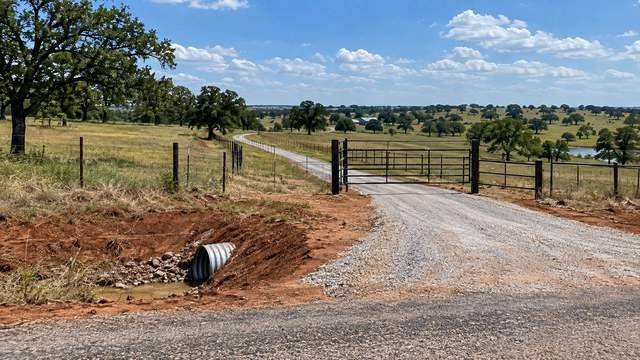
A rural driveway is part road, part drainage system, and part construction access
On Oklahoma acreage, the driveway is often one of the first improvements built and one of the easiest to underestimate.
A short gravel entrance on firm ground can be relatively straightforward. A long driveway with soft soils, drainage crossings, culverts, gates, steep grades, or heavy construction traffic can become a major site-development expense.
The right budget starts with the full route from the public road to the homesite, not just the gravel visible on top.
A practical 2026 planning range
Current national cost guides commonly place installed gravel driveways in a broad range of roughly $1 to $10 per square foot, with some guides clustering around $4 to $10 per square foot for a professionally built driveway with materials and labor.
For rural Oklahoma, that range is useful only as a screening tool because long driveways are heavily affected by base depth, excavation, drainage, trucking distance, local aggregate prices, and whether the route needs major grading.
A 1,000-foot driveway can cost many times more than a suburban driveway even when both use the same surface material.
Long driveways should be budgeted by length, width, and section depth
A rural driveway estimate becomes more useful when you know the approximate length, finished width, base thickness, and surface thickness.
A 12-foot-wide driveway that is 1,000 feet long covers about 12,000 square feet before turnouts, parking pads, aprons, or curves are added.
Small changes in width or aggregate depth can add many truckloads of material over a long route.
The cheapest route is not always the best route
A direct line from the road to the house may cross a low area, steep slope, creek, drainage swale, soft soil, or future septic field.
A slightly longer route on higher, firmer ground can be less expensive over the life of the driveway because it needs less fill, fewer drainage structures, and less repair.
Compare route alternatives before clearing trees or ordering gravel.
Start with the road entrance and access authority
Before building the entrance, identify who controls the road. It may be ODOT, a county, a municipality, a tribal authority, or a private road association.
ODOT has a driveway permit process for access to state highway right-of-way, and its instructions require a location sketch or site plan and proper drainage planning.
County and local road requirements vary, so ask the applicable authority about driveway location, culverts, sight distance, and construction standards before work begins.
State highway frontage can be more complicated than county-road frontage
A tract on a state or U.S. highway can look easy to access because the road is already paved, but the entrance itself may face more design review than a simple county-road connection.
ODOT can evaluate driveway location, drainage, sight distance, and right-of-way conditions.
Do not close on a parcel assuming you can place the driveway anywhere along the frontage.
Sight distance matters at the driveway entrance
The entrance must allow drivers to see approaching traffic and allow traffic to see vehicles entering or leaving the property.
Curves, hills, vegetation, bridge approaches, guardrails, and roadside slopes can limit safe placement.
A poor entrance location can create both a safety problem and a permitting problem.
Culverts are often part of the entrance cost
Where a roadside ditch carries water, the driveway may need a culvert so runoff can continue under the entrance.
ODOT's drainage guidance uses 18 inches as a common minimum size for driveway side drains in its roadway design context, but the actual pipe size for a private entrance should be based on the local authority's requirements and site drainage.
Do not choose culvert diameter only by what is cheapest or available at the farm store.
Culvert installation can cost more than the pipe
The total culvert cost can include excavation, bedding, pipe, end treatment, fill, compaction, erosion protection, traffic control, and driveway reconstruction.
Consumer cost guides in 2026 place professional culvert replacement in a very broad range, often from roughly $1,000 to $9,000 depending on pipe length, material, access, and driveway surface.
A deep ditch, large watershed, road crossing, or engineered structure can cost substantially more.
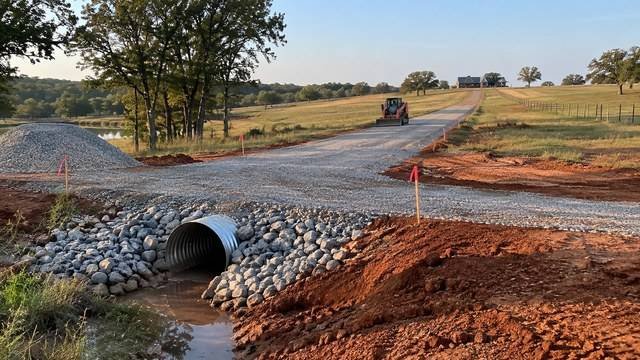
Drainage failures destroy gravel driveways
Water is one of the biggest long-term threats to a rural driveway.
A driveway that blocks natural flow, traps water against the roadbed, or channels runoff down the wheel paths can rut, wash out, lose aggregate, and fail during heavy storms.
Good drainage usually costs less than repeated gravel replacement.
Crown, cross-slope, and ditches keep water moving
The driving surface should shed water rather than hold it.
Depending on terrain, a contractor may use a crown, cross-slope, roadside ditch, broad swale, water bar, turnout, or combination of drainage features.
The exact shape should fit the site instead of copying a generic driveway section.
Oklahoma soils can change the base design
Oklahoma acreage can include expansive clay, sandy soils, red dirt, shale, limestone, shallow rock, and mixed fill.
Soft clay can pump and rut under traffic, while shallow rock can make grading and ditching expensive.
The base section should be designed around actual subgrade conditions, not just the desired finished surface.
Topsoil and organic material should not become the driveway base
Grass, roots, topsoil, and organic-rich soil compress unevenly and hold moisture.
A durable driveway usually begins by stripping unsuitable material and shaping a stable subgrade before base aggregate is placed.
Putting expensive gravel directly over weak organic soil often creates a driveway that needs repair almost immediately.
Geotextile fabric can help on weak ground
Where the subgrade is soft or tends to mix with aggregate, geotextile separation fabric can help keep the stone base from disappearing into the soil.
Fabric is not a substitute for drainage or proper base thickness, but it can be valuable where clay or wet ground would otherwise contaminate the aggregate.
Ask the contractor whether fabric is recommended along the whole route or only in problem areas.
The base layer matters more than the decorative top layer
A rural driveway performs because of its foundation.
A common mistake is spending heavily on attractive surface gravel while using too little compacted base underneath.
The lower layers should provide structure and drainage, while the surface layer provides a smoother driving surface and easier maintenance.
Crushed aggregate usually performs better than rounded stone
Angular crushed stone tends to lock together under compaction better than rounded pea gravel or decorative river rock.
For a working rural driveway carrying delivery trucks, trailers, concrete trucks, and equipment, stability usually matters more than appearance.
Local quarries may use different names for crusher run, road base, screenings, limestone, or other aggregates, so compare gradations rather than relying only on product names.
Aggregate hauling can dominate the budget
Gravel is heavy, and trucking cost becomes important when the property is far from a quarry or aggregate yard.
Two contractors can quote different driveway totals simply because one has a shorter haul or better material source.
Ask whether the bid includes material, freight, spreading, grading, and compaction or only the stone itself.
Construction traffic should influence the driveway design
A driveway built before the house must survive concrete trucks, lumber deliveries, excavation equipment, septic installers, well drillers, utility crews, and possibly cranes.
A light residential surface that works for passenger cars may fail under repeated heavy loads during construction.
Many owners build a strong base first and add the final surface after the heaviest construction traffic is finished.
Temporary construction access and the final driveway can be different phases
It can make sense to establish the driveway alignment, culvert, drainage, and structural base early, then postpone the final topping layer.
This reduces the chance that premium surface material gets mixed with mud, pushed into the base, or damaged by turning heavy equipment.
Include both phases in the budget so the final finish does not become an unexpected expense.
Steep grades can create traction and erosion problems
Long rural driveways sometimes climb aggressively to reach a ridge or homesite.
Steep grades are harder for trailers, delivery trucks, emergency vehicles, and two-wheel-drive cars, especially when wet or icy.
Steep sections also move water faster, increasing the need for cross-drainage and erosion control.
Curves need room for trailers and emergency vehicles
A driveway that works for a pickup may not work for a concrete truck, fifth-wheel trailer, fire apparatus, or equipment hauler.
Tight turns can require wider inside radii, cleared shoulders, and stronger edges.
Lay out curves with the largest likely vehicle in mind before trees, gates, or drainage structures lock in the alignment.
Turnouts can make a long single-lane driveway practical
A narrow driveway can save material, but two vehicles still need a place to pass.
Strategically placed turnouts can reduce the need to build the full length at two-lane width.
They are especially useful on long drives with limited visibility or where delivery traffic is common.
Gate placement affects daily use and safety
A gate placed directly at the edge of a public road can force a vehicle and trailer to stop in traffic while the driver opens it.
Where space allows, set the gate back far enough for the longest vehicle combination you expect to use.
Coordinate the gate with the entrance culvert, mail delivery, emergency access, utility access, keypad location, and future automation.
Gate costs vary widely
A simple farm gate and posts can be inexpensive compared with a powered ranch entrance with columns, operators, solar or electric service, keypad, loop sensors, intercom, and backup access.
Treat the gate as a separate budget line instead of assuming it is included in the driveway quote.
If the gate will be automated, plan conduit and power before the final driveway surface is installed.
Parking and turnaround areas add substantial square footage
A 1,000-foot driveway may be the headline number, but the parking pad, garage apron, shop approach, RV area, and turnaround can add thousands of square feet.
Heavy-use areas often need thicker base or a different surface because vehicles stop, turn, and load the material more aggressively.
Include these areas on the contractor sketch rather than pricing only the linear driveway.
Concrete and asphalt make the most sense selectively on many acreages
Paving an entire long rural driveway can be expensive.
Some owners use gravel for the long approach and place concrete or asphalt only at the public-road apron, steep section, garage approach, or parking area.
This can control dust and maintenance where it matters most without paying to pave the entire route.
Flood-prone crossings deserve special attention
A driveway crossing a creek, low-water area, floodplain, or concentrated drainage path can require more than a standard pipe.
Large culverts, multiple barrels, low-water crossings, bridges, armored approaches, or engineered drainage may be appropriate depending on the watershed and jurisdiction.
Do not let a general grading contractor guess at a major crossing without enough hydraulic information.
Stormwater rules can matter on larger development projects
Land disturbance associated with a home, driveway, pad, utilities, and other improvements can add up.
Oklahoma stormwater permitting requirements can apply when construction disturbance reaches regulated thresholds, and the specific project should be checked against current DEQ requirements.
Even below a formal permit threshold, erosion control is important because bare Oklahoma soil can move quickly during intense rain.
Maintenance is part of the lifetime cost
Gravel driveways are not install-once infrastructure.
Typical maintenance can include grading, adding surface aggregate, cleaning ditches, repairing culvert ends, filling potholes, correcting washouts, trimming vegetation, and restoring the crown.
A driveway built with good drainage and a strong base usually needs less frequent major repair.
Budget examples for rural Oklahoma acreage
The examples below are screening ranges, not statewide quotes. Local aggregate prices, trucking, soil, drainage, access, and contractor availability can move the total significantly.
- Short entrance and parking area on firm ground: often a few thousand dollars
- Several-hundred-foot gravel driveway with clearing, grading, base and surface: commonly moves into the mid four figures or low five figures
- Around 1,000 feet with substantial base, culvert work and drainage: often reaches the low to mid five figures
- Quarter-mile rural gravel road: national planning guides place many projects around $15,000 to $60,000 depending on section and conditions
- Major creek crossings, extensive rock work, paving, retaining walls, or engineered drainage can push costs far above these screening ranges
What should be included in a driveway contractor quote?
A useful quote defines the finished road section and drainage work instead of simply listing a number of loads of gravel.
- Clearing width and tree removal
- Topsoil stripping
- Excavation and grading
- Finished driveway width
- Subgrade preparation
- Geotextile fabric if needed
- Base aggregate type and thickness
- Surface aggregate type and thickness
- Estimated tonnage or truckloads
- Compaction method
- Crown or cross-slope
- Ditches and swales
- Culvert size, material and length
- End treatments and erosion protection
- Public-road apron
- Gate pad or setback area
- Turnouts and turnaround
- Parking and shop areas
- Mobilization and trucking
- Rock excavation allowance
- Repair of fences and disturbed areas
- Final grading and cleanup
Questions to ask an Oklahoma driveway contractor
The best contractor should be able to explain how the driveway will handle water and heavy traffic, not just how much gravel will be delivered.
- What is the finished driveway section from subgrade to surface?
- How much existing soil will be removed?
- What base material do you recommend for this soil?
- Do you recommend geotextile fabric?
- How will the driveway drain during heavy rain?
- What culvert size and type are included?
- Who confirms culvert requirements with the road authority?
- How will steep sections be stabilized?
- How many tons of aggregate are included?
- Is hauling included?
- Is compaction included?
- How will soft spots or rock be handled?
- Can concrete trucks and delivery vehicles use the driveway during construction?
- Is final regrading after house construction included?
- What maintenance should I expect in the first two years?
Questions to answer before buying the land
A driveway can be a land-feasibility issue, not merely a later construction detail.
- Is legal road access established?
- Who controls the road frontage?
- Can a driveway permit be obtained at the desired location?
- Is there adequate sight distance?
- Does the entrance need a culvert?
- How deep is the roadside ditch?
- Does the route cross a creek, drainage swale, floodplain or wet area?
- How long is the route to the likely homesite?
- How much elevation change occurs?
- Will rock or soft clay affect construction?
- Can heavy trucks reach the homesite?
- Where will the gate, turnaround and parking areas go?
- Will future shops, barns or guest homes use the same driveway?
Coordinate the driveway with the entire site plan
The driveway should be planned with the house pad, septic area, water well, electric route, broadband trench, propane tank, drainage, shop, pond, fencing, and future structures.
Poor coordination can force utilities to cross the driveway repeatedly or can place the road through the best septic or building area.
A single site plan shared with the driveway contractor and other trades helps prevent expensive conflicts.
The bottom line
A rural Oklahoma driveway can range from a modest gravel entrance to a major private-road project.
The biggest cost drivers are length, subgrade, base depth, drainage, culverts, terrain, aggregate hauling, and the amount of heavy traffic the driveway must support.
Before buying or building, verify the entrance with the road authority, walk the entire route, identify drainage crossings, estimate the full driveway length, and get a contractor quote based on an actual road section rather than a simple price per load of gravel.
Keep researching
Land & Site Work resources
Clearing, grading, drainage, driveways, pads, excavation, and preparing acreage for construction.
Sources & methodology
Where this information comes from
Cost figures are planning references rather than contractor quotes. Permitting, system-selection, and location-specific guidance should be verified with the appropriate local authority or qualified professional. AcreageReady uses source-backed, AI-assisted editorial workflows and remains responsible for the material it publishes. Read how we research, edit, and correct guides.
- Oklahoma Department of Transportation: Driveway Permit Application Instructions
- Oklahoma Department of Transportation: Roadway Drainage Manual
- Oklahoma Department of Transportation: Culverts, Roadway Drainage Manual Chapter 9
- Oklahoma Department of Transportation: ODOT Forms and Permits
- Oklahoma Department of Transportation: Local Government
- Angi: How Much Does a Gravel Driveway Cost? 2026 Data
- Angi: Driveway Culvert Replacement Tips and Costs
- HomeGuide: Gravel Driveway Cost 2026
- HomeGuide: Gravel and Residential Gravel Road Costs
- AcreageReady: Buying Rural Land in Oklahoma
- AcreageReady: Oklahoma Zoning & Building Permits
- AcreageReady: Oklahoma Rural Power
Common questions
Frequently asked questions
How much does a gravel driveway cost in Oklahoma?
There is no single statewide price. Current 2026 national guides commonly place installed gravel driveways somewhere from roughly $1 to $10 per square foot depending on scope, while rural Oklahoma projects can vary substantially based on length, excavation, base depth, drainage, aggregate haul distance, and culverts.
How much could a 1,000-foot rural driveway cost?
A 1,000-foot driveway can easily reach the low five figures when proper clearing, grading, base aggregate, surface gravel, drainage, compaction, and culvert work are included. Difficult terrain, soft ground, rock, or major drainage structures can increase the total substantially.
Do I need a permit for a driveway in Oklahoma?
It depends on the road authority. Access to an ODOT-controlled highway uses ODOT's driveway permit process. County, municipal, tribal, or private-road requirements vary, so identify the road owner before construction.
What size culvert do I need under an Oklahoma driveway?
The correct size depends on drainage flow and the requirements of the road authority. ODOT roadway drainage guidance uses 18 inches as a common minimum driveway side-drain size in its design context, but your site may require a larger pipe or a different structure.
Should I use gravel, asphalt, or concrete for a long rural driveway?
Gravel is often the most economical choice for long rural approaches. Asphalt or concrete can make sense on high-use areas, steep sections, garage aprons, or near the public road. The best choice depends on budget, drainage, maintenance, and traffic.
Should the driveway be built before the house?
Usually the basic access, drainage, culvert, and structural base need to be in place before heavy construction begins. Many owners wait until late in the build to add the final surface layer so construction traffic does not destroy it.
Is driveway fabric worth it?
Geotextile fabric can be useful over weak, wet, or clay subgrade because it separates the aggregate base from the soil. It is not necessary on every site and does not replace proper drainage or base thickness.
Who installs the driveway culvert?
Responsibility varies by road authority and location. Some jurisdictions require the owner or contractor to install it to specified standards, while others may control or inspect the work. Confirm responsibility before ordering pipe.
Ready to talk with a local professional?
Share your location and project details so AcreageReady can identify relevant providers as the network grows.
Get a free quote