
Fencing acreage is usually a bigger project than buyers expect
A rural fence is not simply a line of posts and wire. On Tennessee acreage, the total cost is shaped by terrain, rock, vegetation, fence type, livestock, gates, corners, road frontage, access, and the number of separate paddocks.
A five-acre parcel may need far less fence than a five-acre parcel with irregular boundaries, multiple road fronts, creek crossings, interior paddocks, and a long gated driveway.
The best budget starts with verified boundary length and a fence plan rather than an acreage number alone.
2026 Tennessee farm-fence pricing spans a wide range
Current Tennessee contractor guides show farm and field fencing commonly ranging from about $8 to $30 per linear foot installed depending on system, terrain, gate count, and market.
Middle Tennessee contractor guides show five-strand barbed wire around $5 to $12 per foot, high-tensile woven wire around $8 to $18, split rail around $20 to $35, wire-backed split rail around $25 to $40, and four-board horse fence around $35 to $55 per foot.
Those ranges are planning figures, not bids. Long straight pasture runs can price differently from small decorative runs, steep property lines, or rocky ground.
Linear feet matter more than acres
Fence is purchased and installed by distance, not by acreage.
A square one-acre parcel has roughly 835 feet of perimeter, but real rural parcels are rarely perfect squares. Long narrow tracts, irregular shapes, creek boundaries, road frontage, and internal cross-fencing can change total footage significantly.
Use a recent survey or verified GIS measurements for early budgeting, then have the installer confirm the actual route before construction.
Woven wire is one of the most versatile rural options
Woven wire is commonly used for cattle, goats, sheep, dogs, and mixed livestock because it creates a physical mesh barrier rather than relying only on spaced strands.
Cost depends on wire height, mesh size, gauge, post spacing, brace assemblies, terrain, and whether electric offset wires are added.
Goat and sheep fencing often needs tighter mesh and careful ground clearance to reduce escapes.
Barbed wire remains economical for many cattle properties
Barbed wire can be one of the lower-cost permanent perimeter options for cattle acreage.
The system still depends on strong corner and end braces, correct wire tension, suitable posts, and proper spacing. Cheap wire on weak braces does not produce a durable fence.
Barbed wire is generally a poor choice for horses because of injury risk and visibility concerns.
High-tensile fencing can reduce material but requires correct installation
High-tensile smooth wire can be effective for cattle and rotational grazing when designed with proper braces, tensioners, insulators, grounding, and an energizer where electric strands are used.
Because the wire carries substantial tension, corner assemblies and end posts matter greatly.
A poorly built high-tensile fence can lose tension, pull posts, or become ineffective even when the wire itself is good quality.
Board fence is attractive but expensive at acreage scale
Three- and four-board wood fences are popular on horse properties, farm entrances, and visible road frontage.
They require substantially more lumber and labor than basic wire systems and also bring long-term painting, staining, board-replacement, and post-maintenance costs.
Many acreage owners use board fence only in high-visibility areas and a more economical wire system elsewhere.
Horse fencing should prioritize visibility and injury reduction
Horses interact with fencing differently from cattle. Visibility, smooth surfaces, post spacing, gate placement, and the ability to avoid trapping legs or creating sharp contact points are especially important.
Board fence, non-climb woven wire, vinyl rail designed for equine use, and properly installed smooth-wire systems are common choices.
Select the fence for the animals you expect to keep rather than the animals currently on the property.
Goats and sheep can expose weaknesses quickly
Small ruminants can push under loose wire, squeeze through larger openings, climb, or challenge gates and corners.
Woven wire with suitable mesh size is a common starting point, sometimes paired with electric offset wires.
If goats or sheep are part of the future plan, tell the contractor before posts and wire spacing are finalized.
Rock and limestone can materially increase Tennessee fence costs
Parts of Middle and East Tennessee have shallow limestone and rocky soils that can make post installation slower and more equipment-intensive.
Contractors may need rock augers, hydraulic breakers, drills, or different post-setting methods.
Ask whether the quote assumes ordinary soil and how rock work will be priced if encountered.
Steep terrain slows production
Rolling hills and steep slopes affect post layout, equipment access, material handling, tensioning, and crew productivity.
A straight open pasture can be installed much faster than a wooded hillside with frequent grade changes.
Contractors may also need additional bracing where fence lines change direction or elevation.
Clearing the fence line can be a separate project
Old hedgerows, brush, trees, vines, fallen limbs, junk fence, and buried wire can slow a fencing crew dramatically.
Some contractors include light clearing while others expect a clean corridor before installation.
Clarify who removes vegetation and old materials and where debris will be disposed.
Corners and brace assemblies are where the fence earns its strength
Long wire runs transfer substantial force into corners and termination points.
Proper H-braces, diagonal braces, anchor systems, gate posts, and tensioning are essential to maintaining wire alignment.
When comparing bids, do not judge quality only by the spacing of line posts. Ask how corners, ends, gates, and elevation changes will be braced.
Gates can change the budget quickly
Every gate adds posts, hardware, labor, and often extra bracing.
Driveway gates, equipment gates, cattle-working gates, paddock gates, walk gates, and automated entrance gates can all have different requirements.
Plan gate widths around the largest equipment that will use them, including hay trailers, livestock trailers, tractors, skid steers, RVs, and emergency vehicles.
Automated entrance gates are their own infrastructure project
A powered driveway gate may require operators, control boards, batteries, solar panels or electrical service, keypads, remotes, vehicle loops, cellular modules, safety devices, and substantial gate posts.
Long rural driveways should also leave enough setback from the public road for vehicles and trailers to stop safely without blocking traffic.
Coordinate gate location with driveway design, power, communications, and future package-delivery access.
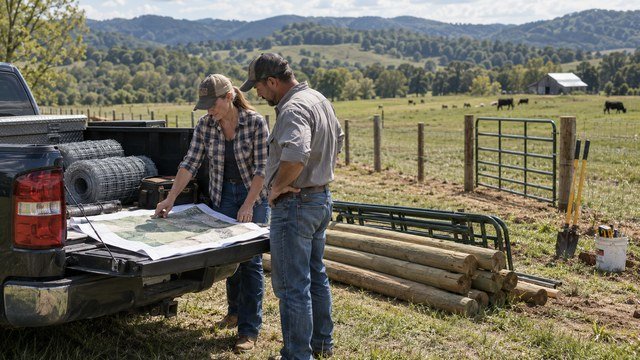
Survey the boundary before building an expensive perimeter fence
A fence is not a substitute for a survey and an old fence is not automatically the legal property line.
Before installing a new perimeter fence, locate survey monuments and review the current plat or boundary survey.
If there is uncertainty, use a Tennessee-licensed surveyor rather than placing thousands of dollars of improvements on a disputed line.
Tennessee has specific law governing partition fences
Tennessee law contains statutory rules for partition fences between adjoining properties.
The law can address shared responsibilities and circumstances in which adjoining owners may be responsible for portions of a partition fence.
Because the application depends on the land use and facts, property owners with a boundary-fence dispute should review the current statute and obtain legal advice rather than relying on assumptions about who pays.
A non-agricultural neighbor can have different responsibilities
Tennessee law includes a process allowing certain owners of non-agricultural residential property adjacent to agricultural land to disclaim responsibility for erecting or maintaining a partition fence.
The disclaimer must meet statutory requirements, including written notice.
That means buyers should not automatically assume a neighboring landowner will share a future fence expense.
Road frontage may involve setback and right-of-way questions
The apparent edge of pavement is not necessarily the property line.
Public road rights-of-way, utility easements, sight-distance requirements, drainage ditches, and local driveway standards can affect where entrance fencing and gates should be placed.
Verify road and right-of-way information before setting permanent posts near the roadway.
Utilities should be located before drilling or driving posts
Fence post installation can damage buried utilities.
Tennessee 811 should be contacted before excavation, but rural owners should also identify private lines that utility marking services may not locate, such as lines to barns, wells, pumps, septic equipment, lighting, gates, and outbuildings.
Provide the fencing crew with all available utility maps and private-line information.
Cross-fencing can make pasture more useful
Interior fencing can divide large pastures into paddocks, separate livestock groups, support rotational grazing, protect wet areas, and control access to hay fields or ponds.
Cross-fencing can add significant footage but may improve land management enough to justify the investment.
Design the entire grazing and water plan before randomly dividing fields.
Tennessee has a 2026-2027 livestock-fencing assistance program
The Tennessee Agricultural Enhancement Program introduced a livestock-fencing program for qualifying producers for the 2026-2027 program year.
Eligible work includes new permanent perimeter fencing and new permanent cross-fencing enclosing pasture or land actively used for qualifying livestock.
The state says reimbursement is determined at $2 per linear foot up to the applicable program maximum.
TAEP funding has eligibility requirements
The fencing assistance program is not a general homeowner rebate.
Tennessee lists qualifying livestock categories and minimum production requirements, and the fencing must be new permanent construction using new materials.
Producers interested in the program should review the current TAEP application, eligibility, reimbursement, and documentation requirements before purchasing materials or starting work.
Fence material is only part of lifecycle cost
A lower-cost fence can become expensive if it requires frequent repairs, cannot contain the intended livestock, or fails in difficult terrain.
Wood systems may require periodic coating and board replacement. Electric systems require energizer and grounding maintenance. Wire fences require tension and brace inspections.
Compare expected service life and maintenance needs, not only the initial bid.
Plan water, shade and gates with the fence layout
Pasture fencing should work with livestock movement.
Animals need practical routes to water, shade, barns, handling facilities, and rotational paddocks without creating bottlenecks or muddy traffic lanes.
A fence plan drawn before construction can reduce unnecessary gates and awkward livestock movement.
Questions to ask a Tennessee fencing contractor
A detailed written scope makes competing fence bids easier to compare.
- What fence system do you recommend for my animals and terrain?
- What is the installed price per linear foot?
- How many linear feet are included in the quote?
- What post type, spacing and depth will you use?
- How are corners and end braces constructed?
- How is rock excavation priced?
- Is brush clearing included?
- Is removal of existing fence included?
- How many gates are included and what sizes?
- What gate hardware is included?
- Will the fence follow surveyed boundaries or an owner-marked line?
- Who contacts 811 before digging?
- How are creek crossings or wet areas handled?
- What warranty applies to labor and materials?
- What items can create a change order?
Questions to answer before requesting bids
Contractors can price a project more accurately when the owner has already made the major planning decisions.
- What animals will the fence contain now and later?
- Is the fence perimeter, cross-fence, decorative frontage, or a combination?
- How many linear feet are needed?
- Has the boundary been surveyed?
- Where are all gate locations?
- What equipment must pass through each gate?
- Are there steep slopes, rock, woods, creeks, or wet areas?
- Does old fence need to be removed?
- Are there private underground utilities?
- Do you need electric strands or an energizer?
- Will any entrance gate be automated?
- Could TAEP livestock-fencing assistance apply?
Build the fencing budget as separate line items
An itemized budget helps explain why two fence proposals that look similar can differ substantially.
- Boundary survey or staking
- Fence-line clearing
- Old-fence removal
- Line posts
- Corner and brace posts
- Wire, boards, rail or mesh
- Fasteners and insulators
- Rock drilling or special excavation
- Driveway and equipment gates
- Automatic gate operator if needed
- Electric energizer and grounding system
- Creek or drainage crossings
- Labor
- Mobilization
- Debris hauling
- Contingency
The bottom line
Tennessee farm fencing can range from economical cattle wire to premium horse board fence and automated estate entrances.
Total cost depends on linear footage, livestock, material, rock, slope, clearing, corners, gates, and access far more than acreage alone.
Verify the property line, design the fence around actual land use, obtain itemized bids, and check current TAEP eligibility before spending money on a large rural fencing project.
Sources & methodology
Where this information comes from
Cost figures are planning references rather than contractor quotes. Permitting, system-selection, and location-specific guidance should be verified with the appropriate local authority or qualified professional. AcreageReady uses source-backed, AI-assisted editorial workflows and remains responsible for the material it publishes. Read how we research, edit, and correct guides.
- Tennessee Department of Agriculture: 2026-2027 Livestock Fencing
- Tennessee Department of Agriculture: 2026-2027 TAEP Updates
- Tennessee General Assembly: Public Chapter 266, Fence and Partition Fence Law
- UT Extension: Planning and Building Fences on the Farm
- Middle TN Fence & Gate: Farm Fence Pricing
- Fleming Fence: Farm Fencing Nashville
- AcreageReady: Buying Rural Land in Tennessee
- AcreageReady: Tennessee Land Surveys & Property Lines
- AcreageReady: Tennessee Easements & Legal Access
- AcreageReady: Tennessee Land Clearing & Grading Costs
Common questions
Frequently asked questions
How much does farm fencing cost in Tennessee in 2026?
Current Tennessee contractor guides commonly show farm fencing around $8 to $30 per linear foot installed, with some systems lower or higher. Five-strand barbed wire may run roughly $5 to $12 per foot, high-tensile woven wire roughly $8 to $18, split rail roughly $20 to $35, and four-board horse fence roughly $35 to $55 depending on terrain, gates and project size.
How much fence is needed for one acre?
A perfectly square one-acre parcel has about 835 feet of perimeter. Real parcels vary by shape, so use survey dimensions or measured boundary lengths rather than acreage alone.
What is the cheapest farm fence for cattle?
Barbed wire and certain high-tensile systems are often among the lower-cost permanent cattle-fence options. The best choice depends on livestock pressure, terrain, maintenance preferences, visibility and whether electric fencing will be used.
What fence is best for horses in Tennessee?
Horse fencing should emphasize visibility and injury reduction. Board fence, non-climb woven wire, equine-rated vinyl rail and properly installed smooth-wire systems are common options. Barbed wire is generally avoided for horses because of injury risk.
Does Tennessee have a fence reimbursement program?
For the 2026-2027 program year, Tennessee's Agricultural Enhancement Program includes qualifying new permanent livestock perimeter and cross-fencing. The state says reimbursement is based on $2 per linear foot up to program limits, subject to eligibility and program rules.
Should I survey my Tennessee property before fencing it?
Yes when the boundary is uncertain or when a permanent fence will be placed close to a property line. An existing fence is not automatically the legal boundary. A licensed surveyor can identify the surveyed line before construction.
Do neighbors have to split fence costs in Tennessee?
Tennessee has partition-fence statutes that can create shared responsibilities in some circumstances, but exceptions and disclaimer provisions also exist. The result depends on the land use and facts, so do not assume a neighbor must pay without reviewing the current law.
Why does rocky Tennessee ground increase fence cost?
Shallow limestone and rock can slow post installation and require specialized augers, drills, breakers or different setting methods. Ask contractors how rock work is handled and whether it is included in the quoted per-foot price.
Ready to talk with a local professional?
Share your location and project details so AcreageReady can identify relevant providers as the network grows.
Get a free quote