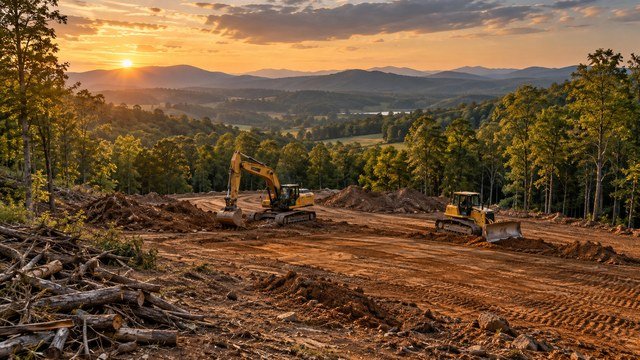
Land clearing and grading can change a cheap parcel into an expensive project
Rural Tennessee land often looks affordable because the raw acreage price is low, but the cost to make the property buildable can be substantial.
Clearing trees, removing stumps, cutting a driveway, building a house pad, managing slopes, stabilizing soil, and controlling runoff can add tens of thousands of dollars before the foundation begins.
The right budget starts with understanding the specific work the property needs rather than using a generic per-acre clearing estimate.
Clearing and grading are different jobs
Land clearing removes vegetation, trees, brush, stumps, debris, and obstacles.
Grading reshapes the land by cutting high areas, filling low areas, creating slopes, building pads, directing drainage, and preparing surfaces for roads or structures.
A property may need one, both, or only selective versions of each.
Tree density is one of the biggest clearing-cost variables
A lightly wooded Tennessee parcel with small brush is very different from mature hardwood forest.
Large trees require more machine time, more skilled removal, and more disposal or processing. Dense woods also slow excavation and can hide rock, gullies, and old debris.
Before getting bids, walk the exact house, driveway, septic, and utility areas with the contractor so the quote reflects the actual clearing limits.
Forestry mulching can be useful when full clearing is not necessary
Forestry mulching grinds brush and smaller trees into mulch in place instead of hauling everything away.
It can be efficient for opening trails, reducing understory, creating views, or preparing broad areas that do not need a fully excavated construction surface.
It does not replace stump removal, excavation, or grading where a house pad, driveway, septic area, or foundation will be built.
Stump removal can materially change the price
Cutting a tree and removing its stump are separate tasks.
House pads, driveways, septic areas, and utility trenches generally need roots and stumps removed from the construction zone. Leaving buried organic material under structural areas can contribute to settlement.
Ask whether each bid includes stump extraction, stump grinding, or simply cutting trees near grade.
Debris disposal has several cost paths
Cleared trees and brush can be chipped, mulched, hauled away, burned where legally allowed, processed as firewood, or stacked for later use.
Each method has different equipment, trucking, labor, and cleanup costs.
Do not assume debris removal is included in a low clearing price.
Rock can completely change a grading estimate
Many Tennessee properties have shallow limestone, sandstone, or other rock that is not obvious until excavation begins.
Rock can affect the house pad, basement, driveway cuts, septic installation, drainage ditches, and underground utilities.
Ask contractors how rock is priced, what equipment they expect to use, and whether the estimate includes any rock allowance.
Slope matters as much as acreage
A two-acre construction area on rolling ground can require more work than ten flat acres of pasture.
Steeper slopes may require benching, larger cuts and fills, retaining structures, erosion-control measures, or a different homesite altogether.
Before clearing, compare multiple potential homesites if the parcel allows it.
House pads require more than making the site look flat
A building pad must be stable enough for the intended foundation and should direct water away from the structure.
Depending on the site, contractors may need to strip topsoil, remove unsuitable material, place engineered fill in lifts, compact it, and shape the surrounding grades.
If significant fill is required, ask the builder or engineer what compaction or testing standards are expected before foundation work begins.
Cut-and-fill balance can save money
On sloped land, one goal is often to reuse suitable excavated soil elsewhere on the site instead of hauling large volumes in or out.
A well-planned site can sometimes balance cuts and fills for the house pad, driveway, and yard.
Excess spoil, unsuitable soil, or a shortage of structural fill can add trucking and material cost quickly.
Drainage should be designed before final grading
The grading plan should answer where stormwater goes after the site is reshaped.
Ditches, swales, culverts, berms, slope breaks, and stabilized outlets may be needed to prevent runoff from damaging the house pad, driveway, septic system, neighboring property, or streams.
A flat-looking site that drains poorly can create recurring repair costs.
Erosion control is part of the project, not cleanup after the project
Tennessee's current erosion and sediment-control guidance emphasizes protecting soil during land-disturbing construction rather than waiting until runoff has already caused damage.
Common controls include stabilized entrances, silt fence, sediment tubes, check dams, temporary seeding, mulch, erosion-control blankets, and phased stabilization.
The controls needed depend on slope, drainage area, soil, weather exposure, and the size of the disturbed area.
One acre of disturbance is an important Tennessee threshold
Tennessee's construction stormwater program generally requires permit coverage when clearing, grading, or excavation disturbs one acre or more.
Projects disturbing less than one acre may also require coverage if they are part of a larger common plan of development or sale that reaches at least one acre of total disturbance.
For acreage projects, measure the whole disturbed footprint, including the driveway, house pad, septic work, utility routes, grading, and other site work.
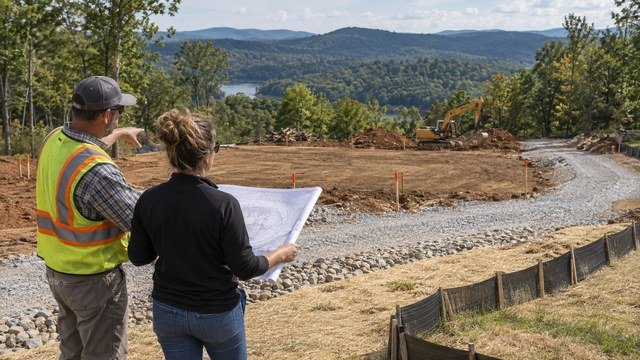
Small residential projects still need erosion planning
Even when a project does not cross the one-acre permitting threshold, uncontrolled sediment can leave the property, clog drainage, affect neighboring land, or reach streams.
Local jurisdictions can also have additional grading, stormwater, or erosion-control requirements.
Ask the county or municipality what applies before major dirt work begins.
Clearing near streams or wetlands deserves extra caution
If clearing or grading affects a creek, stream, wetland, spring, or other water resource, additional state or federal review may be required.
Avoid treating a blue line on a map or a seasonal-looking channel as an automatic safe place to fill or reroute.
If the proposed house or driveway depends on altering a water feature, resolve that issue during due diligence.
Septic areas should be protected before machines arrive
If the property will use septic, coordinate clearing and grading with the approved or proposed disposal area.
Heavy equipment, cut-and-fill work, stockpiles, and compaction can damage suitable soil or interfere with the reserve area.
Mark the septic field and reserve area before clearing crews begin work.
The driveway and house pad should be planned together
A steep driveway can force additional grading near the house, while a poor pad elevation can create drainage problems at the driveway connection.
Planning both systems together helps contractors reuse material, establish practical slopes, and avoid rebuilding finished areas later.
The same site plan should also account for culverts, gates, power, water, and construction access.
Utility routes can reduce or increase clearing cost
Electric, water, fiber, and other utilities often follow the driveway or another shared corridor.
Combining corridors can reduce unnecessary clearing, but utilities may require specific access widths, easements, separation distances, or vegetation clearances.
Coordinate utility routes before clearing so you do not clear one path and then pay to clear another.
Do not clear the entire property unless you need to
Selective clearing often preserves privacy, shade, wildlife habitat, mature trees, and resale appeal while reducing cost.
A phased approach can focus first on the driveway, house, septic, well, utilities, construction staging, and future shop area.
Additional acreage can be opened later when you know how the property functions.
Preserving the right trees can improve the finished property
Large healthy trees can provide shade and character, but trees too close to structures, retaining walls, septic areas, or utility lines can create future problems.
Ask the contractor or arborist to identify trees worth protecting before equipment arrives.
Mark keep zones clearly so operators do not make irreversible decisions in the field.
Wet weather can make grading more expensive
Tennessee rainfall can slow earthwork, damage unfinished grades, and turn exposed clay into a difficult construction surface.
Contractors may need to stop work, recompact areas, replace wet material, or repair erosion after storms.
Scheduling major earthwork during a favorable weather window can reduce risk, but contingency is still important.
Access for heavy equipment should be part of the estimate
Bulldozers, excavators, loaders, dump trucks, mulchers, and haul trucks need safe access and enough room to work.
Narrow entrances, weak culverts, sharp turns, overhead lines, steep approaches, and soft ground can complicate mobilization.
Ask whether the contractor's price includes equipment mobilization and any temporary access improvements.
Mobilization matters more on smaller jobs
Heavy equipment costs money before the first tree is removed because machines have to be hauled to the property.
A small one-day job can therefore have a high effective cost per acre compared with a larger project where mobilization is spread over more work.
If several tasks will be needed, combining clearing, driveway rough-in, pad work, and drainage into one mobilization can sometimes save money.
Typical clearing-cost categories to budget separately
The most useful way to estimate clearing is to break the scope into components rather than relying on one per-acre number.
- Brush and understory clearing
- Forestry mulching
- Large-tree removal
- Stump removal
- Debris processing or hauling
- Rock removal
- Topsoil stripping
- House-pad excavation
- Structural fill
- Compaction
- Driveway rough grading
- Drainage ditches and swales
- Culverts
- Erosion-control materials
- Temporary seeding and stabilization
- Final grading and topsoil
- Mobilization and trucking
Ask for unit prices on uncertain items
A lump-sum quote is useful, but rural sites often contain unknown conditions.
Ask how extra rock, additional trucking, unsuitable soil, tree removal, fill, or drainage structures will be priced if conditions differ from the estimate.
Clear unit pricing can prevent a surprise when the scope changes.
A practical Tennessee land-clearing due-diligence checklist
Before closing, identify the site-development risks that can materially change your budget.
- Walk the proposed driveway and homesite
- Estimate clearing limits rather than total parcel acreage
- Identify large trees and dense timber
- Look for visible rock and steep cuts
- Review topography and drainage
- Locate streams, wetlands, springs, and low areas
- Confirm septic and reserve areas
- Identify utility routes
- Estimate disturbed acreage
- Ask whether construction stormwater permit coverage may be required
- Get at least one site-specific clearing and grading estimate
- Ask how rock and unsuitable soil are priced
- Include erosion-control and stabilization costs
- Add contingency for unknown site conditions
Questions to ask a Tennessee clearing and grading contractor
A detailed scope makes it easier to compare bids and understand what is missing.
- What clearing limits are included?
- Are large trees priced separately?
- Are stumps removed or ground?
- What happens to cleared debris?
- Is rock excavation included?
- Does the price include mobilization?
- How much grading is included around the house pad?
- Is structural fill included?
- How is compaction handled?
- Are drainage swales and culverts included?
- What erosion-control measures are included?
- Will disturbed areas be seeded or stabilized?
- What items are billed as extras?
- How will weather delays or wet soil affect the work?
- Can the same crew rough in the driveway and utility corridors?
Budget the land, not just the house
A rural build budget should include the work needed to convert raw acreage into a stable, accessible, drainable building site.
Clearing and grading costs can vary dramatically even between neighboring Tennessee parcels because tree density, slope, rock, soil, drainage, and access are different.
The best time to understand those conditions is before closing, when you still have the option to change the homesite, negotiate the deal, or walk away.
Sources & methodology
Where this information comes from
Cost figures are planning references rather than contractor quotes. Permitting, system-selection, and location-specific guidance should be verified with the appropriate local authority or qualified professional. AcreageReady uses source-backed, AI-assisted editorial workflows and remains responsible for the material it publishes. Read how we research, edit, and correct guides.
- TDEC: NPDES Stormwater Construction Permit
- TDEC: Erosion Prevention & Sediment Control Handbook
- TDEC: Water Quality Reports & Publications
- AcreageReady: Buying Rural Land in Tennessee
- AcreageReady: Tennessee Zoning & Building Permits
- AcreageReady: Tennessee Rural Power
- AcreageReady: Tennessee Land Surveys & Property Lines
- AcreageReady: Tennessee Rural Driveway Costs
Common questions
Frequently asked questions
How much does it cost to clear land in Tennessee?
There is no dependable statewide per-acre price. Light brush, mature timber, stump removal, slope, rock, debris disposal, and equipment access can all change the cost significantly. Get a site-specific bid for the exact area you plan to disturb.
Is forestry mulching cheaper than full land clearing?
It can be for brush and smaller vegetation because material is processed in place. It is not a replacement for stump removal, excavation, or structural grading where you plan to build a house, driveway, or septic system.
Do I need a stormwater permit to clear land in Tennessee?
Tennessee generally requires construction stormwater permit coverage when clearing, grading, or excavation disturbs one acre or more. Smaller projects can also require coverage when they are part of a larger common plan of development or sale reaching at least one acre.
Should I clear my septic area before the soil work is complete?
Coordinate with the septic professional first. Heavy equipment, cut-and-fill work, and stockpiles can damage suitable soils or affect the reserve area.
Can I grade around a creek on my Tennessee property?
Potentially, but work affecting streams, wetlands, or other regulated water resources can require additional review or permits. Investigate water-resource impacts before clearing or filling near the feature.
Is it better to clear the whole property at once?
Usually not unless the intended use requires it. Selective clearing can reduce cost and preserve privacy, mature trees, habitat, and future flexibility.
What is the biggest hidden grading cost?
Rock, unsuitable soil, imported fill, drainage work, and long haul distances are among the most common cost escalators. Ask contractors how each will be priced before work begins.
Should clearing and driveway construction be done together?
Often yes. Coordinating the driveway, house pad, drainage, and utility corridors can reduce repeated mobilization and help the contractor move soil more efficiently.
Ready to talk with a local professional?
Share your location and project details so AcreageReady can identify relevant providers as the network grows.
Get a free quote